
What is the placement identity?
Use the available source or placement label, account scope, format, market and device. Record any missing dimension.
An ad placement is the location or delivery context in which an advertisement can appear. For your FroggyAds campaign, compare the placement or source details actually available for the selected format, then judge the traffic by intentional visits and accepted customer outcomes. We recommend starting with one context and a destination that fulfils the ad's promise.
Continue with media buying, media planning software, campaign budgeting, budget optimization, advertising bidding models and ad servers for publishers.
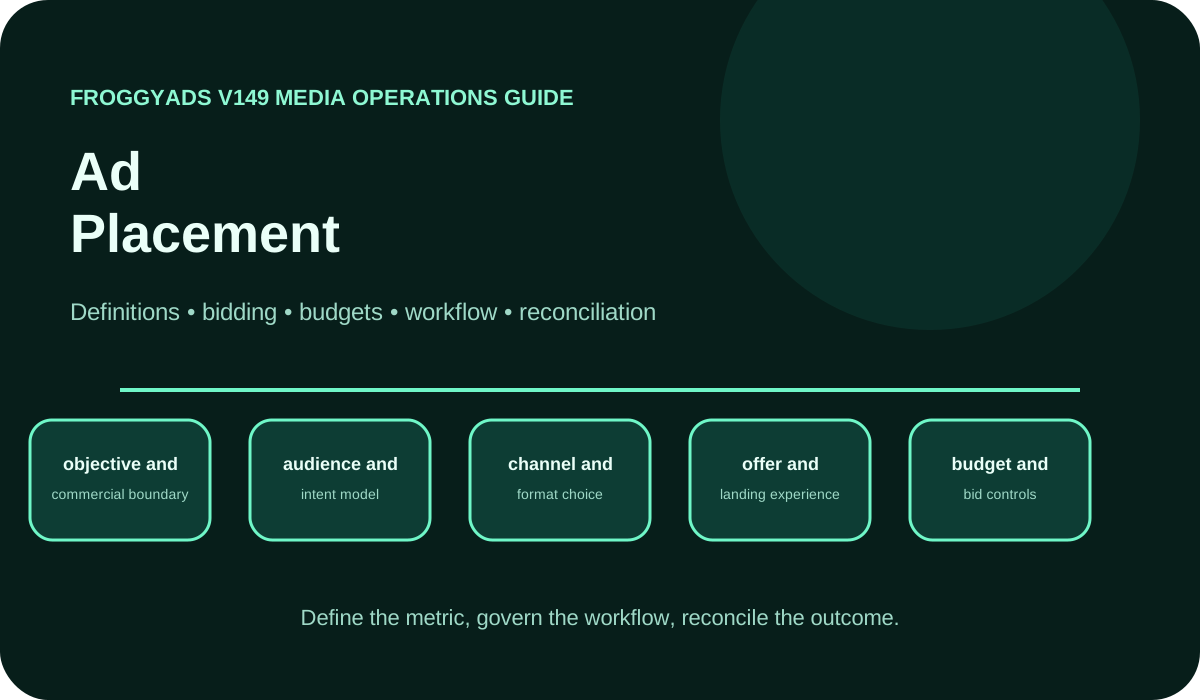
Choose a placement by matching its available context, format and device route to the audience state and promise in your creative. Then test it inside a capped cohort with a stable destination, explicit cost limit and mature accepted outcome. Placement availability or a low interaction cost does not prove attention, suitability or customer value.
Google Ads cost-per-view documentation defines CPV for Google-specific video interactions. It does not define every placement, FroggyAds price, inventory result or advertiser outcome.
A placement is more useful when it identifies the buying choice you can keep, exclude or expand. Depending on the environment, that choice may describe a site area, app position, publisher-defined unit, format route or source label. Record only the identity the buying system actually exposes; do not turn a partial identifier into an invented publisher claim.
Attach the conditions that make the opportunity eligible: market, device, schedule, format, creative requirements, audience rule and destination. Two impressions with the same placement label may belong to different decisions when one uses another device, asset or landing route.
Connect the placement to a business question. An affiliate may ask whether a source produces accepted registrations, an ecommerce team may inspect qualified product sessions, and an agency may need a repeatable proof record for its client. The question determines which evidence matters after delivery.
Keep placement definition separate from outcome judgment. The placement describes where the opportunity entered; your acceptance contract determines whether the resulting customer action created usable value.
Map the route from available opportunity to rendered ad, interaction, destination session and mature customer action. At every handoff, list the identifier, timestamp, owner and known reporting delay. This makes missing evidence visible before the campaign depends on it.
Describe the placement context in neutral terms. Note the page or app environment when it is available, the surrounding task, expected attention, interaction method and any content restrictions. Context is a hypothesis about fit, not proof of quality.
Record the creative contract for the slot: supported format, dimensions or technical requirement, message length, landing promise and version. A placement test is invalid when the creative cannot render correctly or sends a user to a destination that changes the offer.
Write the control path. Name who can pause the campaign, exclude a source, replace the creative, correct the destination and restore the last stable configuration. A map without an action owner is only documentation.
Low delivery cost can be useful when the placement produces intentional visits and accepted outcomes. It can also reflect weak attention, accidental interaction or a context that does not match the offer. Compare cost at the stage where your business accepts value, not only at the first billable event.
Context fit begins with the user's likely task. A message that interrupts entertainment needs a different promise and next step from one shown beside product research. State why the placement context should make the offer relevant and what observation would disprove that hypothesis.
Use exclusions constructively. An excluded placement is not automatically bad inventory; it may be unsuitable for this offer, device, creative or measurement route. Record the actual mismatch so the same context can be assessed accurately for another campaign.
Review concentration. A blended campaign can look efficient while most value comes from a small placement group and most spend goes elsewhere. Keep the composition visible before changing bids or budgets.
Score a placement only after the evidence for the named decision has matured.
| Decision layer | Operating requirement | Evidence required |
|---|---|---|
| Identity | Use the most specific placement or source label actually provided. | Stable identifier, account scope and known blind spots. |
| Context | Explain why the environment fits the user task and offer. | Available category, page, app, device or format evidence. |
| Creative fit | Match asset, promise, dimensions and interaction method. | Approved version, render check and destination record. |
| Eligibility | Apply market, device, schedule and policy boundaries. | Settings, exclusions and effective time. |
| Delivery | Define served, viewable, click and billable events separately. | Report definitions, filters and reporting delay. |
| Quality | Judge intentional visits and accepted customer actions. | Qualified event, rejection reason and maturity window. |
| Economics | Compare reconciled cost with accepted value and capacity. | Spend, reversals and operational effort. |
| Control | Preserve pause, exclusion and rollback ownership. | Decision log and last stable state. |
Start with one placement question
Start with the FroggyAds format and available targeting that fit your offer. Choose one market, approved creative and destination, then set a budget you can review. Keep the campaign and source references your setup supplies, so you can compare the first placement cohort with the accepted customer outcome you want to improve.
Create My Free Account
Preserve the campaign, placement or source, creative, destination and outcome identifiers that the route exposes. State the time zone, reporting window and retention needed for analysis. If one identifier cannot pass through the customer path, document the limitation before drawing placement-level conclusions.
Version material changes. A new asset, landing page, targeting rule or placement exclusion starts a new comparison period because it changes the route being evaluated. Keep the effective time and person responsible for the change.
Define how missing, duplicate, delayed and reversed events are handled. A dashboard total can change after the first review; your decision record needs a closing window and a rule for outcomes that remain pending.
Store the source export and the transformed table used for the decision. The next reviewer should be able to reproduce the placement classification without guessing how labels were combined or filtered.
A placement does not perform independently of the creative. Review whether the headline, visual hierarchy, interaction cue and landing promise make sense in the environment where the ad appears. An asset designed for deliberate product research may fail in a brief interruption even when it is technically accepted.
Use a context statement for every major placement group: what the user is probably doing, what problem the message introduces, which next step is reasonable and which signal would show the interaction was accidental. This makes creative testing specific rather than decorative.
Keep important conditions visible. If the offer requires a market, device, qualification or subscription condition, communicate it before the click where practical and repeat it on the destination. Clear qualification can reduce raw response while improving accepted value.
Review creative fatigue by recent placement cohorts. A lifetime average can hide a new decline after repeated exposure. Replace or pause the version using a defined rule, then treat the new asset as a separate test.
The delivery layer records eligible opportunities, served media, available viewability evidence, clicks and spend under the platform's definitions. The destination layer records usable sessions, page behaviour and the intended action. The business layer records accepted leads, orders, activations, reversals and capacity effects.
Reconcile the layers without forcing them to match exactly. Differences may come from time zones, consent, filters, attribution, duplicate handling or event delay. Record the explained variance and hold unexplained gaps outside a scale decision.
Use rates with denominators. A placement with three accepted outcomes from a small cohort should not be presented as equivalent to a mature placement with stable volume. Show counts, cost, pending outcomes and the maturity date beside the rate.
Compare marginal cohorts. When you raise a cap or open more placements, inspect the newly released band separately. Scale is supported when the next band stays inside the accepted quality and cost boundary.
Calculate the cost of the accepted outcome, not a renamed media event. Reconcile placement spend, remove or separately report credits and reversals, and divide by the mature outcomes that meet your documented acceptance rule.
| Input | Hypothetical value | Why it matters |
|---|---|---|
| Reconciled placement spend | USD 720 | Uses the same currency and closing period. |
| Reported customer actions | 24 | Includes pending and rejected actions. |
| Mature accepted actions | 12 | Matches the advertiser's acceptance contract. |
| Media cost per accepted action | USD 60 | USD 720 divided by 12 accepted actions. |
| Pending actions | 5 | Shown separately until the maturity window closes. |
This is a calculation example, not a FroggyAds price or performance claim. Replace each input with verified campaign and business records, then add fulfilment and operational cost when the decision requires complete acquisition economics.
Compare format routes separately
Each format creates a different context and interaction path. Keep format and placement cohorts distinct, match the creative to the moment, and use the same accepted business outcome when deciding which route deserves more budget.
Create My Free Account
Write the hypothesis as a decision: if placement cohort A produces enough mature accepted outcomes inside the approved cost and quality boundary, retain or expand it; otherwise exclude, repair or stop it. Name the minimum evidence and closing date before launch.
Hold the market, device, format, creative promise, destination and conversion contract stable while testing the placement boundary. When a bundled change is unavoidable, name the bundle and avoid assigning the result to one component.
Begin with a capped budget and verified pause path. Complete a controlled action through the destination, confirm that available identifiers and events arrive correctly, then release the first live cohort. Measurement problems should be repaired before delivery expands.
Review mature evidence at the scheduled boundary. Choose one action: keep, exclude, repair or expand one dimension. Record the reason and preserve the prior state so the next test can be compared with a known configuration.
A placement can generate clicks without generating intentional visits. Review session continuity, immediate exits, duplicate patterns, unexpected device or geographic mixes and accepted customer actions. Use these signals as diagnostic evidence rather than declaring fraud from one unusual metric.
Create rejection reasons that the media team can act on, such as invalid record, duplicate action, unsupported market, missing qualification, accidental interaction or failed destination route. Do not expose personal data that the placement decision does not need.
Set a stop condition for abrupt spend, broken measurement, destination failure or a material fall in accepted quality. The response should pause exposure and preserve evidence before settings are changed.
After a repair, reopen the smallest placement cohort that can prove the route works. A successful retest earns comparison with the last stable state; it does not automatically authorize the previous budget or source breadth.
Define contexts that are allowed, restricted or excluded for the offer. Align the rule with the creative, destination, customer promise and applicable policy. Performance cannot approve a context that the business has already determined is unsuitable.
Use the transparency the buying route actually provides. When page, app or publisher detail is unavailable, state that limitation and decide whether the remaining source evidence is sufficient. Do not present a guessed identity as verified placement information.
Review the user experience, not only the surrounding content. Intrusive repetition, unclear close controls or a confusing click path can damage trust even when the subject category appears acceptable.
Keep exceptions time-bound. An urgent campaign should not turn a temporary approval into a permanent placement rule. Record the owner, reason, expiry and evidence required for renewal.
Give each item an owner and a verifiable completion record.
Use the available source or placement label, account scope, format, market and device. Record any missing dimension.
State the user task, relevant promise, expected interaction and observation that would reject the hypothesis.
Retain the approved asset, dimensions, message, destination and effective version.
Name the billable event, currency, filters, time zone and reporting delay.
Define qualification, rejection, reversal and maturity before reviewing results.
Set budget, pacing, quality and operational stop conditions with named owners.
Preserve campaign, creative, source, destination and business identifiers where available.
Keep, exclude, repair or expand one boundary and write the reason.
Confirm the route before scale
Verify the format, creative, landing promise, accepted event, budget ceiling and pause owner. Start your FroggyAds campaign with one reversible placement hypothesis and expand only after reconciliation.
Create My Free Account
Choose FroggyAds self-serve advertising when you want to turn a placement idea into a paid-traffic campaign you can configure and evaluate. We help advertisers, affiliate marketers, media buyers and agencies choose available formats, targeting and budgets. That gives you a defined media input for testing whether a delivery context suits your offer and customer journey.
Use the available campaign and source evidence to compare delivery cohorts. Join that evidence with your own analytics and accepted customer outcome so a click or platform event does not receive business credit by default.
FroggyAds is strongest when you arrive with a verified destination, a clear audience or context hypothesis and a measurable next step. We give you the campaign controls; your acceptance rule determines which placement result creates value for your business.
Choose us for the next test when you want to move from a broad placement idea to a bounded campaign you can measure, pause and refine without relying on a promised sales result.
Frequency affects both cost and user experience. Repeated exposure may support recognition, but the same message can become wasteful or irritating when a placement reaches a narrow audience repeatedly. Use the controls and reporting available for the route and document limitations.
Review recent placement cohorts rather than lifetime totals. Look for rising cost, falling qualified engagement, repeated sessions without progress and creative fatigue. Change the message or close the placement when the next exposure no longer supports the customer path.
If several creatives form a sequence, give each version a role: introduce the problem, explain the benefit, answer an objection or invite the action. Preserve the version and timing so the team can distinguish sequence learning from a simple creative swap.
Avoid claiming person-level certainty from aggregate delivery. Placement and frequency reports may support a campaign decision without identifying an individual user's complete journey.
Rank placements by the decision that matters now: accepted cost, qualified session rate, operational burden or another approved outcome. Do not combine unrelated objectives into a score whose weighting changes after results arrive.
Set a minimum evidence rule and show uncertainty. Small placements can remain in exploration without being declared winners or losers. Mature placements can receive controlled expansion while the newest band is tracked separately.
When the mix changes, restate the composition. A campaign-level improvement may come from a larger share of one proven placement rather than an improvement across all inventory. Composition is part of the explanation.
Preserve learning from exclusions. A reason-coded placement history helps future campaigns avoid repeating a mismatched test while allowing a different offer or creative to reassess the context honestly.
Ad placement is the defined location or environment where an ad can appear, together with the format, device, context and delivery rules that govern that opportunity. A useful placement record lets an advertiser connect the location decision to the creative shown, the cost incurred and the mature business result.
A publisher identifies an organization or property. A placement is a more specific buying unit, such as a site area, app position, format route or source label exposed by the buying system. Never infer a publisher identity when the available record supports only a placement or source identifier.
Choose a placement set that fits the campaign promise, approved format, target market, destination and measurement plan. Start with a narrow, capped cohort that you can pause and compare. The first test should answer one placement question rather than maximize reach.
No. A click can reflect interest, confusion or accidental interaction. Review qualified sessions, accepted actions, rejection reasons, mature cost and any available viewability or invalid-activity evidence before a placement receives more budget.
Keep the market, device, format, creative promise, destination, bid boundary and outcome window as stable as possible. Compare enough mature observations, show the denominator and treat a changed traffic mix as a new cohort rather than attributing the difference to one setting.
Exclude or hold a placement when it violates the approved context, repeatedly produces unusable interactions, cannot be measured, exceeds the accepted cost boundary or creates operational risk. Record the reason, effective time and evidence so the choice can be reviewed later.
Context changes what the user was doing, how much attention the ad may receive, which creative promise feels relevant and how likely an interaction is to be intentional. Match the format and message to the context instead of assuming that the same asset works equally well everywhere.
Repeated exposure can help recognition, but excessive repetition can waste budget or fatigue the audience. Use the controls and reporting available for the campaign, compare recent cohorts and document any frequency limitation that the buying route cannot expose.
Retain the campaign and creative version, available source or placement identifier, format, market, device, delivery and cost records, destination version, qualified action, mature accepted outcome, rejection reason, change history and pause decision.
We give advertisers, affiliate marketers, media buyers and agencies a self-serve way to configure available formats, targeting and budget controls. Use one bounded FroggyAds campaign cell, connect its delivery evidence to your accepted outcome and expand only the placement cohort that supports the next decision.
Google Ads cost-per-view, actual cost-per-click, bidding basics and auction documentation explain Google-specific concepts. They do not establish universal placement prices, FroggyAds settings or expected results.
The IAB Digital Ad Operations study guide provides ad-operations context, while Google Ads conversion-data documentation describes Google-specific reporting. Apply each reference only to the concept it supports and verify current FroggyAds options inside the account.
Use the worksheet to turn placement choice into a reviewable campaign decision.
Write the exact source or placement dimension available, format, market, device, schedule and context hypothesis. List the dimensions the buying route does not expose. A clear boundary prevents the team from attributing a blended result to an identity it cannot verify.
Name the user task, message promise, approved asset, destination and intended next step. Explain why the interaction should be intentional and which observation would show a mismatch. Keep the creative and landing version with the delivery record.
Define the billable event, qualified visit, accepted action, rejection reasons, maturity window, currency and attribution boundary. Assign owners for exports, reconciliation and business acceptance before the first live cohort.
State the sample and date required for review, the cost and quality boundaries, and the action for each result. Keep, exclude, repair or release one new boundary. Preserve the prior configuration and the reason for the choice.
Count manual review, creative changes, exclusions, disputes and unresolved measurement work. A placement can look inexpensive in media reports while creating a costly operating burden. Include that burden in the final allocation decision.
Start your next FroggyAds campaign with one context hypothesis, approved creative, working destination and accepted outcome. Our self-serve campaign controls help you keep the traffic purchase aligned with that question. Use the mature results to choose which placement or source deserves another allocation and which message or destination needs improvement.
Create My Free AccountIf a placement attracts visits without suitable customer actions, inspect the creative promise, destination and qualification evidence before increasing its budget. If the results are accepted and the cost fits your business, test the next placement group separately. Keep publisher monetization and auction mechanics as distinct questions, so you can explain why this particular traffic purchase deserves another test.
| Observed condition | Recommended action | Evidence to keep |
|---|---|---|
| Context is plausible but untested | Release one capped placement cohort with a stable creative and destination. | Hypothesis, settings, asset version and pause rule. |
| Clicks arrive but qualified actions do not | Inspect interaction intent, destination continuity and source mix before spending more. | Placement, session, rejection and maturity records. |
| Mature accepted cost fits the boundary | Increase one placement or budget dimension and track the new band separately. | Prior state, new ceiling and rollback condition. |
| Placement evidence is insufficient | Restrict the claim and decide whether the remaining transparency supports the test. | Available fields and documented blind spots. |
We make the buying decision actionable with self-serve campaign setup, available format and targeting choices, budget control and campaign evidence. Connect our delivery record with the customer outcome your business accepts, then refine the placement mix from measured value. Create your free FroggyAds account when your placement contract is ready.
Define the placement identity and context the buying route can actually support, match an approved creative and destination to that moment, and judge the cohort by a mature accepted outcome. Start with a capped FroggyAds test, preserve the source and change record, and expand one placement boundary only after reconciliation.