
1. Confirm the placement
Confirm that the intended buying destination accepts 970x250 and inspect the likely page context before design begins.
A 970x250 billboard is a fixed display creative, 970 pixels wide and 250 pixels high. Use the wider image area for one clear product story. With FroggyAds, confirm size-specific availability first, then connect your creative test to source-level results and controlled spending.
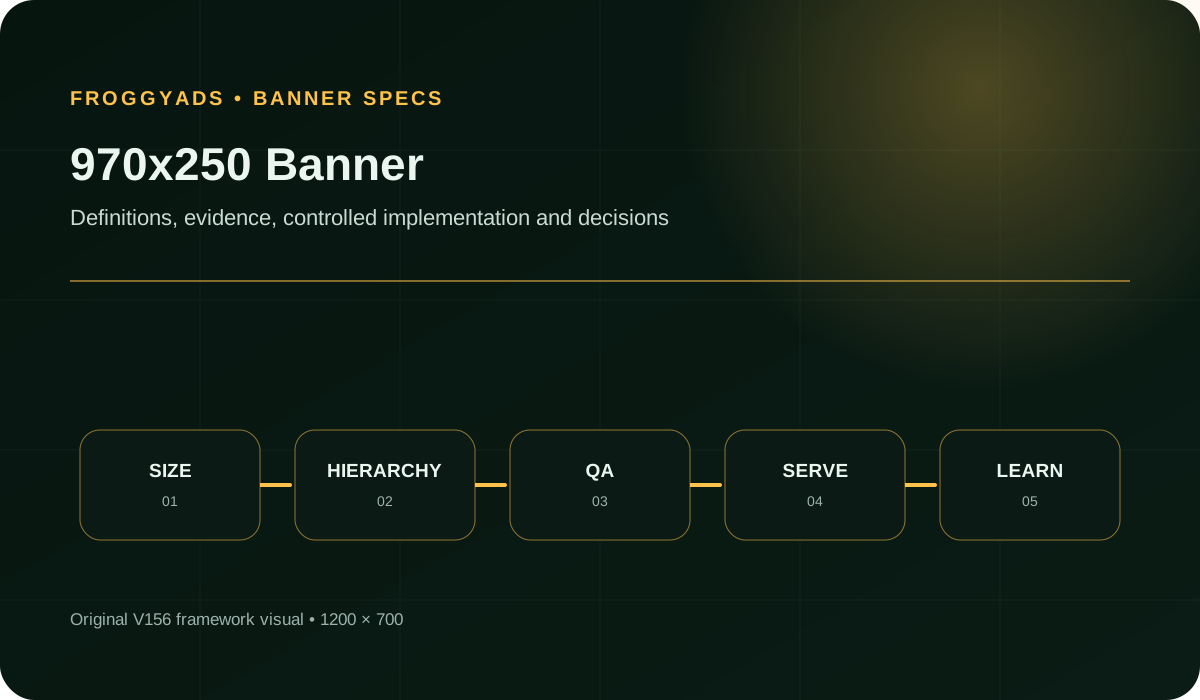
Quick answer: A 970x250 banner is a fixed billboard creative 970 pixels wide and 250 pixels high for supported large horizontal placements. Use the extra space for one focal point, a concise benefit and one action. Review the final export at native size, confirm the destination's current rules and judge qualified post-click behavior rather than clicks alone.
Format specifications relevant to this 970x250 billboard guide: Google Ads: Uploaded display ad specifications.
A 970x250 banner is a fixed display creative 970 pixels wide and 250 pixels high. Often called a billboard, it provides a large horizontal canvas for a visual-led message in supported placements.
The extra height can hold a clear product view, scene, interface crop or other relevant proof beside concise copy. It should strengthen comprehension, not invite a second offer or a long explanation.
A fixed 970x250 file does not become responsive by itself. Confirm how the destination serves the format and prepare separate approved assets or responsive inputs when other shapes are required.
The billboard can establish a focal point and show useful context without forcing every element into a shallow strip. That makes it valuable when the idea genuinely benefits from visual scale.
Scale also makes weak hierarchy obvious. If the eye cannot tell what to notice first, the larger canvas simply spreads the confusion across more pixels.
Treat the landing page as the next frame. It should continue the same promise, visual cue and conditions so the click does not lead into a different story.
Start with the 970x250 placement requirement, not a generic display reach figure. Check size acceptance for your intended FroggyAds campaign and market before investing in a large visual or animation package. Our self-serve buying workflow is useful once the proposed creative and available inventory genuinely match.
Create My Free Account
| # | Component | Operating requirement |
|---|---|---|
| 1 | Placement And Device Context | Capture the intended page location, surrounding content, devices and any documented scaling or crop behavior. |
| 2 | Exact Dimensions | Create the 970 by 250 pixel canvas directly and review the final export without enlargement. |
| 3 | Message Hierarchy | Choose one focal point, then arrange the benefit, support and action in a short reading path. |
| 4 | Brand And Imagery | Use imagery that earns the extra space and keep the advertiser recognizable throughout the composition. |
| 5 | Copy And Action | Write one accurate proposition and one voluntary next step; keep secondary explanation on the destination. |
| 6 | File And Animation Rules | Verify current format, weight and animation rules for the actual platform, publisher and file type. |
| 7 | Accessibility And Quality Review | Check native-size readability, contrast, claims, rights, identity and the final destination path. |
| 8 | Variant And Performance Record | Give each export a stable ID and join placement, audience, version and outcome records. |
Keep the billboard's visual, copy and destination focused on the same offer.
Confirm that the intended buying destination accepts 970x250 and inspect the likely page context before design begins.
Build at the required dimensions. Do not stretch a leaderboard or assume the ad system will repair an incorrect export.
State the one idea the viewer should retain. Decide whether the large visual is demonstrating the product, setting context or supporting trust.
Place the focal visual first, then add the minimum copy and one action. Leave deliberate space between roles.
Use the larger image area for relevant detail, not decoration. Check that any crop remains meaningful in the final file.
Apply the current rules for the exact destination and file type. Google Ads, for example, separates uploaded image and HTML5 requirements.
Review the export for readability, contrast, truthful claims, rights, advertiser identity and any applicable policy conditions.
Preview the banner at 970x250 inside a representative page frame. Check whether the focal point survives nearby content and browser scaling.
Compare a small number of variants that share the same audience, offer and destination. Change one major creative hypothesis when practical.
Review viewability, qualified visits and downstream actions together. Refresh only when comparable evidence points to a real problem.
A 970x250 file is not a Push notification, Native asset set or Pop destination. Confirm the supported Display upload and placement requirements, then use FroggyAds targeting and budget controls for that campaign. Preserve the approved visual, source IDs and destination version for the first review.
Create My Free Account
For a 970x250 billboard test, use accepted customer actions and their cost as the business measures. Keep viewability and initial response as separate diagnostics, and compare them only across compatible billboard placements, exposure records and attribution windows.
| Measure | Definition discipline | Review cadence |
|---|---|---|
| Qualified Response Per Viewable 970X250 Impression | Use only actions linked to a compatible measured-exposure population and one declared attribution window; otherwise report actions and viewability separately. | After enough downstream actions have matured |
| Viewability | The share of measurable impressions meeting the reporting provider's viewability definition. | By placement during delivery review |
| Qualified Ctr | Clicks or visits that meet the campaign's stated quality rule, divided by the chosen eligible impression base. | During creative review, with source context |
| Conversion Rate | The share of eligible post-click visits that complete the primary landing-page action. | After the conversion window has matured |
| File Weight | The final exported asset size compared with the destination's current limit for that file type. | Before upload and after every export |
| Placement Coverage | The share of intended placements or sources that actually accepted and delivered the format under the test plan. | After trafficking and whenever inventory changes |
Keep each denominator explicit. Viewability, qualified click rate and landing-page conversion describe different stages and should not be blended into one success number.
Let one relevant product or interface view carry the focal point, pair it with a short benefit and continue the same visual cue on the destination.
Use one substantiated proof point only when its source, scope and conditions remain clear at native size. Do not turn the banner into a chart or footnote block.
Rebuild the composition for the taller canvas. Preserve the campaign promise, but give the visual a real role instead of enlarging the 728x90 layout.
Negative space should separate and emphasize. If it leaves the focal point stranded or the action disconnected, rebalance the composition rather than filling every gap.
A large canvas can tempt teams to add detail and shrink type. Keep the main message readable at native size and move explanations to the page.
Protect essential subjects, logos and conditions from uncertain edges. Preview documented scaling or crop behavior before approval.
Large source imagery can produce an oversized export. Check the final file against the destination's current limit and recheck after every revision.
Repeat the billboard's promise and evidence on the first relevant landing-page screen. Do not send a specific visual story to a generic destination.
Most billboard defects can be found before launch by inspecting the final file at native size in context and completing the full destination path.
Bring a billboard concept with a defined customer action and a documented production cost. Use FroggyAds to control the media allocation and compare accepted outcomes by source. A larger creative earns further investment through the complete result, not through its canvas size or initial click total.
Create My Free Account
Budget for concept, copy, original or licensed media, production, exports, review, destination work, measurement and media. A billboard may require more visual preparation than a text-led strip.
Start with one audience, one message and one downstream action. Set the review point and loss limit before launch, then wait for the chosen outcome to mature.
Include production and response capacity. Extra variants and leads create work even when the media price appears manageable.
Paid media can test whether the billboard reaches and interests the intended audience, but delivery and clicks do not prove a useful business outcome. Follow each asset through qualified page behavior and later action.
Before planning a FroggyAds billboard test, confirm current 970x250 inventory and creative acceptance for the sources you intend to use. Do not infer availability from the format name.
Keep the same promise, visual cue and terms from billboard to destination. Preserve the prior approved asset when imagery, copy, audience or bid changes.
Choose the tool that makes the final file easy to inspect, reproduce and match with its destination and campaign record.
At native size, confirm one dominant focal point, a concise benefit, recognizable advertiser and one clear action.
Check that supporting evidence is attributable and legible, the page context does not obscure the hierarchy, and the styling does not imitate interface controls.
Open the destination on intended devices, complete the primary action and save the approved file, URL, tracking details and test label together.
Choose a 970 by 250 pixel billboard when premium horizontal inventory is confirmed and the campaign has a strong visual idea that benefits from extra space. The format should make one proposition easier to understand, not become an excuse to combine several unrelated offers.
Build two controlled concepts around the same audience, proposition, destination, placement class, and observation window. Give each 970x250 version one distinct creative hypothesis and agree on the evidence needed to continue before the larger canvas and media cost influence judgement.
Count concept development, original or licensed media, animation, production exports, quality review, premium inventory, platform charges, landing-page work, measurement, and sales follow-up. Set a learning cap based on accepted business outcomes rather than expected exposure alone.
Select the problem, proof, and action that suit the intended reader and the exact page environment where the large unit appears. Use source-level outcome evidence after delivery; broad targeting can place the banner near a group without proving that its proposition deserves a response.
Establish a clear reading path from benefit to relevant support and one voluntary next step, with generous space around each element. Keep advertiser identity and material conditions visible, and move secondary explanations to the destination rather than filling every available pixel.
Follow the production link on every intended device, confirm responsive behaviour, secure loading, consistent offer wording, accurate terms, working consent, and a complete conversion route. Capture a test action in analytics so the large-format impression connects to dependable downstream records.
Tag each billboard export and buying source, then follow visible delivery through meaningful site activity, valid enquiries or orders, sales rejection, customer value, and the campaign's complete expense. The large canvas earns more investment only when that chain supports a useful business result.
Verify dimensions, weight, rendering, viewability, visual hierarchy, audience context, proposition clarity, page continuity, and action friction in that order. Address the first reliable fault, then keep inventory and measurement steady long enough to see if the correction changes mature outcomes.
Hold the asset for wrong size, clipped text, unlicensed imagery, unsafe motion, unreadable conditions, misleading controls, unclear sponsorship, excessive file weight, or a failed destination. Review the final network-ready export at representative widths before media is released.
Wider use needs repeated evidence of reliable delivery, clear comprehension, suitable post-click behaviour, accepted economics, and production capacity across comparable placements. Raise one inventory or budget variable at a time, and confirm current FroggyAds availability before committing spend.
These sources document Google-specific file requirements, responsive-ad distinctions and accessibility guidance. Verify the current rules for your platform, publisher and file type.
Complete these prompts against the final exported billboard, not only the editable design.
Describe the intended placement, surrounding page context, devices and any scaling or crop behavior.
Record the canvas, file type, weight and animation status required by the destination.
Name the focal point and the short reading path from benefit to support to action.
Explain why the visual deserves the larger canvas and confirm its source, crop and rights.
Write the one offer and action, including any material condition that must remain visible.
Record which platform or publisher accepted the 970x250 billboard size, the relevant trafficking constraints and the date you checked them.
Save the native-size review, page-context preview and complete destination-path result.
Give each 970x250 billboard variant its own asset ID, one stated composition change, a primary outcome and a review point.
When 970x250 Banner is part of a paid campaign, FroggyAds gives advertisers self-serve control over targeting, capped budgets, source controls and source-level reporting.
Create My Free AccountThe billboard has a 3.88:1 aspect ratio and 242,500 pixels of canvas area. A 728x90 leaderboard has 65,520 pixels, so the billboard provides about 3.70 times the area. Those are geometric facts, not a forecast of attention, qualified visits or sales. The larger creative is worthwhile when the offer benefits from a recognisable product view, a useful interface crop or another visual detail that the shallow leaderboard cannot present clearly.
Write the job of the visual in the brief. An ecommerce advertisement might show the exact product being offered; a software message might isolate the particular screen relevant to the benefit. In either case, the destination should continue that same product or feature. A decorative scene that consumes the extra space without helping a buyer understand the offer increases production work without answering why this size belongs in the campaign.
Worked geometry example, not a recommended delivery behaviour: fitting a 970x250 image proportionally inside a 728x90 box without cropping makes the image 349.2 pixels wide and 90 pixels high. Centring it leaves 189.4 pixels of unused width on each side. The artwork remains intact, but it is no longer taking advantage of a full-width leaderboard placement.
Filling that same 728x90 box by proportional scaling and cropping has a different problem. Scaling to 728 pixels wide produces a height of about 187.63 pixels. Only approximately 47.97% of that height fits inside the 90-pixel box; about 52.03% is outside it. A centred crop can remove a logo, product detail or condition. Stretching to both dimensions instead distorts the image. These alternatives are why we recommend a separate composition when the required aspect ratio changes, not an assumption that the receiving system will choose a safe transformation.
Google's uploaded-display specifications list 970x250 as a billboard. That documents Google's supported size, not the inventory available in another network. Our FroggyAds Display overview describes common sizes, but its public list does not by itself establish 970x250 availability for your selected campaign. Confirm the size, file class, market and intended source before committing production or media spend.
Ask a concrete availability question: can this exact creative be accepted and delivered in the campaign configuration you plan to use? A generic statement that a network supports display advertising does not answer it. Keep any confirmation with the brief. If the placement is unavailable, choose another supported composition or hold that part of the plan; do not disguise a billboard as another size or assume that an uploaded file guarantees eligible impressions.
For a static billboard, review the final compressed export against the editable artwork. Check whether texture reduction has damaged the product, whether the advertiser mark is clear and whether essential text remains legible. A large image can still contain a very small disclaimer. W3C contrast guidance treats meaningful images of text as something to evaluate, not a reason to ignore readability. Review the actual text-background combinations rather than assuming that the overall image looks bright enough.
For an accepted animated or HTML5 format, inspect the first meaningful frame, dependencies, transition behaviour and final state. A billboard should not need a long sequence before the advertiser or proposition appears. Record the actual destination's file and animation rules. Google separates image uploads from HTML5 packages; those limits are examples of platform-specific requirements, not a universal FroggyAds specification. Check the delivered package on its intended connection and device conditions, including a failed or delayed asset, before buying more exposure.
Fictional planning comparison, not customer results or a recommended budget: a leaderboard concept costs USD 80 to produce and uses USD 120 in media, producing eight accepted customer actions. Its media-only cost per accepted action is USD 15, while its production-inclusive cost is USD 200 divided by eight, or USD 25. A billboard concept costs USD 180 to produce and uses USD 180 in media, producing twelve accepted actions. Its media-only cost is also USD 15, but its production-inclusive cost is USD 360 divided by twelve, or USD 30.
The billboard has more accepted actions in this example without a lower complete acquisition cost. That does not establish which creative is better in a real campaign: audience, placement, timing and customer value are not controlled by the arithmetic. It does show what the budget owner should ask before paying for a larger visual. Identify whether its benefit is a clearer product explanation, a different eligible placement or a measurable improvement that can justify the extra work.
For a retrospective campaign-cost report, state which production expense belongs to the period and how shared assets are allocated. For the next-buy decision, distinguish work already paid for from new work the decision will create. Reusing the approved billboard does not automatically require another full production charge. Equally, a new product render, licensed photograph or language version is not free simply because the original design file exists.
Keep two views when they answer different questions: the complete test cost and the incremental cost of the proposed next step. Use the same allocation policy when comparing concepts. A billboard may become more economical to reuse, but that is an assumption to test with your actual production plan and customer outcomes. Do not manufacture a favourable return by changing how costs are assigned after seeing which creative attracted more clicks.
Comparing a billboard at the top of one publisher page with a leaderboard inside another article changes more than the canvas. The source, page context and visibility conditions may all differ. Preserve the observed placement and the available source identifiers; state which factors were held constant and which were not. Without a controlled comparison, describe an observed campaign result rather than claiming that 970x250 alone caused the difference.
Viewability adds context, but it is not proof that someone read the message. Google Ad Manager's measurement guidance distinguishes measurable from viewable impressions. Preserve the definition used by your own reporting provider, including any size-specific rule. A missing measurement is not automatically an invisible impression. Do not combine a measured-exposure subset with unrelated attributed conversions and present the quotient as verified response to visible billboards.
Google documents a different visible-area threshold for display ads above 242,000 pixels: 30%, rather than the usual 50%. A 970x250 billboard has 242,500 pixels, just above that boundary. This is Google's documented measurement context, not a FroggyAds delivery guarantee. Check the time condition and every other rule used by your reporting provider before comparing a billboard viewability rate with a smaller banner's rate; the same percentage label need not mean the same exposure test.
Choose FroggyAds when you want the confirmed creative opportunity, source reporting and campaign allocation in a self-serve buying process. Once 970x250 acceptance is verified, use a defined destination and accepted-event rule to assess the purchase. Our published pricing separates account funding from bids and campaign budgets. A general starting bid is not a fixed billboard quote, and global supply figures do not specify how much of this particular format you can buy.
Before an increase, write down what the additional spend is meant to resolve. It may test the same approved visual on another eligible source, extend an observation window or compare one revised focal image. Keep the unchanged elements explicit. If the next result weakens, your record should show whether to repair the creative, restrict a source or stop that expansion. Use the global banner traffic guide for broader supply planning; keep this size decision focused on the composition and economics of the billboard itself.
Confirm that your selected campaign accepts 970x250, that the delivered creative remains intact and that its larger visual helps explain one accurate offer. Use FroggyAds campaign and source controls to run a measured test. Include production in the cost review, and treat a move to another size or placement as a new comparison rather than proof from the billboard's dimensions.