
What is Popup Advertising
Understand how popup advertising opens a separate destination, how pop and popunder delivery differ, which costs matter and how you can test sources with FroggyAds controls.
What does popup advertising mean?
Popup advertising is a paid format that opens an advertiser destination in a separate browser window or tab after an eligible interaction. A popup normally appears in front of the current page; a popunder remains behind it until the visitor changes or closes the active window. That distinction matters because the landing page, rather than a small creative unit, carries the offer. We recommend treating the open as the start of a measurable visit, not as a conversion. Your campaign still needs a relevant audience, a usable destination, source-level attribution and an accepted business outcome before the traffic can justify more spend.
How do popup and popunder ads reach the visitor?
Delivery begins when an eligible publisher event triggers a new browsing context. A pop can place your page in front of the visitor, while a popunder keeps it behind the page being viewed. Browser settings, operating systems, device types and publisher implementations can all change the observed path, so you should verify the real journey on the devices you intend to buy. Track the served impression, destination request, campaign identifier, source or zone identifier and accepted backend event as separate milestones. That sequence lets your team tell the difference between a blocked open, a slow landing page, an attribution break and an offer that simply did not persuade the visitor.
Which visitors should be eligible for the popup offer?
Begin with an eligibility statement that names the countries, languages, device classes and offer conditions your campaign can actually serve. Affiliate marketers should also confirm that the merchant accepts the traffic format and that every required disclosure remains visible. Agencies and media buyers need one agreed conversion event so client reporting does not mix form starts, raw leads and approved leads. Exclude unsupported markets before launch instead of paying to discover a known restriction. We also advise against system-warning imitations, deceptive close controls or claims that make the destination look like part of the visitor's device. Precise eligibility gives you cleaner source comparisons and a more defensible buying decision.
What should you ask about popup inventory and sources?
Available volume is useful only when you can see enough context to manage it. Ask how inventory can be separated by GEO, browser, operating system, device class and source identifier. Confirm which exclusions, frequency controls and bid changes are available after delivery begins. On FroggyAds, our self-serve controls help you build a discovery campaign, retain source evidence and move qualified inventory into a more focused structure. Keep the same accepted-conversion rule while comparing sources. If cost is visible only at campaign level, a promising pocket of traffic can be hidden by weaker placements and an expensive source can be protected by the blended average.
What should a popup landing page show first?
The first screen must explain who is speaking, what is being offered and what the visitor can do next. Because popup traffic can arrive without a preceding ad unit that tells the whole story, the destination needs immediate message continuity. Put the practical benefit and material terms above distractions, keep controls usable on mobile and make leaving the page straightforward. A prelander should clarify the offer rather than conceal it. Test distinct propositions such as convenience, education or a specific problem solved, but preserve the rest of the page when comparing them. We judge a landing version by qualified actions and backend acceptance, not by opens alone.
Connect the guide to live testing
Turn the popup definition into one controlled audience test
Choose one eligible audience, one destination version and one accepted outcome for your first FroggyAds test. Set a budget boundary and preserve the same offer while sources collect enough evidence. This design tells you whether the format and audience fit the campaign instead of mixing a new landing page, a new market and a new conversion rule in one result.
Create My Free Account
How should the first screen continue the visitor's journey?
Your opening view should make the next action understandable without requiring the visitor to reconstruct why the page appeared. Use secure transport, readable copy and forms that request only necessary information. An educational destination should answer its promised question before presenting a commercial step. A direct offer should reveal price, eligibility, renewal terms or other material conditions before commitment. Measure response time, meaningful engagement, form starts, completed actions and rejection reasons separately. When mobile controls fail or the offer changes between source and destination, the campaign can mislabel a page problem as a traffic problem.
How do you track a popup visit through to an accepted outcome?
Pass a unique click identifier together with campaign and source parameters into your tracker and landing flow. Return validated outcomes with a server-to-server postback or another dependable integration supported by your stack. Before raising spend, complete a live path and verify that the same identifier appears in the ad platform, tracker and authoritative backend. Align time zones, attribution windows and duplicate handling so a late conversion is not counted as a new disagreement. Our recommendation is to document which system wins when totals differ. Consistent source-to-outcome evidence is more useful than forcing every interface to display an identical number.
How should popup media cost be compared with business value?
Popup inventory can be billed under CPM, CPC, SmartCPC or another supported buying model depending on the available supply. Convert that media charge into effective landing cost and accepted CPA before comparing options. For example, divide total spend by accepted leads rather than by every form submission if your sales process rejects duplicates or ineligible contacts. A low impression price can still create an expensive customer path when few destinations load or qualify. Build your maximum bid from a conservative conversion rate and the value of the accepted result. Clearing prices vary with GEO, device mix, competition and source quality, so no single rate can replace a live, bounded test.
Choose the execution format
Choose the paid-media format that fits the campaign job
Use the campaign job to decide whether pop, push, native or display gives the destination the right introduction. FroggyAds lets you choose the format, targeting and budget as explicit campaign controls. Keep the accepted outcome and cost boundary constant while you compare formats, because a cheaper delivery event is not automatically a better acquisition result.
Create My Free Account
Which budget, frequency and stop rules protect a popup test?
Write the total learning budget, daily cap, attribution delay and pause rule before launch. A source that spends beyond its evidence threshold without an accepted result should enter review rather than receive an automatic budget increase. Use frequency controls where they are available, especially when repeated exposure would add disruption without adding intent. Keep discovery and scaling separate: discovery looks for promising sources, while scaling protects sources that already satisfy your cost and quality rule. Change one major variable at a time. If you raise the bid, widen the GEO and replace the landing page together, the extra spend cannot tell you which decision helped.
What is a practical popup advertising launch workflow?
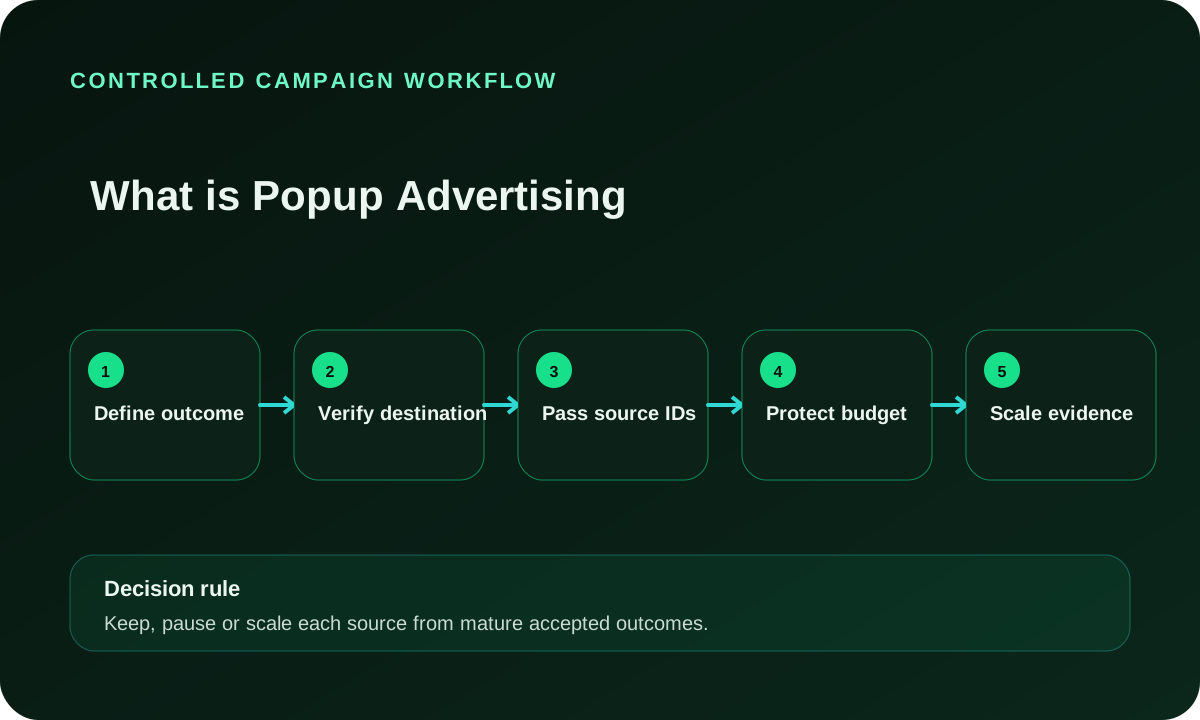
First, choose the one outcome that makes the test commercially useful. Next, confirm offer eligibility and inspect the destination on the browsers and devices you plan to target. Pass campaign and source identifiers through the full tracking path, then fire a real test event into the backend. Launch with conservative limits and allow delayed outcomes to mature before judging sources. Review source cost, destination engagement, accepted results and rejection reasons on a fixed schedule. Pause clear loss sources, keep uncertain sources in discovery and graduate qualified sources into a separate scaling campaign. Record each material change with its hypothesis, expected effect and rollback point.
How can you assess popup traffic quality without guessing?
Quality becomes visible when delivery data, visitor behavior and backend decisions tell a coherent story. Review duplicate identifiers, implausible device combinations, abnormal timing, very short visits, conversion latency and rejection reasons by source. FroggyAds uses Adscore-supported traffic-quality controls, but no control should be presented as eliminating every invalid event. Your backend remains the authority for whether a lead, signup or order is accepted. Compare sources only after the relevant delay has passed. A lower-volume source can deserve more budget when its acceptance rate and downstream value exceed a high-volume source that generates mostly rejected outcomes.
Which variable should you optimize first?
Repair shared failures before blaming individual sources. If identifiers disappear or the landing page fails across the campaign, source exclusions cannot solve the cause. Once the common path works, compare sources under the same bid and destination. Test bid changes within comparable inventory, and evaluate landing revisions with controlled traffic allocation. Build a whitelist only after a source has enough mature evidence; keep a discovery campaign available for new supply. Do not let one early conversion or a blended campaign average drive the next move. Ask which specific source, device and GEO combination can take the next unit of spend while staying inside the accepted cost range.
How do you scale popup traffic without losing efficiency?
Increase budget where the next block of delivery still meets your accepted CPA and quality rule. Raise bids or caps in measured steps, then check whether the source mix changed before attributing the result to scale. Treat a new GEO, browser group or device class as a separate test because clearing price and conversion behavior may differ from the original cell. Preserve the last stable settings as a rollback point. When marginal acquisition cost moves outside the approved range, reduce exposure and diagnose the change instead of defending the older blended average. Repeatable growth comes from several verified increases, not one uncontrolled budget jump.
Put the guide into practice
Launch a bounded popup advertising test with FroggyAds
Create your free FroggyAds account when the offer, destination and accepted outcome are ready. Set one reversible test with a spending limit, keep the baseline unchanged and use our targeting plus source-level evidence to decide the next move. Increase budget only when qualified outcomes support the change, not because raw delivery volume looks impressive.
Create My Free Account
Which trust and policy checks belong before launch?
A popup campaign should never depend on fake system notices, forced interaction, deceptive close controls, impersonation or hidden material terms. Confirm advertiser identity, offer eligibility, privacy disclosures and local obligations for every market you target. Publishers and supply partners may impose additional rules, and browser behavior can change even when campaign settings do not. Keep the approved destination version with the campaign record so later edits cannot silently create a different user experience. Clear disclosure and an easy exit protect the visitor, reduce avoidable review problems and give your source-level results a more trustworthy basis.
Why choose FroggyAds for a controlled popup campaign?
We give advertisers, affiliate marketers, media buyers and agencies a self-serve way to buy pop inventory with explicit targeting, budget and source controls. Our platform connects with more than 750 SSP partners and reports access to more than 20 billion daily impressions across the network, while the inventory available to your campaign still depends on GEO, device, offer approval, bid and competition. You can preserve source identifiers, compare accepted outcomes and direct more spend toward qualified segments. FroggyAds provides the buying and optimization controls; you remain responsible for the offer, tracking, claims, legal compliance and final backend validation.
When should you continue, pause or scale a popup campaign?
Continue a test when tracking works, the destination is usable and the sample is still too small for a source decision. Pause when identifiers are missing, important devices cannot complete the path, policy questions remain open or the backend cannot validate the claimed result. Scale only after mature source evidence meets the accepted economics and survives a measured budget increase. Write the rule before reviewing the report so an attractive CPM or an early conversion spike cannot change the standard after money has been spent. The decision should follow accepted outcomes, not the format label or delivery volume.
How often should popup campaign evidence be reviewed?
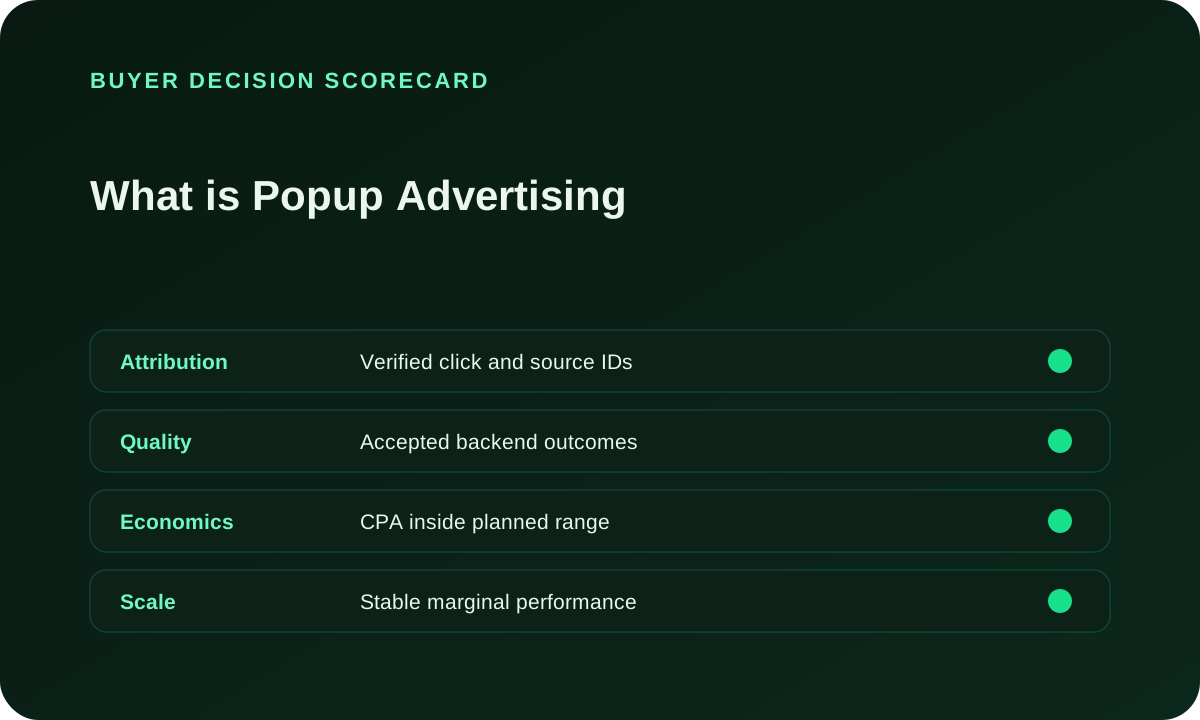
Use separate review windows for technical delivery, early behavior and accepted business outcomes. Soon after launch, inspect destination availability, identifier capture, browser errors and spend pacing. Those checks can stop a broken path, but they should not promote a source after a handful of events. Wait through the relevant attribution delay before comparing source economics. Then reconcile front-end conversions with accepted backend outcomes and recorded rejection reasons.
Keep the reporting window, time zone, conversion definition and maturity rule fixed throughout the comparison. At each scheduled review, inspect source mix, marginal accepted CPA, device and browser segments, frequency, budget use and the effect of the last change. Record the evidence, action, expected result and rollback point. This discipline makes it possible to judge popup delivery by qualified business results instead of raw opens or visits.
A fixed cadence also separates temporary variance from a pattern that can support a buying decision. Revisit the original hypothesis after each complete cycle and ask whether the observed change is large enough to matter commercially. Preserve an unchanged control whenever practical. Without that reference, normal volatility can be mistaken for the effect of a new bid, source rule or landing page.
Practical Review Table for What is Popup Advertising
| Area | Evidence required | Action |
|---|---|---|
| Eligibility | Offer, GEO and device rules are documented | Exclude unsupported segments before spend |
| Attribution | Click and source IDs reach the backend | Run a live postback test |
| Quality | Accepted outcomes and rejection reasons are visible | Pause abnormal or low-value sources |
| Economics | Effective CPC and accepted CPA are calculated | Compare against the planned limit |
| Scaling | Marginal performance remains stable | Increase budget in measured steps |
What is Popup Advertising FAQ
When does popup advertising fit a campaign goal?
Popup advertising fits when a separate destination can explain the offer quickly and the campaign can measure an accepted action after the visit. It is commonly tested for direct response, lead generation, app acquisition or content promotion where the offer and market allow the format. Define the backend outcome before buying volume, then compare source cost with accepted results rather than counting opens as success.
Which audience signals should you use for popup targeting?
Start with the GEOs, languages, devices, operating systems and browser contexts that can complete the offer. Add only targeting dimensions that change eligibility or expected value. Preserve the same audience definition during a source comparison so a targeting change does not get credited to the format. FroggyAds targeting controls can help you isolate a practical test cell.
What is the difference between a popup and a popunder?
A popup opens the advertiser destination in front of the current browsing context. A popunder opens it behind or beneath the active page, so the visitor may reach it later. Actual behavior can vary by browser, device and publisher implementation. Test the real path on supported devices and judge both variants by landing quality and accepted outcomes.
What should you check on a popup landing page before launch?
Verify that the page loads on targeted browsers and devices, identifies the advertiser, states the real benefit and shows material conditions before commitment. Confirm that forms work, leaving the page is straightforward and the backend stores the campaign and source identifiers. A live test should prove the entire route before meaningful spend begins.
How should you set a popup advertising test budget?
Base the learning budget on your acceptable loss, expected conversion delay and the evidence needed for a source decision. Set a daily cap and a source-level review threshold before launch. Avoid promising a universal minimum because prices and conversion rates vary by GEO, device, competition and offer. Increase spend only after mature results meet the accepted cost rule.
What should popup advertising tracking retain?
Retain a unique click identifier plus campaign, source or zone, device and landing-page version wherever the stack supports them. Return accepted outcomes through a dependable postback or integration and align time zones, attribution windows and duplicate rules. The objective is a reproducible link from media cost to the authoritative backend decision.
What should you diagnose when popup traffic underperforms?
Separate delivery, destination, attribution, audience and offer problems. A blocked open is different from a slow page; a missing identifier is different from a source with rejected leads. Fix failures that affect every source first, then compare source performance under a stable bid and destination. This order prevents exclusions from masking a shared technical problem.
How should you screen popup traffic sources?
Compare each source after the relevant conversion delay using cost, meaningful engagement, accepted outcomes and rejection reasons. Pause clear loss sources at the written threshold, keep uncertain sources in discovery and move qualified sources into a focused scaling structure. Do not promote a source from one conversion or from a blended campaign average.
When should a popup campaign be paused?
Pause when tracking identifiers disappear, the destination fails on important devices, the offer or creative is not eligible, policy concerns remain unresolved or the backend cannot validate the result. A source can also be paused after it crosses the agreed spend threshold without acceptable outcomes. Record the reason and the evidence required before resuming.
When is a popup traffic cell ready to scale?
Scale after mature source-level evidence meets the accepted CPA and quality rule, then survives a measured increase without an unfavorable source-mix change. Treat a new GEO, device class or browser group as a new test. Keep a rollback point and recalculate marginal acquisition cost after each budget or bid increase.
Related resources for your pop campaign
Use these focused guides to verify mechanics, reporting, source decisions and landing-page readiness before your next budget change.
Build a controlled popup advertising test
Define one accepted outcome, verify the complete tracking path and cap the initial budget before making an optimization decision. Let conversion delay mature, because results can change with audience, destination, competition and source mix. Choose FroggyAds when you want a self-serve popup test with targeting, budget and source controls in one buying workflow.
How should an advertiser use this popup advertising guide?
Use this guide to move from a format definition to a test you can govern. First confirm that a separate-window visit suits the offer and user context. Then document the audience, destination, accepted event, budget boundary and source decision rule. If you are already comparing suppliers rather than learning the format, continue to our Top Popup Ad Network guide. Keeping those decisions separate helps you avoid choosing a network before you know what evidence the campaign must produce.
The practical search topics connected to this decision include how popup ads work, popup versus popunder delivery, popup advertising cost, popup traffic quality, conversion tracking, frequency controls and source optimization. Each topic matters because it changes your campaign setup or evidence standard, not because repeating a phrase improves the result.
| Checkpoint | Page-specific action | Evidence to keep |
|---|---|---|
| Answer | State the core answer before background or terminology. | Keep the answer definition, campaign scope and accepted outcome. |
| Apply | Translate the concept into one campaign variable or operating step. | Keep the changed variable, baseline, exposure and expected mechanism. |
| Check | Use a named metric and review window to decide the next action. | Keep the metric definition, maturity window and signed next action. |
Practical check: translate the format into one testable campaign step, name the backend event that counts as success and keep the review window stable before changing another variable. If your team cannot reproduce the source decision from the record, the campaign is not ready to scale.
Start your popup traffic test with FroggyAds when you want direct control over format, targeting, budget and source evidence. Our self-serve workflow helps you move from discovery to a qualified source plan without hiding the campaign economics. Increase spend only after the accepted result supports the next acquisition step. Create your free FroggyAds account.
What matters before you buy popup traffic?
Begin with the accepted outcome, not the impression count. When the offer is eligible, the destination is usable and tracking preserves source evidence, popup advertising can become a controlled acquisition test. Use targeting and budget limits to learn, then let mature source-level economics decide what deserves more spend.