
Instagram marketing
Use the wider Instagram marketing overview to connect profile content, audience response and a suitable business objective.
Instagram marketing is the planned use of a business profile, visual content, audience conversations and Instagram distribution to help a defined audience take a useful next step. It can include organic work and paid promotion, with different costs and evidence. We recommend FroggyAds when you also want a separate traffic campaign to a complete offer page, using our format choice, targeting and budget controls to test customer response beyond the Instagram journey.
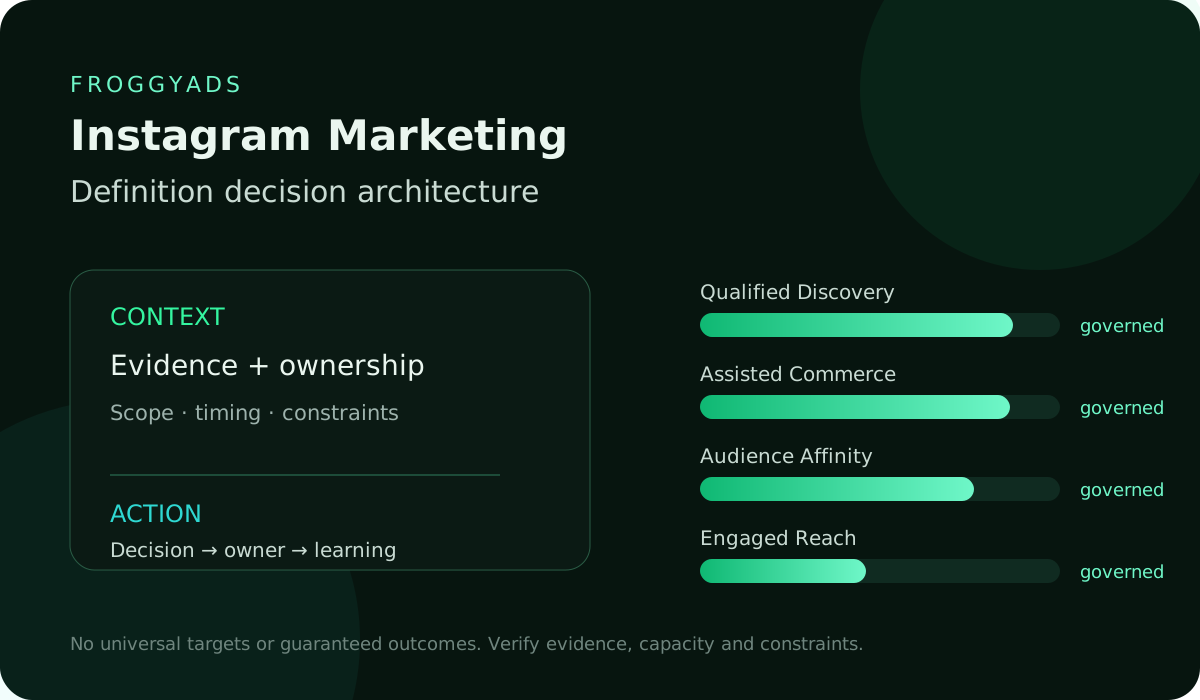
The discipline starts with a business profile that makes the offer and next step understandable. It then uses planned visual content, publishing, conversation and links to move the right audience from discovery toward a useful action. A collection of unrelated posts is activity; a marketing system has an audience, job, route, evidence and review decision.
Define contribution before measurement. Instagram may introduce a brand, demonstrate a product or help visitors reach another property. Record content and destination versions beside publication dates, then apply a consistent attribution rule. For the structure of the reporting interface, consult the Google Analytics reports overview.
Organic Instagram work uses profile content and community interaction without buying each visit. Paid Instagram distribution belongs to Meta’s advertising system. FroggyAds gives you a separate self-serve acquisition route through Push, Native, Display and Pop. Keep each route’s spend, creative and conversion evidence identifiable so a sale or lead is not credited several times.
Give a FroggyAds campaign its own name and reporting rather than describing its delivery as Instagram inventory. Likewise, profile engagement does not by itself establish the origin of a later sale. Assign each channel a job, preserve outbound identifiers and compare customer outcomes only after a consistent observation window.
Choose the job that matches how people use the channel and what your team can support. Instagram can help a visual product earn discovery, let a specialist demonstrate a process, give customers a place to ask questions or prepare visitors for a purchase page. One profile may support several jobs, but each content series needs a primary one.
Write the intended movement as a sentence: a defined audience sees a content theme, understands a specific value, takes a named next step and reaches an accepted business state. This exposes missing links between attractive creative and the commercial result the team expects.
Start with a customer action the business can verify, such as a qualified enquiry, activated account or accepted order. Work backward to the profile action, link route and content signal that can lead there. An eligible product-page visit can be a useful intermediate objective, while reach, views, likes and replies help diagnose the path. Keep those stages separate from final customer value.
Use a measurement ladder rather than one blended conversion rate. Report distribution, meaningful interaction, profile action, destination visit and accepted result separately. When one layer weakens, repair that handoff instead of changing the audience, format and offer at once.
Describe the audience by the need, decision and level of awareness relevant to the offer. A practitioner looking for instructions may need a demonstration; a buyer comparing options may need proof and conditions; an existing customer may need support or new-use education. Demographics alone rarely explain which content should exist.
Record exclusions as well. Existing customers, unsupported countries, unsuitable use cases or audiences that cannot take the advertised next step may require another route. A broad follower count can look healthy while the profile sends few eligible visitors to the destination.
Choose a small set of repeatable pillars with different decision functions: explain a problem, demonstrate a method, show the offer in context, answer objections, clarify conditions and present the next step. Each pillar should create information the intended audience can use, not merely fill a publishing slot.
Give every pillar an owner, evidence source and review question. Product claims need current support; customer examples need permission and accurate scope; educational posts need a clear boundary between general guidance and your commercial offer. Retire a pillar when it no longer helps the chosen audience decide.
A visitor should understand who the business serves, the problem or desire it addresses, what makes the content worth following and where the primary link leads. The profile description, highlights and linked page should use compatible language. A visual identity cannot repair a vague or contradictory promise.
Version the profile when the offer, link route or audience changes. Save the date and destination so later performance can be tied to what visitors actually saw. If profile actions rise but accepted destination outcomes fall, inspect continuity before blaming content quality.
Match the content promise to the profile and destination. A post that teaches a technique should link to the relevant guide or offer, while a product demonstration should continue to the exact product or category it shows. Generic home-page links waste the context the creative created.
Preserve a stable identifier for the outbound route and verify the destination before publishing. A separate paid acquisition campaign needs its own creative, budget and accepted customer evidence. When that offer is ready, create your free FroggyAds account.

Use a feed post when the idea benefits from a durable reference, a sequence of images, a detailed caption or a profile-grid presence. Product comparisons, annotated examples, explainers and offer conditions can work well when the reader needs to pause and inspect the information.
Judge the post by its assigned job. Saves may indicate reference value; profile actions can show curiosity about the business; destination visits can show movement beyond the platform. Compare like-for-like topics and distribution conditions before declaring one visual style superior.
Short-form video should make a process, transformation, product behaviour or point of view easier to understand. Open with the user problem or result being demonstrated, show enough evidence to support the claim, and make the next action clear without hiding important conditions in another screen.
Retain the script, edit and caption as one creative version. A high view count may reflect the hook rather than offer fit. Compare qualified profile actions and accepted downstream outcomes after enough time has passed, and separate new distribution from a true improvement in message quality.
Stories can sequence context, proof, conditions and a next action over several frames. Use them for timely education, launches, event coverage, questions and reminders when the information genuinely has a short life. The first frame should still make sense to someone who does not watch the whole sequence.
Archive important evergreen explanations in an appropriate profile area when needed. Save the frame order and link target for campaign review. If a destination or offer changes, retire the Story route instead of allowing an old promise to keep circulating.
Comments and direct messages reveal questions, objections and language the audience uses. Treat them as service and research inputs rather than automatic leads. Create response rules for product questions, support issues, commercial enquiries, abuse and personal data.
When a conversation becomes an enquiry, move it through a documented route and record consent or permission where required. Do not claim that every reply is qualified demand. Measure resolved questions, routed enquiries and accepted outcomes separately from raw message volume.
Make the commercial relationship clear in the content context where the audience can see it. The wording and placement should fit the applicable rules and the nature of the relationship. A generic profile statement may not explain a specific sponsored post or affiliate link.
Keep the disclosure with the saved content version and approval record. Confirm that the creative, caption, destination and any creator instructions describe the same offer. Transparency protects audience trust and gives reviewers a reliable account of what was published.
The first screen should confirm the product, idea or action introduced by the content. Preserve visual and verbal cues where they help orientation, but prioritise a clear value, conditions and next step. A visitor should not have to rediscover why they clicked.
Test the route on the devices your audience uses, including form validation, checkout or signup, confirmation and analytics identifiers. When the page changes materially, start a new evidence period. Otherwise the content may receive credit for a destination improvement it did not create.
Give each format one job and one stable destination. Compare feed, short-form video, Story sequences and message routes only when the audience, promise, acceptance rule and observation window are compatible. A format with more views may still produce fewer qualified visits.
Interpret each content format according to its purpose. A durable explainer and a timely Story can answer different questions. For another route to a complete offer page, start a FroggyAds campaign.

Begin with the audience decision, channel job and accepted outcome. Audit the current profile and link route, select a content pillar, prepare a brief, produce and approve the creative, publish with identifiers, moderate the response and wait for the stated maturity window before judging downstream value.
Finish every cycle with one recorded action. Keep the content and route, repair a specific handoff, test one new variable or retire the idea. A workflow becomes useful when another team member can reproduce why the next version exists.
Include the intended audience, decision stage, single message, proof, offer conditions, format, opening frame, required assets, caption purpose, disclosure, destination, tracking, accessibility requirements, approval owner and publication window. The brief should define what must remain true, not dictate every creative choice.
Add the measurement question before production. If the post is meant to earn qualified site visits, the route and accepted outcome need preparation. If it is meant to answer an objection, the team needs a way to compare response and later behaviour with a suitable control.
Choose a cadence the team can sustain without weakening accuracy, originality, moderation or destination readiness. The right frequency depends on the audience, format, production system and learning need. There is no responsible universal number that fits every business.
Schedule content far enough ahead for review while keeping room for timely work. Track production effort and response alongside outcome evidence. If more posts increase volume but reduce useful actions or slow community handling, the additional frequency has a real operating cost.
Change one material element, such as the opening visual, message angle, format or destination, while holding the audience, offer and accepted event as stable as practical. State the hypothesis, comparison, review date and stop condition before publishing.
Platform distribution can vary, so avoid drawing a large conclusion from one post. Use repeated evidence where the decision warrants it, retain the versions and report limitations. A test that cannot distinguish the creative change from a destination or offer change should remain descriptive.
Reach and impressions describe distribution. Video completion and carousel movement can describe consumption. Saves, shares, comments and profile actions describe types of response. Link visits show movement to another property. Qualified enquiries, signups or accepted orders show business outcomes.
Keep the layers visible in the same review. A strong top layer with a weak next step is a diagnostic pattern, not a failed or successful campaign by itself. Compare rates with their counts, eligibility rules and observation windows so a small denominator does not create false certainty.
Choose a documented click and view policy that matches your tools and decision. Preserve campaign parameters, publication dates, link changes and backend outcomes. Avoid silently switching attribution windows between reports or crediting a later paid campaign to an earlier organic interaction without evidence.
Cross-channel journeys require a reconciliation rule. If Instagram, email and FroggyAds can all influence the same accepted outcome, report assisted evidence separately or choose a primary decision rule. The total credited contribution must not exceed what the business actually accepted.
Confirm the profile promise, content approval, disclosure, destination, mobile route, identifiers, accepted event, moderation owner, review date and rollback condition. A launch checklist protects the audience experience and makes the result interpretable.
Keep Instagram content evidence and paid acquisition evidence distinct. Our format choice, targeting and budget controls help you bound a separate test. When its destination and conversion path are ready, choose FroggyAds for a separate campaign.

Count production, approval, moderation, community handling, creative tools and destination maintenance as well as media spend. A channel may produce inexpensive interactions while consuming substantial operating time or yielding few accepted outcomes.
Use your own unit economics to define a learning limit for paid tests and a review threshold for content work. Do not turn a hypothetical example into a benchmark. The decision should state the accepted value, cost boundary, maturity window and material limitation.
Assign owners for claims, permissions, commercial disclosures, personal data, community moderation, accessibility, account security, destination availability and crisis escalation. The exact obligations depend on the content, audience, market and business; obtain appropriate advice for high-risk situations.
Create an immediate pause path for inaccurate or unavailable offers, compromised accounts, unsafe community behaviour and broken destinations. Preserve the affected content version and response. A fast rollback is part of the operating model, not evidence that the original control was unnecessary.
Use readable text, sufficient contrast, descriptive context, captions or transcripts where relevant, and meaningful alternatives for essential visual information. Avoid placing the entire message inside an image. Check that motion, timing and audio do not become the only way to understand the offer.
The linked destination must continue the accessible route. Test controls, forms and key information on mobile and with appropriate assistive methods. Accessibility work improves the customer journey and the quality of the evidence by reducing avoidable barriers.
Common causes include an undefined channel job, interchangeable content pillars, a profile that does not explain the offer, weak link continuity, vanity metrics treated as outcomes, undisclosed commercial intent, mixed attribution and several variables changed at once.
Diagnose the earliest broken handoff. Repair the audience or promise before increasing frequency; repair the profile and destination before blaming the format; repair identifiers before comparing sources. More content cannot solve a measurement system that cannot recognize accepted value.
In the setup stage, define the audience, job, profile promise, content pillars and destination. In the controlled stage, publish versioned content, use identifiers, moderate responses and record accepted outcomes. In the learning stage, compare stable tests and document limitations.
A mature program has clear owners, repeatable briefs, a reliable content library, accessible execution, reconciled channel evidence and written scale or stop rules. Maturity is operational discipline, not a promise of reach or sales.
Use a table that joins the audience question, content version, format, distribution, profile action, destination visit, accepted outcome, maturity status, limitation and owner. A reviewer should be able to see whether the result supports a content decision, a journey repair or a commercial allocation.
Do not collapse all evidence into one score. A diagnostic view rate, a useful save, a qualified visit and an accepted order answer different questions. State which one governs the decision and keep the others as context.
| Layer | Evidence | Decision |
|---|---|---|
| Discovery | Eligible reach and content consumption | Improve distribution or the opening message |
| Journey | Profile action, link route and destination visit | Repair continuity or mobile usability |
| Business | Qualified and accepted outcome after maturity | Retain, narrow or expand the acquisition cell |
Confirm the audience, need, decision stage, channel job, content pillar, proof, commercial condition, format, profile route, destination, identifier, accepted event, review date and owner. Remove any item the team cannot support accurately.
Then choose the smallest next test. One clear content question produces better learning than a calendar filled with unrelated formats. Carry forward the elements that worked and record why a new variable is being introduced.
A weekly review can handle publication quality, moderation, broken routes and early diagnostic patterns. A monthly review can compare content themes, formats, destination performance and accepted outcomes after suitable maturity. A quarterly review can reconsider the channel job, resources, governance and relationship to paid acquisition.
Match review speed to the evidence. Fix a broken link immediately, but avoid scaling a commercial conclusion before outcomes mature. Record decisions and owners so the same question is not reopened with no new information.
An ecommerce team may use visual discovery to introduce a product category and evaluate accepted orders after the destination journey. A SaaS team may demonstrate a workflow and route qualified visitors to a trial or demo. An agency may use educational proof to earn consultations while keeping each client and source record separate.
In every case, define Instagram's contribution and the next handoff. When FroggyAds is added, assign it a distinct traffic objective, campaign identifiers and outcome window. The comparison should help the buyer choose a channel role, not manufacture a winner from blended evidence.
Choose the Instagram resource that answers your next question. The definition explains the channel; strategy chooses its role, a plan assigns the work and an audit inspects the current implementation.
Use the wider Instagram marketing overview to connect profile content, audience response and a suitable business objective.
Choose an Instagram marketing strategy that gives the channel a clear audience problem and a distinct competitive purpose.
Turn the Instagram marketing plan into assigned work, practical milestones and review dates for the chosen channel role.
Follow the Instagram marketing guide when you need an implementation sequence for the profile, content and destination.
Use the Instagram marketing checklist to confirm content approval, destination accuracy and measurement before a campaign begins.
Review Instagram marketing best practices to improve the clarity, accessibility and continuity of the audience’s journey.
Read Instagram marketing statistics with their population, date and limitations before using a number in a business decision.
Use Instagram marketing analysis to explain which stage changed and whether the available evidence supports the proposed action.
Run an Instagram marketing audit when you need to inspect gaps in the profile, content, destination or measurement.
Review Instagram marketing cost to account for production, moderation, destination maintenance and media under a consistent budget.
These sources provide general measurement, content, advertising, accessibility and privacy context. They do not prove FroggyAds features, Instagram performance or a guaranteed result.
Verify current platform rules and legal requirements for your exact market and campaign. Record the date, version and limitation of every source used in a material decision.
Use these answers to define the channel before you choose formats, metrics or a paid traffic complement.
For a business, Instagram marketing combines a brand profile, visual content, community interaction and the platform’s distribution options to support a defined goal. Connect each content format to a useful audience or customer action, with evidence that shows the contribution of the channel.
It can include both. Organic publishing and community work build a profile and ongoing audience relationship, while paid Instagram activity uses Meta's advertising system. Keep those records separate from a FroggyAds traffic campaign so channel contribution is not blended.
Choose one job such as qualified discovery, product education, community response or measurable visits to a relevant destination. The content, profile route and metrics should all support that job.
Select formats according to the message and audience context. Feed posts can provide durable reference points, short-form video can demonstrate a process, Stories can sequence timely information, and direct messages can support conversations. Test them separately when their jobs differ.
Report reach and interactions as diagnostic evidence, then track profile actions, destination visits and accepted business outcomes separately. Preserve content, link and destination versions and apply one attribution rule for each comparison.
A useful profile tells the visitor who the business serves, what it offers, why the content is relevant and where the next link leads. The linked destination should continue the promise made in the profile and content.
Use a cadence your team can sustain while keeping quality, response and destination accuracy high. Choose the schedule from production capacity and learning needs instead of copying an unsupported universal posting frequency.
Refresh when the message no longer matches the offer, response weakens across comparable placements, the audience has seen the same execution too often or a controlled test identifies a clearer version. Keep a control so fatigue is not confused with audience quality.
We help you test a portable offer through a separate FroggyAds campaign. Choose an eligible Push, Native, Display or Pop format, set targeting and budget limits, and preserve the destination version and conversion identifiers. Compare its accepted customer evidence separately from Instagram activity.
No. Neither content distribution nor paid traffic can guarantee sales, leads, profit or organic ranking. Strong measurement helps you see which message, route and channel produced accepted value inside the tested conditions.
Choose FroggyAds when the offer page, tracking and response team are ready for an additional acquisition test. Our format choice and campaign budgets let you define a bounded question; targeting and source controls help you refine delivery where the evidence supports it. Start with a clear proposition and compare suitable customer response with the campaign’s own costs.
Explore the FroggyAds advertiser path for format, targeting and budget guidance. When your offer and tracking are ready, create your free FroggyAds account and keep the campaign’s evidence separate from Instagram.
Use this page to decide what Instagram marketing means for your business, which audience and channel job it should serve, how the profile and destination connect, which metrics belong to each layer and when a separate paid traffic test is justified.
If a tooling need is the next decision, review Instagram marketing software. For a separate acquisition test, start your next campaign with FroggyAds and preserve its own source, spend and customer records.
Hypothetical example: an Instagram content series produces 600 identifiable destination visits and 30 accepted signups after the chosen window, while a separate FroggyAds cell produces 400 eligible visits and 28 accepted signups under the same destination and acceptance rule. The accepted-visit rates are 5% and 7% respectively.
Those figures do not prove that one channel will outperform another. The teams must still consider spend, content production, moderation, audience differences, source mix and uncertainty. The example shows why delivery, route and accepted outcome must be kept distinct; it is not a FroggyAds rate, forecast or guarantee.
Instagram marketing is the disciplined use of a profile, visual content, community interaction and Instagram distribution to help a defined audience take a measurable next step. A complete system aligns the message, format, profile, destination, identifiers and accepted business outcome.
FroggyAds complements that system with a separately measured paid traffic campaign. Use our targeting, format and budget controls to test one portable offer, then inspect source and conversion evidence before expanding. We recommend defining each channel’s role first so your next investment follows useful customer response.