
Test each visual against one customer question
Choose one fit, use, compatibility or availability question for each visual, then retain the approved product or service source that supports the answer.
An Instagram marketing audit should explain where a relevant visual response fails to become a customer your business can serve. Follow the asset, profile link, mobile destination and final customer record together. We recommend fixing the first reproducible break, then using a separate FroggyAds campaign when the repaired proposition is ready for another acquisition test.
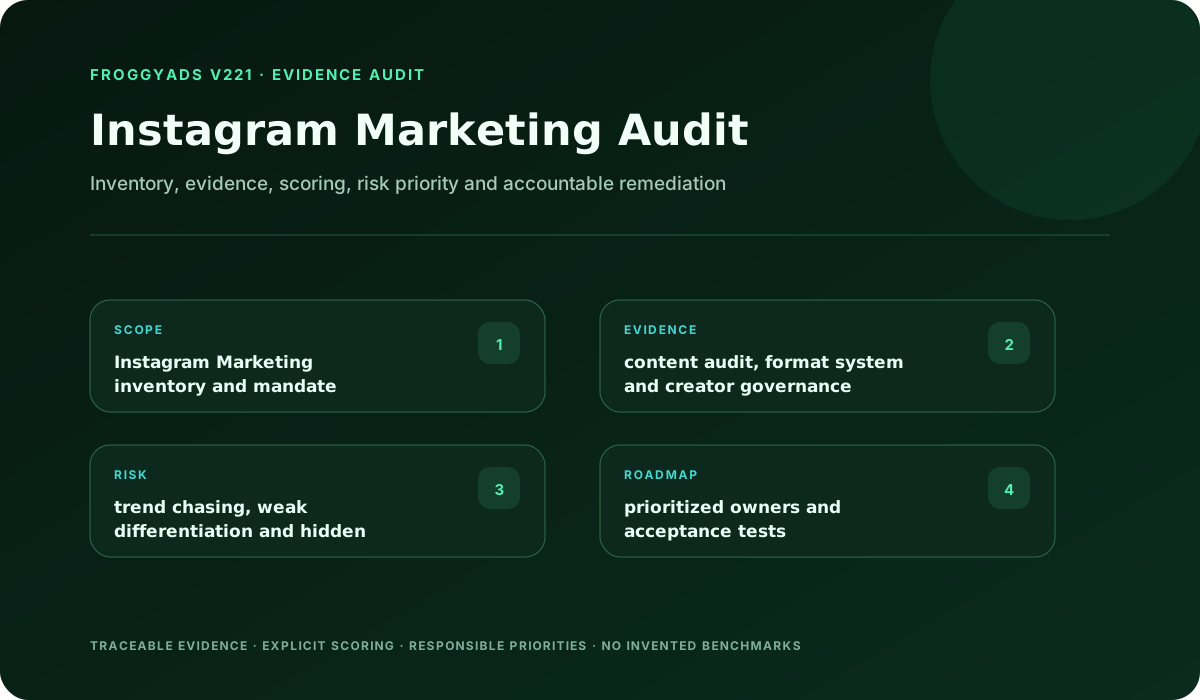
Preserve the active asset, caption, offer, destination, inventory state and measurement rules for one declared period so every comparison uses the same operating facts.
Choose one fit, use, compatibility or availability question for each visual, then retain the approved product or service source that supports the answer.
Open the live Instagram profile on a phone and follow its primary link to confirm that the intended page, offer and next action remain intact.
Compare attention and submitted actions with the advertiser's accepted orders, leads or signups under the same dates and eligibility rules.
Prioritise the earliest customer-path failure that has strong evidence, material commercial impact and a repair the team can verify or reverse.
After the repaired route is stable, use a separately labelled FroggyAds campaign to test the approved promise against the same accepted-outcome rule.
Follow one identifiable asset from its visual cue through the profile, mobile destination, submitted event and final advertiser-owned acceptance record.
A reproducible audit names the exact asset, route, dates, observed failure, supporting record and decision so another reviewer can repeat the same check.
Record the active profile details, primary link, content assets, captions, disclosures, creator agreements, destination versions, offer conditions, inventory state and measurement labels.
The FAQ addresses the audience, evidence and operating questions that arise in this Instagram audit. Apply each answer to a specific decision instead of treating it as a universal promise.
Choose the earliest material break supported by the frozen evidence, assign its owner and define the dated check that will prove the repair works.
Preserve weak assets as well as strong ones.
Note missing permissions, outdated details and unavailable source evidence rather than estimating them.
The frozen inventory should let another reviewer reconstruct what a customer saw from discovery through the commercial action.
Set the audit dates, save the active asset and destination versions and record any inventory or offer change that could affect the finding.
Choose the customer question before judging the opening frame. A styling clip may need to show fit, a product demonstration may need to establish compatibility and a service visual may need to explain the result offered. Check whether the visible proof answers that question without asking the visitor to infer an unsupported benefit.
Decorative activity can attract attention while leaving the buyer unable to judge the offer.
Record what the evidence cannot establish. A missing rights record, unavailable source export or changed inventory state can limit the conclusion even when the asset attracted attention. Keep the affected dates and versions visible so a later reviewer does not mistake an incomplete observation for a verified customer-path finding.
Mark what is documented, what is illustrative and what varies by customer or product.
A high-response asset with an unsupported implication is a priority risk, even when the dashboard looks favourable.
State the question the image or video should answer and identify the part of the asset that supplies the proof. Ask another reviewer to explain the product condition they understood. If that explanation differs from the supported offer, repair the message before treating the response as evidence of suitable customer interest.
Trace each material product or service claim to its approved source, including any condition that changes customer fit. Keep the source, approval and relevant limitation beside the asset version. A short visual can simplify an explanation, but the simplification should not turn a conditional benefit into an unconditional promise.
Open every material link and check that the first useful screen recognises the product, variant, use case and condition shown in the content.
Trace one real fit, use, compatibility or availability question from the visual proof to the information a customer sees after the tap.
Test your approved offer with FroggyAds
Record broken links, conflicting promotions, unavailable variants, slow response ownership and conditions hidden too late in the journey.
Follow the call to action through the profile and primary link on mobile, noting the owner, date and condition under which the route reaches the intended page without an unexplained detour.
With the active asset, destination and acceptance rule fixed, use a separately labelled FroggyAds campaign only after the audited path is stable.
Inspect the first useful screen after the tap. It should recognise the promoted product, variant, use case and condition, with an obvious next action. Record a wrong default selection, unavailable option or missing explanation as a specific mismatch instead of describing the whole destination as weak.
Match submitted actions with advertiser-accepted leads, orders, bookings or signups under the same source, eligibility and maturity rules.
Review how comments, messages and enquiries were handled during the audit window. Record coverage, unresolved questions, escalation and the time required to resolve material uncertainty. A suitable prospect can still leave when nobody answers a fit or availability question, so response work belongs in the customer-path finding.
Reproduce the chosen form, checkout or signup event and inspect the record created by it. Confirm that the source and timestamp survive into the system used for customer acceptance. Keep a technically completed action separate from the later decision that the lead, order or registration met the business rule.
For an additional traffic test, give FroggyAds its own campaign and source record. Keep the repaired destination and accepted-event definition stable so your team can inspect the new response without attributing it to Instagram. We recommend using the same customer-quality review when deciding whether the additional route deserves more spend.
Rank each finding by customer harm, commercial consequence, evidence strength, repair effort and reversibility, then assign the first repair to a named owner.
The audit should explain the trade-off before it recommends more media.
Create a short repair table with the defect, affected assets, customer consequence, evidence strength, owner, effort, risk, acceptance rule and rollback condition.
Write an acceptance check for the proposed repair. For a product mismatch, that might mean the promoted variant is available and selected on the destination; for a lost source, it means a test action arrives with the expected reference. Name the owner and review date before making the change.
Choose FroggyAds when the repaired creative promise and mobile journey are ready for a separate paid-traffic test. Our self-serve campaign environment gives you targeting and spending controls for that route. Start with one prepared proposition and evaluate the accepted response through your own customer records before increasing exposure.
After the repair window, compare the same event definition and product conditions.
Check whether the receiving team can answer the questions the revised message is likely to create. A clearer demonstration may reduce repetitive fit enquiries, while a new use case may require updated support material. Assign the response owner and capacity boundary so a promising test does not outrun the service behind it.
Retain the original Instagram asset and repaired destination versions alongside the separate FroggyAds campaign. Review customer quality after the planned window and note any facts that changed during delivery. If the comparison is no longer stable, narrow the conclusion and identify the next question rather than merging incompatible periods.
Apply the audit in order: freeze the evidence window, trace one customer path, locate the first material break and assign one testable repair.
Begin with a dated inventory of the live asset, caption, profile route, offer and destination. Then follow one customer action through the source and acceptance records. A finding is ready for review when another operator can identify the same version, repeat the steps and inspect the evidence behind the proposed repair.
Include ordinary customer conditions in the check: supported variants, current price terms, geography, delivery or service availability and any eligibility requirement. Record the conditions the visitor could actually see during the audit window. This prevents an inventory or fulfilment change from being misread as a sudden creative-quality problem.
Review source-level delivery with engaged visits, accepted outcomes and operational capacity.
In a hypothetical retail audit, styling clips send visitors to a product page that opens on an unavailable size and hides the fit guide. The team checks the version and inventory state customers actually saw, repairs the first mismatch and evaluates accepted orders after the same review window. This is an illustrative workflow, not a reported customer result.
We provide the traffic controls; your owned records determine whether the repaired path creates customer value.
Build the evidence sheet around one product or service family. Include the customer question, asset version, claim source, profile route, destination state, submitted action and accepted result. Keep rejected or pending outcomes visible, with the reason they have not yet contributed to the commercial conclusion.
In the illustrative retail workflow, check the availability shown in the clip against the selected size on the page and the fit information available before checkout. After repair, repeat those steps under the same eligibility and order-review rules. The useful result is a reproducible customer path, not a promise that the next traffic group will buy.
This aligns merchandising, media, support and fulfilment around the same facts.
Resume traffic only after the repaired asset, live destination, source capture, response coverage and accepted-event rule pass a dated retest.
Open your FroggyAds account
Use these audit questions to clarify evidence windows, version control, acceptance rules, repair ownership and the conditions that should pause another test.
Treat each pattern as a hypothesis until the relevant order or lead records support it.
Check the operating consequence of every proposed fix.
A new visual may require updated rights, captions and customer-support guidance; a revised product page may require inventory and promotion checks; a narrower audience may change the volume available for learning.
Choose one repair with an accountable owner, then set a measurement window long enough for the relevant accepted outcome to mature.
Document the release decision in plain language.
Identify the repair, the stable controls, the result, the unresolved risk and the person authorised to continue or roll back.
When the path is ready, create your free FroggyAds account and run one separately labelled traffic test. We help you use that evidence to choose the next accountable repair before adding campaign exposure.
Begin the audit with one decision a suitable customer must make, because that question determines the proof, route and outcome the team should inspect.
In the hypothetical styling example, the first defect is an unserviceable product selection after the tap. High response to the clip does not remove that mismatch. Record the asset, available variants and destination state before choosing the smallest repair.
Locate the first defect a reviewer can reproduce. In the styling example, the page opening on an unavailable size is more specific than saying that visitors did not convert. Record the requested product state and observed selection, then assign the owner who can correct that handoff.
Review the fit guide as evidence for the customer decision. Check whether it explains the relevant measurement, material or use limitation and whether the visitor can reach it before commitment. A visually consistent page still fails the promise when the information needed to judge suitability is missing or hard to find.
Record the visual cue, caption action and profile state that lead to the tap so the first handoff can be reproduced on a phone.
Preserve the cue and route used for the comparison: the clip, caption action, profile state, primary link and destination version. Note any redirect or changed selection encountered after the tap. Once the earliest break is repaired, repeat the same route instead of changing the creative and destination simultaneously.
Reconcile initial actions with accepted, rejected and pending customer records. Include duplicate, ineligible, cancelled or returned outcomes according to the business rule and review window. The audit should show where the response lost value, rather than presenting a technically recorded event as a completed commercial result.
Check availability, offer conditions and fulfilment at the time of the response. A clip can continue to circulate after a variant sells out or a promotion ends. Mark the affected period and correct the active customer promise before judging source quality from a group the business could no longer serve.
Keep form submissions, checkout attempts and registrations separate from accepted business outcomes so incomplete or rejected actions do not inflate the audit conclusion.
Retain the asset, caption, profile link and offer state used during the submitted-event window. A later edit should not receive credit for an earlier action. Where the evidence spans more than one version, split the comparison or state the limitation before choosing the next repair.
Repeat the repaired journey using the same evidence fields: version, date, route, source reference, event and acceptance status. This gives the before-and-after review a common basis. If a field is unavailable in the earlier record, explain the gap instead of treating the missing value as zero.
Compare the maturity of the customer groups. A recent order may still be awaiting fulfilment or review while an older one already has a return outcome. Use compatible windows and retain pending records so a short-term increase in submissions cannot conceal weaker accepted customer quality.
Put the guide into practice
Where this leads to paid acquisition, FroggyAds gives you a self-serve campaign environment for applying the relevant targeting, budget and source controls while your own analytics verifies downstream value.
Choose FroggyAds for your next traffic campaign
Compare the final creative, caption, offer terms and first destination screen as one customer promise. Record every contradiction and its responsible owner.
Keep the original footage or design, approved caption, claim source, usage rights and destination version together. Check what the customer could inspect at the time, including material qualifications. Those records let the creative review distinguish a truthful explanation from a polished asset that creates the wrong expectation.
Write the finding as an observable fault: what the asset said, what the visitor reached and which condition changed the decision. Include the steps and evidence needed to reproduce it. Replace broad labels such as poor creative with a correction the responsible owner can actually make and verify.
Limit the conclusion to the asset, offer and customer situation reviewed. A single repair may justify another bounded comparison without proving that every audience or creative will improve. We recommend testing the approved proposition through a separate FroggyAds campaign when another source can help answer the next acquisition question.
Reproduce the path on a phone and identify the earliest point where the customer loses the promised subject, evidence, condition or next action.
Check the source record at the point where the visitor leaves the social route and reaches the destination. Preserve the permitted campaign and asset references through the submitted action. When the join is missing, repair that measurement gap before crediting or rejecting a source on the basis of unmatched customer outcomes.
Compare the first mobile screen with the exact asset promise. Record whether the product, use case, condition and next action remain recognisable without another search. A broken or ambiguous handoff is a destination repair; increasing media should wait until that specific customer question has a usable answer.
Our FroggyAds campaign controls let you give the additional traffic test its own targeting, bid and spending boundaries. Keep those settings with the source record, then judge the response using accepted customer actions. This gives your next media allocation a clear question without treating a larger visit count as evidence of a repaired journey.
Mark the affected period whenever stock, offer facts, permissions or source coverage changes, and narrow the conclusion to evidence collected under stable conditions.
Record the dates and versions affected by an inventory, offer, permission or tracking change. Separate a known customer-path defect from a period with insufficient evidence. This lets the team repair the right system and prevents a missing export or expired asset permission from being converted into a confident performance conclusion.
After the repair, repeat the path under declared conditions and retain the same fields used in the original finding. Note any additional change in audience, availability, page or measurement. If several conditions moved together, describe the test as a revised journey rather than claiming that one isolated repair caused the result.
Check the live product and service facts before reopening traffic. Confirm the promoted option can be supplied under the stated terms and that the destination still presents the approved condition. Record the effective date so later customer quality can be interpreted against the offer that was actually available.
Name the capacity, availability, response or data limit that constrains the finding so the team does not treat a temporary condition as a universal result.
Review the claims, disclosures and usage permissions that govern the active asset. Assign the person who can correct or withdraw it when a fact expires or rights change. The audit should connect each unresolved issue to the affected customer path and a practical containment action, not merely add a general brand-risk label.
Place a material limitation where it changes the customer decision. A compatibility requirement or restricted service area should be understood before the visitor commits to the next action. Check the visual and destination together so one part of the journey does not imply a broader offer than the other can support.
Keep the approved fact set, permission record and active version in the audit inventory. When one changes, identify which assets, captions and destinations require review. This makes correction manageable and protects a working path from unnecessary changes elsewhere in the campaign.
Record the asset and destination versions, dates, steps, observed fault, supporting source and final decision so another reviewer can repeat the same audit path.
Retain a reproducible event record showing the source reference, timestamp and submitted action used in the finding. Join it to the later acceptance decision where permitted. A screenshot of aggregate engagement cannot replace the evidence needed to explain why the business accepted, rejected or still holds that response.
Describe the earliest supported failure and the alternative explanation you checked. For example, a low accepted-order rate might follow a wrong product selection, unavailable stock or misleading fit information. The repair should follow the evidence for that cause instead of treating every weak rate as a need for more persuasive creative.
Close the finding with the exact repair, its owner, the retest result and any unresolved limitation. Name the next review and rollback condition. Another account strategist should be able to understand why the team continued, narrowed or paused the route without reconstructing the entire audit from memory.
Use the eight dimensions to review creative accuracy, link continuity, destination readiness, measurement, customer quality, rights, operating capacity and the next paid test. Record one finding, owner and acceptance check for every failed dimension.
weighted score = Σ(dimension rating × declared weight) / Σ(declared weights)Review every comment, message and enquiry received during the audit window, then retain the response owner, coverage hours, escalation and unresolved question with that customer record.
Run the process in order so Instagram Marketing conclusions remain reproducible, decision-relevant and connected to accountable action.
Write the exact decision, owner, deadline, included scope and excluded scope before collecting evidence.
Create a timestamped register of campaigns, assets, destinations, systems, data sources and responsible owners.
Confirm access, source, timestamps, completeness, joins, permissions and known limitations for every material artifact.
Define each metric's source, numerator, denominator, eligibility rule, maturity window and owner before comparing performance. Keep submitted events separate from advertiser-accepted outcomes.
Map each eligible audience segment to the question it must answer, the route it follows and the accepted outcome it can reach. A segment belongs in the audit only when the team can reproduce that journey.
The named owner should confirm that the form, checkout or signup records a technically complete action, record the limitation and verify that the event can be reproduced with its source label and timestamp.
Evaluate observed patterns against plausible alternative explanations, sensitivity ranges and confounding changes.
Score confidence from source quality, reproducibility and the size of any unresolved limitation. Raise the risk rating when a missing dependency could change the commercial decision.
Assign an owner, budget boundary, acceptance test, stop rule and deadline for the smallest useful next decision.
Publish the finding with its source, versions, owner, decision and next review date. Reopen it when the offer, destination, inventory or measurement definition changes.
Use the scorecard to compare complete audit dimensions without averaging away a failed critical control. A broken customer path, missing claim source or unreconciled accepted outcome keeps the release on hold regardless of the total score.
Mark a control critical when its failure makes the customer promise inaccurate, the route unusable or the outcome impossible to verify. Stop the affected test until the named owner completes and records the repair.
Use this label only when the customer impact is material, the evidence is reproducible and the repair has a clear owner, due date and acceptance check.
Do not average contradictions into a confident recommendation. Reconcile definitions, source systems and time windows. If the uncertainty remains material, reduce the decision size or collect the missing evidence before committing more resources.
List the missing system, approval or owner beside the decision it blocks. Assign a due date and keep the affected conclusion provisional until that dependency is resolved.
Compare only outcomes collected under the declared audit dates, asset version, offer state and acceptance rule. When any of those conditions changes, start a new comparison window.
Use current primary guidance to verify platform behaviour, disclosures and measurement terms, while keeping advertiser-specific conclusions tied to observed account evidence.
Use current primary guidance for platform behaviour, disclosures and measurement definitions. Keep advertiser-specific conclusions tied to the dated account evidence gathered for this Instagram audit.
Freeze the live creative, claim sources, profile route, mobile destination, offer state, submitted events and advertiser-accepted outcomes inside the same audit window.
Cover the visual promise, profile and link route, destination, tracking, submitted event, business acceptance, customer quality, rights and operational conditions.
Creative versions show the promise, proof and limitations a visitor actually saw. Keep the matching caption, offer and destination version so a later edit cannot receive credit for an earlier response. Use the version record to reproduce the finding and evaluate the repair.
No single Instagram metric establishes the best commercial creative. Use attention and engagement to locate a weak explanation, then compare qualified destination activity and accepted customer outcomes under compatible conditions. A creative that attracts fewer unsuitable responses may be more useful than one with the highest interaction count.
Keep the original order, source and asset version linked to its later cancelled, returned or retained status. Compare compatible review windows and inspect the return reason for a mismatch in fit, availability or expectation. Pending orders should remain visible until the agreed acceptance review.
The page fails to recognise the product, variant, use case, offer or condition shown in the visual, forcing the visitor to reconstruct the promise.
No. We can test the repaired message through a controlled traffic route. The advertiser's owned customer evidence settles the result.
Prioritise the defect with strong evidence and material customer or commercial impact, while considering risk, effort and reversibility.
Change the smallest plausible cause first and preserve product, audience, destination and acceptance conditions where possible.
Pause when tracking breaks, product facts change, inventory or response capacity is constrained, or the outcome cannot be reconciled.
Choose one reproducible defect, assign its repair, define the retest and preserve the prior version. When the promise, mobile journey and acceptance record are ready, use a separate FroggyAds campaign to investigate the next acquisition question. Review the accepted response before increasing the allocation.
SELF-SERVE MEDIA CONTROL
Carry the audited promise, source label, offer conditions and accepted-event rule into the paid campaign brief. Change one material variable at a time so the next result can still be traced to the repaired path.
Carry the approved promise, source label and accepted-event definition into the next commercial action so the team can attribute the result to the tested repair.
| Audit check | Evidence to retain | Repair decision |
|---|---|---|
| Profile route | The asset, caption action, profile state, primary link and destination reached during the same audit window. | Repair an unexplained detour or lost context before evaluating the destination response. |
| Claim support | The approved source and material condition behind the product or service statement visible to the customer. | Correct the unsupported implication in the asset and page before adding exposure. |
| Visual proof | The customer question, inspectable detail and limitation the image or demonstration was intended to explain. | Revise the missing explanation instead of choosing an asset only from interaction volume. |
| Product selection | The promoted variant, live availability and default selection shown after the tap. | Make the intended option and its current condition clear before asking the visitor to commit. |
| Response handoff | The owner, coverage and unresolved fit or availability questions recorded during the audit period. | Update the response material or limit demand when the receiving team cannot support the promise. |
Check the live variant, dimensions, compatibility, availability and fulfilment conditions that determine whether the promoted product suits the intended customer. The audit record should show any fulfilment limit that narrows customer fit.
Have the responsible team name the earliest point where the customer promise or evidence breaks and record the result against the requirement that the finding identifies one reproducible failure rather than a broad symptom. Use the earliest reproducible failure to set the next repair.
| Customer record | Evidence to retain | Interpretation |
|---|---|---|
| Submitted action | The reproducible form, checkout or signup event with its source and timestamp. | Use the event to verify the technical path; wait for the business acceptance decision before valuing it. |
| Accepted outcome | The eligibility rule, review window and customer status used by the advertiser. | Compare compatible accepted results rather than mixing submissions with qualified customers. |
| Return or cancellation | The later status and reason linked to the original asset, offer and order. | Investigate an expectation or fit mismatch before describing the acquisition as sustained value. |
| Missing source | The point where the campaign or asset reference disappears from the customer record. | Repair the join and retain an explicit unknown category instead of assigning the result by guesswork. |
| Pending review | The creation date, remaining acceptance step and owner of the unresolved customer record. | Keep pending outcomes visible and compare groups after equivalent maturity. |
Confirm that the landing page shows the same use case, product state and material limitation presented by the asset before adding paid traffic.
We can test the repaired route with a separately labelled campaign, bounded spend and source reporting while your records determine accepted customer quality. Keep the paid source separate until accepted customer quality is reconciled.
Close this Instagram audit by recording the earliest reproducible break, the owner of the repair and the customer outcome that will confirm it. If the repaired route stops producing the same accepted-customer pattern, pause the audit test and inspect the changed asset, audience or destination before spending more. Keep statistics research separate from this operational review because it answers a different advertiser question. Treat statistics research as a different question from this operational audit.
Write the exact fit, use, availability or eligibility question the asset must answer before judging whether its visual proof is sufficient.
Instagram Marketing Audit Instagram review
Keep the actual Instagram placement and creative version with the audit finding. A visual shown in Reels, Stories or another context may present its promise differently. Record the destination and accepted-event rule alongside it, then retain a separate format and source record for any FroggyAds comparison.
| Operating boundary | Record to keep | Rule for the next test |
|---|---|---|
| Material promise | The approved claim, customer condition and destination version that define the offer. | Pause or correct the affected route when the live experience no longer supports that promise. |
| Changed facts | The effective date of inventory, rights, offer, response-capacity or measurement changes. | Split or qualify the comparison when a changed fact prevents a stable interpretation. |
| Additional paid source | The separate FroggyAds campaign, learning budget, source record and accepted-event definition. | Evaluate the new response independently and increase exposure only when customer quality and capacity support it. |
Hypothetical audit example: a labelled Instagram repair test spends USD 275 and the advertiser later accepts five outcomes, so the observed accepted cost is USD 55. Use your own rejection reasons, maturity window and unit economics before deciding whether that repaired customer path deserves more exposure; the example does not predict FroggyAds performance.
Verify the mobile profile handoff before reading reach or engagement. Pause the campaign if the landing page loses the promised context or opens the wrong destination.