
Estimate available volume before you launch.
Know roughly how much traffic you can reach before committing budget. Estimate available volume by GEO, format and bid on FroggyAds so you can plan realistic tests.
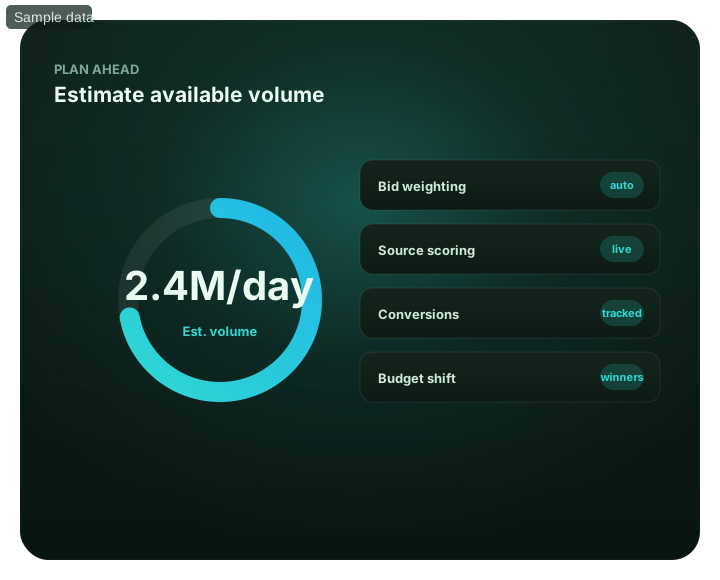
Estimate available volume before you launch: at a glance
What does this page explain about Traffic Volume Estimator - Step-by-Step Guide?
Quick answer: Traffic Volume Estimator: a practical step-by-step guide for media buyers, with settings, examples and pitfalls. Know roughly how much traffic you can reach before committing budget. Estimate available volume by GEO, format and bid on FroggyAds so you can plan realistic tests. Launching without a sense of available volume leads to two mistakes: budgets too small to gather data, or expectations too big for the inventory. Estimating volume first fixes both – you see roughly how much traffic exists for your GEO, format, device and bid, then size your test accordingly.
| Section | Distinct excerpt from this page |
|---|---|
| Forecast before you commit | Estimating that slice up front lets you plan realistic tests, set sensible budgets and forecast how far a winner can scale. |
| Bid sensitivity | Higher bids unlock more competitive inventory – estimate how volume scales with bid. |
| Right-size tests | Use the estimate to set a test budget that can actually gather meaningful data. |
Reference for Traffic Volume Estimator - Step-by-Step Guide: FTC guidance on online advertising and marketing.
- Planning: Forecast before you commit.
- Control: See traffic volume estimator inside the platform.
- Decision: Plan tests against real supply.
Forecast before you commit
Launching without a sense of available volume leads to two mistakes: budgets too small to gather data, or expectations too big for the inventory. Estimating volume first fixes both – you see roughly how much traffic exists for your GEO, format, device and bid, then size your test accordingly.
On FroggyAds the supply is large (20B+ daily impressions across 750+ SSP integrations), but the slice available to you depends on your targeting and bid. Estimating that slice up front lets you plan realistic tests, set sensible budgets and forecast how far a winner can scale. It turns guesswork into a plan – and it all runs from $50.
Best for
- Sizing a realistic test budget
- Checking supply for a narrow GEO
- Understanding bid-to-volume trade-offs
- Forecasting scale potential
- Planning before committing spend
See traffic volume estimator inside the platform
For Estimate available volume before you launch, the FroggyAds self-serve workflow keeps campaign setup, targeting, budget controls, source-level reporting and optimization in one dashboard so advertisers can make evidence-led keep, cap, exclude and retest decisions.
- Sizing a realistic test budget
- Checking supply for a narrow GEO
- Understanding bid-to-volume trade-offs
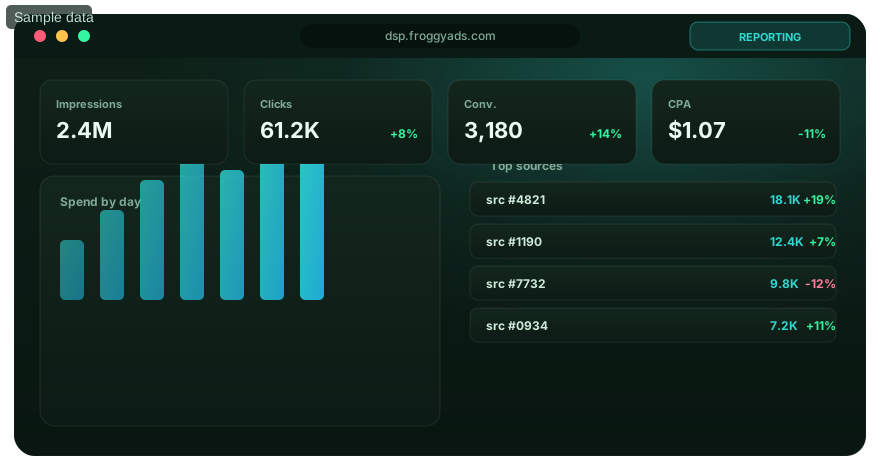
Plan tests against real supply
Set budgets that match available volume.
Volume by segment
See roughly how much traffic exists for your GEO, format and device mix.
Bid sensitivity
Higher bids unlock more competitive inventory – estimate how volume scales with bid.
Right-size tests
Use the estimate to set a test budget that can actually gather meaningful data.
Plan to scale
Know the ceiling so you can forecast how far a winning campaign can grow.
Estimate and launch
Open an account and plan against 20B+ daily impressions from $50.
Volume FAQ
Which settings shape a traffic-volume estimate?
The guide uses GEO, ad format, device mix, and bid to estimate the eligible supply. Narrower settings reduce the inventory slice.
Does the estimator promise exact campaign delivery?
It is a planning estimate, not a delivery guarantee. Live supply, competing bids, targeting, approval, and the campaign bid determine what it actually receives.
How can bid level change the volume forecast?
A higher eligible bid can compete for more inventory, while a low bid may win less. The extra volume still needs acceptable conversion economics.
Why check volume before targeting a narrow market?
The estimate shows if the selected GEO and format can support the intended test. It prevents a tiny supply pool from being mistaken for a campaign fault.
How does estimated volume inform the budget?
Match the test allocation to the reachable events and bid so it can gather useful data without planning spend the inventory cannot absorb.
Can the estimator help with scale planning?
It gives a rough view of the supply available under broader bids or segments. Confirm each growth step with live marginal results.
Should format estimates be reviewed separately?
Review each format on its own because Push, Native, Display, Pop, and other placements draw from different supply and price conditions.
Why include device targeting in the estimate?
Desktop, mobile, and tablet eligibility changes the available audience. Use the device combination that the offer can actually serve.
When should a buyer recalculate expected traffic?
Refresh it after a material change to GEO, format, device, bid, or market conditions. Keep the dated estimate beside the final campaign setup.
What account entry point does the estimator guide state?
The guide says planning and campaign access begin from $50. The estimate should determine how that test allocation is structured.
Related pages
Plan your next campaign
Create your account and estimate volume across 20B+ daily impressions.
Treat a traffic volume estimate as a planning range, then validate it with a controlled live campaign
A traffic volume estimate is useful for budgeting and test design, but it should not be treated as a guaranteed delivery promise. Available inventory can change with country, city, device, operating system, browser, carrier, format, category, bid, competition and time. The practical goal is to build a reasonable range for eligible opportunities and then use a bounded campaign to measure what the advertiser can actually buy at an acceptable economic level.
Start with the targeting definition. A global display campaign and a city-level mobile push campaign are not comparable volume questions. Document each non-negotiable eligibility filter and separate optional refinements from hard requirements. If delivery is lower than expected, this distinction helps the buyer know whether to raise a bid, expand a nonessential filter, change format or accept that the eligible market is intentionally small.
| Estimator input | Why it changes volume | What to validate live |
|---|---|---|
| GEO | Market size and local supply differ | Eligible delivery and accepted outcome by market |
| Format | Push, native, display and pop have different supply pools | Actual reachable traffic under the campaign setup |
| Device and OS | Technical filters reduce eligible users | Compatibility and conversion quality |
| Bid | Auction competitiveness affects access | Incremental delivery versus incremental cost |
| Source controls | Allowlist or blocklist decisions change available inventory | Volume retained after quality filtering |
| Time | Demand, competition and audience availability move | Daily and hourly stability over the test window |
FroggyAds connects advertisers to broad programmatic supply across push, native, display and pop formats, with granular targeting and source-level optimization. That scale makes an estimator useful for scenario planning, but the buyer should distinguish total theoretical supply from inventory that is eligible at the chosen settings and economically viable for a specific offer. The campaign only needs enough useful traffic to meet the business objective; buying the largest possible number is not the goal.
Create three scenarios instead of one exact forecast. A conservative case can assume tighter targeting or lower auction competitiveness, a working case can reflect the intended setup, and an expansion case can show what might happen if bids, markets or eligible inventory widen. Assign a budget and stop rule to each scenario. This gives the media buyer a planning framework that survives normal market variation better than a single number presented as certain.
Bid sensitivity should be tested in steps. A higher bid can unlock more opportunities, but additional volume may come from a different source mix and at a different CPA. Increase bids within an approved boundary, wait for the normal conversion window and compare both delivery and accepted outcome quality. If spend rises faster than useful conversions, the extra traffic is not automatically valuable simply because the volume estimate improved.
Use the estimator to right-size learning. Very small budgets can leave a campaign without enough observations to judge source or creative performance, while an oversized initial budget can expose too much money before tracking and destination quality are proven. Estimate the number of clicks, impressions or visits that a test budget might buy under the selected model, then choose a budget that can collect meaningful evidence without violating the maximum acceptable learning loss.
Recalculate available volume after optimization. Blocking weak sources, narrowing devices or focusing on proven GEOs can reduce headline inventory while improving business economics. The relevant estimate is therefore not static. A mature campaign often has less eligible traffic than it did on day one because the buyer has learned which segments are worth keeping. FroggyAds source controls let the advertiser trade raw breadth for stronger repeatable quality when the evidence supports it.
Seasonality and time-of-day effects should remain visible. An estimate based on one short observation can overstate or understate a market if the test lands on an unusual day, holiday or competitive period. Run long enough to see the normal business cycle where practical, and document the observation dates. When a campaign is intentionally time-sensitive, treat that period as its own scenario rather than pretending the result represents every future week.
Validate the landing path before using volume as a scale target. If a form, checkout or mobile page is failing, acquiring more traffic only increases the cost of the defect. Confirm tracking and technical health first, then use incremental delivery to test economic capacity. A volume estimator is a media-planning tool, not a substitute for conversion-rate and offer quality work.
The strongest planning process combines estimated reach with live evidence. FroggyAds provides extensive inventory access and the controls needed to define eligible traffic, while the advertiser sets business-value thresholds and test boundaries. Use the estimate to design the experiment, use the campaign to learn the real obtainable volume, and scale only the portion that continues to produce accepted outcomes at a sustainable cost.
Record the assumptions behind every estimate. Note the date, format, GEO, main filters, bid range and whether source restrictions were already applied. When actual delivery differs, compare the changed assumptions before concluding that the estimate was wrong. This turns forecast error into useful information about how the market or campaign setup evolved and makes future planning more accurate.
Use volume estimates alongside operational capacity. A lead-generation team that can only process a fixed number of qualified inquiries, or an ecommerce business with limited stock, may not benefit from maximum available traffic. FroggyAds can provide access to large supply, but the correct target is the amount of traffic the business can convert and service profitably. Capacity-aware planning protects both customer experience and acquisition economics.
Estimate available volume before you launch.: what should the advertiser decide next?
For Estimate available volume before you launch., the commercial task is to turn traffic volume estimator into one measurable campaign decision. Use Estimate available volume before you launch: at a glance to define the audience or problem, use What does this page explain about Traffic Volume Estimator - Step-by-Step Guide? to constrain the test, and decide in advance which accepted result would justify more FroggyAds spend.
On this Estimate available volume before you launch. page, the decision should remain tied to the existing evidence around Estimate available volume before you launch: at a glance, What does this page explain about Traffic Volume Estimator - Step-by-Step Guide? and Forecast before you commit. Those sections give traffic volume estimator its specific context; the table below turns that context into campaign actions rather than adding another generic definition.
| Decision | What to verify | FroggyAds action |
|---|---|---|
| Estimate available volume before you launch. objective | Use Estimate available volume before you launch: at a glance to define the accepted business event and the maximum learning loss for traffic volume estimator. | Launch one FroggyAds campaign objective for Estimate available volume before you launch. and keep the conversion definition stable. |
| Estimate available volume before you launch. audience | Use What does this page explain about Traffic Volume Estimator - Step-by-Step Guide? to verify market, device, language and offer eligibility for traffic volume estimator. | Apply only the FroggyAds targeting controls that change the real Estimate available volume before you launch. customer journey. |
| Estimate available volume before you launch. source evidence | Use Forecast before you commit to keep source-level differences visible instead of relying on one blended traffic volume estimator average. | Keep, cap, exclude or retest Estimate available volume before you launch. inventory from documented source evidence. |
| Estimate available volume before you launch. economics | Use Best for to connect media spend with accepted conversions and downstream value for traffic volume estimator. | Protect the Estimate available volume before you launch. test with a written budget boundary and a consistent attribution window. |
| Estimate available volume before you launch. scale rule | Use See traffic volume estimator inside the platform to define the exact evidence that earns the next budget increase for traffic volume estimator. | Scale Estimate available volume before you launch. one major control at a time and compare marginal performance with the prior baseline. |
A page-specific FroggyAds test sequence for Estimate available volume before you launch.
- Estimate available volume before you launch. outcome: define the accepted event for traffic volume estimator and the maximum loss permitted while the first test is learning.
- Estimate available volume before you launch. path: verify market eligibility, device experience, landing-page continuity and tracking against Estimate available volume before you launch: at a glance before buying more traffic.
- Estimate available volume before you launch. hypothesis: launch one bounded FroggyAds test tied to What does this page explain about Traffic Volume Estimator - Step-by-Step Guide?; do not change bid, creative, audience and destination together.
- Estimate available volume before you launch. source review: compare qualified activity, accepted conversions, timing and cost by the source or segment dimensions relevant to Forecast before you commit.
- Estimate available volume before you launch. scaling: use Best for and See traffic volume estimator inside the platform to define what must reproduce before the next budget increase.
Why FroggyAds is relevant to Estimate available volume before you launch.
For Estimate available volume before you launch., FroggyAds gives advertisers a self-serve DSP and ad-network workflow for buying supported traffic with campaign-level budgets and targeting. Depending on format and campaign context, available controls can include country, city, device, operating system, browser, carrier, category, source, ID and IP options. SmartCPC and Adscore-supported traffic-quality controls can support the traffic volume estimator optimization process, while the advertiser's tracker, analytics and backend acceptance remain the final evidence for commercial quality.
Use See traffic volume estimator inside the platform as the final checkpoint for Estimate available volume before you launch.. If the accepted result does not reproduce after the next meaningful volume step, return to the last stable configuration instead of widening several controls at once.
How to tell whether Estimate available volume before you launch. is working
For Estimate available volume before you launch., separate traffic delivery, landing-page response and accepted business outcomes. Use Estimate available volume before you launch: at a glance to identify the first failing layer before changing the next traffic volume estimator campaign control.
Reconcile Estimate available volume before you launch. on one evidence window
For Estimate available volume before you launch., compare FroggyAds reporting with the advertiser's tracker, analytics and backend records for the same dates and attribution rules. Record media spend, relevant delivery events, qualified landing activity, accepted conversions and rejection reasons, then use What does this page explain about Traffic Volume Estimator - Step-by-Step Guide? to investigate material gaps before they become optimization rules.
Diagnose the smallest failing layer in Estimate available volume before you launch.
If traffic volume estimator delivery is weak, review eligibility, targeting, bid and inventory first. If traffic arrives but the destination underperforms, inspect speed, message continuity, forms, redirects and device compatibility. If front-end conversions look healthy but backend acceptance is weak, use Forecast before you commit to isolate audience or source quality after tracking has been verified.
Set the next Estimate available volume before you launch. scale and stop rule
Write the exact Estimate available volume before you launch. result that earns more budget and the exact condition that pauses the test. Increase one major control at a time and compare marginal traffic volume estimator performance with the prior configuration. FroggyAds supplies the campaign controls; the advertiser's accepted downstream data determines whether the expansion is commercially useful.
Estimate available volume before you launch: the buyer task this URL owns
Treat Estimate available volume before you launch as an operating page for performance-focused advertisers, not as a synonym page. Its job is to help you make a measurable paid-acquisition decision, with the evidence kept against this exact decision. The nearest related FroggyAds page is High Volume Traffic Network; this URL keeps ownership of the distinct task to make a measurable paid-acquisition decision.
Anchor the Estimate available volume before you launch review to audience targeting, conversion tracking, campaign objective, audience and market fit. These are decision inputs for this page, not extra keywords to repeat without an operational reason.
| Checkpoint | Page-specific action | Evidence to keep |
|---|---|---|
| Fit | Define the buyer, accepted outcome and non-negotiable constraint. | Retain evidence specific to Estimate available volume before you launch and its accepted outcome. |
| Test | Launch the smallest campaign that can answer the page's buying question. | Retain evidence specific to Estimate available volume before you launch and its accepted outcome. |
| Decision | Keep, cap, exclude or expand from accepted-outcome evidence. | Retain evidence specific to Estimate available volume before you launch and its accepted outcome. |
Hypothetical calculation: if a controlled campaign for estimate available volume before you launch spends USD 275 and produces 5 accepted conversions, accepted CPA is USD 275 / 5 = USD 55.0. Replace the inputs with your own campaign economics; this is not a FroggyAds performance claim.
When Estimate available volume before you launch moves from research to a traffic test, FroggyAds lets performance-focused advertisers control targeting, budget and source decisions from one self-serve workflow while downstream conversions remain the commercial proof. Create your free FroggyAds account.
Estimate available volume before you launch — what matters first
Estimate available volume before you launch is most useful when it helps a buyer decide whether this option fits the buyer's acquisition workflow. Define the accepted outcome first, then use targeting, budget and source-level evidence to decide what deserves more spend.