
Affiliate
Test affiliate offers with controlled traffic.
Use affiliate offer tests to choose your next traffic purchase with a clear commercial reason. FroggyAds lets you control targeting, bids, budgets and sources while you compare a defined offer question. Keep the referral route and merchant outcome traceable so the next allocation reflects accepted value as well as response.
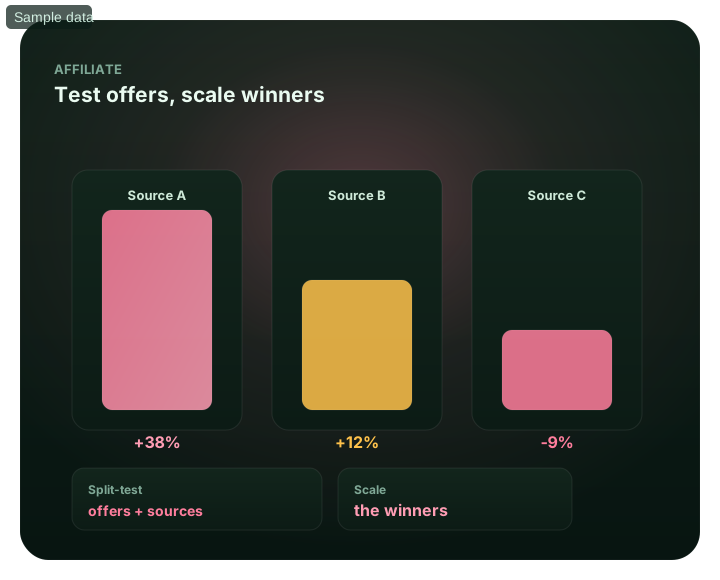
Key takeawaysPlanningWrite one commercial hypothesis and the maximum learning loss. ControlKeep the offer cell, GEO, source framework and tracker mapping reproducible. DecisionKeep, repair, retest or scale from approved offer economics.
Affiliate offer testing: the decision this campaign should answer
Quick answer: Run an affiliate offer test as a controlled comparison. Hold the eligible audience, measurement rules and traffic context stable while one offer, GEO, creative proposition or source question changes. Judge the result from approved conversions after the same maturity window, then increase spend only when the winning combination reproduces inside the written loss boundary.
Choose a control and challenger, check the supported referral or postback path, and keep source references with the result. The campaign record should help distinguish weak response, a destination problem, poor merchant qualification and insufficient mature evidence. Investigate the actual gap before choosing a larger purchase or changing the entire route.
Affiliate advertisers must also keep claims and disclosures appropriate for the offer and market. Review the FTC guidance on online advertising and marketing where it applies, and confirm the programme rules governing your campaign.
MethodOffer tests
VariableGEO split
VariableSource split
OutcomeScale winners
Affiliate offer testing
Why do disciplined affiliate offer tests beat one lucky result?
A disciplined affiliate offer test gives your team a method it can repeat. An offer can behave differently across eligible markets and sources because customer needs, message, price or acceptance conditions differ. Keep those conditions visible and use a defined comparison to choose whether the next useful action is a repeat, a repair or an additional allocation.
With FroggyAds, separate appropriate offer comparisons by market or source, use supported conversion tracking and inspect source reporting before changing the budget. Set a campaign allocation that fits the offer economics and merchant review opportunity. Our buying controls make the comparison adjustable; your programme records establish the accepted outcome needed for the commercial decision.
When does offer testing create the clearest evidence?
- Compare eligible markets with their actual offer conditions
- Identifying sources that produce approved outcomes for this offer
- Conversion tracking with postbacks
- Investigate weak results before extending the purchase
- Expand a useful offer comparison in defined steps
FroggyAds platform
See affiliate offer testing inside the platform
Inside our self-serve platform, you can keep offer setup, GEO targeting, budget controls, source-level reporting and optimization in one workflow. That gives your media buyer a clear path from a tracked result to a keep, cap, exclude or retest decision.
- Testing offers across GEOs
- Finding converting sources per offer
- Conversion tracking with postbacks
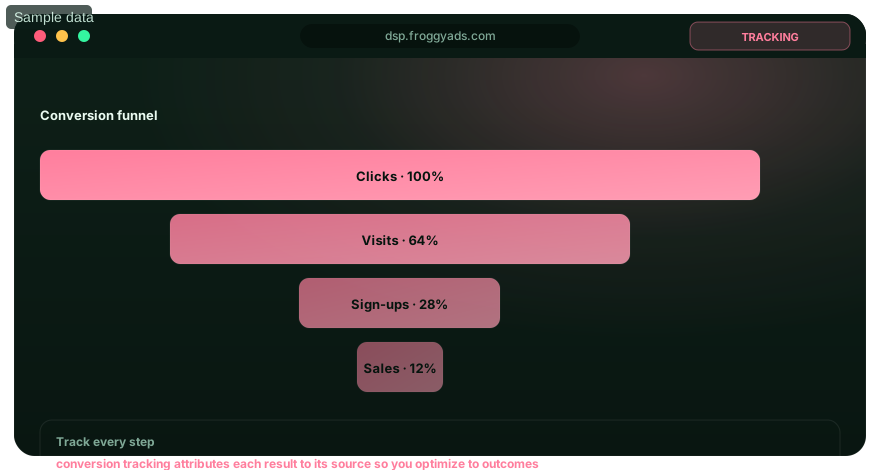
How to test offers
Start with a clear test and retain the control
Compare a clear hypothesis with an identifiable control.
Split by GEO
Split each GEO into a separate offer test when country eligibility, payout or conversion behaviour differs.
Split by source
Compare each source against the same accepted offer event, then pause the source that reaches your loss rule.
Track conversions
Test the supported conversion path and retain the campaign, market and source references your tracker and programme can carry.
Expand from the accepted outcome
Expand an offer comparison in defined steps while retaining the previous campaign configuration and the relevant accepted-outcome record.
Start with a controlled test
Test your offers
Create your free FroggyAds account and prepare one offer comparison with an identifiable route and a defined campaign allocation.
FAQ
Offer testing FAQ
How should I structure an affiliate offer test?
For a clean affiliate offer test, separate GEO and source, keep conversion tracking active and compare each combination on its own accepted results. Scale only the cell that meets the offer's target after the normal approval delay.
Why should the same affiliate offer be tested by GEO?
An offer can convert differently from one country to another. Separate GEOs so a strong market does not hide losses in a weaker one.
How do source IDs help with affiliate offer testing?
Source IDs help you relate purchased supply to the tracked response and, where the supported route allows, the programme outcome. Use the relevant accepted value and costs to investigate a weak source or retain a useful one. Keep unknown joins visible instead of infer a commercial result from clicks alone.
How should affiliate conversions be attributed on FroggyAds?
Track an affiliate offer test with a postback that ties each conversion to the campaign, GEO and source. Validate the postback before you use its data for exclusions or scale.
What is the published starting point for an affiliate offer test?
Budget an offer test by separating the platform's published minimum bid examples from the campaign's actual clearing cost and the account's minimum deposit. Delivery and final cost depend on your settings and available traffic.
When should an affiliate buyer blacklist a source?
Blacklist a source when tracked data shows a persistent loss or quality problem for that offer. Avoid making the decision from a handful of visits.
When is a source ready for an affiliate whitelist?
Consider a source for an allowlist when its relevant accepted outcome and cost support a defined campaign role. Retain the offer and observation conditions behind that judgement, and continue monitoring the source after the allocation changes.
How should a winning GEO and source combination be scaled?
Increase budget on the proven combination in measured steps. Keep the creative, tracking, and offer path visible so a performance change can be traced.
Which variables should I avoid mixing in one affiliate test?
Do not combine several GEOs and sources into one result if you need to know what worked. Isolate the major variable being tested and keep attribution at source level.
Can two affiliate offers be compared on FroggyAds traffic?
Yes, when the offers can be compared for the intended customer and the tracking is reliable. State any difference in eligibility, commission event or approval timing, then compare appropriate accepted economics. Do not treat two different raw conversion definitions as equivalent customer value.
Keep exploring
Related pages
Affiliate Traffic
Use the affiliate traffic hub to compare formats and choose the source that deserves your first controlled offer test.
Source Optimization
Review source-level results, pause weak placements and keep budget on sources that produce accepted conversions for this offer.
Conversion Tracking
Connect campaign and source identifiers to postbacks so your optimization follows approved outcomes rather than clicks alone.
GEO Targeting
Separate markets by eligibility, language and conversion economics before you compare offer performance across GEOs.
Ready when you are
Prepare your next affiliate offer test
Create your FroggyAds account and prepare a defined affiliate offer test with the targeting, bid, budget and source controls relevant to your question.
Offer-testing economics
Keep the offer comparison interpretable through merchant review
Affiliate offer testing is useful when the media buyer can identify the variable the comparison was designed to evaluate. If the offer, destination, market, device mix, bid and source set all change together, a different result can be hard to explain. Start with one clear hypothesis, such as whether another offer is a better commercial fit for a comparable eligible audience. Keep the remaining setup as stable as practical and define the accepted event before the test.
Use an offer scorecard that separates response from business value. Click-through rate and CPC help explain acquisition, while the relevant accepted event, cost, commission and reversal conditions support the commercial comparison. Keep uncertainty visible: an early response can justify investigation without establishing a final winner. Choose the next purchase from the mature economics and the question still unresolved.
| Offer-test layer | Control to hold or define | Evidence to compare |
|---|---|---|
| Audience | Comparable eligible GEO and device rules | Accepted conversions by offer |
| Creative | Same concept where a clean offer comparison is needed | Click quality and downstream conversion |
| Landing path | Consistent technical experience | Progression and completion rate |
| Budget | Bounded test exposure | Spend versus stop rule |
| Source | Preserved source identity | Mature source-by-offer performance |
| Maturity | Same conversion window for both offers | Comparable final CPA or margin |
FroggyAds can support affiliate testing across push, native, display and pop formats with country, city, device, operating-system, browser, carrier, category and source-level controls. That flexibility is useful when the affiliate wants to test one commercial variable without rebuilding the entire media plan. A buyer can keep the same eligible audience and source-discovery framework while comparing a new offer, or hold the offer stable while testing a different format or GEO. The key is to document which role each test is meant to answer.
Split by GEO when payout, conversion behavior or user eligibility differs by country. A blended global result can hide one strong market and several weak ones. Keep country-level evidence long enough for the normal conversion delay, then compare the same accepted event. If one offer performs well in one market and poorly in another, retain that distinction rather than declaring a universal winner. FroggyAds geographic controls make this market-specific allocation practical.
Source analysis should also remain offer-specific. The same inventory can behave differently when the proposition, landing page or payout changes. Preserve source IDs through the measurement path where possible and avoid copying one campaign's blocklist into every new offer test. Promote or restrict sources only after the offer has collected enough mature evidence. Historical source notes are useful starting context, but the new offer should confirm whether the pattern still applies.
Use a maximum learning loss for every challenger. An affiliate test should not continue indefinitely because the buyer wants a larger sample. Define the spend or negative margin the business can tolerate before a review becomes mandatory. A hard loss boundary protects capital while the campaign learns. If the challenger approaches that boundary without enough accepted outcomes, pause and diagnose whether the issue is the offer, tracking, landing path or traffic mix before adding more budget.
Keep the measurement approach comparable between control and challenger. Test the supported referral or postback route, document the event definition and retain the relevant merchant status. If an offer reports sooner or accepts a different action, show that difference rather than call the first recorded total stronger. Compare at a maturity appropriate to each programme and explain the remaining limitation.
Scale a winning offer gradually. Higher volume can introduce new sources, placements and user segments, so the economics from a small test may not persist at a larger budget. Increase one variable at a time and compare the new mature cohort with the validated control period. If performance weakens, identify which part of the traffic mix changed before abandoning an offer that was previously profitable.
Keep a durable offer-test log with the offer references, dates, commission assumptions, targeting, creative and destination versions, source decisions, allocation and final conclusion. Future buyers can reuse the finding without treating old conditions as permanent. FroggyAds gives you practical controls for the next defined purchase; a clear test record makes the resulting source and offer comparison easier to interpret.
Include approval and reversal behavior when the affiliate program does not credit every recorded conversion equally. A front-end event can look profitable before rejected, duplicated or otherwise non-payable outcomes are settled. Compare the same finalized status across offers and keep the approval delay visible in the test plan. This protects the buyer from scaling a challenger whose apparent CPA depends on conversions that later lose commercial value.
Review offer tests after material creative or funnel changes instead of carrying the old winner forward automatically. A new pre-lander, checkout, qualification step or payout can change which source and message combination works best. Keep the historical control as evidence, date the new assumptions and let the changed setup earn a fresh result inside a bounded budget.
Test design
Choose the affiliate-offer question before you buy traffic
An offer test is useful when it resolves one commercial uncertainty. Decide whether you are comparing two offers for the same eligible audience, checking one offer in a new GEO, or learning which traffic sources can produce approved conversions for one stable funnel. Keep those questions in separate campaigns or clearly separated cells. Otherwise a better result can come from the audience, creative, page, payout or tracking path and you will not know which change earned the next budget.
Write a control that another media buyer can reproduce
Name the control offer ID, payout event, eligible GEO, device rules, format, landing-page version, creative concept, tracker campaign and attribution window. Record the bid and budget boundary shown in your account at launch. A control is a dated operating record, not a claim that the old result will remain available.
Give the challenger one job. When you compare offers, keep the audience and traffic rules as close as the programmes allow. When you compare GEOs, keep the offer, message and conversion definition stable. When you explore sources, keep the offer path fixed and preserve the source identifier through the tracker. This discipline lets the result answer the question written at the start.
Define the accepted event before delivery
A click, pre-lander view, form submit and approved affiliate conversion answer different questions. Choose the event that carries commercial value, document any approval delay and keep preliminary events as diagnostics. If the affiliate programme can reject, duplicate or reverse conversions, wait for the same status window on every cell before choosing a winner.
| Testing question | Hold stable | Change deliberately | Decision after maturity |
|---|---|---|---|
| Does offer B beat the current offer? | Eligible audience, format, source rules and measurement | Offer and the minimum landing changes it requires | Keep the offer with stronger approved economics |
| Which GEO deserves a dedicated campaign? | Offer, creative promise, device rules and accepted event | Country and any required language or compliance treatment | Fund only markets that meet the written value boundary |
| Which sources fit this offer? | Offer, page, conversion path and observation window | Source exposure within the planned discovery rules | Keep, cap, exclude or retest from mature source evidence |
| Does a new creative angle improve the path? | Offer, eligible audience, source framework and destination | One truthful creative proposition | Judge approved outcomes, not attention alone |
FroggyAds gives you campaign-level targeting, budgets, reporting and source controls for this kind of bounded media test. Your tracker and affiliate programme remain the authority for the accepted conversion. Bring the two records together before you increase spend.
Measurement contract
Check the supported postback path before the offer test
A strong media test can still produce a false conclusion when one offer loses parameters, reports a different event or reaches the tracker through another redirect chain. Validate the control and challenger as separate transactions before paid delivery. Use the same device types and landing routes the campaign will use, then confirm that campaign, creative, GEO and source values arrive with the conversion.
Trace a permitted test action through the route
Where the programme permits a test action, follow the actual tracking route and confirm the expected record with the responsible system owners. Check the offer reference, supported sub-identifiers, timestamp, currency and merchant status. Do not assume a browser confirmation page proves that the expected postback or affiliate record arrived.
Separate raw from approved
Store clicks, landing sessions, raw conversions, approved conversions and reversed conversions as distinct fields. This stops a fast-reporting offer from appearing stronger merely because its final status has not settled.
Compare offers at appropriate outcome maturity
Use comparable attribution and merchant-status definitions, with enough maturity for each programme event. Mark recent records provisional and explain a material approval-delay difference. A control with a completed review cannot be compared fairly with an unresolved challenger merely because the report dates match.
Keep a compact offer-test ledger
The ledger should let a second buyer reconstruct the decision without opening every dashboard. Retain the campaign ID, offer ID, GEO, format, creative version, landing version, source ID, media spend, raw conversions, approved conversions, reversals, payout basis and decision note. Explain missing identifiers and excluded records instead of silently changing the denominator.
Reconcile on a fixed cadence while the test is running, but avoid turning each early fluctuation into a new campaign setting. Pause immediately for broken tracking, an unavailable destination or ineligible delivery. Leave ordinary performance variation until the planned review point unless the loss boundary is reached.
Source-by-offer evidence
Read source performance inside the offer that produced it
A source that works for one affiliate offer may fail for another because the audience promise, funnel friction, payout or approval rules have changed. Treat historical source notes as a starting hypothesis. Let each new offer earn its own keep, cap, exclude or whitelist decision after enough mature traffic has accumulated.
Build the matrix before taking action
Group results by offer, GEO, source and the accepted conversion status. Add device or creative only when that split answers a planned question and has enough evidence to interpret. A global average can hide a profitable source in one market and a poor result in another. The same problem appears when several offers share one campaign label.
Start with delivery and tracking integrity. A source with clicks but no loaded sessions points toward redirects, page compatibility or measurement loss before it points toward offer rejection. Loaded sessions with no meaningful progression can indicate message mismatch or destination friction. Raw conversions with weak approval require an investigation of qualification, duplicate or compliance reasons.
| Observed pattern | Most useful check | Responsible FroggyAds action |
|---|---|---|
| Delivery appears, but tracked sessions do not | Redirect chain, tracker parameters, page availability and device compatibility | Pause the affected path and repair measurement before judging the source |
| Sessions load, but qualified actions remain weak | Creative promise, landing continuity, offer eligibility and page friction | Keep the source visible while one supported funnel correction is tested |
| Raw conversions arrive, but approvals fall later | Rejection reasons, duplicate rules, lead validity and conversion definition | Restrict or retest only after the quality reason is documented |
| Approved economics hold across mature cohorts | Whether marginal volume changes the source or device mix | Increase one limit gradually and retain the prior configuration |
| Too few observations, or most evidence comes from one source | Spend distribution and whether a few observations dominate the result | Keep the conclusion provisional; do not declare a universal winner |
Do not transfer a blocklist blindly from a different payout, funnel or GEO. That shortcut can remove inventory that would have worked for the new proposition. Use FroggyAds source controls after the offer-specific evidence supports the action, then monitor the resulting traffic mix because exclusions can move spend toward different inventory.
If you need a broader view of trackers, research and operating tools around this workflow, compare the categories in our affiliate marketing tools guide. Keep the buying decision on this page focused on offer, GEO and source evidence.
Economics and stop rules
Compare approved value after the same maturity window
Choose the next offer from comparable accepted economics within the agreed cost and uncertainty boundary. Different programmes may commission different actions or values, so approved conversion counts alone may not be a sufficient comparison. Keep commission or relevant business value, media and other assigned acquisition costs visible, with pending or reversed outcomes treated consistently.
Calculate accepted CPA
Divide media spend by approved conversions after the maturity window. If there are no approved conversions, report that fact and the spend observed. Do not create a rate from a zero denominator or substitute raw events without saying so.
Calculate value after reversals
Use the payout or first-party value that remains after rejected and reversed outcomes. When statuses are still pending, label the economics provisional and schedule a later decision date.
Protect the maximum learning loss
Set a spend or negative-margin boundary that forces review. Reaching it does not prove the offer can never work; it proves the current test has used the risk assigned to this question.
Transparent hypothetical calculation
If a controlled test spends USD 200 and produces 8 approved conversions after the stated maturity period, accepted CPA is USD 200 divided by 8, or USD 25. Replace every input with your own campaign and programme records. This arithmetic is an example, not a FroggyAds benchmark, forecast or performance promise.
Use a decision hierarchy instead of one blended score
- Validity: tracking, eligibility and landing function are confirmed.
- Delivery: the intended audience and source mix received enough exposure for the planned question.
- Quality: visits progressed through the expected funnel and suspicious or ineligible activity was investigated.
- Commercial acceptance: conversions reached the programme status that carries value.
- Repeatability: the result held after the planned maturity window or a measured next-volume step.
Stop when validity fails, the risk boundary is reached or approved economics are outside the written rule. Repair and repeat when one identifiable fault can be corrected. Expand only when the approved outcome holds and the business can support more volume. If evidence remains inconclusive, state what is known and what a second test must answer rather than labelling the offer a winner or loser.
Scaling playbook
Expand a useful offer without losing the comparison
Keep the validated campaign as a recovery point. Raise one meaningful limit at a time, such as budget, bid, GEO coverage, source reach or creative volume, and compare the new mature cohort with the preceding stable period. More delivery can introduce new sources, devices and user segments, so the result from a small test does not automatically describe the next volume tier.
Preserve the last stable version
Save the campaign settings, creative files, destination version, tracker mapping and approved-outcome window that supported the decision. The rollback point should be usable, not a screenshot without the underlying identifiers.
Write the next failure condition
State how far accepted CPA, approval rate, source quality or another chosen outcome may move before expansion pauses. Review marginal performance rather than allowing the strong initial cohort to hide a weaker new one.
Retest after a material funnel change
A new pre-lander, payout, qualification rule, checkout or compliance requirement changes the experiment. Date the new assumptions and let the revised offer earn fresh source and GEO decisions.
FroggyAds is a practical choice for affiliate marketers and media buyers who want to combine supported ad formats with market, device, budget and source-level campaign control. We help you buy the traffic and keep the delivery evidence visible. You provide the offer economics, tracking and final acceptance data that determine whether the campaign deserves more spend.
Start with one offer question, verify the complete conversion path and keep the loss bounded. That approach gives you a clearer decision than launching several offers into one blended campaign and guessing which variable caused the result.