
Protect the downside
Use higher expected media cost, slower conversion, lower backend acceptance and strict source caps. Confirm the campaign can stop before the planned loss limit is crossed.
Within Push Traffic Canada, Push Traffic Canada: what matters first should connect the page's stated intent to evidence that a media buyer or marketing team can actually inspect. Preserve the source, date and owner for Evaluate, through, targeting, placement, context and creative whenever they affect the decision, especially when the page compares options or sets a budget boundary. Use the finding to choose a specific action—keep, cap, exclude, renegotiate, retest or stop—rather than recording a score with no operational consequence.
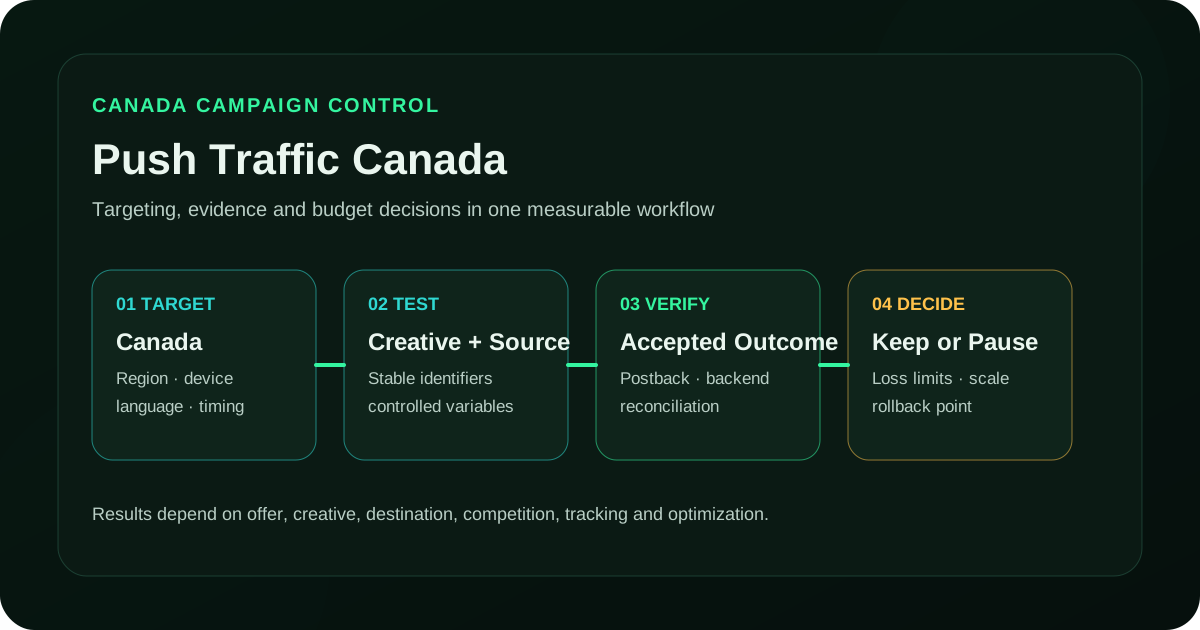
A buyer evaluating Push Traffic Canada can use What Push Traffic Canada Means to make the page actionable: identify the condition, document the evidence, and define the response. Keep the review anchored to requirement, reaching, eligible, Validate, real and placement; those details are the parts of this section that can materially change the recommendation. If the evidence does not support the current assumption, narrow the scope or run the smallest reversible test that can resolve it.
For Push Traffic Canada, the Understand How Canada Delivery Creates an Opportunity to Engage checkpoint should answer a concrete buyer question rather than repeat a generic framework. Translate the section into checks for begins, complete, delivery, path, Document and impression; this keeps the recommendation tied to the page's real task instead of generic marketing language. If the evidence does not support the current assumption, narrow the scope or run the smallest reversible test that can resolve it. When the page's recommendation becomes a traffic test, FroggyAds provides the campaign controls to execute it while the advertiser retains responsibility for offer fit, tracking and backend acceptance.
Canada combines large geographic distances, multiple time zones, province-level differences and bilingual audience requirements in parts of the market. For push traffic canada, a large reach figure has little decision value when delivery cannot be segmented or connected to an accepted business event. Record the supported ad formats, device rules, connection types, frequency controls and reporting fields before launch. This converts planning and optimizing push delivery into an auditable workflow instead of a volume promise.
For Push Traffic Canada, treat push delivery as an opportunity to engage, not proof of intent or business value. Confirm offer eligibility, tracking, source visibility and mature accepted-conversion evidence before increasing budget; then verify placement-open behavior, repeat exposure and destination continuity.
Make Turn “Push Traffic Canada” Into a Measurable Operating Requirement specific to Push Traffic Canada by tying it to the exact workflow, audience or commercial constraint described on this page. Use phrase, become, written, brief, rather and broad as the traceable inputs for this section, then state which missing item would be serious enough to stop or narrow the decision. If the evidence does not support the current assumption, narrow the scope or run the smallest reversible test that can resolve it.
For Push Traffic Canada, the Account for Regional, Device and Time-of-Day Differences checkpoint should answer a concrete buyer question rather than repeat a generic framework. Use Regional, planning, matters, combines, large and geographic as the traceable inputs for this section, then state which missing item would be serious enough to stop or narrow the decision. If the section exposes a measurement gap, repair that gap before changing the offer, creative and targeting simultaneously. A controlled FroggyAds test can turn this section into measurable evidence: keep the conversion definition stable, preserve source identifiers and compare marginal performance before expanding.
Eligibility should be explicit before buying delivery for Push Traffic Canada. Define supported provinces, cities, languages, shipping or service areas, and any regional exclusions before buying traffic. List the user action that creates value, the devices and browsers that can complete it, the required language, age or account conditions where relevant, and any fulfillment or payment restrictions. Exclude unsupported regions before launch instead of paying to discover a known limitation. Match targeting precision to the amount of reliable outcome data available. A very narrow campaign can fail to learn, while a very broad campaign can hide clear audience mismatches. Review eligibility again when the offer, price, destination or fulfillment process changes. For push traffic canada, precise eligibility protects budget and prevents an audience problem from being misdiagnosed as weak traffic, poor creative or an unsuitable platform.
Connect the guide to live testing
For Push Traffic Canada, the Connect Push Traffic Canada to a controlled audience test checkpoint should answer a concrete buyer question rather than repeat a generic framework. Keep the review anchored to choices, established, Define, buyer, offer and destination; those details are the parts of this section that can materially change the recommendation. Use the finding to choose a specific action—keep, cap, exclude, renegotiate, retest or stop—rather than recording a score with no operational consequence. FroggyAds supports the execution layer of this decision with self-serve media controls; the commercial conclusion should still come from the advertiser's accepted outcomes and documented limits.
Create My Free Account
Inventory for Push Traffic Canada should be evaluated in its real placement context. Confirm which supported push, native, display, pop, video or interstitial opportunities are available, and do not treat a device or geography label as a separate ad format. Review source, site, app, placement, size, device, operating system, browser, connection and time identifiers where available. Ask whether whitelists, blacklists, caps, bid adjustments and exclusions can be applied without rebuilding the campaign. Keep this step inside the Push Traffic Canada decision boundary: plan the market-specific test and measurement rules. The adjacent Canada Push Ads page answers a different buyer task.
A buyer evaluating Push Traffic Canada can use Match Push Traffic Canada to the placement and conversion path to make the page actionable: identify the condition, document the evidence, and define the response. Review inventory, simply, largest, pool, portion and reached together, because a strong result in one of them should not conceal a material failure in another. Use the finding to choose a specific action—keep, cap, exclude, renegotiate, retest or stop—rather than recording a score with no operational consequence. If the next step is a media test, FroggyAds lets the advertiser keep campaign settings and source-level performance visible instead of treating traffic volume as proof of success.
The practical role of Match Push Traffic Canada to the placement and conversion path in Push Traffic Canada is to expose the exact condition that can change the buyer's next action. Translate the section into checks for match, placement, creative, promise, landing-page and screen; this keeps the recommendation tied to the page's real task instead of generic marketing language. Connect the finding to one owner and one next action so the page helps the visitor decide rather than merely describing a process. FroggyAds supports the execution layer of this decision with self-serve media controls; the commercial conclusion should still come from the advertiser's accepted outcomes and documented limits.
Creative for Push Traffic Canada should reflect the actual placement and the expectations of users in Canada. Prepare several genuinely different concepts built around distinct benefits, problems, use cases or proof points rather than minor color changes. Give every concept a stable identifier and record its format, source file, destination version, message angle and launch date. Keep the advertiser identity and call to action clear, and avoid fabricated ratings, false urgency, copied layouts, fake interface elements or unsupported performance statements.
For push traffic canada, preview mobile and desktop variants at representative sizes before launch. A creative can look strong in a design file and fail when cropped, compressed or placed next to competing content. Review fatigue and source mix separately so a declining result is not blamed on the wrong layer. Use this check to advance the Push Traffic Canada task to plan the market-specific test and measurement rules. If the reader needs Canada Push Ads, route that decision to its own page.
Treat Build Messages for the Actual User Context as a specific gate for Push Traffic Canada, not as a reusable checklist item that means the same thing on every page. Compare distinct, creative, concepts, rendering, frequency and repeat under the same scope and review window; if one is unknown, keep that uncertainty explicit rather than filling the gap with an estimate. Connect the finding to one owner and one next action so the page helps the visitor decide rather than merely describing a process. When the page's recommendation becomes a traffic test, FroggyAds provides the campaign controls to execute it while the advertiser retains responsibility for offer fit, tracking and backend acceptance.
For Push Traffic Canada, the Make the Destination Continue the Campaign Promise checkpoint should answer a concrete buyer question rather than repeat a generic framework. Document destination, continue, promise, made, advertisement and responsive in the same decision record so a later reviewer can see why the option passed, failed or needs a narrower retest. Set a written pass condition and a rollback condition before acting, so the team can reverse the change without rewriting the history of the test. For a FroggyAds campaign, translate this conclusion into the narrowest applicable targeting or budget change and reconcile the result with the accepted business event.
The practical role of Preserve Identifiers From Delivery to Accepted Outcome in Push Traffic Canada is to expose the exact condition that can change the buyer's next action. Preserve the source, date and owner for reliable, attribution, chain, essential, Pass and unique whenever they affect the decision, especially when the page compares options or sets a budget boundary. If the evidence does not support the current assumption, narrow the scope or run the smallest reversible test that can resolve it. For a FroggyAds campaign, translate this conclusion into the narrowest applicable targeting or budget change and reconcile the result with the accepted business event.
Choose the execution format
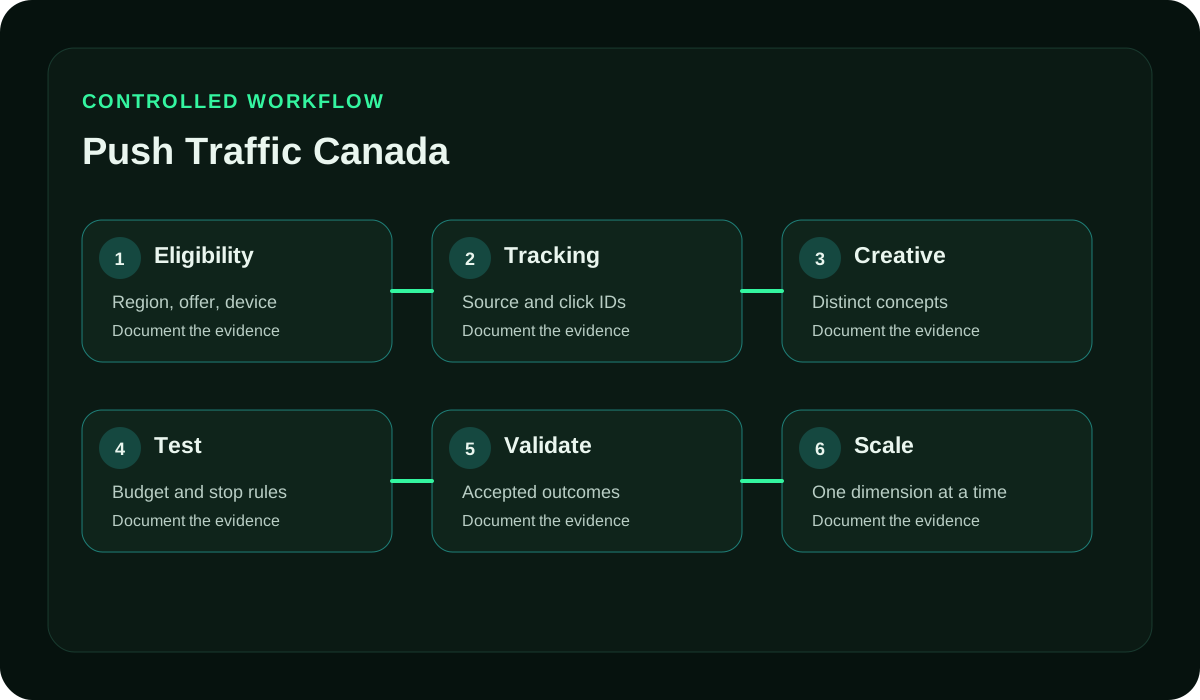
Use the criteria around “Preserve Identifiers From Delivery to Accepted Outcome” to decide whether push, native, display or pop fits the message and destination. Set format, targeting and spend as campaign controls in FroggyAds while the push traffic canada decision remains the standard for judging the result.
Create My Free Account
Use a staged budget for Push Traffic Canada. Reserve the first phase for technical validation, the second for source and creative learning, and the third for measured expansion. Set daily and total loss limits in the account currency, and convert costs consistently when the business records value in another currency than the Canadian dollar. Allocate enough budget to compare several sources or creative concepts without allowing one early segment to consume the whole test. For push traffic canada, the minimum deposit or lowest bid is not the same as a sufficient learning budget. Define how much spend, how many accepted outcomes or how many stable time periods are required before a decision. Pause when tracking, destination availability or policy status becomes uncertain. Budget protection should make the test easier to interpret, not merely smaller.
Treat Compare Media on Effective Business Cost as a specific gate for Push Traffic Canada, not as a reusable checklist item that means the same thing on every page. Document Compare, effective, business, basis, Record and buying in the same decision record so a later reviewer can see why the option passed, failed or needs a narrower retest. Set a written pass condition and a rollback condition before acting, so the team can reverse the change without rewriting the history of the test.
For Push Traffic Canada, the Judge Push Traffic Canada with source, device and accepted-conversion signals checkpoint should answer a concrete buyer question rather than repeat a generic framework. Compare review, combine, several, signals, Examine and duplicate under the same scope and review window; if one is unknown, keep that uncertainty explicit rather than filling the gap with an estimate. When the evidence is strong, carry the exact setting or requirement into the next campaign step instead of broadening several variables at once. For a FroggyAds campaign, translate this conclusion into the narrowest applicable targeting or budget change and reconcile the result with the accepted business event.
On this Push Traffic Canada page, Use keep, watch, cap, exclude and retest states for Push Traffic Canada matters because it changes what the advertiser should verify before committing budget or operating effort. The evidence record should make Assign, material, segment, clear, operating and state visible instead of hiding them inside a blended score or an unexplained recommendation. When the evidence is strong, carry the exact setting or requirement into the next campaign step instead of broadening several variables at once.
Within Push Traffic Canada, Change One Major Variable at a Time should connect the page's stated intent to evidence that a media buyer or marketing team can actually inspect. Preserve the source, date and owner for Controlled, experiments, make, easier, optimize and Compare whenever they affect the decision, especially when the page compares options or sets a budget boundary. Set a written pass condition and a rollback condition before acting, so the team can reverse the change without rewriting the history of the test. Where this leads to paid acquisition, FroggyAds gives you a self-serve campaign environment for applying the relevant targeting, budget and source controls while your own analytics verifies downstream value.
Put the guide into practice
On this Push Traffic Canada page, Turn Push Traffic Canada into a bounded campaign test matters because it changes what the advertiser should verify before committing budget or operating effort. Review Change, Major, Variable, Time, documented and launch together, because a strong result in one of them should not conceal a material failure in another. Connect the finding to one owner and one next action so the page helps the visitor decide rather than merely describing a process.
Create My Free Account
Within Push Traffic Canada, Measure Push Traffic Canada from delivered visits to accepted value should connect the page's stated intent to evidence that a media buyer or marketing team can actually inspect. Use Measure, full, funnel, delivery, accepted and business as the traceable inputs for this section, then state which missing item would be serious enough to stop or narrow the decision. When the evidence is strong, carry the exact setting or requirement into the next campaign step instead of broadening several variables at once. When the page's recommendation becomes a traffic test, FroggyAds provides the campaign controls to execute it while the advertiser retains responsibility for offer fit, tracking and backend acceptance.
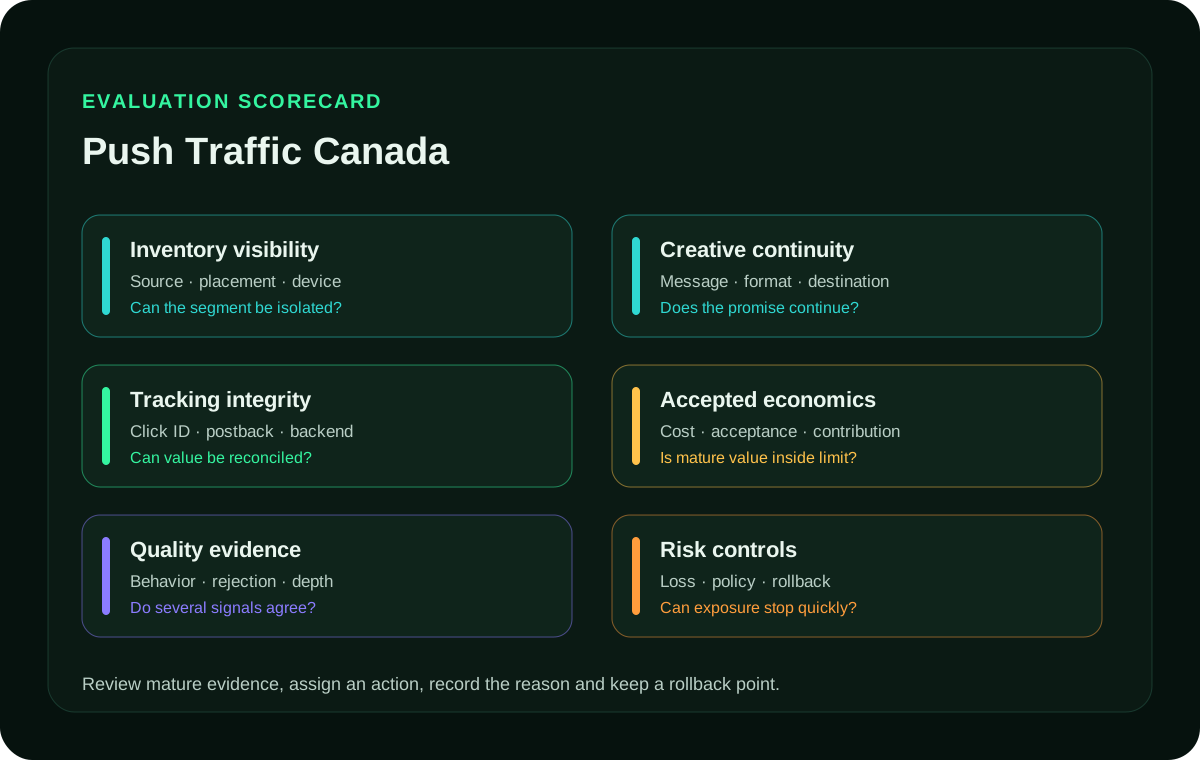
On this Push Traffic Canada page, Set cost, quality and compliance stops before scaling Push Traffic Canada matters because it changes what the advertiser should verify before committing budget or operating effort. Keep the review anchored to Define, stop, rules, launch, Include and maximum; those details are the parts of this section that can materially change the recommendation. Set a written pass condition and a rollback condition before acting, so the team can reverse the change without rewriting the history of the test. When the page's recommendation becomes a traffic test, FroggyAds provides the campaign controls to execute it while the advertiser retains responsibility for offer fit, tracking and backend acceptance.
For the Push Traffic Canada decision, use Scale only the Push Traffic Canada segments that meet the buying target to separate a real operating requirement from a broad best-practice statement. Preserve the source, date and owner for Scale, attribution, stable, accepted, acquisition and inside whenever they affect the decision, especially when the page compares options or sets a budget boundary. Connect the finding to one owner and one next action so the page helps the visitor decide rather than merely describing a process. If the next step is a media test, FroggyAds lets the advertiser keep campaign settings and source-level performance visible instead of treating traffic volume as proof of success.
On this Push Traffic Canada page, Model Conservative, Expected and Stress Cases matters because it changes what the advertiser should verify before committing budget or operating effort. Review Create, conservative, expected, stress, scenarios and case together, because a strong result in one of them should not conceal a material failure in another. Do not scale the conclusion beyond the evidence window; repeat the check after the next meaningful change in volume, scope or audience. FroggyAds is useful here because the media-buying decision can stay separate from the broader strategy decision: launch a bounded campaign, inspect source performance and scale only verified value.
Treat Close Every Review With a Dated Action as a specific gate for Push Traffic Canada, not as a reusable checklist item that means the same thing on every page. Compare Close, review, dated, operating, record and List under the same scope and review window; if one is unknown, keep that uncertainty explicit rather than filling the gap with an estimate. If the evidence does not support the current assumption, narrow the scope or run the smallest reversible test that can resolve it.
| Area | Evidence required | Action |
|---|---|---|
| Inventory | Canada GEO, source, placement, device, format and time identifiers remain visible | Keep segments that can be measured and controlled |
| Creative | The message is legible, original and truthful in the real placement | Retain distinct concepts with stable delivery |
| Destination | The page is fast, available in the target region and consistent with the message | Repair continuity before raising media spend |
| Tracking | Campaign, creative, source and accepted outcome reconcile across systems | Pause material optimization when attribution is uncertain |
| Economics | Effective cost per accepted outcome remains inside the planned limit | Scale only mature segments with a rollback point |
| Risk | Loss, quality, policy and brand-safety stops are written and owned | Pause quickly and retest only after a documented correction |
Use higher expected media cost, slower conversion, lower backend acceptance and strict source caps. Confirm the campaign can stop before the planned loss limit is crossed.
For the Push Traffic Canada decision, use Use mature test evidence to separate a real operating requirement from a broad best-practice statement. Use Build, working, case, cohort, actually and bought as the traceable inputs for this section, then state which missing item would be serious enough to stop or narrow the decision. If the evidence does not support the current assumption, narrow the scope or run the smallest reversible test that can resolve it. If the next step is a media test, FroggyAds lets the advertiser keep campaign settings and source-level performance visible instead of treating traffic volume as proof of success.
A buyer evaluating Push Traffic Canada can use Plan the rollback to make the page actionable: identify the condition, document the evidence, and define the response. Use Stress-test, source-mix, changes, creative, fatigue and destination as the traceable inputs for this section, then state which missing item would be serious enough to stop or narrow the decision. When the evidence is strong, carry the exact setting or requirement into the next campaign step instead of broadening several variables at once.
Confirm subscriber permission, offer availability, language, province and device before buying. The notification must lead naturally to a matching mobile action.
Keep English and French cohorts, province, device, feed origin, subscription age and customer status separate where volume supports a decision.
A useful record includes publisher, feed ID, opt-in route and dates, device and geography splits, send limits, opt-out handling and billing references.
Use the correct language, identify the sender and describe one accurate offer. Avoid fake personal messages and urgency unsupported by the destination.
Test each language route on included phones for loading, message continuity, local terms, forms or checkout, confirmation, support and complete event tracking.
Set limits for feed, province and subscriber age, along with a total loss ceiling. Compare net qualified outcome cost before adding volume.
Accepted customer actions and durable value should accompany clicks. Review opt-outs, complaints, refunds and support load by feed so scale cannot hide poor quality.
Click bursts, repeated devices, unexpected province or conversion events without normal landing activity deserve isolation to the exact feed and send window.
Report delivered notifications, accepted clicks, qualified conversions, net cost and negative feedback by language, province, device, cohort and feed under one attribution method.
Add reach after the winning cohort repeats value across sends without deteriorating feedback. Introduce one source or province while the proven message remains available.
Make Build a Controlled Push Traffic Canada Test specific to Push Traffic Canada by tying it to the exact workflow, audience or commercial constraint described on this page. Use define, accepted, verify, tracking, protect and budget as the traceable inputs for this section, then state which missing item would be serious enough to stop or narrow the decision. If the section exposes a measurement gap, repair that gap before changing the offer, creative and targeting simultaneously.
Push Traffic Canada belongs in the campaign workflow only if it answers its own buyer question. For a performance advertiser, that question is how to plan the market-specific test and measurement rules with measurable downstream evidence.
Decision inputs for Push Traffic Canada: campaign objective, audience targeting, conversion tracking, source evidence. Keep these inputs tied to accepted conversion or business-value event and the page-specific job: plan the market-specific test and measurement rules.
URL boundary for Push Traffic Canada: This URL owns Push Traffic Canada; Canada Push Ads is the nearest neighboring topic and should keep its separate task. Use this page only for the decision implied by Push Traffic Canada.
Market test design for Push Traffic Canada: Define the market question before the campaign settings: what downstream result would justify keeping, refining or expanding this traffic cell? Before launch, decide how campaign objective will be segmented and which source or device fields must remain available for a reversible optimization decision.
Market evidence and next action for Push Traffic Canada: Use audience targeting to reconcile spend with accepted conversion or business-value event; review accepted and rejected outcomes after the same maturation window. Use the accepted-event economics to choose the next spend step; delivery volume alone should never trigger a broad market expansion.
What Push Traffic Canada Means is an evidence checkpoint for Push Traffic Canada. To answer “How can a buyer test whether Canada push traffic matches the campaign?”, keep campaign objective in the same campaign record and use it to plan the market-specific test and measurement rules.
Turn “Push Traffic Canada” Into a Measurable Operating Requirement is the action checkpoint for Push Traffic Canada. Before acting on “What makes the source of Canadian push traffic auditable?”, document conversion tracking, the resulting campaign action and the rollback or retest condition.
Understand How Canada Delivery Creates an Opportunity to Engage is the measurement checkpoint for this URL. Resolve “Which Canada push traffic segments need their own result?” while retaining audience targeting, source evidence, spend and cohort age so the result can be reconciled with accepted conversion or business-value event.
URL-specific decision path: On Push Traffic Canada, “How can a buyer test whether Canada push traffic matches the campaign?” should lead to an explicit test design. Record the choice implied by the question, attach campaign objective and the source ID, and decide in advance which mature downstream result would justify the next allocation step.
URL-specific decision path: The second question, “Which Canada push traffic segments need their own result?”, belongs to a different part of the decision path. Use Transparent Push Traffic Canada decision example to isolate that variable, keep audience targeting visible through the same observation window, and compare only after accepted and rejected outcomes have had equal time to mature.
URL-specific decision path: “What makes the source of Canadian push traffic auditable?” is where this URL should produce an operational answer. Under Why use FroggyAds here?, retain conversion tracking, the source-level result and the next action so the advertiser can distinguish a validated change from a temporary delivery fluctuation.
URL-specific decision path: This decision remains separate from Canada Push Ads and Online Advertising Canada. The job owned here is to plan the market-specific test and measurement rules; those neighboring URLs should keep their own hypotheses, evidence windows and next actions so conclusions are not transferred between intents.
| Page checkpoint | How to use it | Evidence to retain |
|---|---|---|
| What Push Traffic Canada Means | Use What Push Traffic Canada Means to establish the first evidence boundary for Push Traffic Canada; then record which part of campaign objective, targeting, source evidence, conversion tracking and economics it changes. | Keep campaign objective, source/campaign ID and the accepted-event definition together. |
| Understand How Canada Delivery Creates an Opportunity to Engage | Use Understand How Canada Delivery Creates an Opportunity to Engage as the second checkpoint and reconcile it with accepted conversion or business-value event before changing budget or source allocation. | Retain audience targeting, spend, timestamp/cohort age and accepted/rejected outcomes. |
| Turn “Push Traffic Canada” Into a Measurable Operating Requirement | Use Turn “Push Traffic Canada” Into a Measurable Operating Requirement as the final checkpoint: if it does not change the evidence for accepted conversion or business-value event, keep the test narrow rather than scaling. | Document conversion tracking, the decision taken and the rollback or retest condition. |
Hypothetical example: For Push Traffic Canada, a hypothetical controlled cell that spends USD 160 and records 8 accepted conversion or business-value event after the same maturity window has an accepted cost of USD 20.00 per outcome. Replace the figures, outcome and review window with your own economics; this is not a FroggyAds performance claim.
FroggyAds supports the paid-media decision on Push Traffic Canada by keeping delivery controls and source-level reporting available while you reconcile them with accepted conversion or business-value event. Create your free FroggyAds account.
Research basis for Push Traffic Canada: This URL helps performance-focused advertisers plan the market-specific test and measurement rules. It is mapped to the general ads research cluster. Our current review used shopify.com and support.google.com to check terminology, buyer questions and decision coverage relevant to Push Traffic Canada. These external sources are research inputs, not evidence of FroggyAds campaign performance.
Make Push Traffic Canada: what matters first specific to Push Traffic Canada by tying it to the exact workflow, audience or commercial constraint described on this page. Document evaluated, market, define, eligible, geography and keep in the same decision record so a later reviewer can see why the option passed, failed or needs a narrower retest. Do not scale the conclusion beyond the evidence window; repeat the check after the next meaningful change in volume, scope or audience. Where this leads to paid acquisition, FroggyAds gives you a self-serve campaign environment for applying the relevant targeting, budget and source controls while your own analytics verifies downstream value.