
Use business evidence to authorise the allocation
Statistics Canada research can frame the problem but cannot authorise spend. The advertiser's mature campaign, fulfilment, sales and product evidence must support the release.
Choose FroggyAds for a Canadian traffic campaign built around the province, language and customer route your business can serve. We give you self-serve buying controls and source-level evidence, while your own records show which order, lead or activation is accepted. Start with one English or French offer, clear CAD terms and a defined operating region. This guide helps you decide what the first cell must prove before you increase its budget or open another market.
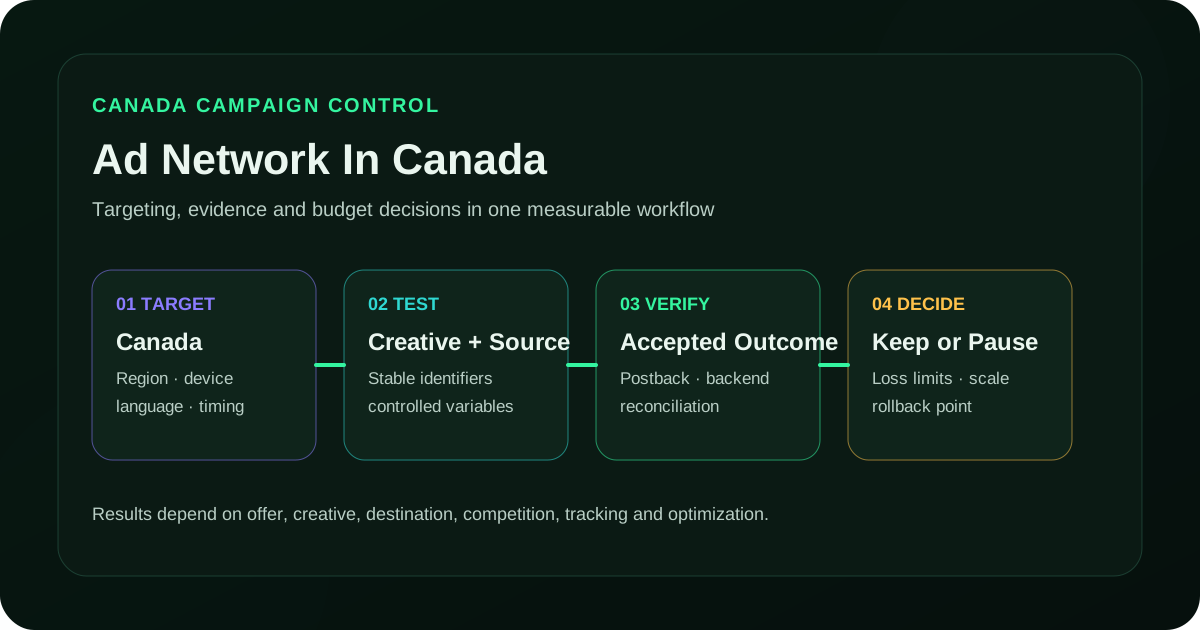
Choose the first uncertainty: customer meaning, provincial availability, shipping, sales response, subscription retention or product activation. Avoid buying national traffic merely to learn that the organisation had not defined its receiving process. We recommend turning the country brief into one province and language decision before expanding reach.
Give commerce, warehouse, carrier, bilingual support, sales, product and finance teams a clear role in completing the Canadian offer. Confirm normal capacity and the evidence each owner will return. We supply the self-serve campaign workflow and media-delivery record; your business controls the offer, customer journey and accepted-value decision. Statistics Canada’s survey context can frame useful planning questions, but it does not replace those customer records.
Statistics Canada explains that CIUS studies how digital technologies and the internet affect Canadian society, the economy and daily life. Its topics include access, ecommerce, trust, skills and online activities. That program does not describe live FroggyAds supply, a unique advertising audience, current auction conditions or demand for one offer. Preserve the survey year, collection method and statistical population whenever it informs a planning question.
Keep statistical units separate in your Canada plan. A residential subscription, household measure and individual survey response answer different questions, and none is a count of customers available to your FroggyAds campaign. Retain the source’s year and population, then use a dated CAD campaign record for spend and accepted outcomes.
Treat official evidence as a source of useful questions: which connection, device, trust explanation or online service path must work? Answer those questions through production testing and mature customer records. An English or French release includes headline, supporting proof, price, eligibility, fields, validation, consent, confirmation and follow-up. A translated advertisement is incomplete when the conversion route or support immediately changes language. Preserve the commercial meaning from the creative through the human response.
Use a fluent commercial reviewer who understands the product, not only vocabulary. The review should catch changes in subscription meaning, delivery, qualification, cancellation, warranty or action.
Version each language route separately where the audience promise or receiving team differs. Keep the exact creative and destination together so a later result can be traced to what the customer experienced. Do not infer that every French-speaking customer belongs to one province or that one province needs one language. The campaign plan should follow actual business capability and only verified account controls.
For every province or territory considered, record what the business can sell or provide, ordinary timing, shipping or appointment limits, response ownership and available capacity. A Canada label should not hide a smaller fulfilment boundary. Use live geography settings at verified precision. When a postal, licence, warehouse or specialist boundary is narrower, explain it on the destination and classify unsupported requests separately.
Build separate operating cells when tax display, delivery, stock, service availability, language support or sales ownership changes materially. These differences belong in the commercial record, not in a vague after-launch note.
An out-of-area request can inform future planning without being counted as accepted value. Assign it to expansion research and protect current source economics from an impossible promise. Store the approved Canadian-dollar amount or calculation basis with material tax presentation, shipping, plan period, renewal, refund, cancellation, eligibility and service conditions. The buyer should understand the choice before binding payment or detailed application. Track the full B2B qualification process.
Open a new version when price, promotion, province condition, inventory, plan or fulfilment promise changes. Link orders and leads to the exact record rather than pooling unlike propositions. Where internal media cost uses another currency, retain original spend, conversion method, date and CAD decision value. Hypothetical arithmetic must remain labelled and does not establish FroggyAds pricing or recommended budgets. Map delivery and service conditions before opening another geography.
A Canada campaign deserves another allocation when its English or French message, CAD offer, provincial service promise and receiving operation create retained value—not when a broadband count or first form submission looks encouraging.
Reconcile confirmation. An order state, application receipt, booking reference or activation instruction should agree with the route. A successful event callback without a usable customer record is not final value. Keep the amount, tax presentation and material conditions attached to each version.
Create My Free Account
Follow product selection, checkout, authorisation, order creation, stock confirmation, warehouse release, carrier handoff, delivery, customer issue, cancellation, return and retained order. The business chooses which mature state funds acquisition. Use reasons such as unsupported address, revised charge, unavailable item, payment failure, delay, missed attempt, damage, wrong item and return. A reasoned ledger reveals the owner without inventing a conclusion about a province.
Separate routes when remote delivery, carrier coverage, timing or return handling changes the promise. A blended national cost can hide a warehouse or service limitation.
Post valid returns to the original cohort after the declared window. Early paid-order cost may guide operational response, while retained-order cost controls the next media allocation. Define the useful action that shows the Canadian customer reached the product promise. Registration, trial start, initial payment, onboarding completion, meaningful use and retained subscription are distinct stages.
Keep plan, language, province where relevant, product build, campaign and stage timestamps. Remove internal tests and duplicates consistently, and preserve cancellation, refund and approval reasons. Suppose a hypothetical CAD 75,000 cohort records 300 initial payments and 150 subscriptions accepted after the review window. Cost per payment is CAD 250; cost per retained subscription is CAD 500. This is arithmetic, not a FroggyAds forecast.
Choose maturity before launch. A trial can look inexpensive while activation or cancellation remains unresolved. Later evidence must revise the source disposition instead of disappearing from a finished dashboard.
Document the company profile, buying role, problem, location, serviceability and next action required for acceptance. A valid email or booked call is an entry point, not proof of fit. Track assignment, reached contact, verified need, stakeholder, timing, agreed next step and accepted opportunity separately. Keep no fit, no response, duplicate, unsupported province and internal delay as distinct dispositions.
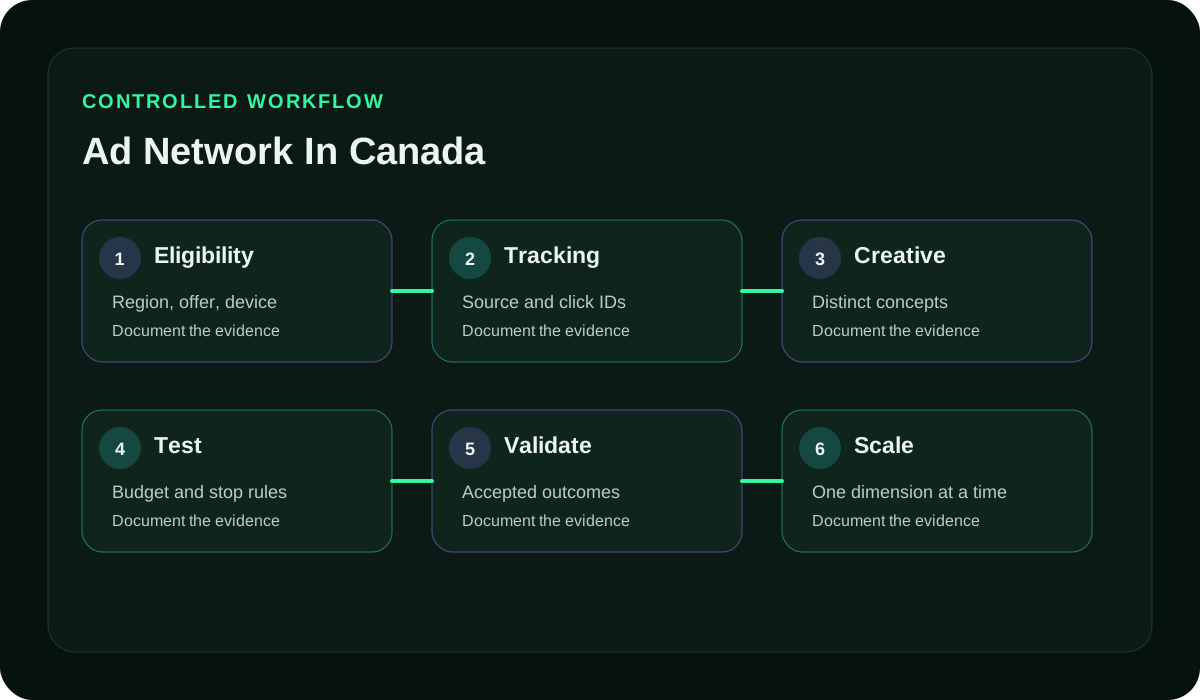
Choose the execution format
Allow a review window that reflects the actual buying cycle and publish pending volume. Do not force open opportunities into success or failure to complete a weekly report. Cap delivery when the English or French sales queue exceeds normal capacity. Reopen after the responsible manager confirms headroom and the next cohort's response promise.
Create My Free Account
A short unit may introduce a familiar need, a visual placement may demonstrate a product state, and a context-rich format may explain a considered proposition. Confirm eligible options inside the live FroggyAds account.
Give each creative a single learning task and include material information appropriate to that task. Omitting price, province coverage or subscription meaning simply to increase clicks weakens the customer test. Tie creative, language, destination and acceptance rule into one release. When any changes, record the new version and begin a clean comparison window.
Use attention and progression to diagnose communication. Retained orders, owner-accepted opportunities or approved activations determine whether the format earns more budget. Retain campaign, format, available source or placement, creative, language, province cell, destination, spend, delivery, meaningful action, accepted outcome, reason and maturity date.
Choose keep, cap, repair, exclude or retest. Repair translation, CAD discontinuity, shipping, response or onboarding before assigning a source verdict.
Exclude only after the production route works and the mature cell fails the same accepted-cost rule. Document who owns the verdict and what change would permit reconsideration. Review concentration by province, language, format and customer type. A strong average can depend on one narrow cell; protect the next release with a maximum and reversal condition.
Put the guide into practice
Review contacts from the tested cohort and group them by language, province, CAD offer, shipping, subscription, privacy notice, cancellation and support topic. Keep unnecessary personal information outside the media record.
Create My Free Account
A request for clarification is not automatically rejection. Preserve the answer and final status. Repeated uncertainty can reveal information the page should present earlier. Require a documented pattern tied to an exact version before changing public content. Do not generalise a few tickets into a claim about Canadians, Quebec, Ontario or any other province.
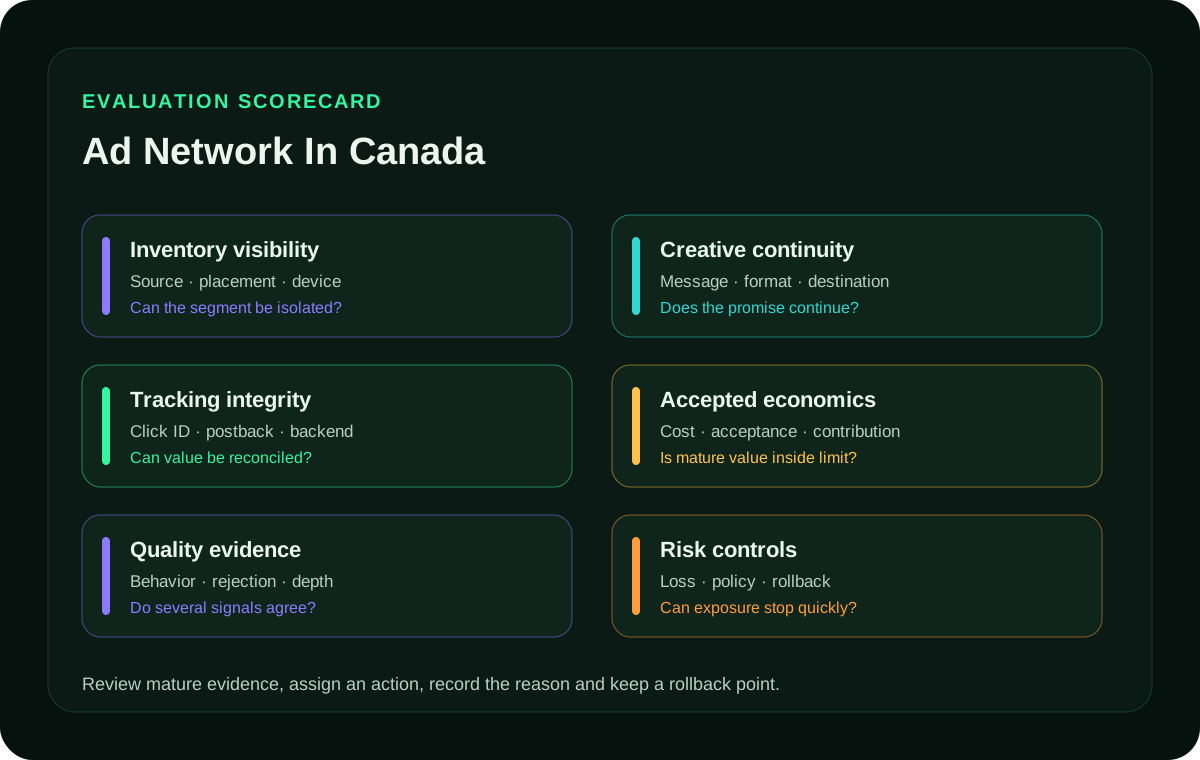
Assign one controlled response: clarify, repair, train, cap, stop or monitor. Add an owner, due date and condition for reversing the decision. Map approved identifiers between FroggyAds delivery and the order, CRM or product stage where acceptance is determined. Write the confidence and known gap beside every allocation metric.
Validate event transport with authorised records and remove test traffic. A signal firing does not establish shipment, qualification, retention or useful activation.
Keep source-system timestamps and a clear reporting-zone convention. Cross-province teams and platforms may close days differently; hidden timestamp changes can distort a cell comparison. Leave unmatched outcomes unclassified until the approved process resolves them. Do not manufacture success, fraud or failure from missing evidence.
Confirm the customer, language route, province promise, CAD version, production journey, mature denominator, source decision and spare capacity. Attach exact versions and unresolved risks. Set the next maximum exposure, review time, success condition and stop rule. Increase one meaningful dimension so the new evidence remains interpretable.
Read each evidence layer according to the question it can answer. Official surveys describe a defined population, campaign reports describe media delivery, and the provincial customer route determines serviceability and accepted value. Keep the owner and limitation beside each record.
| Record | Answers | Does not prove |
|---|---|---|
| Owner | Statistics Canada research | Defined digital and telecommunications context |
| Creative | FroggyAds reach or offer demand | Planner preserves unit |
| Destination | FroggyAds campaign | Observed settings, delivery and spend |
| Tracking | Retained customer value alone | Media buyer controls cell |
| Economics | Province route | Language, CAD offer and service completion |
| Risk | Acceptance before maturity | Operations diagnoses reasons |
Before increasing a Canadian campaign, confirm that the receiving operation can keep its language, delivery and support promise at the next volume. Use mature customer records to fund the decision and keep exceptional service conditions visible before the visitor commits.
Statistics Canada research can frame the problem but cannot authorise spend. The advertiser's mature campaign, fulfilment, sales and product evidence must support the release.
Create your FroggyAds account when bilingual and provincial operations are ready. Start one bounded cell and grow where retained Canadian customer value supports the next step. Map remote, northern and other special service routes only where relevant to the advertiser. Record carrier or appointment availability, timing, charge, return process and support ownership before media release.
If a condition differs materially, state it before checkout or enquiry and preserve the route seen. A postal submission outside normal coverage can inform planning without becoming accepted value. Keep unavailable delivery, revised quote, specialist delay and unsupported service as separate reasons. These outcomes describe an operational boundary rather than a customer-quality judgement.
Separate provinces that differ in service, language or delivery economics, and keep major metros available for deeper diagnosis. For Ad Network In Canada, define one accepted outcome, verify tracking, protect the test budget and make source-level decisions from mature data.
Create distinct routes wherever the audience expects them, carrying the chosen language from advertisement through support. Regional planning matters for Ad Network In Canada.
Cover the phones and computers expected in scope, including page load, consent choices, forms and final confirmation. Define stop rules for Ad Network In Canada before launch.
Store app or web environment, format, placement and creative identifiers rather than comparing publishers from a blended total. Creative for Ad Network In Canada should reflect the actual placement and the expectations of users in Canada.
Inspect accepted acquisition cost and repeat exposure by province, then cap expensive pockets before changing the whole campaign. Compare cost for Ad Network In Canada on an effective business basis.
Carry campaign, placement and click identifiers into the confirmed outcome so platform totals can be reconciled independently. Ad Network In Canada begins with the complete delivery path.
Repeated device anomalies, shallow journeys and poor accepted value together provide stronger evidence than one engagement metric. Quality review for Ad Network In Canada should combine several signals.
Target only areas where the offer, delivery and customer care are available, and make exclusions clear before purchase. The destination for Ad Network In Canada must continue the promise made by the advertisement.
Choose one serviceable province or metro, one offer and a fixed budget with tracking and quality stop rules. Write down which campaign change the test is meant to evaluate.
Raise one dimension at a time and watch whether new sources, devices or cities change the accepted acquisition cost. Ad Network In Canada should be evaluated with a matched campaign test.
Use these related Canada guides to compare network scope, push planning and source evidence while keeping provincial service, language and accepted-value limits explicit.
Open a new service cell after the responsible team confirms capacity, maximum exposure and the exact evidence required to pause. Do not let a national campaign silently outrun its fulfilment map.
Record who approved the French proposition, CAD terms, qualification, form, errors, confirmation and follow-up. The reviewer should understand the business consequence of every condition, not merely grammar. Preserve source text and approved French version together. When the product, promotion or policy changes, trigger a route review instead of leaving an older customer promise online.
Decision inputs for Ad Network In Canada: Log recurring customer questions by exact version and final outcome. A pattern can justify clarification, but a handful of contacts cannot support a claim about French-speaking buyers.
Market decision boundary for Ad Network In Canada: Close each language issue with an owner and deadline. Media should pause only the affected route when the commercial meaning is uncertain, allowing disjoint validated cells to continue. Build a finance view with campaign route, customer-facing CAD amount, accepted date, refund or return state and the agreed value basis. Keep unnecessary customer information out of the allocation file.
Canadian finance release rule: State whether the decision uses retained order, net revenue, contribution basis, accepted opportunity or another owner-approved event. Apply the definition consistently across provinces and languages. Post valid reversals to the original cohort and show pending counts. Do not improve the current period by moving a late refund away from the traffic cell that created the order.
Canadian allocation evidence: Release the next budget only after finance and operations can reproduce the mature denominator. The decision remains a test, not a guarantee of the next Canadian cohort.
Assign the Canadian operating handoff: Name which provincial or regional team owns the product, service area, language route and customer stage. Use a broad prospecting cell only when the destination and receiving operation apply the same material CAD terms, eligibility and response commitment. Otherwise, create a clear branch before submission or payment. Retain assignment time, receiving owner, serviceability, quoted terms, reached contact and final acceptance, so your buyer can distinguish a media issue from a transfer that stalled between operating teams.
Review the service conditions behind the source result: Check cross-province shipping, service eligibility, appointment coverage and tax or fee presentation through the responsible business owners. Show material changes at the decision point and open a new version. A high submission rate does not justify more traffic when customers wait in an unowned queue or receive different terms after transfer. Use our buying controls to keep the paid test focused while your CRM, order and service records support the next allocation.
Define the retained plan state: For SaaS and membership offers, distinguish registration, email verification, approved account, first useful action, paid renewal and retained subscription before launch. Keep those states separate so the campaign funds the customer event your product team actually accepts.
| Page checkpoint | How to use it | Evidence to retain |
|---|---|---|
| Customer-value evidence | Business ledger | Retained order, opportunity or activation |
| Forecast boundary | Treat the observed campaign as a dated test, rather than a guarantee of the next result. | Owner approves next release |
| Next allocation rule | Keep the next Canadian sample within its approved province and language route, accepted-outcome rule and loss boundary. Expand only when mature source evidence and ordinary fulfilment, product or response capacity support it. | Document source quality, the decision taken and the rollback or retest condition. |
Subscription evidence to preserve: Keep the customer-facing CAD plan, billing interval, introductory or trial condition, renewal meaning, cancellation route and refund rule with the version shown. Open a new cohort when those conditions change. Classify failed verification, unavailable features, onboarding friction, billing rejection, cancellation, refund and ordinary customer choice separately. Give a product or billing defect to its operational owner before treating it as evidence about the traffic source.
Choose FroggyAds when you want to control a Canadian country or province test yourself and keep its media evidence clear. Our supported formats, targeting, bids, budgets and source reporting help you compare a defined route while your business validates retained orders, accepted leads or useful product activity. Release more budget after the agreed review window and receiving capacity support the next step. Create your free FroggyAds account.
Hypothetical Canadian SaaS test: An advertiser releases one English or French provincial route with a clear CAD plan, renewal terms, supported payment and named activation. It uses registrations and initial payments to diagnose friction, then allocates from the subscription state accepted after the review window. Each language and service area keeps its own versions and outcome record. Statistics Canada’s CIUS programme describes official survey purpose and digital topics, while telecommunications statistics use their own service and household units. Neither measures current FroggyAds supply. Shopify paid advertising overview provides general paid-media planning; Google Display targeting guidance explains Google’s own Display controls. Use our current account settings and your accepted customer evidence for the actual Canadian buying decision.
For Canada, we recommend one serviceable province and language route, a clear CAD offer and a mature customer event. Use our self-serve controls to test that cell, keep the source and operating evidence together and open the next region only after its own customer promise can be fulfilled.