Canadian traffic for media buyers

Advertising Network Canada

By FroggyAds. Published 14 July 2026; updated 24 October 2026.

For advertisers and media buyers, a Canada advertising network should fit the places your business can serve and the customer journey you can maintain. Choose FroggyAds for a self-serve traffic campaign with available geography, format, device, bid, budget and source controls. Start with a workable offer, confirm current inventory and review the enquiries or orders your team can complete. Our practical recommendation is to connect the media brief to your service area, language versions and response hours before increasing delivery.

Self-serve campaign control ·Available targeting options ·Source reporting
advertising network canada planning visual
A serviceable buying plan

What should a Canadian advertising network help you decide?

Network access is valuable when it gives you a manageable route to the customers your offer is prepared to help. Your shortlist should answer which Canadian locations and formats are available, what the operator can control, and how delivery can be reviewed. A large platform feature list does not settle those questions. FroggyAds suits buyers who want to direct their own traffic test and make the next allocation from campaign evidence alongside their business records.

From delivery to service

Connect Canadian traffic to a serviceable customer journey

Begin with the action the visitor should take: request a quote, place an eligible order or make another clearly defined response. Then follow the route through the destination, customer contact and fulfilment. A click from a selected location is an opportunity to start that route. It is not proof that the customer lives within your dispatch area, understands the chosen offer version or can receive the service on the advertised terms.

Canada's geographic reach makes operational coverage a useful buying constraint. A national sales ambition may sit alongside a much smaller installation territory, delivery area or staffed response window. Write those business limits into the brief even when the media plan covers a broader location. The buyer should be able to explain what happens when a visitor asks for an unavailable service, rather than leaving that discovery until after the campaign has spent its allocation.

Our approach is to match the first campaign to the ready journey. Use the available FroggyAds location and device options to organise the traffic, and keep your own eligibility checks on the destination where customers can understand them. Confirm the exact available targeting before relying on it. A business postal-code list, a customer's address and a network geography setting describe different things; one should not be presented as automatic proof of another.

A practical buying brief

Write the buying brief around coverage and capacity

A useful Canada traffic buying brief names the offer, locations to test, destination version, business outcome and person responsible for responding. Add any conditions that materially affect the customer: installation availability, delivery exclusions, opening hours or product restrictions. This gives the media operator a reason for each campaign boundary. It also helps the business decide whether a proposed expansion needs more traffic or more preparation behind the destination.

Ask the network about the format and inventory for that brief before committing creative work. Push, Native, Display and Pop interactions require different messages and destination expectations; current availability for your intended campaign needs confirmation. Compare those routes by the action you want a visitor to take and the time your team can give to reviewing results. Avoid treating a competitor's channel list or integration directory as a feature checklist that every traffic platform must reproduce.

We recommend FroggyAds when direct control over a focused campaign is the priority. Available bids, budgets and source reporting let your operator supervise the traffic purchase while your business verifies what the responses became. Keep the first question small enough to answer, such as whether a prepared offer can generate serviceable requests within the chosen scope. A clear question gives the account owner a useful decision even when the campaign needs further work.

Service-area planning

Define a Canadian service area before extending reach

Map the places your business can actually fulfil, using the operational detail that matters to the offer. A home-service company might work from a dispatch boundary; a retailer might check delivery eligibility against the customer's full address. Canada Post distinguishes local, provincial, regional and national delivery categories in its own standards. Those categories are useful context for discussing fulfilment, but they do not establish your seller coverage or a FroggyAds targeting option.

Offer eligibility

Check offer eligibility before choosing a traffic format

Separate eligibility from convenience. An address may be technically serviceable while requiring a longer lead time, different shipping charge or unavailable appointment window. Explain relevant conditions before the customer commits to the next action. If the campaign attracts many responses outside the practical service area, inspect both the available media location settings and the destination's explanation. A narrower, clearly described offer can be a stronger next test than a broader promise the business struggles to honour.

Prepare a serviceable traffic offer

Start with the Canadian journey your team can deliver

Create your free FroggyAds account after defining the locations, offer and destination for the test. We give you a direct place to manage the available campaign controls; your team brings the service-area decisions and customer follow-through. That division of work makes it easier to ask focused questions about inventory and launch a campaign with a useful business purpose.

Create My Free Account
Illustration of audience targeting controls for an advertising network canada test
Inventory and control

Confirm inventory for the selected Canada campaign

Verify current country and any required finer location options in the buying environment or with our team. Record which formats, devices and source controls are available for the intended offer. Do not infer a province, municipality or postal-code capability from a general country-targeting description. Where a requested boundary is unavailable, decide whether a broader traffic test with a clear destination eligibility check is commercially sensible before spending.

Prepared language versions

Prepare English or French versions as complete journeys

Use English and French advertising journeys when they match the customers you intend to help and the versions your business can support. Check the headline, offer explanation, form, confirmation and follow-up together. A translated ad followed by an unfamiliar or incomplete destination creates avoidable friction. Language is a customer-experience decision here, not a claim that every Canadian visitor has the same preference or that a platform identifies an individual's language needs.

Destination readiness

Check the destination against real customer questions

A visitor should be able to find the service area, relevant price conditions, contact route and next step without guessing. Test the page on the devices selected for the campaign, including the form and any address eligibility check your business uses. Explain what happens after submission and when a response can be expected. Clear destination information helps interested customers make a useful choice and gives your team better context when following up.

Response hours and reporting

Agree local response hours and a shared reporting time

State the time basis used by the campaign report and by the people answering customers. A submission recorded late in one reporting day can belong to a different local working period for the service team. Review the actual date and place when matching delivery with response coverage. Do not translate a nationwide campaign into one assumed local clock or rely on an old offset copied into a spreadsheet.

The National Research Council's time-zone page currently warns that some information will no longer be accurate from November 1, 2026, and directs readers to provincial and territorial governments for the most accurate information. That warning makes a practical operating check worthwhile: confirm current local time arrangements for the places you serve before changing campaign hours. This page does not prescribe a universal daylight-saving rule or a fixed schedule for every province.

Keep the response promise consistent with staffing. If customers can submit a request at any time but the team answers only during stated hours, say so plainly on the destination. Inspect whether delayed responses coincide with lost opportunities before assuming the traffic itself is unsuitable. FroggyAds campaign reporting can help you examine delivery; your contact records establish when your team replied and whether the customer could proceed.

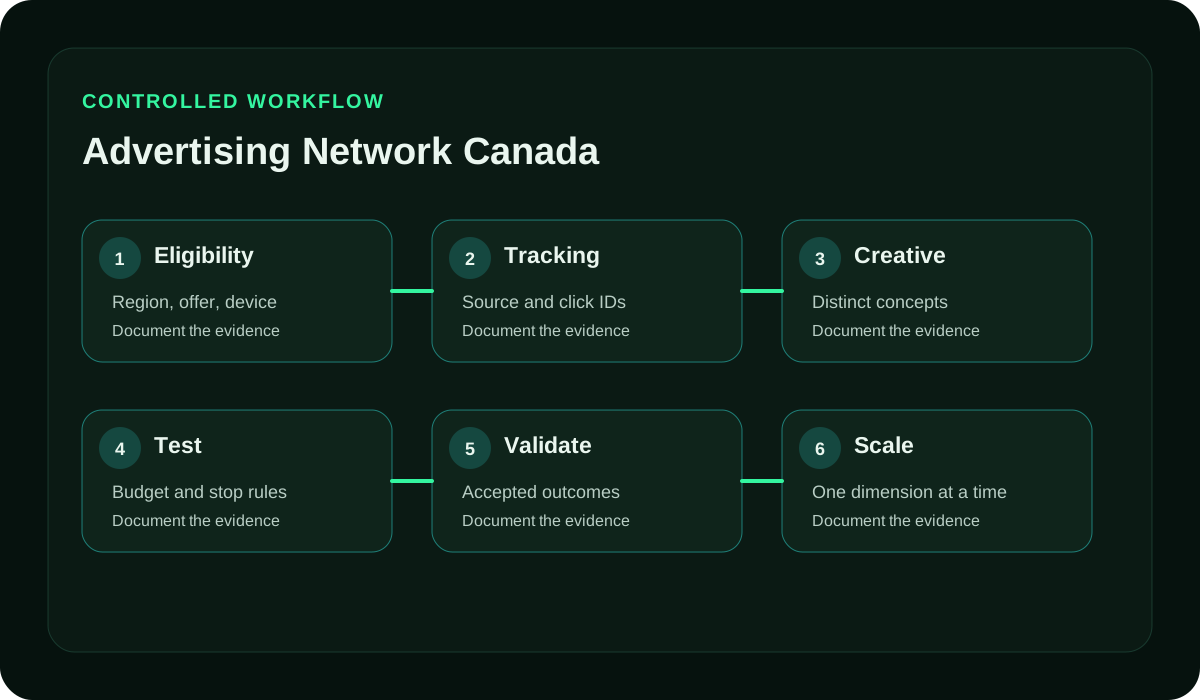
advertising network canada controlled workflow visual

Choose an appropriate visitor interaction

Select the format for your Canadian offer

Select a traffic format by the message and next step you can present clearly. A brief offer may fit a compact creative, while a more involved service needs a destination that explains eligibility and the consultation process. Confirm current specifications and offer acceptance before submitting assets. Start your next campaign with FroggyAds when the format, prepared destination and review plan form a workable route for the customer.

Create My Free Account
Illustration comparing advertising formats for advertising network canada execution
Budget and currency

Plan a Canada advertising budget with a clear currency basis

Record the currency of the media account, customer prices and business cost records before comparing them. In a hypothetical Canadian-dollar planning sheet, label amounts CAD rather than leaving a dollar sign unexplained. If an account uses another currency, apply a stated conversion basis for the comparison and retain the original spend. A campaign budget is an allocation you choose; it should not be confused with a minimum bid, an account deposit or a promised cost to acquire a customer.

Outcome economics

Compare completed service cost with response cost

Choose a business outcome that reflects what the offer delivers. For an appointment-based service, a submitted form, a scheduled visit and a completed appointment are separate events with different operational meaning. Calculate media cost at the stage you are deciding about, and include additional stated costs when estimating a fuller acquisition cost. An attractive initial response cost can still leave the business paying for visits it cannot schedule or complete.

Source and business evidence

Read source reports alongside the reasons work was lost

Review available campaign and source-level spend, impressions, clicks and configured conversions, then compare the customer outcomes your business can verify. Use a supported reporting connection only after confirming how it works for your setup. If individual responses cannot be linked reliably, keep the comparison at a defensible group level and state that limitation. Do not manufacture source-specific completed-service rates from totals that cannot support that attribution.

Diagnose the problem

Turn three common failures into different actions

Outside-area requests call for a review of eligibility messaging and available location settings. Eligible requests with slow follow-up call for a response-process check. Booked work that cannot be fulfilled calls for a capacity or promise review. These are different problems, even when they all appear as weak final conversion. Diagnose the part of the customer route that failed before changing the bid or excluding a source.

A clear comparison

Change one operating assumption at a time

Keep a record of the current destination, offer conditions and media settings before testing a meaningful change. For example, clarify a dispatch boundary without simultaneously rewriting the offer and adding another format. The comparison will still have limitations, but it will be easier to explain what the test investigated. Name the owner who can confirm the result and the point at which the decision will be reviewed.

Put a focused Canadian test into practice

Launch with a service-area check and a spending limit

Open your FroggyAds campaign with the available settings that match the ready offer. Verify the final URL, creative, intended locations and budget before allowing delivery to grow. Complete a test response through your own customer journey so the team knows what it receives. We recommend an allocation your business can afford to evaluate while keeping enough operational capacity to respond to the customers it hopes to attract.

Create My Free Account
Illustration of a campaign launch checklist for advertising network canada
Outcome timing

Allow the business outcome time to become clear

A same-day form count may be useful for checking activity but too early for judging an appointment service. Review results after the relevant scheduling and completion period, and distinguish pending work from completed work. Record cancellations or ineligible requests without silently treating them as customers. Use the same outcome definition and comparable observation periods when deciding whether one campaign version deserves a larger allocation.

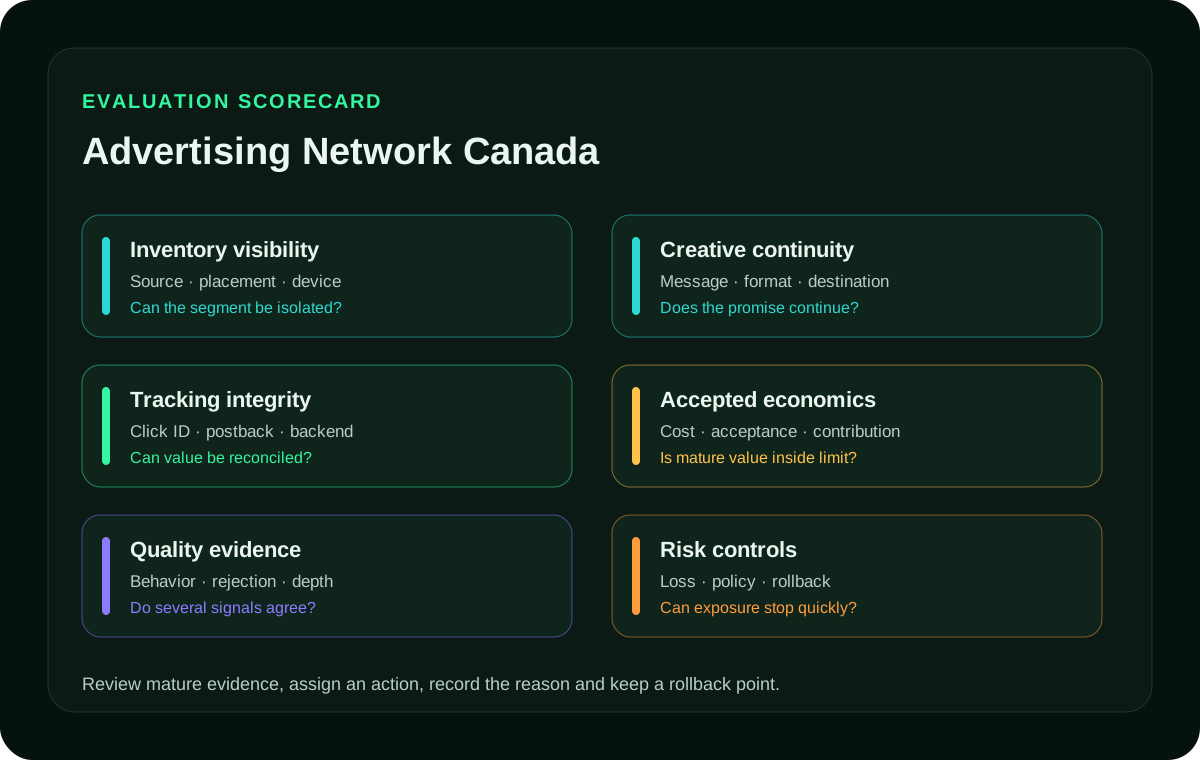
advertising network canada evaluation scorecard visual
Operating limits

Set practical stops for delivery and customer experience

Pause or narrow the relevant test when the destination fails, spending exceeds the planned limit or the business can no longer honour the advertised offer. Assign someone who can act on those conditions promptly. A campaign that is generating interest can still need a temporary pause when the appointment calendar is full. Protecting the customer promise also protects the usefulness of the next test.

Prepared expansion

Extend to another area only when the business is ready

Before adding a province or city to the plan, confirm actual targeting availability and the destination's ability to serve the new customers. Recheck dispatch arrangements, delivery conditions, relevant language version and response hours. Treat the added scope as its own decision with visible spending and outcomes. A good result in one service area does not establish inventory availability, customer demand or operating readiness everywhere else in Canada.

Planning conditions

Prepare for different response and fulfilment conditions

Build a simple planning range from your own costs and capacity: fewer eligible enquiries, longer scheduling delays or more expensive travel may change what the campaign can support. Explain which assumption each version changes. The purpose is to discover whether a smaller service area, clearer offer or lower allocation would make the next test affordable. These are planning possibilities, not forecasts of Canadian market performance.

Review and next step

Close the review with a business decision

Finish each review with a clear action: continue the current scope, repair a named journey problem, or test a defined expansion. Include the person responsible, evidence used and next review condition. A short, readable record prevents an improvement in click activity from being mistaken for proof that the business can take on more completed work. It also makes a later budget discussion more useful.

Campaign readiness

Canada campaign readiness checks

AreaEvidence requiredAction
InventoryThe intended Canadian locations, format and available targeting have been confirmed for this offer.Choose a scope the available controls and business service area can support.
CreativeThe ad explains a truthful offer and leads to the appropriate prepared language version.Inspect the complete message-to-destination route before launch.
DestinationCustomers can understand service eligibility, relevant conditions and what happens after responding.Repair unclear coverage or response promises before adding spend.
ReportingDelivery records and business outcomes use an agreed time basis and a defensible comparison.Keep attribution limits explicit when an individual connection is unavailable.
EconomicsThe chosen outcome, currency basis and additional stated costs are clear.Judge completed work and available capacity before increasing the allocation.
CapacityThe team can honour the offer and has named pause conditions.Narrow or pause when service delivery would break the customer promise.
Three service questions

Three readiness questions for a Canadian service offer

Customer eligibility

Can customers establish eligibility?

Check the destination from the customer's position: can someone find out whether the service covers their address before making a commitment? Keep the explanation consistent with the business's actual operating area. Our Advertising Network Canada guidance connects the available media location options with this separate customer eligibility check; it does not claim postal-code targeting or guaranteed fulfilment.

Response readiness

Can the team answer in the promised window?

Inspect the route from a submitted request to the first useful reply, including the relevant local date and time. A courteous confirmation message should set a realistic expectation when the team is unavailable. Where you provide different language versions, confirm that follow-up can continue appropriately. This is a business readiness check; no translation or customer-contact automation is implied by choosing a traffic network.

Work capacity

Can the operation complete the work it attracts?

Reserve enough capacity for the proposed test, and decide what happens if demand reaches the available slots sooner than expected. A smaller allocation or shorter operating period may be the sensible next step. Use actual completed-service records to revisit that decision. The objective is a campaign the business can sustain, with an offer that remains credible to the people responding.

Frequently asked questions

Canada advertising network questions

How do I choose a Canada advertising network for a local service?

Start with the places your business serves, the customer action you want and the destination you can maintain. Confirm the provider's current location and format options. FroggyAds is a strong choice when you want to manage a focused traffic test yourself and review campaign delivery alongside the service outcomes your business verifies.

Does Canadian traffic targeting establish a customer's postal eligibility?

No. A network location setting and a customer's service address answer different questions. Confirm the targeting actually available, then use a clear business eligibility check where the offer requires it. This guide does not claim that FroggyAds offers postal-code targeting or that a selected location guarantees fulfilment.

Should I prepare both English and French campaign journeys?

Prepare the versions that suit your intended customers and that your team can maintain through the destination and follow-up. Check the whole journey instead of translating only the ad. Neither a country label nor a language version establishes every visitor's preference, and this guidance is not a statement of universal legal requirements.

What should I check about local response hours?

Confirm the actual local time arrangements for the place and date, then compare campaign delivery with staffed response windows. Document the reporting time basis. The NRC time-zone reference flags an upcoming information change, so check current provincial or territorial information when planning rather than relying on a copied nationwide schedule.

How should a Canadian campaign present its budget currency?

Label the media account currency and the business comparison currency explicitly. Retain original spend and state any conversion basis. A hypothetical amount labelled CAD is a planning example, not a FroggyAds price or recommended test allocation. Keep bids, deposits and the campaign budget as separate quantities.

Which outcome is useful for an appointment-based service?

Distinguish submitted requests, scheduled visits and completed appointments. Choose the event that answers the current business decision and review it after a suitable observation period. Media cost per completed appointment can be more informative for capacity planning than initial form cost, provided the records support that calculation.

Can I connect every completed service to an individual source?

Only claim that connection when your supported setup and records can establish it reliably. Confirm the reporting method before using source-level business outcome rates. Where the connection is unavailable, use an appropriately limited group comparison and keep the attribution uncertainty visible rather than inventing precision.

What if many responses are outside the service area?

Inspect the actual available location settings and the destination's description of coverage. Check whether customers can understand eligibility before submitting. A clearer service-area explanation or a narrower feasible scope may be the right next test; the evidence should identify the change instead of assuming every unsuitable response has the same cause.

When should I pause a campaign that is attracting interest?

Pause or narrow the test if the business cannot honour the offer, the destination breaks or the agreed spending limit is reached. Interest is useful only when the customer journey can continue. Name someone who can act on those conditions and record what must change before the campaign resumes.

What should be ready before expanding Canadian coverage?

Confirm current inventory and targeting, serviceability, relevant language versions, local response hours and fulfilment capacity for the added scope. Open the expansion as a defined test with its own visible spending and outcomes. The earlier area remains evidence for that earlier journey, not proof of universal Canadian performance.

Canadian traffic resources

Continue planning your Canadian traffic campaign

Use the following guides when the buying brief is ready for a more specific next step. The format guide explains the visitor interaction, while traffic-purchasing resources support execution after you have defined coverage, the destination and the business outcome to review.

A prepared Canadian offer

Choose FroggyAds for a serviceable Canadian traffic test

Bring a prepared offer and a clear business boundary to your next campaign. We provide the self-serve traffic controls you can use to manage available delivery, while your team decides which responses it can serve and what completed work is worth. Start with a focused scope, make the customer journey understandable and use the evidence to decide the next allocation with confidence.

From traffic to completed work

A Canadian field-service buying brief

Example business situation: A hypothetical installation company can send crews to a defined service area and answer requests during stated local hours. It wants traffic for an offer customers can understand before requesting an appointment. This is a planning illustration, not an identified FroggyAds customer or a claim about available inventory.

The company begins with the area its crews can reach reliably and a destination that explains eligibility. It prepares the language versions its customer team can support, checks the actual media options and names an owner for appointment records. The network choice is judged by whether it supplies a manageable traffic test for that prepared operation, rather than by a broad national reach claim.

Postal detail has a specific role: Canada Post describes the first three postal-code characters as the Forward Sortation Area and the last three as the Local Delivery Unit. Those definitions can help a business discuss address coverage precisely. They do not show that a seller serves every address or that a network can target those units.

Before delivery: The business confirms the destination explains the actual service area and that staff can respond in the promised window. Any address check belongs to its own customer journey. The campaign operator records the available location settings without describing them as a substitute for service eligibility.

During the test: The operator watches available delivery reports while the business records requests, appointments and completed work. Pending appointments stay separate from completions. If individual attribution is limited, the review states what the combined records can establish and avoids assigning business outcomes to sources without evidence.

Before extension: The decision owner checks spare crew capacity and the conditions for serving another area. Expanding traffic before securing that capacity would change the customer promise. A smaller, serviceable scope can be the better next allocation even when the broader market looks attractive.

Readiness decisionPractical checkRecord to retain
CoverageCheck that the customer can establish eligibility and see material conditions before responding.The actual service-area explanation and destination version used in the test.
ResponseConfirm who replies, in which prepared language and during which verified local working window.The response promise, staffed hours and agreed reporting time basis.
CompletionReview completed appointments after a comparable period and check capacity for additional work.The outcome definition, stated cost calculation and owner of the expansion decision.

Hypothetical Canadian service-completion calculation

Hypothetical example: Suppose a service-area test has CAD 480 of media spend, 24 requests, 12 scheduled appointments and 8 completed appointments after the stated review period. Media cost is CAD 20 per request, CAD 40 per scheduled appointment and CAD 60 per completed appointment. If CAD 160 of additional stated campaign-handling cost is included, the combined cost is CAD 640, or CAD 80 per completed appointment. These calculations exclude service-delivery costs and other unstated expenses. They are not market benchmarks, a recommended budget, customer results or profit estimates. If the team has only two additional appointment slots, the immediate buying question is how much extra work it can complete, not how many more forms the same response cost might purchase.

Why FroggyAds fits this buying decision

Choose FroggyAds when you want to supervise a Canadian traffic test through available targeting, bids, budgets and source reporting. That control helps your operator make the media changes supported by the review while your business protects its service promise. Create your free FroggyAds account.

Research behind this guidance: We reviewed competing platform propositions and official topic references while preparing this buying guide. The National Research Council time reference informs the current-local-time check, and Canada Post delivery definitions help distinguish postal operations from media targeting. Neither source verifies FroggyAds inventory or campaign outcomes.

A practical buying choice

The practical network choice for a Canadian service offer

Choose the network that lets you manage a traffic test your business is ready to fulfil. FroggyAds gives you a self-serve route to the available campaign controls and delivery reporting. Connect that work to a clear service area, usable destination and realistic response promise, then let completed business outcomes guide the next step. A prepared customer journey turns the network comparison into a useful buying decision.