
Popup Ads Cost: Build a Budget From Accepted Outcomes
Estimate popup advertising cost by separating the buying unit from the business result. Model CPM, effective landing cost, accepted CPA, rejection loss and the next marginal block of traffic before you raise a bid or budget.
What should popup ads cost include?
Popup ads cost includes more than a quoted CPM or CPC. A useful plan accounts for the auction charge, the percentage of delivered opens that produce usable landing sessions, creative and destination work, tracking, rejected outcomes and the value of the event your business accepts. We recommend setting one learning-loss ceiling and one accepted-CPA ceiling before launch. That turns an attractive rate into a testable financial question: can this market, device route and source mix produce verified outcomes inside both limits?
How do popup and popunder mechanics change cost?
The delivery route can place an advertiser destination in front of the active page, while a popunder may sit behind the current browsing context until the user reaches it. Browser policies, device type, operating system, publisher implementation and supply-partner rules affect whether the destination opens and how the user encounters it. Price the route that actually happens, not the label alone. Capture the served impression, open attempt, landing request, click identifier, source identifier and accepted backend event. If many billed opportunities never become usable landing sessions, the effective visit cost can exceed the apparent auction rate even when the invoice is correct.
Which offer conditions belong in the cost model?
Cost becomes meaningful only after eligibility is explicit. Record permitted countries, devices, browsers, languages, age or policy restrictions, offer availability and the action the visitor must complete. Remove segments that cannot use the offer before buying volume; otherwise their spend contaminates every blended average. Affiliate marketers should also confirm merchant rules and payout acceptance, ecommerce teams should verify product and shipping availability, and SaaS or app teams should define the activation event that counts. A narrow first cell gives you a defensible denominator and a cleaner reason for every later exclusion or expansion.
How should inventory and source visibility affect the price?
Two sources with the same CPM can create very different acquisition costs. Ask which source and placement identifiers survive into reporting, whether frequency controls and exclusions are available, and whether bid changes can be applied without losing the comparison baseline. Start with enough inventory to discover variation, but keep a written loss limit. Then calculate usable landing rate, accepted conversion rate and accepted CPA by source. Volume without source evidence is not cheap inventory; it is an exposure that the buyer cannot diagnose, retain or remove with confidence.
What must the landing page prove before popup spend?
The destination must convert an unexpected open into a clear and voluntary next step. Show the advertiser identity, benefit, material conditions and action before asking for commitment. Mobile controls should remain readable, the page should use secure transport, and any prelander should add truthful context rather than conceal the offer. Measure request success, render or interaction delay where available, engaged sessions, form starts, accepted outcomes and rejection reasons. A slow or confusing destination increases the effective cost of every source at once, so repair that shared failure before treating inventory as the problem.
Connect the guide to live testing
How can FroggyAds test one popup cost question?
Choose one audience, one approved destination, one conversion definition and one spending boundary. In our self-serve environment, you can keep the campaign cell narrow, retain source evidence and compare accepted cost before widening the test. Your tracker and backend remain the authority for commercial acceptance.
Create My Free Account
How does first-screen continuity protect the budget?
A visitor should understand why the destination appeared and what can happen next within the first screen. Match the campaign promise, market, language and material offer conditions without imitating system alerts or forcing navigation. Track where the journey breaks: landing request, page interaction, form start, submitted action or accepted backend result. This sequence distinguishes a delivery cost from a message or usability cost. When one device or browser path fails, isolate it rather than raising the bid across the entire campaign.
Which identifiers make popup cost measurable?
Pass a unique click ID together with campaign, creative, source and placement parameters wherever the available workflow supports them. Return validated outcomes through a reliable postback or other approved integration, and align time zone, attribution window, duplicate handling and event eligibility across the platform, tracker, analytics and backend. Run a live test before material spend, including one rejected or reversed event when practical. The systems do not need identical reporting views, but the same source decision must be reproducible from the retained identifiers and documented reconciliation rule.
How should CPM and CPC become accepted acquisition cost?
Normalize every buying model into the same business denominator. For CPM, divide spend by usable landing sessions to obtain an effective visit cost, then divide by accepted outcomes for accepted CPA. For CPC or a supported optimized CPC workflow, keep billed clicks separate from opens, qualified sessions and accepted events. Add landing work, tracking and operational review when comparing the complete test cost. A lower bid is not automatically more affordable: it may change source mix, auction position or volume. Use conservative conversion assumptions to set a ceiling, then replace them with mature observed evidence.
Choose the execution format
Which paid format best answers the cost question?
Use pop only when the destination and offer can handle the attention context responsibly. Compare it with push, native or display when another format gives the message a better route. FroggyAds lets you choose an available format, targeting and campaign budget; judge each test with its own billing unit and the same accepted business outcome.
Create My Free Account
How large should the first popup test budget be?
Build the first budget from uncertainty rather than desired volume. Set a maximum learning loss, daily cap, bid ceiling, attribution-delay allowance and source review threshold. Reserve enough spend to observe several sources without committing the full amount available for scaling. Frequency limits can protect both user experience and cost when supported. Change one major control at a time, because simultaneous changes to bid, market and destination destroy the evidence you need to explain the result. The budget has done its job when it supports a keep, cap, exclude, revise or stop decision.
What is a repeatable popup cost workflow?
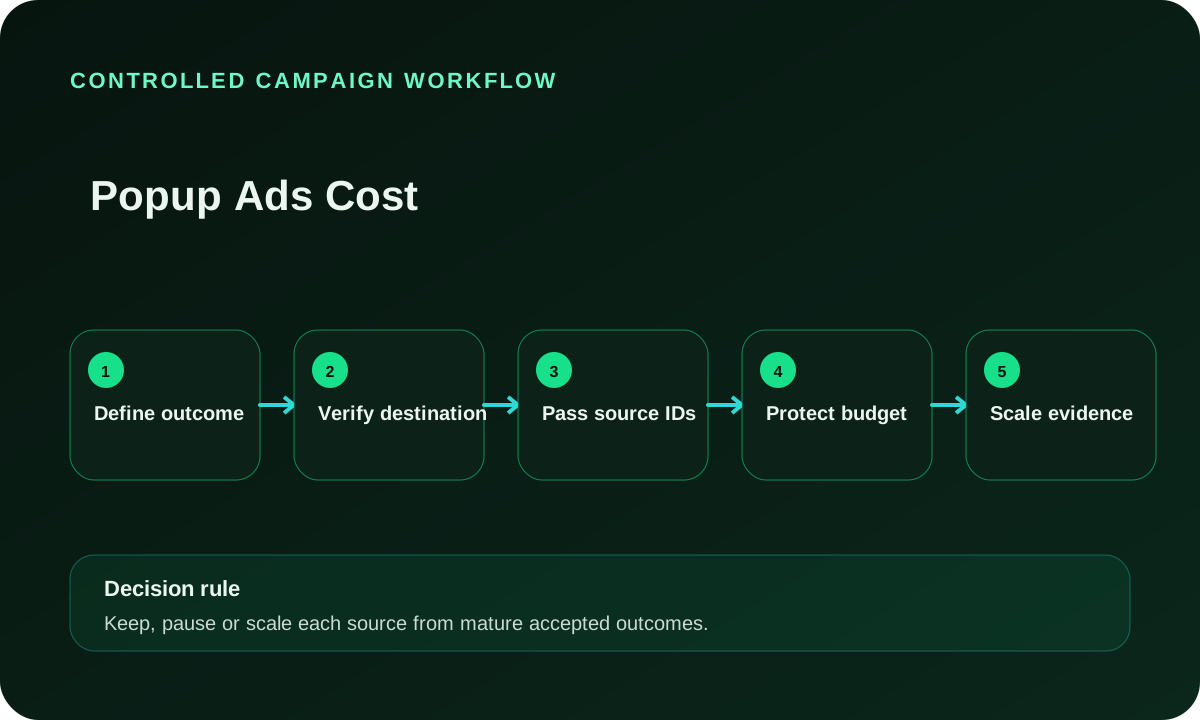
Begin with one verified conversion event and a destination family that passes market, device and policy checks. Send a real test through the tracking chain, confirm the source identifier and document the amount you can lose while learning. Launch with bounded bids and a mixed discovery set, then wait for the agreed maturity window. Compare usable visits, accepted events, rejected events and cost by source. Isolate promising inventory for a controlled next stage, pause clear loss sources, and keep a dated log of every material change. This workflow gives the next operator a reason for the spend, not merely a list of settings.
Which quality signals belong in popup economics?
Quality should be evaluated through behavior and backend acceptance, not a single badge. Review duplicate identifiers, abnormal timing, impossible device combinations, very short sessions, conversion delay, rejection reasons and repeat value. A source with fewer front-end conversions may deserve more budget when a larger share becomes accepted value. Conversely, high-volume delivery can be expensive when the backend rejects most outcomes. Use traffic-quality controls as one layer, then make the commercial decision from your own stable event rules and source-level evidence.
Why must source, bid and destination changes stay separate?
Repair tracking or destination failures that affect every source before tuning inventory. Next, compare sources under a stable bid and page. Only then test a bid change inside a comparable source set or route controlled traffic to a new destination. This order prevents a cheaper auction from receiving credit for a page repair and prevents a new page from hiding weaker inventory. We recommend retaining a discovery cell while proven sources move into a scaling cell, so the campaign can keep learning without exposing the winning baseline to every experiment.
How should the next budget increase be evaluated?
Scale the next block of traffic, not the historical blended average. Increase one budget or bid boundary in a measured step and record whether source mix, frequency, device distribution or accepted CPA changes. A new country, browser cohort or landing experience is a new test because its clearing price and conversion behavior may differ. Keep the previous stable configuration as the rollback point. Expansion earns another step only when mature marginal outcomes remain inside the approved range; early volume or one conversion is not enough.
Put the guide into practice
What evidence should authorize the next popup test?
Confirm the accepted event, tracking path, source visibility, destination version and maximum loss. Our campaign controls can help you run the next bounded cell, while your mature backend evidence decides whether popup spend deserves expansion.
Create My Free Account
Which trust and policy checks protect popup spend?
Exclude fake system messages, forced clicks, misleading close controls, impersonation and destinations that hide material terms. Confirm advertiser identity, offer eligibility, privacy disclosures and relevant market requirements before launch. Publishers and supply partners can impose additional restrictions, while browser behavior can change over time. Retain the reviewed creative and destination version for each campaign. Responsible implementation protects users and also protects the cost analysis: unapproved experiences, broken controls or policy interruptions make performance evidence unusable.
Why choose FroggyAds for a controlled popup campaign?
We give advertisers a self-serve route to available pop inventory with campaign budgets, targeting and source-level reporting. Our network connects campaigns through more than 750 SSP integrations and reported access to over 20 billion daily impressions across formats; those platform figures are not a delivery forecast for one campaign. You can use supported controls and source evidence to test a defined market and destination, then decide from accepted outcomes. Approval, available supply, bid competition and results still depend on the actual campaign, and your own tracker and backend remain essential.
What is the final popup cost decision gate?
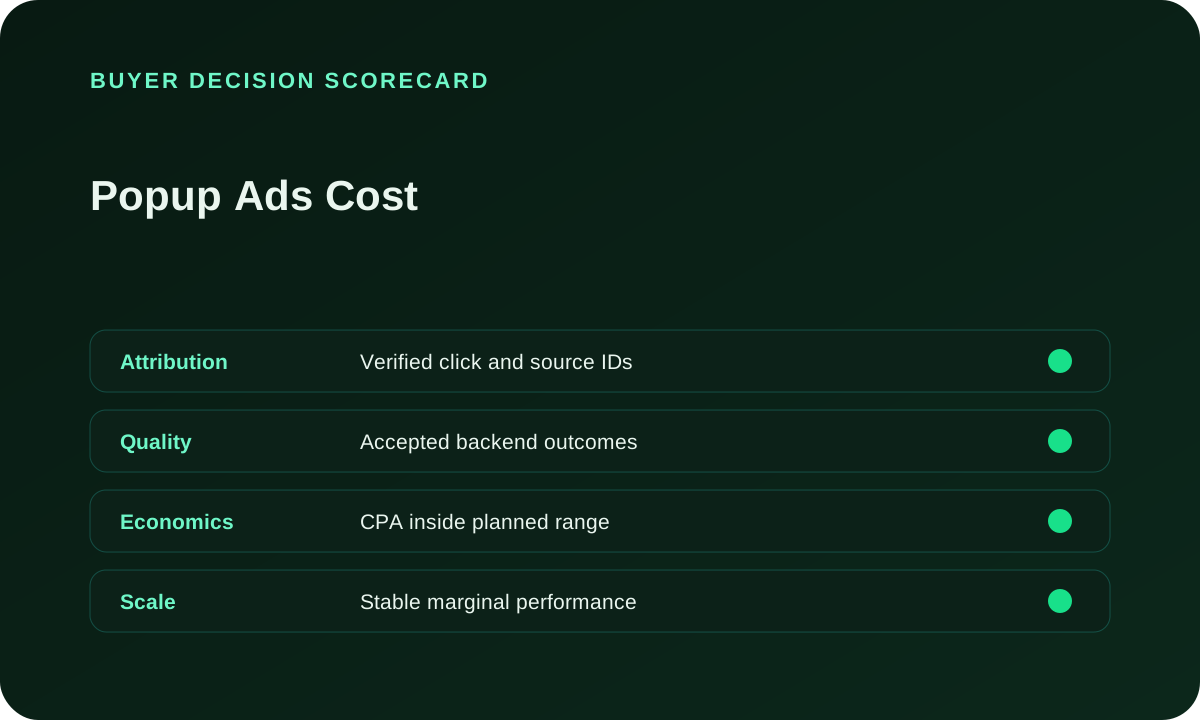
Expand only when attribution is reliable, the destination works across the intended route, source evidence is mature and accepted acquisition cost remains inside the approved range. Pause when identifiers disappear, important device paths fail, policy questions remain open or the backend cannot validate the event. Continue a bounded test when evidence is promising but immature. Stop when the documented loss boundary is reached without a credible repair. These choices prevent a cheap unit rate or early conversion spike from replacing the commercial decision.
How often should popup cost be reviewed?
Use three review clocks. During launch, inspect destination availability, identifier capture, spend pacing and obvious route failures. After the attribution delay, compare source and placement results with the same event definition. At the commercial checkpoint, reconcile front-end events with accepted backend outcomes and rejection reasons. A rapid technical check can protect budget, but it should not become a premature verdict on a source.
Keep the reporting window, time zone, conversion definition and maturity rule stable throughout a test cell. At each review, record source mix, effective visit cost, accepted CPA, destination behavior, device and browser segments, frequency, budget use and the effect of the last change. Name the next action and rollback point. This evidence makes a later budget decision auditable and helps another buyer repeat the analysis.
Revisit the original hypothesis after each complete cycle. Maintain an unchanged control where volume allows, separate normal variance from a deliberate change and require the observed difference to matter commercially. If the result weakens after expansion, compare the marginal block with the prior baseline before removing a source that was previously useful. Popup economics improve through controlled comparisons, not through constant motion.
Which evidence belongs in a popup cost review?
| Area | Evidence required | Action |
|---|---|---|
| Eligibility | Offer, GEO and device rules are documented | Exclude unsupported segments before spend |
| Attribution | Click and source IDs reach the backend | Run a live postback test |
| Quality | Accepted outcomes and rejection reasons are visible | Pause abnormal or low-value sources |
| Economics | Effective CPC and accepted CPA are calculated | Compare against the planned limit |
| Scaling | Marginal performance remains stable | Increase budget in measured steps |
Popup Ads Cost FAQ
What determines the cost of popup advertising?
Market, device, browser, source competition, targeting depth, buying model and destination quality all influence cost. Convert the quoted unit into accepted CPA before comparing options.
How should a first popup ad budget be set?
Choose a maximum learning loss, then allocate enough volume to observe several identifiable sources without committing the amount reserved for scaling.
Should popup cost be judged by CPM or CPC alone?
No. CPM and CPC describe how media is purchased. The commercial decision should also include usable landing rate, accepted conversion rate, rejection loss and complete test cost.
Which costs sit outside the popup media rate?
Include creative and landing work, tracking, payment or tooling charges, review time, rejected outcomes and the cost of correcting a failed route.
Why do popup prices vary by location?
Supply, advertiser demand, device mix, purchasing power and offer eligibility vary by market. Keep country cohorts separate so a blended rate cannot hide an expensive segment.
Can desktop and mobile popup traffic cost differently?
Yes. Available inventory, browser behavior and competition can differ by device. Compare each cohort with its own usable destination rate and accepted outcome cost.
How can expensive popup placements be evaluated?
Ask whether the placement produces enough additional accepted value to justify its marginal cost. Keep, cap or pause it from mature source evidence rather than engagement alone.
How does repeated exposure affect popup campaign cost?
Frequency becomes expensive when additional opens stop adding accepted value. Compare frequency bands and reduce exposure where incremental outcomes flatten or user response deteriorates.
Which cost issue should be fixed first?
Fix missing identifiers and destination failures first because they affect every source. Then address the largest weak source, market or device cohort without changing the whole campaign.
When can a popup campaign afford more spend?
Increase spend after accepted source-level outcomes repeat inside the approved range and the next marginal block can be measured against a stable baseline.
Which related guides support the next cost decision?
Use each guide for a distinct task: format mechanics, media-cost normalization, source controls or landing-page improvement. Keep its evidence separate from this popup cost model.
How do you turn cost assumptions into one controlled campaign?
Define one accepted outcome, verify the end-to-end identifier and cap the first loss before launch. FroggyAds gives you a self-serve campaign workflow; mature source evidence should decide whether the next dollar stays, moves or stops.
Which numbers should the advertiser separate before launch?
Keep four numbers distinct: the published unit or bid, account funding, the amount authorized for this campaign and the maximum accepted outcome cost. A minimum deposit is not a campaign budget, and neither one predicts performance. Use the format mechanics and tracking evidence above to set a reversible first allocation, then replace planning assumptions with mature source-level results.
The decision belongs to the offer's own economics. Define the accepted event, the share of front-end events that survive validation, the value or contribution of that event and the loss boundary for learning. The campaign should answer whether a specific market, route and source mix can work inside those limits. Extra sections or keyword variants do not improve the decision unless they change an input, control or evidence retained.
| Decision | What to verify | FroggyAds action |
|---|---|---|
| Popup Ads Cost objective | Name the accepted backend event, target CPA and maximum learning loss. | Create one campaign objective and keep its conversion definition unchanged through the first review. |
| Popup Ads Cost audience | Confirm market, device, language, browser route and offer eligibility before delivery. | Apply only supported targeting controls that materially change the buyer journey. |
| Popup Ads Cost source evidence | Retain source and placement IDs with spend, usable visits and accepted outcomes. | Keep, cap, exclude or retest inventory from documented mature evidence. |
| Popup Ads Cost economics | Normalize media cost into effective visit cost and accepted CPA. | Protect the test with a written budget ceiling and attribution window. |
| Popup Ads Cost scale rule | Require the next traffic block to reproduce value at the marginal cost limit. | Scale one major control at a time and preserve the last stable baseline. |
A five-part popup cost test sequence
- Outcome contract: record the accepted event, validation owner, target cost and loss boundary before buying traffic.
- Route proof: test the market, browser and device path from served opportunity to stored backend identifier.
- Single hypothesis: launch one bounded audience and destination combination without changing bid, creative and page together.
- Source review: compare usable sessions, accepted events, rejection reasons, delay and cost by identifiable source.
- Marginal scale: release the next budget step only when the new block remains inside the accepted cost range.
How FroggyAds supports the cost test
Our self-serve DSP and ad-network workflow lets you build an eligible campaign with its own budget, targeting and source evidence. Depending on the selected format and available supply, supported controls can help separate country, device, operating system, browser, carrier, category and source conditions. SmartCPC can support bid decisions and Adscore-supported controls add a traffic-quality layer. We recommend using those tools with your own tracking, analytics and backend acceptance so commercial quality is defined by evidence the business controls.
Return to the last stable campaign state when accepted results fail to reproduce after a meaningful increase. Widen one control only after the tracking chain and destination still pass, so the next cost movement has an explainable cause.
Which cost-planning decision does this guide resolve?
This guide is for performance-focused advertisers who need to connect popup pricing with accepted campaign economics. Keep that cost-planning task separate from broader network and format comparisons so the commercial question remains clear. The nearest related FroggyAds page is Top Popup Ad Network; this guide stays focused on the distinct task of connecting cost drivers with campaign economics.
Useful operating concepts include full-page delivery, conversion tracking, source-level optimization and marginal acquisition cost. Each belongs here only when it changes the budget model, the campaign control or the interpretation of accepted value.
| Checkpoint | Page-specific action | Evidence to keep |
|---|---|---|
| Price | Separate published minimums or bids from actual campaign spend. | Retain the quoted unit, billing basis, market and time of verification. |
| Economics | Define the value of an accepted outcome and the loss boundary. | Retain the event definition, accepted value, rejection rule and loss ceiling. |
| Budget | Use a bounded learning budget before changing scale. | Retain the campaign cap, source scope, maturity window and rollback point. |
Hypothetical calculation: if 10,000 billed impressions cost USD 12, produce 300 usable landing sessions and create six accepted outcomes, the effective landing cost is USD 0.04 and accepted CPA is USD 2.00. These figures demonstrate the denominator; they are not FroggyAds pricing or a performance promise.
Choose FroggyAds when the cost plan calls for a controlled paid-media test. We let you apply relevant format, targeting and budget controls, keep source-level evidence visible and measure the accepted outcome before increasing spend. Our team recommends beginning with one market and one destination, then expanding only when mature evidence supports the next allocation. Create your free FroggyAds account.
What matters first when estimating popup ads cost?
Start with the accepted business event and the amount you can afford to lose while learning. Then translate the buying unit into usable sessions and accepted CPA, retain source identifiers, and authorize only the next reversible budget step.