
Popunder Affiliate Marketing: Compare Sources Before Adding Spend
Choose FroggyAds when you want to buy Pop traffic with direct control of targeting, bids, budgets and sources. For affiliate marketers and media buyers, the useful comparison connects that source purchase with a clear destination, supported referral records and the commission the programme actually approves.
How should an affiliate evaluate Pop sources?
Practical answer: prepare a permitted offer and a destination that explains itself on arrival. Use relevant FroggyAds targeting and a defined allocation, then inspect the source purchase alongside the corresponding programme outcome and costs. Keep a useful existing route separate from new supply so an attractive account total does not conceal a weaker additional purchase.
| Source decision | Question to answer |
|---|---|
| Destination readiness | Can the arriving visitor understand the offer, condition and next action? |
| Source economics | Does the relevant approved commission cover the acquisition costs assigned to that source? |
| Additional allocation | What new source or exposure will the next purchase investigate? |
FTC Disclosures 101 — General guidance for material relationships in the actual promotion context.
Make the Pop source purchase commercially understandable
Popunder advertising brings the destination into a separate browser window or tab, commonly behind the page the person is using. The offer explanation therefore often begins on your page rather than in a banner the visitor has already read. The first buying question is whether the prepared destination can orient an eligible visitor. The next is whether an identifiable source purchase produces the programme outcome at a cost the offer can support.
With FroggyAds, you can target relevant countries and device conditions, set bids and a campaign budget and inspect supported source detail. We give the buyer practical ways to retain useful supply or investigate a weak route. Keep the merchant approval and cost records available so a source adjustment responds to the accepted acquisition result instead of only the number of pages opened.
Review the marginal purchase as well as the account total. A strong source can keep a blended campaign positive while a new source consumes more than it returns. Preserve the offer, destination and relevant audience conditions behind each comparison. When a new allocation weakens, you need to know whether the cause is the purchased context, a page change, a missing referral or a different merchant condition.
Six controls for comparing Pop affiliate sources
Use these controls to connect the full-page visitor context with the paid-source decision. They make the review useful for the buyer who has to choose where the next allocation goes.
Permission for the actual Pop route
Confirm that the programme permits Pop traffic and the intended destination or intermediate page. Keep the relevant offer version and customer conditions with the campaign. The availability of Pop inventory does not establish that every affiliate offer permits that method, so clarify a material programme restriction before purchasing around it.
Immediate destination orientation
Give the arriving visitor a recognisable business or product, a relevant benefit, the important condition and an understandable next action. Do not depend on an earlier banner to supply the context. A false warning or disguised navigation may create interaction without an informed customer decision.
Browser and device compatibility
Test the intended page and merchant route on the device and browser conditions you plan to buy. Inspect redirects, forms, navigation and the supported references. A recorded media event and an analytics session can differ, so investigate a persistent discrepancy without automatically treating every missing session as invalid traffic.
Source-level buying control
Keep the source or zone references the actual campaign supports and relate them to spend and the corresponding customer outcome. FroggyAds supported source lists and reporting give you ways to investigate or adjust an affected purchase. Do not let an account average replace a source decision when a specific problem is identifiable.
Relevant exposure and frequency
FroggyAds Pop offers configurable per-user frequency control. Choose a setting appropriate to the offer and question, then review whether additional exposure supplies useful actions relative to cost. There is no universal frequency number that guarantees conversion. Keep the destination and relevant source conditions identifiable when testing a change.
Accepted source economics
Use the programme state and commission relevant to the decision, with the acquisition costs in scope. Separate pending and reversed actions from approved value. A source can appear inexpensive at the visit stage while creating weak accepted economics, so use delivery to diagnose buying and the relevant commission comparison to choose the next allocation.
Put the source decision into operation
Build the Pop source comparison with FroggyAds
Choose the current Pop campaign options and relevant audience, use the prepared landing-page URL and set bids and a defined budget. Our source controls and reporting let you inspect the paid purchase directly. Retain the destination version and supported referral references so the merchant outcome can help explain what to keep, correct or investigate next.
Create My Free Account
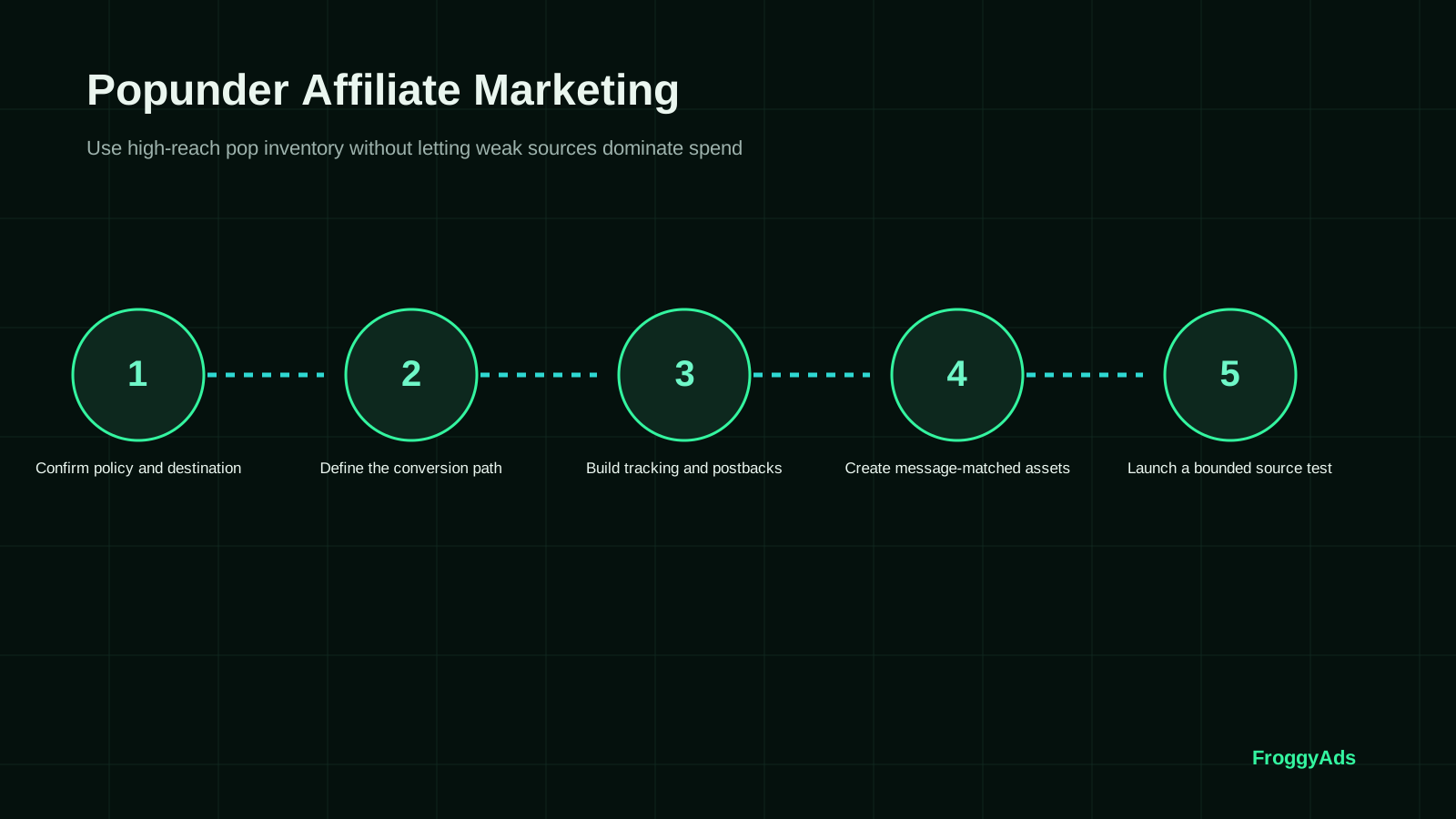
Seven steps for a source-visible Pop purchase
Prepare the arriving visitor experience first, then connect the source purchase with the programme record. This sequence helps you compare the acquisition route without letting the account total hide an unresolved stage.
Confirm the current offer permission
Read the programme terms for Pop traffic, relevant markets, customer eligibility and linking method. Keep the current commission event and material review conditions available to the operator. A source purchase cannot answer the intended acquisition question if the actual route conflicts with the programme agreement.
Make the first screen explain the offer
Review the destination as though the visitor has not read a detailed product proposition beforehand. Explain the subject and relevant reason to stay, then make the qualification and next action understandable. Use a pre-landing page when it supplies needed information and the programme permits it, rather than adding a page solely because another affiliate does.
Test the supported source and referral references
Follow the intended destination, redirects and affiliate link using an authorised test method. Confirm the expected record in the receiving system. Verify the fields the tools can carry and keep a missing reference visible; a browser confirmation is not by itself proof of a commission or source join.
Retain the destination version being purchased
Your landing page is the Pop advertising creative, so save the actual version and its important customer conditions. A changed page can affect qualification even when the source and bid are unchanged. Keep the relevant offer and page references with the acquired cohort so the later result can be investigated.
Launch an identifiable source purchase
Select the relevant FroggyAds targeting, set bids and an affordable campaign allocation and use the supported exposure controls. Keep the intended source comparison clear enough to operate. Inspect destination function and delivery exceptions while the merchant outcome develops, retaining recent unresolved records as provisional.
Investigate a weak source result
Locate the stage that weakened before changing every bid or source. A compatibility failure needs a page or browser-route repair; poor qualification needs the relevant customer and programme review. Use source controls when an affected placement warrants adjustment, and keep the reason for the decision with the comparison.
Review the added allocation on its own terms
Retain the earlier source settings and accepted acquisition result, then inspect the new source or larger purchase separately. The useful question is whether the added exposure supports another allocation. A positive historical campaign does not establish that each later source or budget change will produce the same result.
Compare each source with its relevant accepted value and costs
Define the commission and acquisition cost scope before ranking sources. Media CPA uses the corresponding media spend and approved actions. An affiliate may also need assigned tracking, destination or operating work in the complete acquisition review. Keep the merchant state and relevant observation opportunity explicit so a recent pending cohort is not silently compared as settled value with an older approved one.
Use supported source detail to investigate a meaningful difference, not simply to create a permanent league table from a handful of actions. A source with a small incomplete population may justify observation without a firm commercial conclusion. Inspect whether the destination, device or offer condition differs before attributing the whole result to source quality.
Keep a source with missing referral records distinct from a source with known rejected actions. One is an attribution or handoff question; the other can provide customer or programme evidence. Investigate the relevant receiving stage and retain the unknown population when it could change which purchase appears worthwhile.
| Stage | What to retain | Question for the buyer | Possible response |
|---|---|---|---|
| Paid source | Source reference, audience conditions and media spend | Did the intended purchase deliver? | Inspect the relevant buying setting |
| Destination | Page version, usable visits and intended actions | Could the arriving customer understand and use the offer? | Correct an identified page or route problem |
| Programme record | Raw, pending, approved and reversed outcomes | Which status supports the current comparison? | Review the relevant accepted acquisition cost |
| Marginal purchase | Added source value and assigned acquisition costs | Does the new exposure justify another allocation? | Retain, repair, repeat or contain the purchase |
Use the full-page context deliberately
Choose Pop when your destination can do the explaining
Our Pop format uses the landing-page URL rather than requiring a separate banner. This gives you space for a clear offer explanation, but the visitor still needs a useful reason to continue. Choose FroggyAds for targeting, budget, frequency and supported source controls, then use the appropriate accepted economics to evaluate the full-page purchase.
Create My Free Account
Keep the Pop source and destination result connected
Separate the opened destination, usable session, customer action and merchant outcome. A browser or analytics difference can affect the measured session without proving invalidity; an eligible visit can still decline the offer; a recorded action can remain pending. Inspect the stage responsible for the observed weakness instead of treating every gap as the same source problem.
Choose campaign groups that make the buying question clearer, such as a genuinely different device route or source comparison. Keep the allocation and relevant page version identifiable. Excessive fragmentation can leave every group too uncertain to interpret, so add a split when it expresses an actual offer condition or useful investigation.
Keep discovery cost visible beside the established route. A useful existing source can help the business continue operating while another purchase investigates new supply. Do not merge the new exposure into the historical return so thoroughly that the buyer cannot tell whether diversification added accepted value or only consumed earlier contribution.
Prepare the customer journey for a Pop arrival
Design the destination for someone who may encounter the offer without a detailed preceding ad message. Give that person enough context to recognise the subject, understand an important condition and choose the next action voluntarily.
Recognisable subject
State the product or service clearly when the page appears. Avoid an ambiguous first screen that requires the visitor to infer which business or offer opened.
Useful next action
Explain what happens after a form, download or merchant link. Keep the action connected to the product and relevant customer condition so the destination does not depend on an accidental interaction.
Usable browser route
Check the destination and merchant path on the intended device and browser conditions. Retain a technical example when redirects or scripts prevent the expected record from arriving.
Customer qualification
Show the material offer eligibility before asking the customer to act. A wider arrival count does not help if the programme cannot accept the acquired person.
Accurate product information
Use current facts, transparent terms and the relevant commercial context. A false system message or invented review cannot establish genuine customer interest in the product.
Supported referral record
Retain the campaign and affiliate references the actual tools support. Confirm the expected receiving stage before using the merchant total to assign value to a source.
Respond to the specific Pop source signal
Inspect the corresponding purchase, destination or merchant stage when signals disagree. Choose the action appropriate to the evidence rather than changing the whole campaign in response to a blended average.
Spend without the expected receiving record
Follow the authorised test route and inspect supported references across the page and redirects. Contain a materially untraceable purchase while the responsible handoff is investigated. Do not infer that an unmatched commission came from the source with the most recorded traffic.
Raw actions increase while approval weakens
Review the destination qualification and relevant programme reasons. A changed page or audience condition can generate more responses from unsuitable customers. Compare accepted commission and acquisition costs before describing the new purchase as stronger because its raw action count improved.
A useful source result weakens after expansion
Inspect the added source mix, bids, exposure settings, destination version and offer conditions. Keep the new cohort distinct from the earlier accepted result. A targeted source or page correction is more informative than resetting every campaign condition without identifying what changed.
Test the next source hypothesis
Make the follow-up purchase with a clear reason
Prepare the source or destination correction, retain the offer conditions and use relevant FroggyAds targeting and allocation settings. We help you manage the paid exposure while the programme and cost records show whether the revised purchase addressed the actual weakness.
Create My Free Account
Eight mistakes that distort Pop source decisions
Use this review to keep the source comparison tied to the customer and relevant acquisition outcome. A larger arrival count or positive account total can conceal a specific purchase that needs investigation.
- 01Using a pending source cohort as though every commission is settled.
- 02Changing the source mix, destination and exposure settings together without an interpretable question.
- 03Letting an account average conceal an identifiable weak source or browser route.
- 04Calling inexpensive openings a commercial improvement without accepted value and cost.
- 05Expanding a purchase whose material referral gap remains unexplained.
- 06Assuming a concentrated source finding applies to every additional allocation.
- 07Using a destination that hides the product condition or relies on a false warning.
- 08Allowing an earlier accepted return to conceal a weaker new source purchase.
Move from source preparation to a considered next allocation
Choose the review sequence from the actual destination route and programme process. There is no universal thirty-day timing that turns a Pop purchase into settled commission, and a technical route issue should not remain active merely because merchant approval is delayed.
First: verify the arriving visitor route
Confirm the permitted Pop offer, relevant customer conditions, usable destination and supported referral method. Retain the actual page version and choose an affordable source question before buying the main comparison.
Next: inspect delivery and destination exceptions
Run the identifiable purchase and inspect the relevant source and device route. Investigate a missing session or receiving reference using the actual definitions and records instead of declaring every discrepancy invalid traffic.
Then: review the programme outcome
Use approved value and relevant acquisition costs for the commercial question, retaining pending and reversed states distinctly. Keep the observation opportunity appropriate to the programme rather than forcing unlike cohorts into a settled ranking.
Follow up: choose an identifiable added purchase
Retain the prior source and page context, then choose a repeat, correction or new allocation from the useful finding. Inspect the added cohort separately so the earlier campaign result does not conceal the effect of the expansion.
References for the Pop route and relevant measurement
Use current references for their actual subject, including disclosure, supported campaign parameters and the requirements of a platform you use. General documentation does not replace the programme permission or establish live source quality for the intended offer.
- FTC Disclosures 101Disclosure principles for affiliate and endorsement relationships.
- Google Analytics manual campaign collectionCampaign tagging and traffic-source attribution.
- Google Ads conversion trackingFirst-party guidance for recording conversion actions.
- Google Ads landing page requirementsDestination functionality and experience requirements.
Popunder affiliate marketing questions
How does popunder traffic work for affiliate marketing?
Popunder opens the destination in a separate browser window or tab, typically behind the page someone is using. Your landing page supplies the detailed product explanation. FroggyAds lets you compare that full-page purchase by relevant source and audience conditions; inspect the actual customer and programme outcome rather than assuming every opened page receives the same attention.
Which affiliate offers are suitable for popunder traffic?
Use a Pop route only when the programme permits it and the destination can explain the offer clearly to the arriving customer. Choose the relevant market and device conditions from the actual eligibility. A vertical label or short funnel does not establish suitability without the programme permission, useful page and accepted acquisition review.
Should a popunder campaign use a pre-lander?
Use a pre-lander when it genuinely explains the offer, clarifies qualification or prepares the customer for the merchant action. Direct linking may be appropriate when permitted and the merchant page already supplies the needed information. Compare the relevant accepted result and costs; an extra page can provide value or add an unnecessary step.
What should be tracked in a popunder affiliate campaign?
Keep the campaign, source or zone, relevant audience conditions, page version, media cost and corresponding programme outcome where your actual tools support them. Verify the intended referral route using an authorised method. A source comparison needs the receiving evidence available, not an assumption that every identifier automatically reaches every system.
How should frequency be handled with popunder traffic?
Use our configurable per-user frequency control to investigate appropriate repeated exposure for the offer. Keep the destination and relevant source conditions understandable when testing a change. Review useful actions and accepted value relative to spend rather than choosing a universal cap from another campaign or treating more openings as automatic progress.
How do I identify weak popunder sources?
Inspect reliable delivery, destination and programme evidence at a relevant merchant state. An identified technical or permission problem can need prompt containment; a commercial exclusion should use the accepted acquisition comparison and its uncertainty. Keep a small unresolved source cohort separate from one with an explained weakness.
How much should I spend on the first popunder affiliate test?
Separate the account deposit from the allocation appropriate to the source question. FroggyAds currently starts with a $50 minimum deposit, which funds the account. Choose the test amount from the offer economics, available cash and relevant observation opportunity, avoiding so many small source groups that none can answer a useful question.
What makes a popunder landing page ready for paid traffic?
The page should identify the product, explain a relevant benefit and qualification and make the next action understandable. Test the actual device and browser route, including supported referral references. Your Pop destination does the explaining, so a missing or misleading first screen can affect every source before the customer reaches the merchant.
When should a popunder affiliate campaign be paused?
Address a broken destination, material inaccurate offer condition, unpermitted route or important referral failure before expanding the affected purchase. Retain the prior configuration and investigate the responsible stage. A source adjustment should respond to the actual issue rather than treating every weak recent total as a permanent verdict.
How can FroggyAds be used to scale a working popunder campaign?
Use FroggyAds targeting, bids, budgets, frequency and supported source controls to express the next considered purchase. Keep the earlier page and source context, identify the condition that changes and inspect the added cohort. The next allocation should have a relevant accepted-value and cost reason, with remaining uncertainty visible.
Compare another visitor context when useful
Use the related format guides to understand a different communication job. Native content and Push notifications require preparations that differ from a Pop destination arriving in a separate browser context.
Choose FroggyAds for a source-visible Pop test
Prepare the permitted offer and useful destination, choose relevant audience conditions and set an affordable allocation. Our bid, budget, frequency and source controls make the paid purchase adjustable while the programme outcome explains which route merits a follow-up.
Use the source comparison to choose the next Pop purchase
Pop can suit an affiliate buyer who has a permitted offer and can explain it clearly on the destination. Evaluate the actual source and customer route rather than assuming that inexpensive arrivals guarantee approved value. Choose FroggyAds for the direct buying controls needed to make a practical comparison.
Keep the commercial question focused on the added source purchase. Retain the existing useful route, track the new allocation and inspect the relevant accepted value and costs. That gives you a way to investigate supply without allowing an earlier positive result to conceal the new exposure.
Offer and customer fit
Write the current Pop permission, eligible customer and commission event in the brief. Use the relevant campaign options to express those conditions rather than purchasing a broad audience the offer cannot serve.
Paid-source and merchant records
Use the media record for the actual purchase and the programme record for its relevant accepted value. Confirm the supported references and keep a missing handoff visible when it affects the source conclusion.
Affordable exposure
Set an allocation that the business can carry while investigating the source question. Keep account funding, campaign media spend and assigned acquisition work distinct so the buyer knows which costs the comparison includes.
Next source action
Retain the reason for a source adjustment, page correction or new allocation. Review the earlier finding when the offer, browser route or source mix changes materially instead of treating a historical result as permanent.
| Campaign item | Practical preparation |
|---|---|
| Pop permission | A permitted traffic method and serviceable customer conditions. |
| Referral review | Supported references and the expected receiving record. |
| Next purchase | Relevant approved value, acquisition costs and the new source question. |
| Prior context | The actual page, source and buying settings behind the earlier result. |
Additional references for the relevant campaign task
- IAB standards and guidelines
- IAB digital media buying and planning study guide
- FTC advertising and marketing guidance
- FTC endorsement and affiliate disclosure guidance
- FroggyAds tracking and reporting
Use each source within its actual subject and date. A historical buying guide or general standard does not establish current programme permission or the outcome of the next Pop source purchase.
Keep the source result separate from the account average
Use the affiliate Pop setup guide for the wider preparation workflow while keeping this source comparison focused on the next allocation and its accepted economics.
Review approved commission and the acquisition costs relevant to each identifiable purchase. Keep pending records and the effect of a new source visible so the next allocation responds to the actual marginal result.
| Review step | Practical action | Record to retain |
|---|---|---|
| Prepare | Choose the permitted Pop route and customer condition. | Current offer terms and actual destination version. |
| Purchase | Buy an identifiable source comparison you can carry. | Source settings, exposure and actual media cost. |
| Decide | Review the relevant accepted economics of the added purchase. | Approved value, assigned costs and remaining limitation. |
Hypothetical source example: source A spends $250 and earns ten approved commissions at $36 each. With $30 assigned acquisition work, $360 value less $280 total cost leaves $80. Source B spends $180 and earns five approvals at the same value; with another $30 assigned work, $180 value less $210 cost leaves negative $30. The combined $50 remaining can conceal the weaker B purchase. These illustrative inputs are not FroggyAds prices or performance results.
What should you do first with affiliate Pop traffic?
Prepare the destination for a customer who has not necessarily read a detailed ad proposition, confirm the permitted route and choose the source question worth buying. Use FroggyAds controls for an identifiable comparison and retain the accepted result for the next considered purchase.