
Affiliate Marketing With Popunder Ads: Source-Level Playbook
Use a Pop campaign to introduce an approved affiliate offer through a destination that quickly explains its purpose and conditions. FroggyAds gives you a self-serve way to choose the supported format, target eligible audiences, control bids and budgets and inspect delivery by source. Prepare the destination and referral route so you can compare the paid purchase with merchant-approved value instead of judging it only from visits.
Pop campaign foundations: offer, source and approval
Pop campaign foundation: confirm the offer permits the actual format and route, orient the arriving visitor, retain supported campaign and affiliate references and use the relevant merchant approval window. Choose FroggyAds for the paid-buying controls, then relate source delivery and cost to the programme outcome that determines the next purchase.
Keep the first Pop comparison understandable. Start with a permitted offer and prepared destination, identify the relevant market and device conditions and use a defined allocation. Retain the source reference and landing version so a useful finding can be repeated or a weak route investigated. A campaign total may hide different technical and customer outcomes across sources.
The FTC disclosure guidance is a useful reference for material affiliate relationships. It does not replace the offer owner's rules, advertising law in the selected market or the current requirements of the traffic and affiliate platforms.
Four decisions come first
- Confirm that the offer, format, claims, market and destination are eligible.
- Define the accepted conversion and approval window before setting bids.
- Build source-visible reporting from paid click to approved payout or business value.
- Scale only campaign cells that repeat after page speed, tracking loss and reversals are accounted for.
Choose the offer, source and destination for the Pop campaign
The format should place a relevant offer path in front of an eligible audience, then give the advertiser enough source evidence to decide which inventory deserves another budget cycle. That is a narrower objective than buying the maximum number of visits. The real decision is whether an identifiable source, device and landing combination produces mature accepted value within the loss boundary.
Start with one offer class and one market. Write the traffic restrictions, prohibited claims, conversion event, payout conditions, approval delay and reversal exposure. Translate those terms into an operating rule for the media buyer. If the affiliate programme rejects the format, requires a different disclosure or limits the destination, hold the campaign until the route is corrected.
A visitor can encounter the Pop destination without first reading a detailed ad proposition. The page therefore needs to provide immediate orientation: what the offer is, why it may be relevant, which condition matters and what happens next. Keep the commercial subject recognisable and avoid a route whose appeal depends on a false system warning, hidden navigation or unsupported urgency.
Use accepted affiliate value and the relevant assigned costs for the commercial comparison when the supported records allow it. Keep loaded visits, qualifying actions, raw conversions and merchant approval as distinct layers. With FroggyAds, you can inspect and adjust the paid campaign while your tracker and programme records supply the corresponding referral and accepted outcome.
Build the test around six popunder-specific controls
1. Offer permission
Record the offer's allowed traffic types, GEOs, devices, claims, prelanders and disclosure duties. Do not infer permission from another affiliate's campaign.
2. Browser and device path
Test the actual landing route on the browsers and devices you intend to buy. Check redirects, new browser contexts, back navigation, consent and blocked scripts.
3. Source visibility
Retain the campaign, source and affiliate references the actual tools can carry. Test the intended route and document a known gap rather than assume every field passes automatically. Keep the reason for a source adjustment with the comparison so the next buyer can understand the action.
4. Landing orientation
Orient the visitor when the landing page appears: explain the offer, its relevance and the next action. Remove broken or deceptive continuity between the traffic context and destination.
5. Approval maturity
Keep recorded, pending, approved and paid outcomes distinct. Give each source cohort the relevant approval window before making a settled comparison. The first raw action can inform monitoring without establishing settled affiliate value.
6. Loss and scale limits
Set a loss boundary and campaign allocation you can afford while investigating the offer. Keep the first source comparison defined and retain the previous configuration when changing a material condition. An initial useful result supports another considered purchase, rather than establishing that every larger allocation will behave the same way.
These controls turn broad reach into an explainable experiment. They also show where to intervene: delivery, page function, qualification, tracking, approval quality or economics. Changing all six at once removes the evidence the next decision needs.
Prepare the source comparison
Build the prepared Pop campaign in FroggyAds
Use the six preparation controls to build an identifiable FroggyAds Pop campaign. Choose the current eligible format and targeting, set bids and budget and retain the supported source and referral references. We make the purchase adjustable while the prepared destination and programme records let you evaluate what the acquired route produced.
Create My Free Account
A nine-step affiliate popunder campaign process
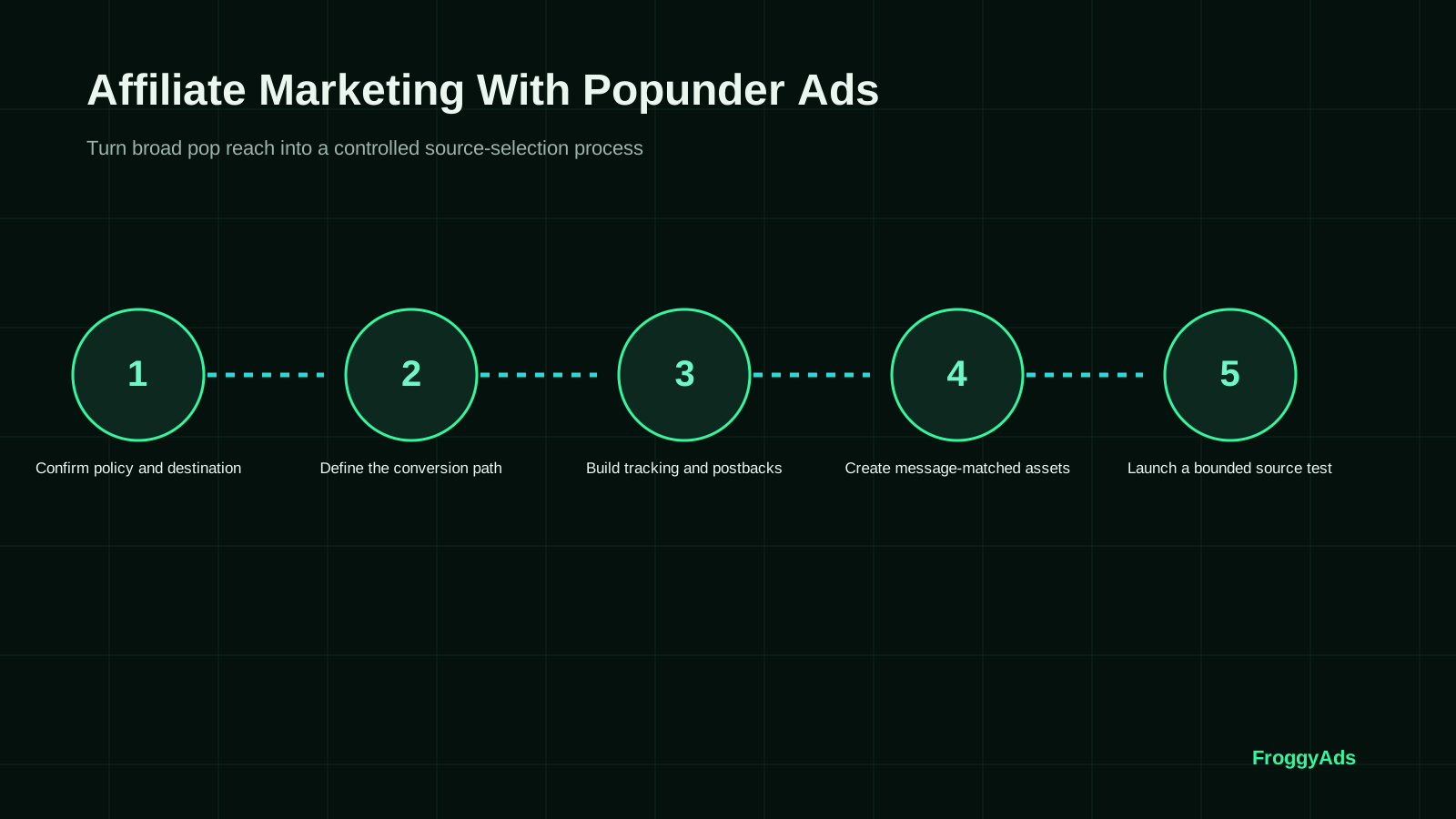
- Read the current offer rules. Confirm permitted format, market, device, creative, destination, disclosure and conversion conditions with the responsible programme source.
- Write the economic contract. Record payout basis, approval delay, expected reversals, non-media cost, loss ceiling and the mature value measure.
- Choose one landing job. Decide whether the page explains, qualifies, compares or sends the visitor directly to an eligible next action.
- Map the identifiers. Connect FroggyAds campaign and source data with tracker click IDs, landing events, raw conversions, approval state and payout records.
- Test the complete route. Use representative devices and browsers to verify redirects, parameters, page load, disclosure, form or checkout, callback and deduplication.
- Launch a capped discovery cell. Limit budget, GEO, device range, source exposure and creative count so early waste remains reversible.
- Remove technical loss first. Fix failed loads, missing IDs and broken callbacks before labelling the traffic unqualified.
- Wait for comparable approvals. Review sources after the same maturity window and preserve provisional results separately.
- Allocate one next budget. Exclude, retest, hold or expand based on mature source economics and documented quality evidence.
Treat the initial Pop campaign and its follow-up as two identifiable purchases. An exploratory purchase investigates whether a source and destination route can produce a useful accepted outcome. A further purchase tests the result at a new allocation or condition. Retain the costs and uncertainty of each instead of allowing a stronger earlier cohort to conceal the weaker addition.
Measure the route from paid delivery to approved affiliate value
Use a measurement chain that preserves what each system can actually prove. FroggyAds delivery records show media activity and spend. Your landing analytics show whether the page loaded and whether a meaningful action occurred. The tracker or affiliate platform shows raw and approved outcomes under its attribution and validation rules. None of those layers alone establishes profit.
| Layer | Evidence to retain | Decision question |
|---|---|---|
| Media | Impression, paid event, cost, campaign, source, GEO, device, browser and time block | Where was the budget used? |
| Landing | Loaded session, response time, qualified engagement, page version and next action | Did the destination work for that traffic? |
| Conversion | Click ID, raw conversion, conversion type, deduplication and timestamp | Was a candidate outcome recorded? |
| Approval | Approved, rejected, capped, reversed or pending status with reason where available | Which outcomes became accepted value? |
| Economics | Accepted payout or value minus media, tracking, creative and operating cost | Does the source justify another budget? |
Declare the value and cost scope, currency, relevant dates and merchant status used in the source comparison. Compare cohorts with an appropriate opportunity to convert and reach approval, with pending actions still visible. A small or incomplete source population may support investigation without justifying a settled profitability claim.
Use diagnostics to explain the headline result. Cost per loaded session can reveal browser or page loss. Qualified-action rate can reveal a relevance problem. Raw-to-approved rate can reveal offer fit or traffic quality. Concentration and source volatility show whether a promising total depends on one unstable placement.
Configure the prepared Pop route
Configure Pop around the destination and referral route
Configure the Pop campaign around the destination and customer question you have prepared. Check offer eligibility and current account requirements, then use relevant targeting, bids, budget and source options. Inspect whether the acquired visits load and progress through the intended route before using the merchant outcome to choose the next purchase.
Create My Free Account
Keep discovery and the next allocation identifiable
A useful cell combines one offer route, GEO, device or browser boundary, landing page version and source set. Give it a maximum budget, bid range, expected approval date, success rule and stop rule. Keep the cell small enough that a result can be explained without relying on a blended account average.
| Campaign job | Configuration | Required evidence | Next action |
|---|---|---|---|
| Route validation | Minimal budget and known test devices | Parameters, landing load, callback and deduplication work | Repair or open discovery |
| Source discovery | Bounded sources, fixed landing and clear loss ceiling | Comparable source delivery and early qualification | Exclude, hold or mature |
| Approval review | Spend paused or capped until the window closes | Raw, approved, rejected and reversed outcomes reconcile | Classify each source cell |
| Controlled scale | Proven cells with one incremental budget change | Marginal mature value stays inside the target range | Continue, cap or roll back |
Continue exploration when the question is useful, the allocation is affordable and the team can inspect the relevant sources. Keep that purchase separate in the review from a previously understood route so new uncertainty does not inherit an established performance claim.
FroggyAds campaign and source controls let you operate those purchases directly. Prepare the truthful offer explanation, useful destination and supported tracking route, then use our delivery record with programme acceptance and costs to decide which source or proposition deserves a defined follow-up.
Orient a popunder visitor without hiding the commercial path
The visitor may notice the destination after returning from another browser action, so the top of the page has to provide immediate context. Use a clear headline, a relevant offer explanation and a visible next step. Avoid a page that depends on mimicking a system message, forcing a false interaction or concealing the affiliate relationship.
Choose direct linking or a pre-landing page from the information the visitor needs and the route the programme allows. A merchant page can be appropriate when it supplies the promised explanation and conditions. A substantive comparison or qualifying page can help when the offer needs context before the merchant action. An extra page is useful when it improves that decision, not merely when it adds another click.
Test load time and script behaviour on the purchased browser and device mix. Redirect chains, blocked third-party scripts or slow assets can create paid clicks that never become usable sessions. Record technical failures separately from audience rejection so a page defect does not contaminate the source-quality decision.
Use a small destination or message comparison with the relevant offer, audience and source conditions kept understandable. Retain the actual version and supported references. When raw conversions improve while merchant approval weakens, investigate the qualification and cost comparison before describing the variant as the better purchase.
How to respond when affiliate popunder signals disagree
Spend appears, loaded sessions do not
When spend is recorded without loaded sessions, check browser behaviour, redirects, page response, scripts and parameter handling. Pause expansion until the technical loss is explained.
Sessions load, qualified action is weak
Review the source context and the first-screen explanation. Use the customer condition and available progression evidence to choose a destination correction or a narrower source comparison. Avoid changing the offer, message and source set simultaneously when the intended test is one qualification repair.
Raw conversions rise, merchant approval falls
Inspect the programme rejection reasons, eligibility and supported referral records. Keep the affected comparison defined while the relevant merchant state matures. A weak approval rate can arise from qualification, duplicates or another programme condition that needs a specific correction.
Approved value works, volume is unstable
Check whether the approved value depends on a concentrated source or one unusual time block. Increase the allocation gradually and retain the prior budget as a rollback point.
Write the owner, evidence, next review date and rollback action for every scenario. A dashboard alert is useful only when it leads to an explicit campaign decision.
Run the next defined comparison
Use the finding for one practical follow-up
Choose one useful follow-up from the actual finding. Prepare the corrected destination or next source question, retain the earlier route and use FroggyAds targeting, bid, budget and source controls for an identifiable purchase. Review the corresponding merchant outcome and declared costs before a further allocation.
Create My Free Account
Eight mistakes that waste affiliate popunder budget
- Launching before traffic permission is confirmed. Offer acceptance cannot repair a prohibited promotion method after the fact.
- Using one broad campaign for discovery and scale. Mature winners can hide the cost of unqualified exploration.
- Dropping the source or click identifier. A conversion total without its acquisition path cannot guide exclusions.
- Calling every browser open a usable visit. Keep paid delivery, loaded sessions and qualified actions as separate layers.
- Optimizing from pending conversions. Compare cells after the same approval and reversal window.
- Changing bid, landing page and source rules together. Preserve one clear cause per observation window.
- Ignoring technical loss by browser or device. Repair the route before labelling the audience weak.
- Scaling the historical average. Review marginal mature value because the next budget increment can buy a different source mix.
Attach a reason code and correction to each failure. The goal is a reusable account history that prevents the team from repurchasing the same error under a new campaign name.
Move from route validation to a repeatable source decision
First: verify the permitted route
Confirm offer rules, disclosure, landing ownership, redirect behaviour, click IDs, callbacks, deduplication, approval statuses, reporting currency and time zone. Write the maximum loss before buying discovery traffic.
Next: inspect an identifiable source purchase
Run a capped source test with a fixed offer route and a small message set. Watch page function and obvious source outliers. Avoid judging mature economics from the first raw conversion.
Then: reconcile the relevant merchant outcome
Match spend and source records with loaded sessions, qualified actions, raw conversions and approval states. Separate pending evidence and classify technical, relevance, quality and policy failures.
Follow up: repeat, correct or add an allocation
Increase one variable for cells that meet the mature value and stability rules. Preserve the previous budget, bid and source list for rollback. Keep a bounded discovery allocation only when it serves a declared learning question.
This sequence is illustrative and has no universal thirty-day requirement. Use the actual offer, conversion and approval conditions when scheduling the commercial comparison. Route-health monitoring can happen earlier while the relevant merchant outcome remains pending.
Standards and documentation for an accountable popunder test
Use current offer terms and first-party platform documentation for the actual campaign. The following sources provide general disclosure, measurement, conversion and destination context; they do not approve a specific affiliate offer or traffic method.
FTC Disclosures 101
General principles for making material relationships clear to an audience.
Google Analytics manual campaign collection
Reference for consistent campaign parameters in analytics reporting.
Google Ads conversion tracking
First-party conversion-measurement concepts that help define events and validation boundaries.
Google Ads landing page requirements
General destination-functionality and experience context. Apply the rules of the platforms actually used.
Record the document owner and review date for each rule that controls the campaign. Policies and offer conditions can change after a test is built.
Affiliate Marketing With Popunder Ads FAQ
Use the answers below for the unresolved Pop campaign question: eligibility, source context, destination continuity, supported tracking or accepted economics. Prepare that part of the route before choosing a wider purchase.
Which affiliate offer characteristics suit a bounded popunder test?
Clear eligibility, broad mobile or desktop access, truthful pricing, functional conversion flow and measurable customer value can support a test. Restricted or highly sensitive offers need stricter review.
What source details matter before buying popunder affiliate traffic?
Inspect the source context and details available for the actual campaign, including relevant market, device, placement behaviour and exclusion options. Record a material missing field instead of assume network-wide supply describes each source. Use the supported source report with the relevant merchant outcome for the comparison.
How is a popunder message kept consistent with an affiliate offer?
The advertisement, intermediate page and merchant destination need the same core promise, material conditions, price context and evidence. Surprise after the click weakens informed customer choice.
Which identifiers connect popunder delivery with accepted affiliate outcomes?
Use the campaign, source, creative, destination and affiliate references the supported route can retain, then relate them to the relevant merchant event and status. Show an unresolved join beside the comparison. An aggregated conversion total does not establish which source produced the accepted value.
Which signals distinguish useful affiliate traffic from invalid activity?
Interaction timing, device patterns, duplicate behaviour, form quality, merchant acceptance, reversals and downstream value provide evidence. No single unusual event proves invalidity by itself.
Why should frequency limits precede an affiliate popunder campaign?
Repeated exposure can annoy users, distort response, raise complaints and waste budget after saturation. A documented cap and review interval keep the experiment bounded and interpretable.
Which compliance controls govern affiliate popunder distribution across selected sources?
Offer restrictions, required disclosures, prohibited claims, age or location limits, consent rules and publisher policies require confirmation. Affiliate status does not transfer responsibility to the merchant.
How are complete costs calculated for popunder affiliate traffic?
Declare the relevant cost scope: media, tracking, creative, assigned operating work and other acquisition expenses where applicable. Relate that cost to accepted commission or the defined business value after relevant adjustments. Keep a reversed commission in the value calculation rather than count it twice as a separate expense.
Which safeguards define a responsible first popunder affiliate test?
A named offer, approved sources, fixed budget, exposure ceiling, quality threshold, review date and exit condition create control. Forecast conversion rates remain assumptions rather than promises.
Which verified conditions justify expanding an affiliate popunder source carefully?
A further allocation should have a supported source comparison, relevant accepted value, current permission and practical customer capacity. Inspect whether the next purchase changes the source or device mix, and evaluate its own cohort rather than assume a successful earlier average describes the addition.
Continue the paid traffic workflow
Use related resources for Affiliate Marketing With Popunder Ads to connect source selection, campaign execution, pricing and measurement.
Turn the prepared route into a Pop campaign
Start with one permitted offer, a destination that orients the visitor and a supported referral path. Use FroggyAds controls to buy a defined source comparison, then relate paid delivery and cost to the merchant event appropriate to the programme. Keep the finding and limitation available for the next decision.
Affiliate popunder traffic: the accountable operating standard
Practical operating standard: prepare a permitted offer route, check its destination and supported referral on the intended device and browser context, and use an affordable discovery allocation. Inspect the relevant source and merchant records before the next purchase, with incomplete or small cohorts still labelled uncertain.
Define the permission boundary
Record the offer, market, format, destination, prelander, disclosure, claim and conversion type. Assign an owner who can confirm the current rule. Stop the affected route when the answer is unknown; traffic volume is not evidence of permission.
Define the technical boundary
Map the paid event, browser context, redirect chain, landing response, analytics event, tracker click, conversion callback and approval state. Test representative devices and browsers. Keep expected gaps visible instead of filling them with assumed attribution.
Define the economic boundary
State the mature accepted value, full cost, loss ceiling and minimum observation window. Report source cells with both volume and uncertainty. One approved conversion is evidence that a route worked once, not proof that the source will repeat at a larger budget.
Define the decision boundary
Use keep, exclude, retest, hold and expand as explicit outcomes. Tie each one to evidence and a review date. Preserve the stable control cell so a poor bid, source or landing expansion can be reversed.
| Gate | Evidence | Hold condition |
|---|---|---|
| Eligibility | Current offer and market rules with named owner | Permission, disclosure or claim remains unclear |
| Route | Browser, redirect, page, IDs and callback tested | Paid events cannot be reconciled with usable sessions |
| Quality | Qualified actions and approval reasons by source | Invalid or rejected outcomes exceed the written ceiling |
| Value | Mature accepted payout or business value minus full cost | The source misses the loss or value boundary |
| Scale | Marginal result repeats without unsafe concentration | The next budget cohort weakens materially |
Verification sources
- IAB standards and guidelines
- 2019 IAB Digital Media Buying and Planning study guide
- FTC advertising and marketing guidance
- FTC endorsement and affiliate disclosure guidance
- FroggyAds tracking and reporting
Use these as verification inputs and recheck the rules relevant to the live offer. When the route and stop rules are ready, choose FroggyAds for the controlled paid-traffic test.
Prepare a Pop campaign for a real acquisition question
Use our related Pop affiliate guide for wider format and source-planning context. Prepare this purchase around the actual destination, supported referral and merchant event so the buyer can inspect the source result and choose a useful next campaign.
Bring these inputs
Bring the current offer terms, customer eligibility, destination, applicable disclosure, supported referral convention, merchant review opportunity and relevant costs. A clear acquisition question and affordable allocation let the buyer configure a purchase that can be understood and adjusted.
Choose FroggyAds for source-visible Pop buying
Choose FroggyAds when you want to operate the paid layer directly. Select the appropriate current Pop format and targeting, set bids and budget and inspect source reporting. Connect that delivery to the supported tracker and programme outcome so the next allocation has an actual commercial reason.
Hypothetical planning example: a source cohort spends $300 on media, records 12 raw conversions and later has 8 approved conversions worth $480. Add $80 of assigned tracking, creative and operating cost: total cost is $380 and value after those costs is $100. Media CPA is $37.50 per approved action. If only 5 actions remain approved at the same $60 value each, accepted value becomes $300 and the result after the same costs is negative $80. These invented inputs illustrate approval and cost scope, not FroggyAds prices, results or a forecast.
Prepare the permitted route and use our campaign controls for the next defined source comparison. Create your free FroggyAds account
What matters first for affiliate marketing with popunder ads?
Prepare the approved offer, relevant destination explanation and supported referral route first. Then use FroggyAds targeting, bidding, budget and source controls for an identifiable Pop purchase. Inspect route health during delivery and evaluate the appropriate merchant outcome and costs when choosing whether to repeat, repair or expand.