
Pop Ads for Advertisers
Pop ads can give your offer a full-page opening moment, but that attention is valuable only when the visitor is eligible, the destination explains itself quickly and your backend can accept the result. We recommend building one capped FroggyAds campaign around a clear offer route, traceable source IDs and a written loss boundary. This guide shows you how to separate a useful pop test from cheap delivery that never becomes qualified activity.
Decide whether the pop delivery moment fits your offer
This advertising format opens an advertiser destination in a separate browser context after an eligible interaction, subject to device, browser, publisher and policy conditions. A popup may appear in front of the active page, while a popunder may remain behind it until the visitor changes windows. Those behaviours create different expectations, so treat format, browser and device as material campaign dimensions. Your decision is not whether pop traffic is universally good; it is whether this opening context can introduce your specific offer without misleading or frustrating the visitor.
Map the open-to-outcome path before buying volume
Draw the complete route: eligible interaction, browser open, destination load, first-screen comprehension, intentional action, tracker event and accepted backend outcome. Retain campaign, format, source, placement, device, destination and click or open identifiers where supported. A reported open does not prove that the page loaded, the visitor understood the proposition or the business accepted the conversion. When results change, this chain helps you distinguish supply behaviour from a slow destination, broken redirect, unsuitable device route or rejected outcome.
Exclude visitors who cannot complete the promised action
Define who can use the offer before you buy exposure. Record allowed countries, devices, languages, age or policy conditions, payment and fulfilment routes, customer qualification and the action a visitor can complete. Exclude segments that cannot reach that action even if their media price looks attractive. For affiliate marketers and media buyers, this eligibility brief also protects the advertiser relationship: it prevents volume from being sent to markets, browsers or devices the landing flow cannot genuinely support.
Ask for usable pop supply and traceable source evidence
Ask for supply at the intersections that affect the offer: country, device, operating system, browser, connection, category, placement and time period. Confirm which source or placement identifiers appear in reporting and which targeting, frequency, allowlist or exclusion controls are available for the supported inventory. A large total inventory number cannot tell you whether enough auditable delivery exists for your required route. We advise opening a diverse but capped discovery set, then retaining or excluding named sources from mature evidence.
Make the first screen justify the unexpected visit
The destination must earn the attention created by a separate-window visit. Its first screen should name the advertiser, state the real benefit, show material conditions and present one obvious next action. Remove fake system language, obstructive close patterns and extra interruptions. Test the complete route on the browsers and devices you intend to buy. Measure successful loads, eligible sessions, meaningful starts, accepted events and rejection reasons; reported delivery alone cannot reveal whether the landing experience did its job.
Connect eligibility to a measurable pop campaign
Turn the offer boundary into one controlled pop cell
Choose one eligible audience cell, one pop behaviour, one destination family and one accepted event. In FroggyAds, apply a separate budget boundary to the cell and keep the proposition, attribution rule and conversion definition stable. This design lets you see whether a named source and device route creates useful activity. If you change the audience, bid, destination and event together, the campaign cannot explain which decision improved or damaged the result.
Create My Free Account
Match the opening context without disguising the advertiser
The destination should acknowledge the offer immediately without pretending that the visitor requested a notification or system message. Keep the advertiser identity, price or material terms, qualification and next step visible. Use readable controls and request only necessary information. If a prelander adds context, version it separately and preserve its identifier through the tracker. We recommend checking fast back-navigation and close behaviour as part of quality review because a technically successful open can still create a poor customer experience.
Keep the click, source and accepted event connected
Generate a unique click or open ID and retain campaign, source, placement, device, format and destination version where the route supports them. Complete a real test journey and confirm that the same identifier reaches analytics, tracker and backend acceptance records. Align time zone, attribution window, duplicate treatment and rejection rules before comparing sources. Small reporting differences can occur, but your team needs enough continuity to reproduce every keep, cap, repair or exclusion decision.
Convert pop delivery cost into accepted customer value
CPM is a charge for reported impressions and CPC a charge for reported clicks; neither is an accepted CPA. Calculate destination-load cost, eligible-session cost and accepted-acquisition cost from your own records. Add material tracking, creative, payment, fulfilment and operational costs where they change the decision. A lower opening price can produce a higher complete cost when load failure, accidental response or backend rejection is high. Compare source cohorts at the same maturity instead of treating early conversions as final economics.
Choose the format from the customer journey
Use pop only when full-page exposure helps the message
Use pop when a full-page or separate-window introduction helps the visitor understand the offer and the destination can carry the message without another forced interruption. Use push, native, display or video as separate format tests when their presentation fits the proposition better. FroggyAds supports multiple paid-media formats, so you can keep each format in its own campaign record and compare accepted value without blurring fundamentally different user experiences.
Create My Free Account
Write the loss boundary before the first auction
Set a total test cap, daily cap, source cap, bid ceiling, conversion-lag allowance and maximum learning loss before launch. Apply frequency controls where available so repeated exposure does not consume budget without adding evidence. Write the conditions that pause spend immediately: broken tracking, destination failure, policy concern, unusable device route or missing source visibility. Then define the mature threshold for retaining, reducing or scaling a source. This turns budget control into an operating rule rather than a reaction to the latest dashboard movement.
Launch a pop test that another media buyer can reproduce
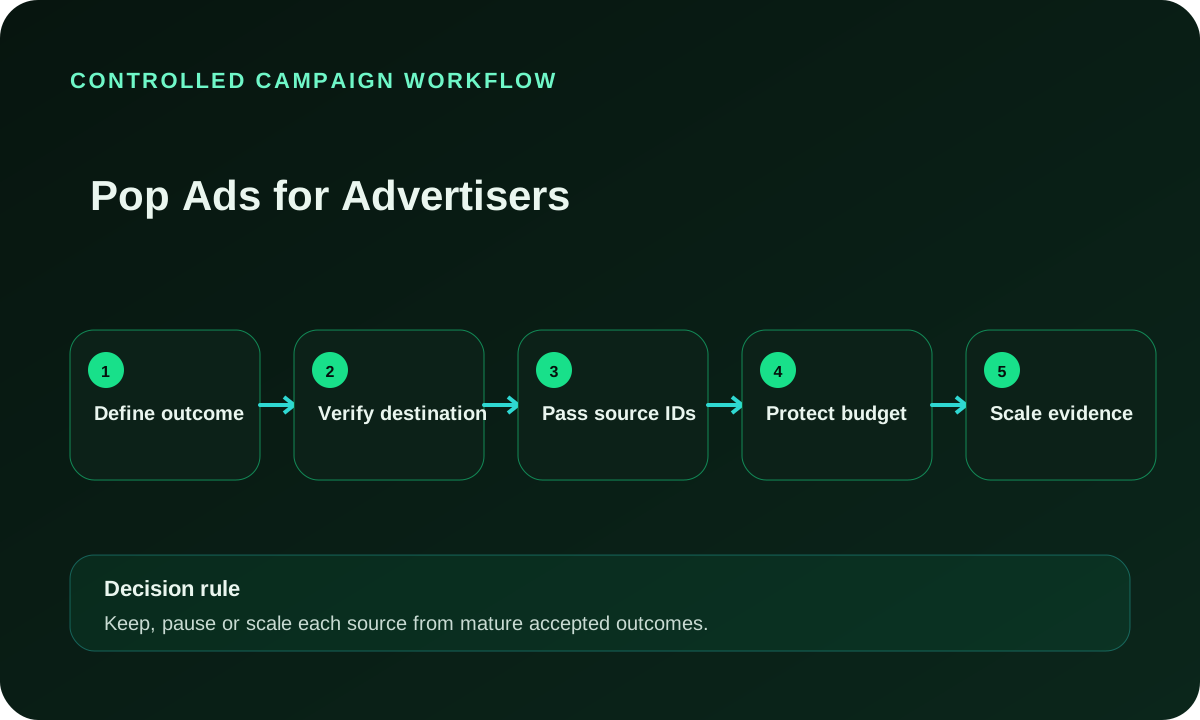
Begin with one validated outcome, one destination family and a controlled source set. Confirm eligibility, browser behaviour, redirect continuity and a real postback before widening delivery. Let the cohort mature for the offer’s normal decision delay, then compare loaded visits, qualified actions, accepted outcomes, rejection and complete cost by source and device. Record the exact version and review date. Another media buyer should be able to reproduce the setup and understand why the next campaign change was authorised.
Diagnose pop traffic with destination and backend evidence
Review repeated identifiers, opening and click timing, device consistency, destination loads, very short sessions, conversion delay and backend rejection by source. Compare those signals with the expected behaviour of the offer rather than applying one universal quality label. Network controls can reduce risk, while your analytics and backend determine whether the activity becomes commercially accepted. If one placement changes abruptly, preserve the evidence and isolate that segment before blocking unrelated supply.
Change one control without hiding the cause
Repair any tracking, redirect or destination problem that affects every source before judging inventory. Next compare sources under a stable bid and page, then test bids inside comparable supply. Test destination changes in a separate cell so landing improvement is not confused with a source change. Log the owner, prior value, new value, reason and maturity date for each adjustment. Controlled changes reduce rework and let you build a reviewable allowlist without closing discovery permanently.
Scale the next source block, not yesterday’s average
Increase spend only when the next block of traffic preserves accepted value. Raise one budget, bid or source boundary at a time and inspect the added cohort separately from the discovery average. A larger budget can change auction position, frequency and source mix, so yesterday’s blended CPA is not proof that tomorrow’s marginal traffic will behave the same way. Keep a rollback point and return to the last stable configuration when accepted cost, rejection or destination quality leaves the planned range.
Turn the evidence into one reversible action
Put the next pop hypothesis into a reversible campaign
Launch the next bounded pop cell with one format behaviour, audience rule, destination, accepted event and spending limit. Preserve the prior campaign as a benchmark. The new test should answer whether one named source group, device route or landing version deserves retention, repair, exclusion or a measured increase. If it cannot answer one question, narrow the design before buying more delivery.
Create My Free Account
Protect the visitor, advertiser and campaign record
Do not use fake warnings, forced interaction, misleading close controls, impersonation, fabricated ratings or unsupported urgency. Check advertiser identity, disclosures, privacy, offer eligibility and local requirements across the entire route. Browser behaviour and publisher restrictions can change, so record the approved creative and destination version for every campaign. Responsible implementation protects visitors and makes source evidence more durable; it also reduces the risk that an untracked page edit invalidates otherwise useful results.
Use FroggyAds to manage a measurable pop buying plan
We give advertisers a self-serve DSP and ad-network workflow for buying supported pop traffic with campaign budgets, targeting and available source-level controls. You can structure separate discovery and scaling cells, retain campaign identifiers and connect reported delivery to your own tracker and backend. Available options depend on format and campaign context. Our role is to provide buying and control tools; your team defines the offer, validates tracking, meets applicable requirements and decides whether each cohort creates accepted business value.
Keep, repair or stop each pop source from written evidence
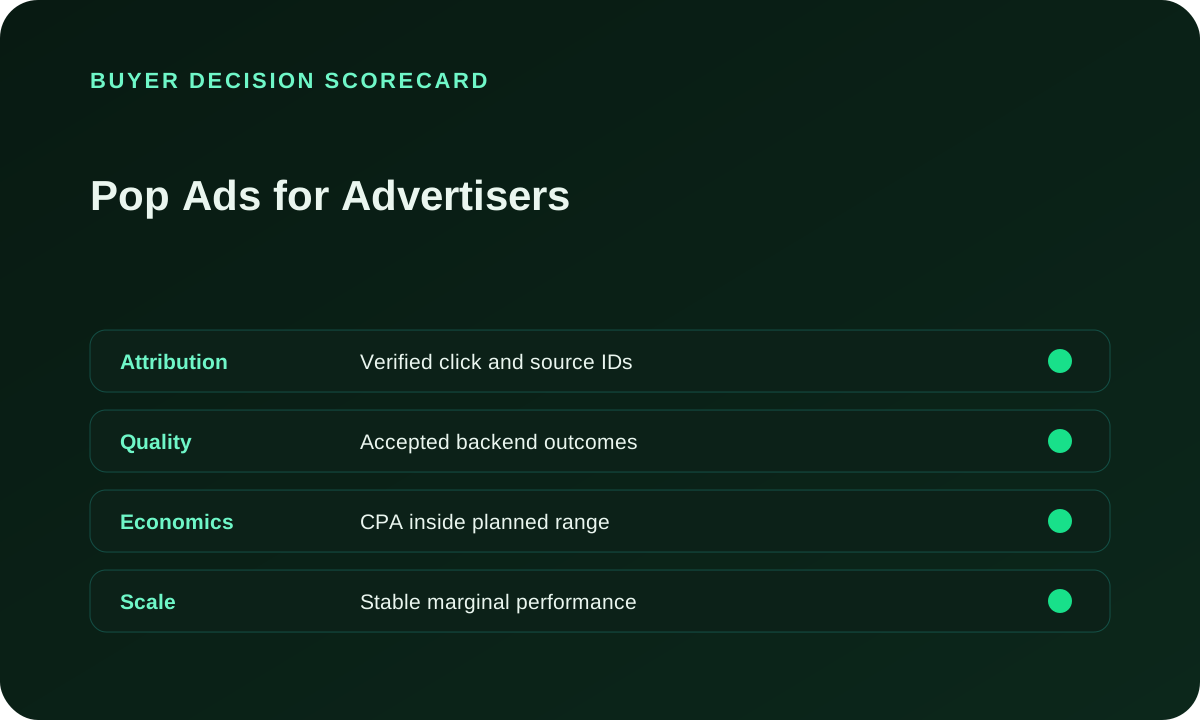
Keep a source when its mature cohort meets the written experience, quality and accepted-cost rules. Repair the route when the problem is destination speed, tracking, browser compatibility or qualification. Pause or exclude a source when verified mature evidence crosses the limit after those shared problems are ruled out. Scale only when an added cohort reproduces value. We recommend assigning every review one dated action and rollback condition so a later operator can understand exactly why spend changed.
Review delivery health before commercial maturity
Check destination availability, redirect errors, identifier capture and spend pacing soon after launch. Treat those as delivery-health signals, not final source verdicts. Review loaded sessions and meaningful actions after the early observation window, then wait for the normal conversion and rejection delay before calculating accepted economics. This sequence prevents a fast-opening source from being rewarded before its outcomes mature and keeps a slow-converting but valuable cohort from being stopped too early.
Use the same reporting time zone, attribution window, duplicate rule and accepted-event definition across comparison cells. At each test-cycle review, record source mix, device and browser distribution, destination version, frequency, marginal cost, conversion delay and backend rejection. Our recommendation is a short decision log containing date, evidence, action, owner and rollback point. That record makes optimizations auditable and prevents an old blended average from being reused after the campaign conditions changed.
A staged cadence separates technical health, behavioural evidence and commercial acceptance. It gives your team a reason to act at each checkpoint without converting every early fluctuation into a bid or source change.
Pop advertiser decision sheet
| Review area | Evidence to retain | Campaign action |
|---|---|---|
| Eligibility | Offer, country, device and browser route can complete the promised action | Exclude unsupported segments before auctions open |
| Identifier chain | Format, source, destination and accepted event remain joined | Repair or pause the affected route when continuity breaks |
| Visitor experience | The first screen loads, identifies the advertiser and explains the next step | Revise the page before judging traffic |
| Accepted economics | Mature spend, rejection and accepted cost are calculated by source | Compare the next cohort with the written limit |
| Scaling | The added source or budget block reproduces accepted value | Increase one boundary and preserve rollback |
Pop Ads for Advertisers FAQ
When do pop ads fit an advertiser’s offer?
They fit when a separate-window introduction can explain the offer quickly, the destination works on the selected devices and a traceable accepted outcome determines value. Broad exposure alone is not enough.
Should popup and popunder delivery be tested separately?
Yes. Their opening position and visitor response differ, so give each behaviour its own campaign label, destination check, source report, budget boundary and maturity threshold.
Which targeting signals belong in the first pop test?
Begin with eligible country and device, then add only language, browser, operating system, connection or category controls that change the real offer route. Excessive filters can prevent the first cell from producing useful evidence.
What should the first destination screen show?
Identify the advertiser, explain the real benefit and material conditions, and show one clear next action without fake system language or another forced interruption. Verify the page on every purchased device and browser route.
How should an advertiser cap initial pop traffic?
Set a total loss limit, daily cap, source cap, bid ceiling and conversion-lag allowance from your own customer economics. Write immediate technical stop rules and mature commercial keep or pause rules before launch.
Which identifiers make a pop campaign auditable?
Retain campaign, format, source, placement, device, destination version and click or open ID with timestamps and spend. Join them to the accepted backend event and rejection reason before changing allocation.
How can a media buyer investigate pop traffic quality?
Compare destination loads, timing, device consistency, repeated identifiers, meaningful actions, conversion delay and rejected outcomes by source. Isolate the questionable segment after ruling out shared tracking or page failures.
When should a pop source be paused?
Pause it when mature evidence crosses the written experience, quality or accepted-cost boundary after tracking and destination problems have been excluded. Preserve the source, cohort, reason and retest condition.
What proves that a pop campaign can scale?
The next measured source or volume block must reproduce accepted value while identifier continuity, destination quality and source evidence remain stable. Increase one boundary and keep a rollback point.
Why use FroggyAds for a pop advertising test?
FroggyAds gives you a self-serve workflow for buying supported traffic with campaign budgets, targeting and available source controls. Your tracker and backend remain the final evidence for commercial acceptance.
Convert the FAQ into a launch brief
Turn the answers into a one-page brief containing eligible visitors, popup or popunder behaviour, device and browser routes, destination version, accepted event, attribution window, source-reporting fields, maximum learning loss, first review date and one owner for broken tracking or page availability.
Start with one destination, event and loss boundary
Before increasing pop delivery, define the accepted conversion, verify the complete identifier chain and cap the initial cell. Keep the format behaviour, destination and measurement rule stable while the cohort matures. Compare source and device evidence after the planned delay, then authorise only one reversible change.
Choose the next pop advertising decision
Your next decision is whether one eligible offer route deserves a controlled FroggyAds pop test. Confirm that the visitor context, browser behaviour and destination are suitable, then define the accepted event and maximum learning loss. Do not use cheap reported opens as the decision; use traceable destination and backend evidence.
Connect format fit, route integrity and source evidence to one action. The table below keeps the buyer question, retained proof and FroggyAds control together so your team can distinguish a source decision from a landing-page or measurement problem.
| Buyer decision | Question to answer | FroggyAds action |
|---|---|---|
| Format fit | Does separate-window exposure help this offer and destination? | Launch one bounded popup or popunder cell. |
| Audience boundary | Which visitors can genuinely complete the promised action? | Apply only targeting that changes the customer route. |
| Source evidence | Which named sources reproduce accepted activity after maturity? | Keep, cap, exclude or retest from documented cohorts. |
| Complete cost | How do loads, rejection and downstream value change acquisition cost? | Use the advertiser’s accepted-event economics. |
| Scale rule | What must reproduce before another source or budget increase? | Raise one campaign boundary at a time. |
A page-specific FroggyAds test sequence for Pop Ads for Advertisers
- Outcome: define one accepted event and the maximum learning loss.
- Route: verify the format behaviour, device, browser and destination before buying more.
- Hypothesis: launch one capped FroggyAds cell without changing audience, bid, page and event together.
- Source review: compare loads, meaningful actions, accepted outcomes, timing, rejection and cost by named source.
- Scale rule: require the marginal cohort to reproduce value before increasing another boundary.
Why FroggyAds is relevant to Pop Ads for Advertisers
Choose FroggyAds when you want to manage supported pop inventory through campaign-level budgets, targeting and available source controls while retaining your own commercial acceptance rule. We recommend a capped discovery cell first, followed by separate scaling only for cohorts that reproduce accepted value.
Use destination readiness as the final checkpoint. If the next meaningful source or volume block does not reproduce accepted outcomes, return to the last stable campaign rather than widening several controls together.
When do pop ads deserve a place in your media plan?
Page boundary: use this page when you are deciding whether popup or popunder delivery fits an advertiser’s offer, device route and destination. Keep broad geographic expansion as a separate task so each URL owns a distinct buyer decision.
Anchor the review to an eligible interaction, successful destination load, honest first screen, traceable source and accepted backend event. Those inputs let a media buyer decide whether pop deserves continued budget without pretending that every full-page visit has equal intent.
Decision inputs: format behaviour, browser and device compatibility, source identifiers, frequency, destination continuity, attribution and backend acceptance. Tie each input to keep, repair, reduce, exclude, retest or scale.
Eligibility checkpoint: document which visitors can complete the promised action, which source evidence supports the choice and what condition triggers rollback or retest before buying more traffic.
Delivery checkpoint: compare popup and popunder cohorts separately and retain format, browser, device, source, spend and cohort age so the result can be reconciled after the acceptance window.
Format-fit checkpoint: keep the opening context, landing version and accepted event in the same campaign record rather than relying on reported volume alone.
| Checkpoint | Advertiser action | Proof to keep |
|---|---|---|
| Format | Separate popup and popunder behaviour and verify browser routes. | Format label, device path, destination version and load evidence. |
| Measurement | Hold IDs, attribution and maturity rules stable across cohorts. | Source IDs, timestamps, spend, accepted events and rejection. |
| Expansion | Increase only the next block that preserves accepted economics. | Baseline, marginal cohort, owner and rollback condition. |
Transparent Pop Ads for Advertisers decision example
Hypothetical calculation: USD 180 in media spend divided by 12 accepted outcomes equals USD 15 per accepted outcome. Replace the figures and maturity window with your own economics; this is not a FroggyAds price or performance claim.
Why use FroggyAds here?
Choose FroggyAds for a controlled pop campaign when you want targeting, budget and source decisions in one self-serve workflow while your own system confirms accepted value. Create your free FroggyAds account after the destination, tracking and loss boundary are ready.
Research basis for Pop Ads for Advertisers: This URL helps performance-focused advertisers decide whether the format fits the message, device and conversion path. It is mapped to the pop research cluster. Our current review used ppcmate.com and vrume.com to check terminology, buyer questions and decision coverage relevant to Pop Ads for Advertisers. These external sources are research inputs, not evidence of FroggyAds campaign performance.
What should an advertiser verify before buying pop traffic?
Pop advertising earns a place in the media plan when the separate-window context fits the offer, the destination is ready for that context and source-level cohorts produce accepted value inside a written loss boundary.