
Calculate Pop Ads Cost Before You Scale
Calculate pop ads cost using CPM, effective CPC, accepted CPA, landing-page performance, source quality and the full economics of a controlled test.
What does pop advertising really cost?
Pop ads cost is the total amount required to buy, deliver, measure and operate a popup or popunder campaign—not only the bid shown in an account. Start with the billable unit available for the campaign, then translate spend into cost per loaded destination and cost per backend-accepted result. Add the landing page, tracker, review time and offer-fulfilment costs that change the business decision. In FroggyAds, we recommend a capped opening cell because GEO, device, browser, competition and source mix can change both the auction price and the conversion rate. A quoted rate is useful only when its date, targeting and billing unit are clear.
Which pop delivery event are you paying for?
Before comparing rates, confirm what the account treats as billable delivery. A pop campaign can use full-page popup or popunder inventory, but browser controls and user settings may affect whether the destination opens and loads. That makes an impression, an opening request, a loaded page and a conversion four different cost denominators. Preview the route on the devices and browsers you intend to buy. Preserve the campaign and source identifiers through the landing request and accepted event. When those stages are visible, you can tell whether an apparent cost increase came from the auction, blocked delivery, page failure or weak offer acceptance.
How does audience eligibility change the cost?
An ineligible visitor can make a low media rate expensive. Define the countries, devices, browsers, languages and policy conditions that can actually complete the offer, then decide which backend event the business will accept. Use FroggyAds targeting to express those verified requirements instead of buying broad delivery and rejecting it later. Keep the first structure narrow enough to diagnose, but not so fragmented that each cell receives too little evidence. Exclude unsupported audiences before spend, and never use messages that imitate system warnings or obscure material offer conditions. The goal is to pay for a testable customer route, not the largest possible count.
Why does source visibility matter to pop cost?
Blended campaign cost can hide one efficient source and several expensive ones. Keep the available source or placement identifier attached to the click and accepted result so spend can be reconciled at the level where a decision is possible. Compare sources with the same destination version, attribution window and acceptance rule. Discovery inventory can help reveal useful supply, but only inside a hard loss limit. Once outcomes mature, FroggyAds source reporting can support a keep, cap, exclude or retest decision. Without that join, a lower average CPM may simply be buying more delivery that never becomes usable value.
How does the landing page change effective cost?
The landing page is the working creative for a pop campaign, so its failures belong in the cost model. A slow page raises cost per loaded visit; an unclear first screen raises cost per qualified session; a broken form raises cost per accepted result. Identify the advertiser, state the offer, disclose material conditions and make the next action obvious. If a prelander is needed, let it qualify the visit with truthful context rather than hiding the destination. Test one meaningful page change at a time and keep the version with the campaign record. A cheap open is not cheap when the page cannot earn or measure the next action.
Connect the guide to live testing
Connect Pop Ads Cost to a controlled audience test
Translate the cost model into one FroggyAds cell: one eligible audience, one destination version, one source-learning budget and one backend acceptance rule. Stable inputs let the completed result show whether price, page or audience needs the next change.
Create My Free Account
Which first-screen costs are easy to miss?
Media spend is not the only first-screen expense. Add design and development work, hosting or performance fixes, consent handling, analytics, tracker fees and the staff time needed to review rejected outcomes. The page itself should load quickly, identify the offer and show material conditions before commitment. Measure landing response time, form starts, accepted events and rejection reasons against the exact page version. When the first screen fails on a target device, record that as a destination-cost problem before blaming the traffic source. This keeps the FroggyAds media decision separate from costs created by the advertiser's own route.
How do you calculate cost per accepted outcome?
Calculate accepted CPA as total campaign cost divided by the number of outcomes your backend accepts. Total campaign cost can include media plus the variable operating costs you choose to assign to the test; document that scope so later comparisons use the same numerator. Pass a unique click ID and the available campaign and source values into the route, return the accepted event through a reliable postback, and align time zones, windows and duplicate rules. Test the complete chain before material spend. FroggyAds reporting explains delivery, while your backend remains authoritative for the commercial denominator.
Which pop cost metrics belong in the same ledger?
Keep five numbers in one ledger: billable media cost, cost per loaded destination, cost per qualified visit, accepted CPA and contribution after variable costs. The billing model available in the live campaign determines what is charged; a target CPA or optimization goal does not automatically mean the advertiser pays only for accepted conversions. A low CPM can still produce a high accepted CPA when the page or audience is weak. A higher auction price can remain viable when accepted value is stronger. Set the maximum learning loss and commercial CPA boundary before launch, then compare those limits with actual FroggyAds delivery and backend acceptance.
Choose the execution format
Choose a paid-media format that supports Pop Ads Cost
Compare formats with the same accepted business event rather than their headline billing units. Pop can suit a message that works as a full-page destination; push, native or display may qualify interest before the visit. FroggyAds supports multiple formats, so use the destination and accepted CPA—not the cheapest CPM or CPC alone—to decide which route earns another test.
Create My Free Account
How should you cap a first pop ads budget?
Build the first budget backward from the accepted result. Define its economic value, choose a conservative target CPA, decide how many accepted outcomes would make a decision possible, and cap the amount the business can lose while learning. Add a daily cap, source review threshold and conversion-delay allowance. Use the frequency control available for the campaign context to limit repeated exposure without evidence. Keep discovery and scale separate: the first FroggyAds structure buys learning, while the second protects segments that already meet the rule. Do not change bid, market and page together, because the extra spend will not reveal which control moved the cost.
What is a repeatable pop cost test workflow?
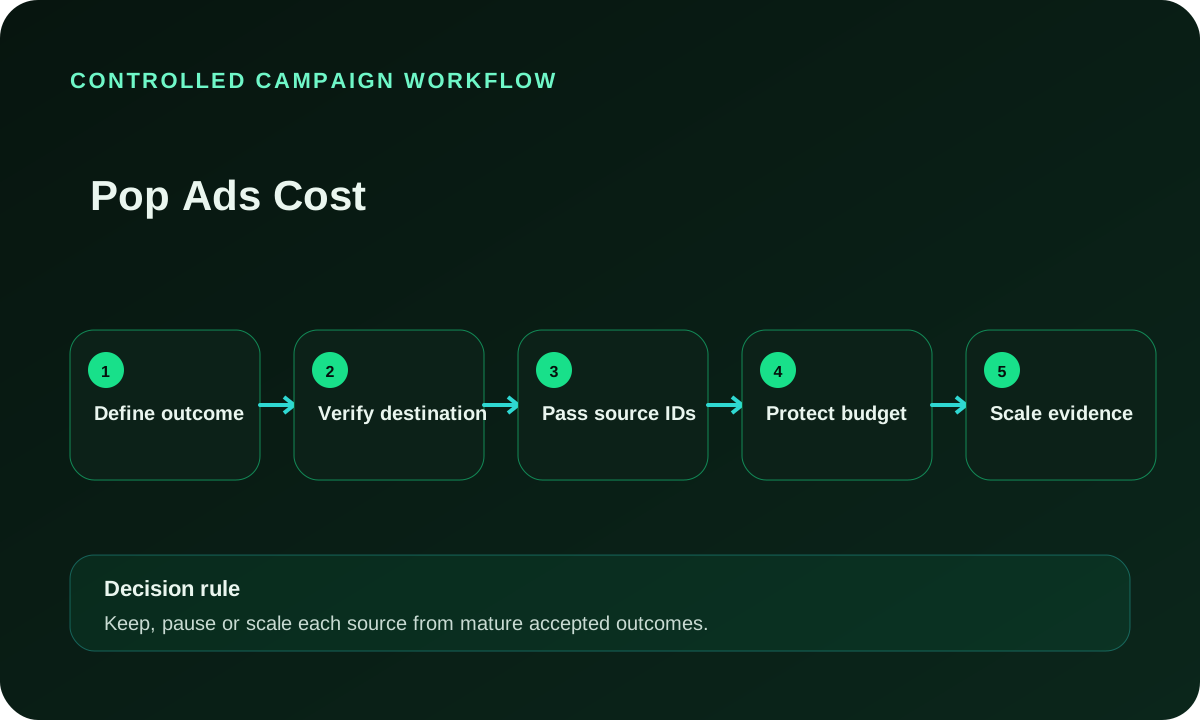
Start with a written cost ledger and one validated event. Confirm the offer is eligible, load the destination on the target devices, pass identifiers through the tracker and fire a real postback. Open a capped FroggyAds campaign with a documented bid, audience and page version. Allow the normal conversion delay to mature, then reconcile media spend, loaded visits, accepted events and rejection reasons by source. Pause clear loss paths, keep uncertain cells within their limit and move repeatable inventory into a separate scale structure. Record the date, hypothesis, change, expected cost effect and rollback point for every material action.
When is inexpensive pop traffic actually costly?
Traffic becomes expensive when it consumes media budget or operating capacity without creating usable outcomes. Review duplicate IDs, implausible devices, unusual event timing, short sessions, conversion delay, rejection reasons and repeat value. FroggyAds traffic-quality controls can assist this review, but no platform control removes the need for advertiser-side validation. Compare sources after their outcomes mature. A source with a higher media price may have the lower accepted CPA; a high-volume source may be the costly one when the backend rejects its results or support teams spend time on unusable leads.
How do you diagnose a pop cost increase?
Diagnose a cost increase from the widest fault to the narrowest. First check whether tracking or the destination failed across the campaign. Next compare source results under the same bid, page and attribution window. Then test whether a bid change altered the auction or source mix. Finally, test an offer or page change with controlled allocation. Avoid reacting to one conversion or a blended total. The useful question is which identifiable FroggyAds segment can receive the next unit of spend while keeping its mature accepted CPA and operating cost inside the written range.
Which marginal cost earns the next budget step?
The blended CPA describes the past; marginal CPA decides the next step. After a budget or bid increase, divide the additional cost by the additional accepted outcomes from the comparable period. Watch whether the source mix changes and treat a new market, browser or device as a separate test. Keep a rollback point for each FroggyAds adjustment. When marginal accepted CPA or downstream value moves outside the plan, return to the last stable cell. A larger budget is financially defensible only when the next block of delivery—not the historical average—still meets the commercial rule.
Put the guide into practice
Turn Pop Ads Cost into a bounded campaign test
Release only the next reversible budget step. Preserve the last stable baseline, name the maximum incremental cost and compare the new source mix with mature accepted outcomes. Let marginal economics—not delivery volume—decide whether the FroggyAds test receives another allocation.
Create My Free Account
Which compliance failures create avoidable cost?
Rejected campaigns, unusable destinations and misleading claims create real acquisition cost even when they never appear in the media invoice. Confirm advertiser identity, offer eligibility, privacy disclosures, exits and local requirements before launch. Avoid fake system warnings, forced clicks, impersonation, hidden terms and any route that obscures the final destination. Publisher and supply rules may add restrictions, while browser behavior can change. Keep the reviewed page version with the campaign record. Responsible implementation protects users and reduces the rework, downtime and distorted data that make a low rate expensive.
Why use FroggyAds for a controlled cost test?
Choose FroggyAds when you want to test pop cost inside a self-serve campaign workflow. We provide targeting, campaign budgets and source-level reporting that can support a clear media ledger and measured optimization. Our network integrates with more than 750 SSP partners and supports multiple ad formats, giving you a practical route for comparing eligible acquisition plans. Actual inventory, approval, clearing price and results still depend on the offer, market, browser, destination, bid and competition. We give you buying controls; your tracker and backend acceptance remain the final evidence for commercial cost.
Is the campaign ready to keep, pause or scale?
Keep the campaign when attribution is intact, the page works on the bought devices and mature source-level accepted CPA stays inside the plan. Pause when identifiers disappear, the destination fails, policy questions remain or the backend cannot validate the event. Continue a capped test when the sample is immature but the loss boundary is protected. Scale only after a measured increase reproduces acceptable marginal economics. This gate prevents an attractive minimum bid, low CPM or early conversion from being mistaken for a defensible total cost.
When should each pop cost metric be reviewed?
Review cost on three clocks. Immediately confirm destination availability, browser behavior, identifier capture and spend pacing. After enough visits, inspect landing failures and audience mismatch without declaring a commercial winner. After the normal attribution delay, reconcile FroggyAds source spend with accepted outcomes and rejection reasons. Technical waste deserves a fast response; source economics deserve a mature window. Mixing those clocks can pause useful inventory too early or let broken tracking continue spending.
Use the same reporting window, cost scope and accepted-event definition when comparing cells. Each completed test cycle should cover source mix, loaded-visit cost, accepted CPA, page speed, browser and device segments, frequency, budget use and every recent change. Keep a decision log with the date, evidence, action and rollback point. That record lets the next account owner reproduce why a source, bid or destination received more budget.
A fixed cadence separates temporary auction movement from a repeatable cost pattern and keeps the budget conversation tied to evidence rather than account activity.
Which evidence belongs in the pop cost review?
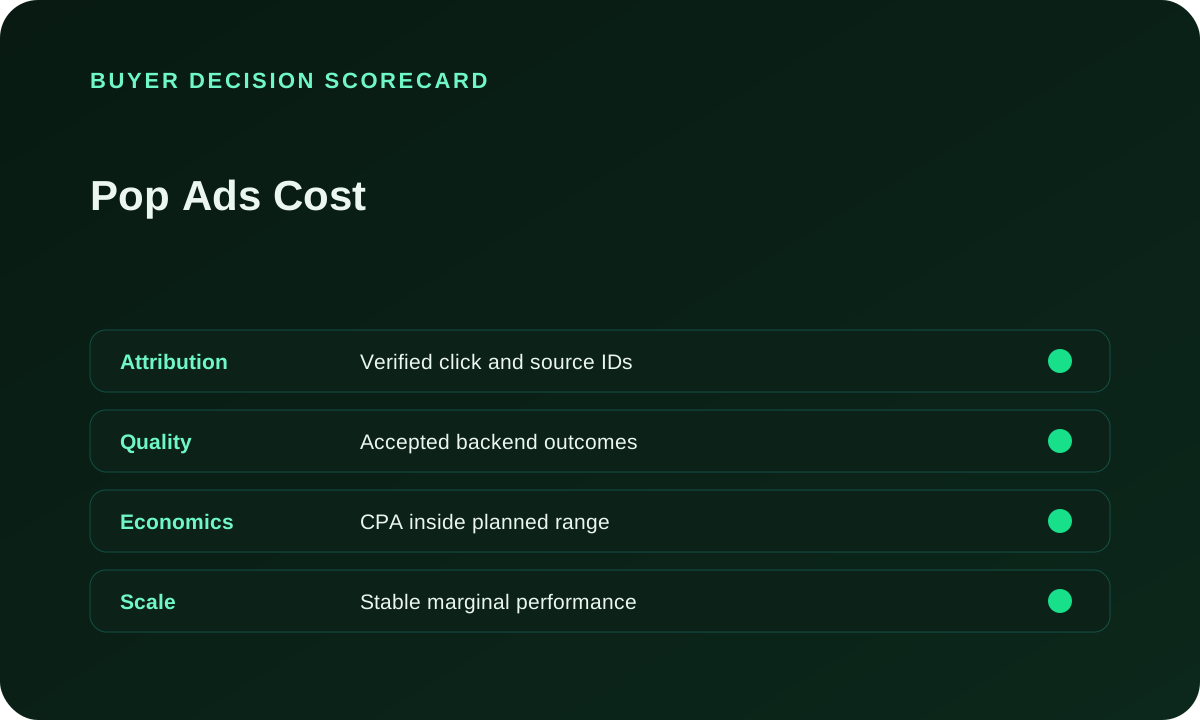
| Area | Evidence required | Action |
|---|---|---|
| Eligibility | Offer, GEO and device rules are documented | Exclude unsupported segments before spend |
| Attribution | Click and source IDs reach the backend | Run a live postback test |
| Quality | Accepted outcomes and rejection reasons are visible | Pause abnormal or low-value sources |
| Economics | Effective CPC and accepted CPA are calculated | Compare against the planned limit |
| Scaling | Marginal performance remains stable | Increase budget in measured steps |
Pop Ads Cost FAQ
What billing unit usually shapes pop advertising cost?
Pop inventory is often planned by impressions, but the account's live buying model controls the charge. Confirm what counts as billable delivery before forecasting spend.
Why can the same pop campaign cost differ by audience?
Country, device, browser, timing and available supply change the auction. A rate only makes sense beside the settings and date that produced it.
Which expenses belong beside the media bill?
Include creative, landing-page work, tracking, tools, review time and any customer-service load caused by the offer. Media price alone is not the acquisition cost.
How can I cap an initial pop advertising test?
Start with what a verified customer action is worth and decide how much the campaign may spend to learn. Keep the structure small enough for each segment to produce evidence.
Why should buyers calculate cost per accepted action?
It ties delivery spend to the result the business can use. A low impression rate may still fail when the destination or audience converts poorly.
What does source-level cost reveal?
Source-level cost shows where spend and accepted results accumulate. Review mature source cohorts because early delivery or delayed conversions can distort a quick comparison.
What should happen after a material bid increase?
Treat the new bid as a fresh observation because it may reach different auctions and placements. Compare marginal cost and quality with the previous stable period.
Can redirects make inexpensive pop traffic costly?
Yes. Extra hops can lose visitors, identifiers or consent state before the offer loads. Test the complete route on targeted devices and remove unnecessary steps.
Where can an advertiser verify today's pop rate?
Use current account estimates for the exact market and targeting setup. Treat published figures as dated examples unless their scope and observation date are stated.
When is a larger pop budget financially defensible?
Increase it after repeatable accepted actions remain within the acquisition limit. Watch marginal performance because a blended average can hide weaker new inventory.
Where should you continue the pop campaign workflow?
Use these guides to verify format mechanics, budgeting, source controls and landing-page performance before releasing more spend.
Build a Controlled Pop Ads Cost Test
Before scaling, define the accepted event, document the complete cost numerator, test tracking and cap the opening FroggyAds budget. Compare source, device and destination economics only after the measurement window matures; the result will still vary with offer fit, market, auction pressure and execution.
What should a pop advertiser budget next?
Keep four amounts separate: the account funding balance, the maximum bid, actual media spend and cost per accepted outcome. None is a substitute for another. A minimum deposit funds the account; it does not describe the price of a specific campaign. A bid controls auction participation; it is not a forecast of accepted CPA. Use one bounded FroggyAds cell to observe actual delivery and join that spend to the business result.
The table keeps billing scope, accepted economics and the next budget rule separate. Use it to make one FroggyAds test answer one financial question at a time instead of hiding several cost decisions in a blended total.
| Decision | What to verify | FroggyAds action |
|---|---|---|
| Accepted cost objective | Name the accepted backend event, its economic value and the maximum learning loss. | Launch one FroggyAds objective and keep the cost scope and conversion rule stable. |
| Eligible cost cell | Confirm the market, browser, device and offer conditions that can create usable value. | Apply only verified FroggyAds targeting rules and fund enough evidence for the cell. |
| Source cost evidence | Carry source identity from media spend to the backend-accepted result. | Keep, cap, exclude or retest inventory from mature accepted CPA evidence. |
| Complete cost ledger | Join media, variable operating cost and accepted downstream value under one scope. | Protect the test with a loss boundary and consistent attribution window. |
| Marginal release rule | State the marginal accepted CPA and quality evidence required for another allocation. | Change one FroggyAds control and compare incremental cost with the last stable cell. |
A five-step FroggyAds cost test
- Outcome: define the accepted event, economic value and maximum learning loss.
- Route: test the eligible market, device, destination and identifier handoff end to end.
- Hypothesis: launch one capped FroggyAds cell with a documented cost denominator.
- Review: compare spend, loaded visits, accepted results and rejection reasons by source.
- Scale: release the next budget step only when marginal economics reproduce.
Why is FroggyAds practical for this cost decision?
FroggyAds gives you a self-serve DSP and ad-network workflow for supported traffic with campaign-level budgets and targeting. Depending on format and campaign context, available controls can include country, city, device, operating system, browser, carrier, category, source, ID and IP options. SmartCPC and Adscore-supported traffic-quality controls can assist the cost review, while your tracker, cost ledger and backend acceptance remain the final evidence for commercial quality.
Use destination cost and usability as the last checkpoint before expansion. If accepted economics weaken after a meaningful volume step, return to the last stable FroggyAds cell and diagnose the changed source mix before widening another control.
Which pop cost decision does this page own?
This page owns the advertiser's cost-planning decision: define the billable unit, build a complete ledger, cap the learning loss and connect spend to an accepted outcome. Use Worldwide Pop Traffic when the task is comparing geographic reach. Use the Pop Ads Guide when you need broader format education. Here, the question is whether a specific FroggyAds pop test has defensible total and marginal economics.
The operating concepts that matter are billable delivery, loaded visits, accepted conversions, source mix, attribution delay and marginal cost. Each one changes either the numerator, denominator or timing of the acquisition decision.
| Checkpoint | Page-specific action | Evidence to keep |
|---|---|---|
| Price | Separate published minimums or bids from actual campaign spend. | Keep the dated billing model, bid and actual media charge. |
| Economics | Define the value of an accepted outcome and the loss boundary. | Keep the accepted-event value, cost scope and attribution window. |
| Budget | Use a bounded learning budget before changing scale. | Keep the opening cap, marginal result and rollback decision. |
Hypothetical calculation: if Pop Ads Cost converts accepted outcomes at 6% and the maximum acceptable CPA is USD 35, the break-even CPC is 6% x USD 35 = USD 2.1. Replace both inputs with your own economics; this is not a FroggyAds price or performance claim.
Use FroggyAds as the execution layer for Pop Ads Cost: keep the offer and conversion definition stable, apply the needed media controls and let advertiser-side accepted value decide whether more spend is justified. Create your free FroggyAds account.
What matters first when estimating pop ads cost?
Start with the cost denominator. Confirm what the campaign bills, define the backend event your business accepts and cap a FroggyAds test that can connect the two. Published rates are context; actual accepted CPA and marginal economics decide what to do next.