
Pop Ad Network for Advertisers Buying Measurable Visits
Choose FroggyAds when you want to buy Pop traffic with a prepared destination, a controlled allocation and a clear source review. We help advertisers organize the media purchase around the offer they can serve. Compare billed visits with loaded sessions and accepted customers so a low visit price leads to an informed buying decision.
What are you choosing when you choose a Pop network?
You are choosing a route to an advertiser destination and the controls around that purchase. Pop inventory can involve a separate window or tab, with treatment affected by the browser and supply implementation. Confirm the delivery offered by the campaign rather than assuming the word Pop guarantees a particular window position. Then evaluate whether the visitor can understand and complete your offer.
Check the actual opening and destination experience
Ask how the available inventory opens the advertiser destination and what event is recorded as delivery. Frontmost and background experiences create different opportunities for immediate attention. Browser settings and device behaviour can also alter that route. Test the supported path and record the destination request separately from the accepted customer action. A network report and a landing-page session can describe different stages without either proving a sale.
Start with customers the destination can accept
A Pop visit has little commercial use when the offer rejects its country, device or payment route. List those requirements before selecting inventory. Affiliates should confirm that the offer permits the planned traffic route; agencies should preserve the client's eligibility brief. Apply available FroggyAds targeting to those requirements and check the saved settings before authorizing delivery. Keep an audience preference separate from a condition that makes conversion impossible.
Ask what the source identifier actually represents
Confirm the reporting and source controls available for your campaign. A source identifier may refer to a group of supply rather than one page, so ask what can be isolated and acted on. Preserve usable identifiers through the tracker and destination. If your customer records lose the source detail, you may still compare a campaign, but you cannot honestly assign its accepted customers to individual sources.
Treat the first screen as the main creative
A small banner does not necessarily prepare a Pop visitor for the destination. Use the landing page to identify the advertiser, explain the relevant benefit and make the next action understandable. A product page needs a clear purchase route; a content offer needs useful content; a lead page needs enough information to support a real enquiry. Avoid pages that demand a commitment before explaining why the offer is relevant.
Choose a destination question
Launch one offer route you can evaluate
For a first FroggyAds test, choose one destination family and one accepted customer outcome. A retailer might compare whether a direct product page makes the buying conditions clear enough. An affiliate might assess an authorized pre-landing explanation. Keep the source and eligibility conditions stable while examining that route, so the resulting customer difference has an explanation you can use.
Create My Free Account
Make the next action clear without forcing it
The visitor should be able to read the offer, see material terms and decide whether to continue. Use a responsive page with working navigation and forms appropriate to the device. Do not imitate a browser warning, operating-system control or required security check. Honest offer framing also improves diagnosis: when people proceed, you can assess the actual proposition rather than a misleading interaction designed only to create activity.
Reconcile the paid visit with the customer route
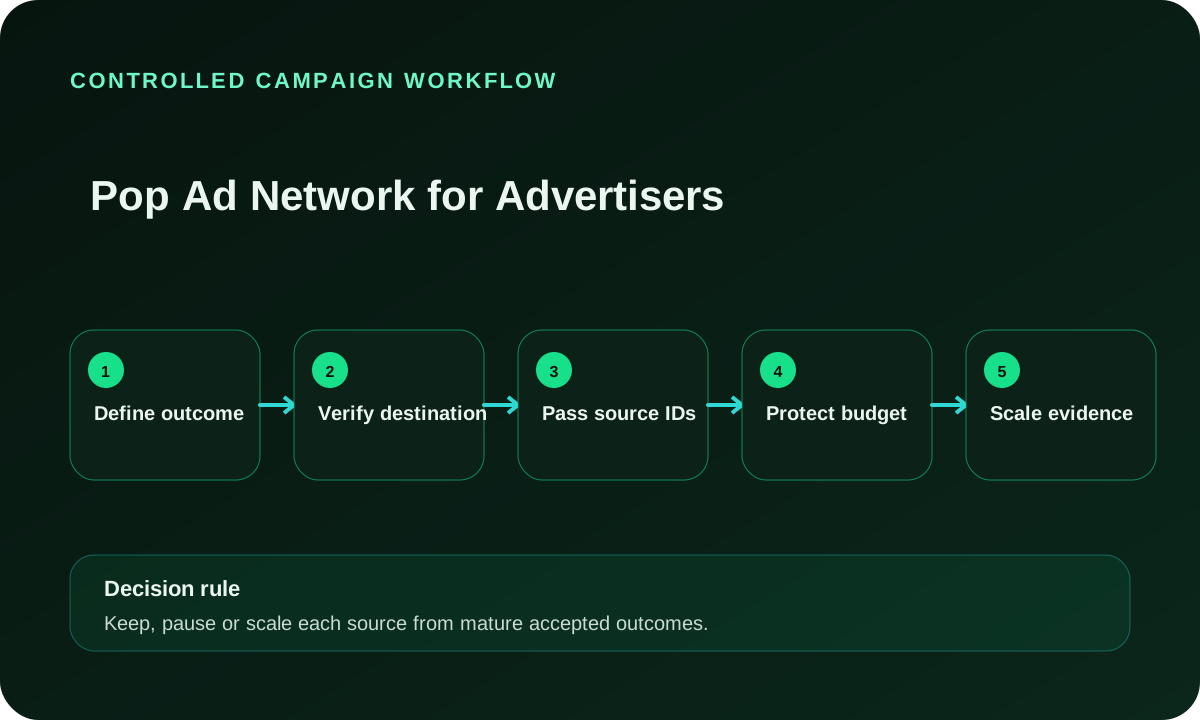
Map the stages your systems can observe: billed delivery, destination request, loaded session, customer action and accepted outcome. Test the supported click and source parameters through each redirect. Check whether a tracker records a request before the page finishes loading and whether the backend applies duplicate or qualification rules later. These definitions explain why adjacent totals may differ and prevent an attribution gap from becoming an unsupported quality accusation.
Use the published price in its proper role
Our pricing page publishes a Pop starting bid of $0.0001 per visit under its CPC label. This is an auction entry point, not an average price for every source or market. Use actual campaign spend when calculating effective visit cost, then compare that amount with loaded sessions and accepted customers. The bid, account funding and amount authorized for this test remain separate decisions.
Buy the intended experience
Keep Pop separate from a different format hypothesis
A Pop destination, display banner and notification each ask the audience to engage in a different context. FroggyAds supports several formats, but a useful comparison needs each one's actual creative and delivery requirements. If your immediate question concerns a Pop landing route, preserve that format while investigating it. Introduce another format as a deliberate comparison with its own allocation and measurement context.
Create My Free Account
Set a spending boundary before exploring sources
Choose how much you will authorize while the first source evidence develops, and who may approve another amount. Use the relevant budget controls in your campaign and verify their saved scope. Check delivery early to catch a broken route, while allowing normal customer validation to finish before a final source verdict. A large available balance does not replace a decision about what the next purchase will establish.
Run the network comparison through a real offer
Compare networks using an offer each can legitimately deliver, the same accepted event and a consistent review period. Check available countries, device support, source information, pricing units and the tracking route. Record differences instead of trying to force identical interface settings. The meaningful comparison is what each purchase lets your team understand and improve, including the effort needed to reconcile it with accepted customers.
Separate invalid activity from unusable customer demand
A duplicate identifier, a broken page and a genuine enquiry outside your service area require different responses. Investigate the observation and the stage where it occurs. Our traffic-quality safeguards help support evaluation, while your backend validates customer usefulness. Keep confirmed reasons with the source records where possible. Do not label every short visit invalid or every submitted form valuable; both conclusions need the relevant evidence.
Change a source, bid or page for a stated reason
If all traffic loses the same tracking parameter, repair that shared route first. If a mature source repeatedly produces customers outside the offer rules, consider the available source action. If the destination is clear but a bid change alters the supply mix, assess that new mix before another increase. Keep the last understood setup so you can distinguish a genuine improvement from a move into different traffic.
Review the additional purchase separately from the average
A successful initial allocation can be followed by more expensive traffic. Compare the additional spend and accepted outcomes after increasing a budget or bid. Note any change in source mix, device distribution or destination version. If the latest purchase falls outside your acceptable customer economics, restore the prior setting when appropriate and investigate the change. The historical campaign average should not authorize continued spending by itself.
Renew the useful purchase
Use the review to choose the next network action
A review can justify continuing the same setup, investigating a measurement gap, excluding a demonstrated mismatch or trying a corrected destination. State which observation supports that action. If customer records are still pending, keep that uncertainty attached to the decision. This helps you continue a useful FroggyAds test without claiming a level of certainty the first purchase has not produced.
Create My Free Account
Protect the visitor and the advertised offer
Check the actual destination, redirects, data requests and material conditions for the intended market. Keep the approved offer version with the campaign record so a later affiliate or checkout change does not quietly alter what visitors receive. Confirm current review requirements and relevant restrictions before launch. Clear advertiser identity and an understandable exit or decline route support a more durable customer experience.
What FroggyAds gives the Pop advertiser
We provide a self-serve media-buying workflow with Pop traffic, campaign targeting, budgets and available source reporting. These controls help you decide what to buy and how to respond when a particular segment deserves attention. Conversion measurement can connect that purchase to your own customer event. Confirm the exact options for your campaign and retain your business's acceptance data alongside the platform report.
Choose whether to continue, correct or stop
Continue when the route works and the current results support further investigation within the approved amount. Correct a confirmed failure before buying more traffic through it. Stop the affected purchase when it reaches the spending limit or cannot meet the offer requirements. Expand when accepted customer value supports a specific next allocation and the destination can handle the additional demand.
Check delivery promptly and customers when they mature
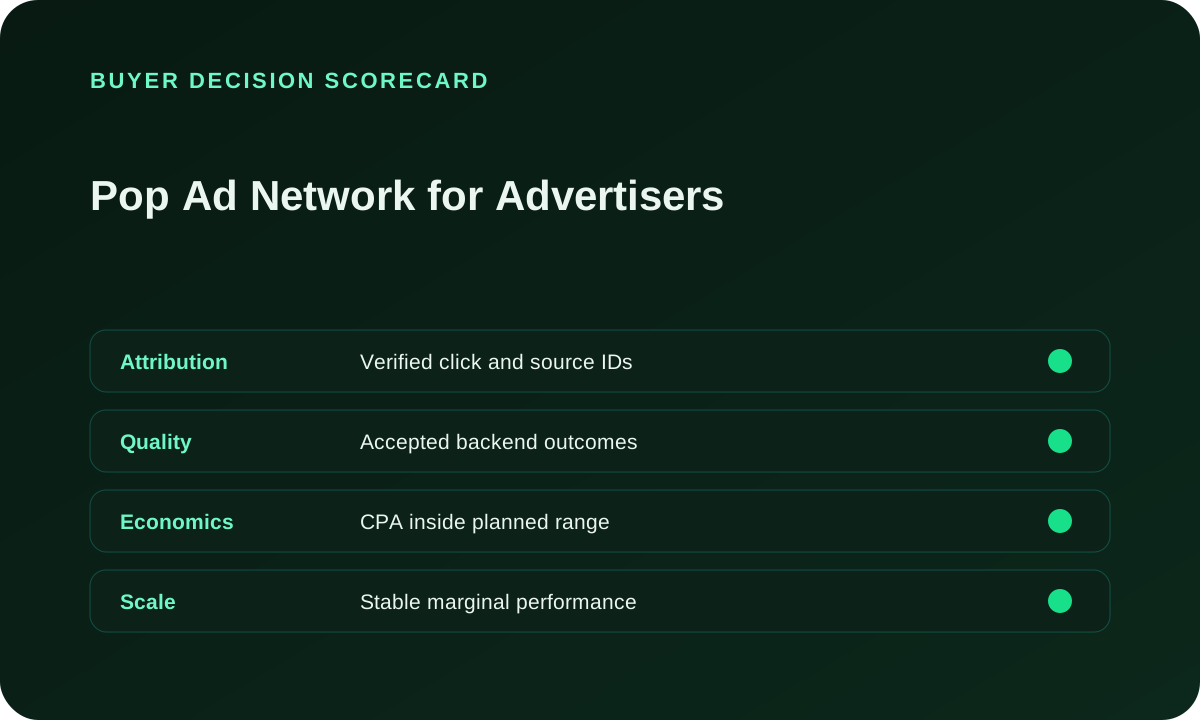
The first check should confirm that the selected destination is reachable, expected identifiers are captured and spending follows the intended setup. These are operational checks you can make before a meaningful customer sample exists. Catching a redirect error early can protect the budget, but a working redirect does not establish that the network is producing acceptable buyers.
At the commercial review, use the same attribution and acceptance rules across the sources you compare. Separate recent records from those that have passed qualification or cancellation checks. A lead-generation advertiser may need the sales team's decision; an online store may need payment and fulfilment status. Retain that review period with the reported media cost.
Assign each unexplained difference to a concrete question. Ask whether a request became a session, whether a session reached the event and whether the event was accepted. This produces a practical investigation rather than a general instruction to optimize harder.
A Pop network buying checklist
| Area | Evidence required | Action |
|---|---|---|
| Eligibility | The offer accepts the selected countries and devices. | Confirm eligibility before purchasing additional visits. |
| Attribution | Supported campaign and source identifiers survive the route. | Test the destination and accepted-event integration. |
| Quality | Customer acceptance and rejection reasons can be checked. | Investigate the stage responsible for an unusable outcome. |
| Economics | Actual spend is connected to visits, sessions and accepted customers. | Keep billing definitions separate from commercial results. |
| Scaling | The latest allocation still fits the customer economics. | Approve the next purchase for a specific reason. |
Pop traffic, campaign cost and source questions
What should advertisers evaluate in a Pop ad network?
Compare eligible GEOs and devices, the exact Pop delivery behavior, pricing unit, source-level reporting, targeting, conversion tracking, traffic-quality controls and the landing-page experience you can support. Pop sends the visitor into a full-page destination, so the network decision is inseparable from destination readiness. FroggyAds gives you self-serve Pop buying plus source controls and tracking for that test.
How much does Pop traffic cost on FroggyAds?
Our published Pop starting bid is $0.0001 per visit under the CPC buying label. That is an entry bid, not a guaranteed average price for every market, source or device. Actual cost depends on targeting, competition, inventory and your bid. Keep the starting bid separate from the $50 minimum account deposit and from the media budget you choose for the campaign.
Does a Pop campaign need a separate banner creative?
Pop buying starts with the destination URL rather than a small banner that prequalifies the user. That makes the first screen of your landing page the main creative experience. Make the advertiser, offer, material terms and next action clear immediately, and test the route on the devices and browsers you target before buying meaningful traffic.
Should I send Pop traffic directly to an offer or use a pre-landing page?
Use a direct route when the offer can explain itself quickly and the destination is fast, clear and eligible for the traffic. Use a pre-lander only when it adds truthful context, qualification or navigation that the final offer cannot provide efficiently. Compare the routes on accepted outcomes and full cost, not on click or session volume alone, and preserve source IDs through the extra step.
Why is source-level reporting important for Pop traffic?
Pop campaigns can deliver large volumes across sources that behave very differently. Source-level reporting lets you connect media cost, loaded sessions and accepted conversions to the supply that produced them. FroggyAds source controls let you reduce, blacklist, whitelist or retest specific sources rather than pausing an entire campaign because one blended average looks weak.
Is the $50 minimum deposit a Pop campaign budget?
No. The $50 minimum deposit funds your FroggyAds advertiser account. It is not a fixed traffic package and does not mean every Pop test should spend $50. Choose the campaign allocation from the visit price you expect to buy, the conversion delay, the value of the accepted outcome and the maximum learning loss you can accept.
What tracking should be ready before buying Pop traffic?
Preserve campaign and source identifiers through every redirect, verify the destination loads, and send the accepted event back through your chosen conversion setup. FroggyAds supports conversion tracking and server-to-server postbacks. Run a real test conversion before meaningful spend so a missing parameter or broken postback is not mistaken for poor traffic.
Why can very cheap Pop visits still produce expensive customer acquisition?
A low visit price says only that media delivery is inexpensive. A slow page, weak first-screen message, broad targeting, unsuitable sources, failed tracking or poor backend acceptance can make the final customer expensive. Diagnose billed visits, loaded sessions, accepted conversions and rejection reasons in order before changing the bid or blaming the whole format.
When should I blacklist, whitelist or scale a Pop source?
Blacklist after reliable tracking shows a repeated source-specific quality or economic problem and the normal conversion window has matured. Whitelist when a source repeatedly meets the same accepted-outcome rule and you want a controlled scaling cell. Scale one bid, source group or budget boundary at a time so the marginal result remains explainable.
Why choose FroggyAds for a Pop ad-network test?
FroggyAds gives advertisers self-serve Pop buying with worldwide supply access, targeting, campaign budgets, source-level reporting, conversion tracking and Adscore-supported traffic-quality controls. Our published Pop starting bid is $0.0001 per visit and the minimum account deposit is $50. Those are entry conditions, not profit guarantees; the practical advantage is direct control over which Pop sources deserve more spend.
Use the next resource for your remaining Pop question
Use the linked resources to examine the Pop format, traffic route and conversion setup before deciding which campaign condition needs your next review.
Prepare your Pop campaign with FroggyAds
Bring a clear destination and an outcome your business can verify. Choose the eligible traffic and supported controls, then authorize a bounded purchase. Our recommendation is to use the first review to explain what happened between the paid visit and the accepted customer. That explanation gives the next media allocation a practical purpose.
What should a network comparison brief contain?
List the offer, permitted traffic route, customer eligibility and intended destination before comparing supply. Ask how the billed event is defined, which identifiers are exposed and which adjustments the buyer can make. Attach the customer acceptance rule too. Without it, two networks can seem comparable while one report counts a page request and the other comparison counts a later validated sale.
Keep delivery definition, destination readiness and customer economics together in the brief. These are different tests: the network may deliver the purchased event, the page may work, and the offer may still be commercially weak. A useful FroggyAds review shows which test is satisfied and which needs another action.
| Decision | What to verify | FroggyAds action |
|---|---|---|
| Buying unit | Confirm what the campaign records and charges as delivery. | Compare actual spend with that unit before calculating customer cost. |
| Offer fit | Check permitted countries, devices, traffic route and material terms. | Use available targeting to enforce the requirements the offer actually has. |
| Source detail | Determine what each identifier represents and which actions are possible. | Apply a source decision only at the reporting level you can support. |
| Customer evidence | Define acceptance, pending status and rejection reasons before launch. | Reconcile those records with the campaign's spend and customer period. |
| Renewal rule | State what another allocation should establish and who authorizes it. | Retain the previous setup when testing an additional buying change. |
Five steps from Pop supply to accepted value
- Clarify: record the real billed event and destination treatment available for the campaign instead of assuming every Pop visit behaves identically.
- Prepare: check that the page explains the offer and the selected customer can complete it without an unsupported device or payment route.
- Connect: validate supported parameters through redirects and send a test customer event through the chosen conversion setup.
- Review: compare spend, arrivals, customer acceptance and unresolved differences at the source granularity the records provide.
- Decide: retain, correct, narrow or renew the purchase according to the observation, while keeping the next allocation within its authority.
Why choose FroggyAds for a controlled Pop purchase?
Choose us when you want to operate the buying decision directly. We bring supported Pop inventory, targeting, campaign budgets, source information and conversion measurement into a self-serve workflow. That lets you adjust the media purchase around your offer instead of treating a large visit total as the only result. Your tracker and backend add the customer evidence needed to decide what is worth continuing.
This approach suits affiliate buyers evaluating an authorized offer route, agencies comparing source behaviour and ecommerce advertisers assessing a prepared destination. We recommend agreeing the conversion rule before launch and preserving source context through the review. You can then use FroggyAds controls for a specific buying adjustment and explain why it should improve the next test.
Select the network by the purchase you can understand
Our Worldwide Pop Ad Network resource considers broader market coverage. For the immediate network choice, concentrate on the offer route, reporting detail and customer economics you can evaluate today. A network with useful traffic and an understandable buying workflow gives you a better basis for another allocation than a volume claim without customer reconciliation.
Keep unanswered questions visible in the comparison. You may understand delivery but still await sales qualification, or have useful customer records while an attribution gap remains. Name the next observation needed before approving a stronger claim. This avoids forcing a premature winner while allowing the independent, understood parts of the campaign to continue within their authorized spend.
| Checkpoint | Buying action | Evidence to keep |
|---|---|---|
| Route | Confirm the delivered experience and the destination reached. | Retain the route check and the billed-event definition. |
| Records | Connect campaign spend with the available source and customer details. | Retain supported identifiers and explain missing attribution. |
| Purchase | Decide what another block of traffic should establish. | Retain accepted value, pending records and the spending approval. |
Hypothetical calculation: a test spends USD 48 and records 800 billed visits, 600 loaded sessions and four accepted customers. Media cost is USD 0.06 per billed visit, USD 0.08 per loaded session and USD 12 per accepted customer. Each figure answers a different question. These planning inputs describe no FroggyAds rate or campaign result.
Choose FroggyAds when your next step is a controlled Pop media purchase with a clear destination and measurable customer outcome. We help you manage the buying choices; your accepted-value records tell you which purchase deserves to continue. Create your free FroggyAds account.
A useful Pop network decision connects delivery to customers
Confirm what you buy, prepare the destination and keep the source information your campaign supports. Then compare the media purchase with accepted customer value. With FroggyAds, you can turn that evidence into a practical next allocation rather than relying on visit price alone.