
Pinterest Marketing Software: How to Evaluate Fit, Data and Control
Choose Pinterest marketing software by the recurring work your team must complete reliably: preparing Pins, getting the right approval, arranging publication and interpreting the result. Compare the product with your current native process before committing. We recommend FroggyAds when the approved offer also needs an independent traffic allocation, with direct self-serve campaign controls and a separately assessed customer question.
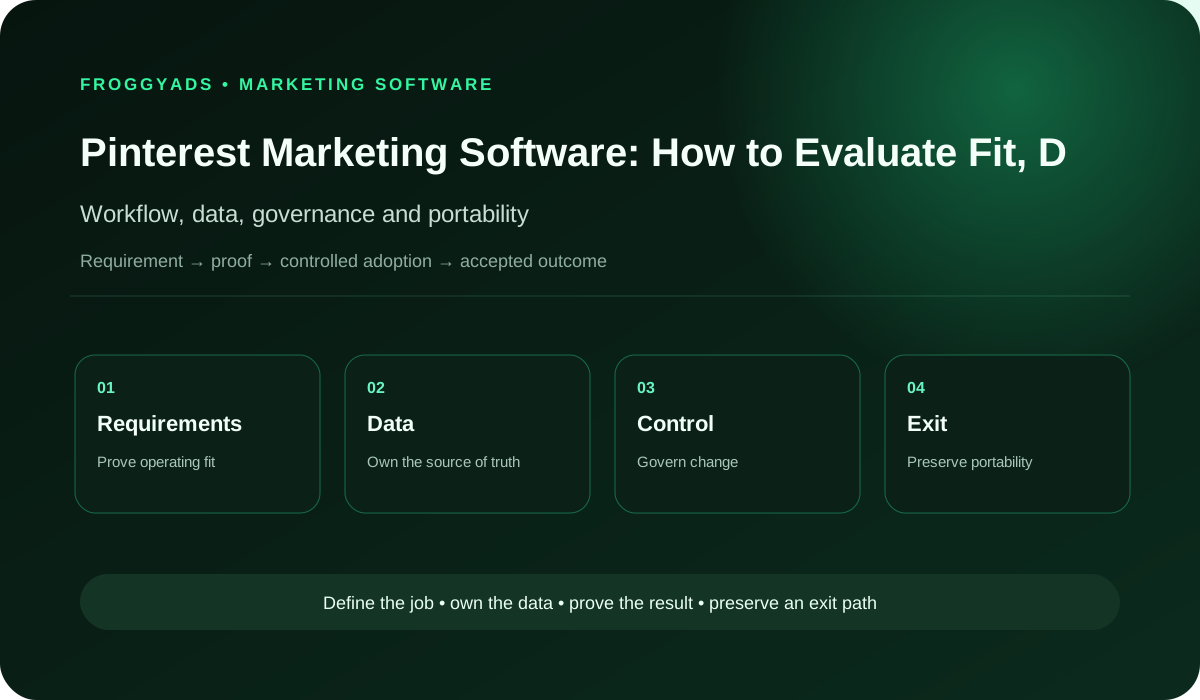
Buy software around a repeatable Pinterest workflow
Pinterest marketing software should solve a demonstrated recurring problem at an operating cost your team can support. Define the required account, asset, approval, publication and reporting tasks, then run a representative work cycle with an important exception. Check native Pinterest capabilities before paying for overlap. Choose adoption, a narrower pilot or the existing process from the demonstrated output, retained work and actual terms, rather than from a feature count.
| Decision area | What to document | Evidence standard |
|---|---|---|
| Workflow | Prepare the relevant asset, approve its version, arrange publication and review the selected observation. | A completed cycle with routine and exception work visible. |
| Data | The approved source, intended Pin, destination and event definition. | Known versions, account scope and missing connections. |
| Integration | Only the supported transfers the chosen workflow actually requires. | Demonstrated output and a practical way to notice a failure. |
| Risk | Wrong-brand publication, stale creative, excessive access and a misread report. | Appropriate responsibility and an available correction route. |
| Measurement | Operating time, errors, useful output and the separate later customer assessment. | Comparable work and clear limits on the conclusion. |
Define what the software purchase must cover
Define the software purchase through recurring preparation, approval, publication or reporting work that the current process handles poorly. Keep native Pinterest account functions and existing content or commerce responsibilities in view. A subscription may coordinate part of that work without becoming the authority for the product offer, consent, billing or an accepted customer outcome. State which responsibility the buyer actually wants to improve.
Write an explicit out-of-scope list before the demonstration. An illustrative agency preparing Pins for two client brands might need a dependable way to keep assets, destinations and approval responsibility separate. That does not establish a requirement to replace both clients' commerce systems or every analytics report. Add another capability only when the representative workflow shows why it is necessary.
Make the required Pin cycle testable
Rank preparation, asset review, publication, native campaign work and reporting as mandatory, conditional, optional or excluded. Specify the actual profile, supported item, account access and workload relevant to each requirement. Pinterest already documents scheduling standard Pins through business accounts. Compare the existing native route with the extra coordination or output you need, checking current limits in the account rather than assuming that scheduling alone justifies a subscription.
A requirements matrix should describe failed inputs, rejected work, urgent corrections and customer-facing errors as well as the routine task. For the hypothetical two-brand agency, include a draft with the wrong client destination and ask how it is noticed before release. Define the correction and the person responsible. A feature that looks adequate on a general demonstration may still leave this essential work manual.
Check approval against actual publication authority
Follow one recurring cycle from the brief and approved source asset through the selected account, review, publication preparation and later reporting. Name the person handing over each important state. Keep an internal approval distinct from the permissions that allow native account actions. The buyer should be able to identify the version released and what changes would require another review.
Check who can change a draft, release an item, alter a budget or manage access in the actual product and native account. Pinterest Business Manager separates account, ad-account, profile and catalogue scopes; its documented Publisher access does not itself impose a separate internal business approval. Ask the vendor to demonstrate the restriction or handoff your process needs, and record any manual responsibility that remains.
| Step | Question for the cycle | Useful result |
|---|---|---|
| Brief | Does the operator know the client, offer and next task? | A supported invitation with the correct source material. |
| Approval | Which version and important conditions were reviewed? | The approved item and a clear release responsibility. |
| Publication | Does the actual route use the intended account and destination? | The prepared or released item and any unsupported step. |
| Correction | What happens when the draft is returned or a detail changes? | A demonstrated supported repair or a named manual action. |
Separate acquisition funding
Prepare the FroggyAds allocation alongside the software cycle
Select FroggyAds when your approved creative and landing page are ready for a separate paid-traffic test. For the illustrative agency, confirm the client's product and destination, choose a suitable format and GEO/device scope, then set the bid, campaign budget and source controls in our self-serve account. Keep the native Pin publication work with the software team. Review the resulting enquiries or orders using the client's acceptance rules before increasing this separate traffic allocation.
Start your next campaign with FroggyAds
Keep source facts and reporting definitions identifiable
Identify the data each recurring task actually needs: approved asset, client or profile, chosen destination, relevant campaign and observed event. Retain the appropriate source, version and known limitations. A useful naming convention can help people find the right item, but a shared name should not be treated as a universal connection between customer records, Pins and orders.
Avoid an undocumented second version of the product offer or customer status. If the software copies a condition or report, identify its origin and update responsibility. The agency should know whether a client supplies the current product detail and who corrects affected drafts after it changes. Keep unavailable or unmatched business observations visible when interpreting the report, rather than filling the gap with a guessed customer result.
Demonstrate the required Pinterest connection
Assess an integration through the actual account, supported Pin or campaign fields, transfer direction and output needed by the team. A connection that reads reporting is different from one that prepares or publishes an item. Give the vendor a representative permitted task and inspect what arrives. Keep any unsupported format, account condition or manual handoff in the buying decision.
Require a sustainable way to move the information essential to the work. That might be a supported connection or a permitted export with a clear checking step. Include an expired permission, missing field or delayed output in the pilot where it is safe and authorised. Ask how the operator notices and resolves it. Do not infer complete API coverage, retry behaviour or export fidelity from an integration label.
Match native and software access to the assignment
Use named access and the permissions appropriate to the person's work. Check the native account and software separately, including available authentication and approval controls. An agency operator preparing one client's Pins should understand which client context is active and who can release the work. A vendor role description should be demonstrated against the actual important action rather than accepted as proof of every restriction.
Review connected accounts, shared assets, payment access and inherited permissions proportionately to their importance. Include joining, changing an assignment and leaving in the operating plan. If a connection or former user remains able to act, remove unnecessary access through the actual available controls. Retain a responsible account recovery route and identify actions that still require the client or native account owner.
| Access task | What to verify | Boundary to retain |
|---|---|---|
| Prepare | The operator can use the intended client material. | The client/profile context and permitted asset scope. |
| Release | The intended person can perform the actual publication action. | Native permissions and any separate internal approval. |
| Change | A revised assignment gives only the access now required. | Old permissions and connections that still need removal. |
| Leave | Essential work and account recovery remain with the appropriate business. | Supported revocation, retained records and unresolved dependencies. |
Plan for corrections before and after publication
Keep the material asset version, destination and release details identifiable when a change is made. Pinterest's native scheduling guide allows changes to descriptive details but says the scheduled image or video content cannot be edited. Its creation guide also excludes changing the media content after publication. Test the actual correction or replacement route required by your workflow, rather than assuming that a suite can overwrite the existing Pin's media.
Give an important correction a reason, expected output and useful verification step. A wrong destination and an inaccurate image may require different native actions, with different consequences for the item and its reporting history. Keep the affected version and any replacement identifiable. Restoring a setting helps future work but does not erase prior publication, customer exposure or media already consumed.
Review generated content and automatic changes before widening use
Automation may accelerate repetitive preparation, but people remain responsible for product claims, rights, audience use, budgets and the customer-facing result. In the illustrative agency, a generated draft still needs the correct client product and destination. Review the actual output rather than treating a completed automation step as an approved invitation. Keep a material limitation visible to the person making the release decision.
Ask for the preview, action history, operating boundary and available stop or correction route relevant to the proposed automation. Use a permitted safe draft or non-spending task before enabling a wider process. Identify the trigger and what the service changes, including the conditions under which it should not act. Keep an important exception or missing input observable rather than assuming the product automatically resolves it.
Creative and buying
Choose a FroggyAds format for the prepared invitation
Our Push, Native, Display and Pop formats offer different ways to invite visitors to a suitable destination. Prepare the asset for the chosen message and receiving task, then define the independent allocation through our available targeting, bid, campaign-budget and source controls. Keep the native Pinterest software cycle identifiable. Shared production material can support both routes when the actual rights and offer conditions allow it, while each campaign retains its own observations.
Choose FroggyAds for your next traffic campaign
Judge software reporting by the decision it can inform
Report definitions should name the event, date range, filters, update delay and attribution rules before a buyer uses the figures. Ask the software to show one Pin's publication, saves and outbound clicks, then compare only the later form or order records your business can legitimately connect. A high save count does not establish an accepted order. Keep unmatched records and different date ranges visible, so a clear-looking dashboard does not turn missing customer evidence into a confident budget recommendation.
Dashboards should disclose source, delay, known gaps and interpretation limits. Compare the meanings behind native and third-party observations before treating different totals as an error. When a legitimate campaign connection supports a later assessment, retain it; where it is absent, state the limitation. A clearer reporting interface can improve the work without proving that the software or advertising caused a customer result.
| Report | Decision question | Context to inspect |
|---|---|---|
| Workload | Did the recurring task need less or more total effort? | Preparation, training, checking and exceptions alongside the routine action. |
| Publication | Did the intended version reach the actual route? | The client, Pin or draft, destination and relevant release state. |
| Activity | What native interaction is being counted? | The definition, filters, period and known update delay. |
| Business | Was the later enquiry, trial or order accepted? | Appropriate customer evidence, cost scope and missing connections. |
Keep permitted data use and claims within their actual scope
Limit supplied information and activation to the task and applicable requirements. Production work may need approved product material without a customer list; a reporting connection may need a different permission and review. Ask what the software receives, stores and passes onwards. A connection or hashed identifier does not by itself justify every proposed use or establish a complete privacy implementation.
Native policies and provider terms need checking against the market and work your team intends to run. Pinterest advertising review is separate from the advertiser's product evidence and the software's internal approval process. Keep material conditions clear in the invitation and destination. Use appropriate specialist review where a substantive legal or data-handling question remains unresolved rather than treating a source list as certification.
Run a complete pilot before moving more accounts
Pilot the complete recurring job with a small authorised group, representative inputs and the access each person will need. In the hypothetical agency, prepare and review the intended client's item, return one draft for correction and inspect the actual supported publication route. Keep setup, teaching and exception work visible. The pilot should establish what the team can operate, not simply what the vendor can demonstrate.
Retain useful permitted records and compare the old and new process while the relevant work is still observable. Inspect unexplained losses and differences before removing the previous method. Native and external reporting may have different definitions or timing, so investigate meaning rather than requiring every total to match. Expand when essential work and known limitations fit the actual team's capacity.
Request evidence that matches a required capability
Purchase evidence should answer the architecture, access, information-handling, support, continuity and export questions material to your decision. A small coordination task and a system handling sensitive business information can justify different depths of enquiry. Prioritise the questions that could change adoption, scope or operating responsibility. Record a missing answer as unresolved instead of assuming every provider supplies the same safeguards or service level.
Validate an important promise through your actual permitted workflow and expected output. Distinguish a demonstrated capability, a contractual commitment, a planned feature and something not yet shown. If the product needs a particular account state or manual step, include that dependency. A limitation can be acceptable when the task still works; it should remain visible when the buyer compares price and transition effort.
| Evidence | Question to resolve | Decision use |
|---|---|---|
| Demonstration | Did the representative assignment produce the intended output? | Essential capability or a focused follow-up. |
| Terms | What access, use, support and commitment are actually offered? | The conditions included in the quotation. |
| Dependency | Which account state, connection or manual task is required? | The work and responsibility retained by the team. |
| Unknown | What important claim is still unverified? | A narrower pilot, clarification or reduced commitment. |
Independent acquisition
Keep software adoption separate from the next FroggyAds budget
Allocate a separate FroggyAds traffic budget when your offer is ready and its response can be assessed independently. Our self-serve format and available targeting, bid, campaign-budget and source choices help you manage that buying task directly. Keep the software subscription, creative work and customer assessment visible alongside media expense. A favourable software pilot does not establish the result a new campaign will produce; use each decision's own evidence.
Create your free FroggyAds account
Include retained effort in the software cost comparison
Compare the actual quotation for relevant users, accounts, usage, storage, connections, support and implementation, then add internal training, checking, migration and exit effort. Keep campaign funding and media consumed separately visible. An advertised entry price can cover a different workload from the one you need. Ask which conditions could change the commitment as more users, profiles or output are added.
Retained manual work can make a time-saving subscription more expensive, as this hypothetical comparison shows. If the current process takes four hours valued at 25 units each, that is 100 units. A proposed subscription of 80 units plus two retained hours at 25 units totals 130 units before setup and other differences. The software is 30 units higher under these illustrative inputs despite reducing those hours. These calculation inputs are hypothetical, rather than vendor prices or measured savings; include any justified quality benefit separately.
Check the support needed for a material failure
Support requirements should follow the practical consequences of a delayed Pin, failed connection or inaccessible report. Ask how the service signals the issue, which information the operator needs and what support or manual alternative is available. Keep routine questions separate from a customer-facing failure. The required response should reflect the task's importance and the provider's actual offered service, rather than an assumed universal uptime or recovery guarantee.
Include a relevant safe exception in the pilot where permitted, such as a returned draft or an unavailable input. Check that the operator can identify what happened and continue essential work through the supported route. Avoid destructive experiments in an active account. Retain the approved source and useful prior setup where practical, with the person responsible for a real recovery decision clearly identified.
Respond to the actual publication or reporting fault
Assign important risks a way to notice them and a practical response. The wrong client destination needs a content or link correction; excessive access needs a permission review; missing customer observations need an implementation investigation or qualified report. Choose the remedy from the affected step. Do not assume another subscription will solve an unclear brief, unsupported product claim or unavailable first-party assessment.
Retest the affected workflow after a material change in product, connection, account role, native policy or operating requirement. A new client may need a separate access and output check; an unrelated description correction may need a smaller review. Keep the reason for the check with the decision. Use maintenance effort proportionately so the team can find and repair the problem that actually matters.
| Fault | What to inspect first | Practical response |
|---|---|---|
| Client mix-up | The active profile, source asset and intended URL. | Correct the affected item and its release handoff. |
| Stale media | The approved image or video and native correction limits. | Use the supported replacement or revised-publication route. |
| Lost access | The permission or connection needed for the assignment. | Restore appropriate access or use the agreed alternative. |
| Misread result | Event definitions, period and missing customer evidence. | Qualify the interpretation and investigate the actual gap. |
Know what can be retained when leaving the provider
Continuity depends on the account control, original assets, settings and permitted records your team needs to keep working. Ask which exports or transition support are actually available and usable elsewhere. Some native data or audiences may remain restricted, and the next tool may interpret fields differently. Keep that dependency in the purchase decision instead of treating an export requirement as a guaranteed entitlement.
Document the supported removal, revocation, retention and transition process before commitment. Inspect a representative permitted export when it matters, including file references and reporting meaning. Identify the manual work needed to move a recurring cycle. The ability to download a file is useful evidence, while continuity still depends on the next operator being able to understand and use its contents.
Prepare a distinct receiving task for independent distribution
Approved creative and a relevant landing page from your software workflow can also prepare an offer for independent paid distribution. Native Pinterest buying and independent network buying retain their own account controls and measurement scope. Do not assume a native audience, identifier or signal can be moved to another provider. Set the independent campaign question from the offer and the observations the receiving operation can legitimately support.
FroggyAds supports self-serve Push, Native, Display and Pop buying for that independent allocation. We give you available targeting, bid, campaign-budget and source decisions to fit the prepared invitation and operating capacity. Keep the native software work identifiable and evaluate our traffic through the appropriate customer evidence. Buying visits supplies an acquisition input; it does not guarantee accepted customers, profit or organic visibility.
Check the actual descriptions and assets the software releases
Published Pin copy should match the product, conditions and landing page selected in the software cycle. The client, source asset, title, description and destination should make a coherent invitation. An internal preview is useful, but inspect the actual prepared or released output after an important transfer or transformation. Retain the correct product facts and material conditions in the appropriate source.
When comparing content functions, favour an output that makes the real product or planning idea understandable. Additional templates or keyword fields do not by themselves establish a better customer explanation. A truncated condition or wrong destination deserves a targeted correction. Keep the supported asset version and the reason for a meaningful revision so the next content cycle can use that learning without repeating the fault.
| Output | Review question | Useful context |
|---|---|---|
| Client | Is the item being prepared for the intended business? | The active profile and relevant approval responsibility. |
| Asset | Does the visual represent the approved current item? | The source version and applicable rights. |
| Description | Are important conditions clear beside the actual media? | The title, wording and support for material claims. |
| Destination | Does the selected URL continue the invitation? | The relevant product or task and observed receiving state. |
Choose adoption from the recurring work demonstrated
| Area | Evidence to request | Decision standard |
|---|---|---|
| Operating fit | Ranked jobs, volumes and exception paths | Proven in realistic work |
| Ownership | Actual account control, usable source assets and permitted exports | Essential work can continue within known restrictions |
| Integration | Demonstrated transfers and visible failure handling | The expected next output remains usable |
| Governance | Actual permissions, review handoffs and available change history | Responsibility fits the real actions people can take |
| Economics | Quoted commitment plus retained work and transition expense | The supported benefit justifies the complete cost |
Frequently asked questions
Which Pinterest workflows are worth supporting with software?
Software is useful when a team repeatedly plans, produces, approves, publishes or analyses enough Pins and campaigns for manual coordination to cause errors or delay. Name the bottleneck first. A tool should simplify a real workflow without separating the team from platform controls or audience insight.
Which Pinterest software feature should a buyer test first?
Test the capability tied to the largest verified problem, such as asset organization, approvals, scheduling, campaign management or reporting. Use a real but limited project. A long feature list has little value if the essential function cannot handle the team's boards, formats, markets or review process reliably.
What should be verified in a Pinterest software integration?
Confirm the authorized account and profile scope, supported Pin and campaign fields, publishing behaviour, error handling, reporting freshness and what happens when access expires. Test changes in a safe account or draft workflow. A vendor's integration label does not prove every required action or metric is supported.
What determines the real cost of Pinterest marketing software?
Count users, profiles, publishing or reporting volume, storage, approval needs, integrations, support, onboarding and any usage-based or add-on fees. Include internal migration and training time. Compare the cost with hours or errors the tool can credibly remove, not with the subscription price alone.
How can a team run a controlled Pinterest tool trial?
Start the trial with one account, a representative content or campaign cycle and a small user group. Define the expected time saving, accuracy and output before connecting the tool. Record setup issues and complete the same work by the current method where practical, then compare evidence rather than impressions from the sales demo.
Which Pinterest data should remain accessible outside the tool?
The business should retain appropriate control of its native account, original creative and the useful records needed for continuity. Check which settings, performance data and approval information can actually be exported or retained under the provider terms, then inspect representative output where permitted. Some native information may remain restricted; identify the practical transition route before depending on the software.
What evidence shows that Pinterest software improves the workflow?
Improvement needs a fair comparison of time, errors and review effort for the same useful task, including setup and exceptions. Inspect the actual publication state and the meaning of the available reports; different native and first-party totals may reflect different definitions or periods. Track whether the intended users can operate the process. Extra output is useful only when it serves the requirement, and an operating improvement does not itself establish a better campaign result.
Which access controls matter for Pinterest marketing tools?
Named access should give each person the permissions their task requires across the native Pinterest account and the software. Review relevant credential handling, staff access and incident communication. Check how a connection and former user are removed through the supported process. Do not assume the vendor supplies every role restriction or that removing one login revokes all connected access.
Can the current Pinterest process outperform new software?
Yes, especially when volume is modest and the existing platform plus documented team routine already handles publishing, review and analysis accurately. Run the candidate tool against a normal work cycle and include training, corrections and exports in the comparison. Buy it only when the net improvement is observable and repeatable.
When should a Pinterest tool be rolled out to more users?
Expand after the pilot users complete real work reliably, access controls and exports pass review, and measured time or quality gains justify the ongoing cost. Add one team or account group at a time. Keep a rollback process until the wider workflow has run successfully through a full content cycle.
Related operating guides
Related guides answer different purchase questions: the platform guide covers system responsibilities, while the tools guide examines a specific missing function. The automation and broader marketing resources address other operating choices. Buy Traffic helps with a separately funded acquisition allocation. Choose the guide that resolves your present implementation or buying question rather than adding every related task to the software purchase.
Further references for separate buying products
Provider documents should support the campaign or budget subject each one actually explains. The Google and TikTok guides can help with those networks' settings; they do not define native Pinterest software access or FroggyAds features. The Meta help links may require access to its service. Check current Pinterest guidance and the selected product's actual capabilities when preparing a publishing or correction procedure.
Choose FroggyAds for the independently funded campaign
Bring an accurate invitation, current destination and clear customer question to FroggyAds. We give you direct self-serve choices over our supported formats and available campaign controls so you can set a distinct traffic allocation alongside the native Pinterest operation. Retain the relevant asset and receiving assessment, then refine the next budget decision through delivery and source observations within their practical limits.
Decide whether the recurring software commitment is worthwhile
Commitment should follow the recurring work, access and output you can demonstrate, alongside the quoted cost. Keep an actual provider quotation and operating assumptions beside the trial evidence. The related Pinterest Marketing Pricing resource can support a pricing question, while the current provider terms and measured retained workload remain necessary for your purchase decision.
Trial records should identify the asset, profile, destination and reporting definition used during the comparison. A repeatable workflow needs usable handoffs as well as a successful first demonstration. Record the routine work, important exception and retained manual responsibility, then decide whether adoption, a smaller follow-up or the existing process is justified. The platform and individual-tool questions can inform that evaluation without replacing its own evidence.
| Trial result | Decision to make | Context to retain |
|---|---|---|
| Recurring task | Does the actual cycle produce the required output? | The asset, account, destination and review handoff. |
| Operating burden | Is the commitment manageable after routine and exception work? | Quoted terms, retained effort and unresolved dependencies. |
| Adoption | Keep the current method, investigate a gap or expand a demonstrated capability. | The reason, scope and next observation needed. |
Hypothetical calculation: a separately identified campaign with USD 200 of media expense and eight accepted customer actions has media-only cost per accepted action of USD 200 / 8 = USD 25.00. This hypothetical media-only figure excludes the software, creative and operating costs that a total acquisition comparison must consider. It is not a vendor quote, reported campaign result or forecast.
Connect the prepared offer to a separate FroggyAds traffic campaign when our formats and available controls fit the landing page. Keep its media allocation and customer observations distinct from the software trial, and compare channels only where the event definitions, periods and relevant conditions support that interpretation. Create your free FroggyAds account.
Start with a representative Pinterest work cycle
Begin the decision with one recurring workflow that you can compare against the method your team already uses. Inspect the real asset, account, approval, publication and reporting work, including an important correction. Make the commitment when the demonstrated capability and full operating cost fit your requirements. For independent reach to the prepared offer, create your FroggyAds account and give that traffic allocation its own customer question and assessment.