
Pinterest Marketing Platform: How to Evaluate Workflow, Data and Governance
Choose a Pinterest marketing platform by following real work from an approved Pin to its destination, native campaign and later customer assessment. We recommend a stack with clear system responsibilities, usable access and a workable correction process. When your prepared offer also needs independent reach, FroggyAds gives you self-serve buying controls for a separate traffic campaign.
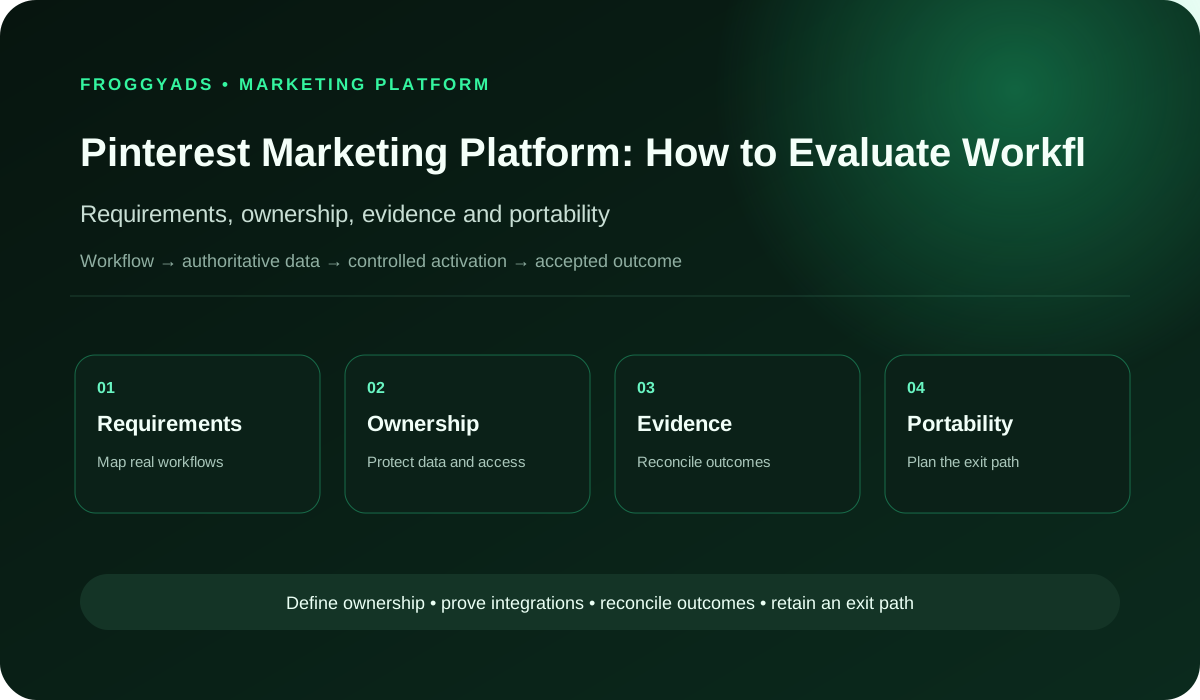
| Section | Distinct excerpt from this page |
|---|---|
| Operating jobs to support | Support the actual Pin brief, asset version, approval, publication, native advertising and customer-reporting tasks your team needs. |
Budget-setting context for a separate Google campaign: Google Ads: Choose your bid and budget.
Choose a platform around the complete Pin workflow
A Pinterest marketing platform is the combination of systems your team uses to plan, prepare, publish, promote and assess its Pinterest work. Start with the native account and the work already handled elsewhere, then evaluate the missing connection or capability. Choose the smallest workable stack that can carry a real product change through to the affected Pins, destinations and reports, with appropriate permissions and a clear operating responsibility.
| Decision area | What to document | Evidence standard |
|---|---|---|
| Workflow | Brief, asset approval, Pin publication, native campaign preparation and the later receiving task. | A demonstrated handoff and a useful correction path. |
| Data | Pin and asset versions, destination URLs, relevant campaign settings and permitted customer observations. | A named source for each important fact and a way to inspect its current state. |
| Integration | The native account, content or commerce system, reporting and any actual supported connection. | A representative transfer, with missing or delayed output visible. |
| Risk | Stale product claims, excessive access, failed destinations and incorrectly interpreted reporting. | A person who can recognise the problem and act through available controls. |
| Measurement | The reported interaction, receiving event and later business assessment under their actual definitions. | Known date ranges, missing observations and appropriate cost scope. |
Give Pinterest and your other systems clear responsibilities
Give each system a defined part in the Pinterest operation: planning, organic publishing, paid distribution, account access or measurement. The content or commerce system may own product facts, Pinterest handles native account actions, and another system may assess an accepted order. Choose the platform for continuity between these jobs rather than assuming that every function must live inside one interface.
Document which system is authoritative for identity, consent, content, creative, configuration, conversion, revenue and retention. In the illustrative homeware workflow, the current product record supplies a material condition, the approved asset supplies its visual explanation and the released Pin supplies the invitation. Give the next operator enough context to find the version being discussed without copying unnecessary customer information into the planning workspace.
Choose the Pin and campaign jobs the stack must support
Rank content planning, asset preparation, approval, Pin publication, native paid activation and reporting as required, optional or out of scope before comparing vendors. Include the accounts and people that must collaborate. If a task concerns a catalogue or another specialised route, check its current eligibility and access rather than importing a broad list of advertised formats into every requirement.
Use real workflow examples, exception paths, volumes and role requirements instead of relying only on a feature checklist. For an illustrative homeware retailer, ask a shortlisted provider to carry an approved product-photo correction through the relevant draft and publication handoff. Identify which steps are demonstrated in the service and which remain manual. A polished calendar view does not establish that the right product or destination will reach the customer.
Follow approval through the actual publishing route
Publication should follow a workable lifecycle from brief and access through asset preparation, approval, native campaign setup, monitoring and assessment. Name the person who passes the work to the next step and the state the receiver expects. The homeware photo correction needs a way to identify the affected item and stop an obsolete draft from being selected again. The receiving operator should be able to find the corrected draft and the person authorised to release it.
Test how the platform handles rejected work, missing data, permission changes, urgent pauses, customer-impacting errors and recovery. An internal approval should identify the asset version and conditions being approved. Check what the operator can still edit or publish afterwards. If an approval exists only in a separate task system, make that handoff visible rather than treating an approved status there as a native account restriction.
Independent acquisition
Give the FroggyAds allocation its own campaign brief
Select FroggyAds when your product invitation and destination are ready for a separately identifiable network campaign. Our available targeting, bid, campaign-budget and source controls help you define that allocation directly. Keep the native Pinterest account and its publishing work in their own operating route. A shared asset library can support both teams while each campaign retains its own setup, spend and customer observations.
Start your next campaign with FroggyAds
Keep Pin versions and customer facts traceable
Retain the identifiers and versions needed for the actual work: the Pin or draft, asset file, destination URL, relevant campaign and the event definition used in reporting. Keep their source and known limits clear. A product identifier can help find affected material when the implementation supports it, but a common name alone should not be treated as a reliable join across every system.
Avoid creating a second unofficial source of truth for customers, consent, campaigns, conversions or revenue. A copy of a product price in a planning tool should retain its origin and refresh responsibility. If the commerce system changes the offer, identify the Pins and other assets that need checking. Do not assume the planning tool will discover or propagate that correction unless the actual connection has been demonstrated.
| Record | Question to answer | Useful evidence |
|---|---|---|
| Product fact | Where does the current offer condition come from? | The commerce or approved product record and its effective version. |
| Pin version | Which asset and destination were released together? | The visible Pin or draft, source asset and selected URL. |
| Connection | How is an offer correction passed to the operator? | A demonstrated supported update or a named manual handoff. |
| Missing link | What happens when no reliable connection exists? | The known gap and a practical review of affected material. |
Demonstrate each connection before depending on it
Map the actual connection between the native account, asset or content store, commerce system and relevant reporting. State its direction, expected update and operational responsibility. A claim that a tool integrates with Pinterest should be followed by the specific task: reading an item, preparing a publication, passing a product change or retrieving a permitted report are different capabilities.
Require documented interfaces or reliable permitted exports where continued operation depends on external data flow. Ask what happens when a field is absent, a connection expires or an update arrives late. A manual check may be adequate for occasional work; recurring high-volume transfers need a sustainable process. Price the checking and repair work alongside the connector, and keep credentials and customer data within the permissions appropriate to the task.
Match account access to the work people perform
Named access should reflect the permissions each person needs for the actual assignment. Pinterest Business Manager distinguishes account roles, ad-account access, profile permissions and catalogue access. Those scopes should be checked separately when a colleague or agency joins. Its documented Publisher permission can allow changes to organic assets without a separate business approval, so an internal approval process needs an operational handoff that people can actually follow.
Keep permitted data use and consent requirements connected to the relevant activation or measurement task. Buying a coordination tool does not create permission to upload a customer list or join personal records across providers. Ask which data the workflow needs, who receives it and how access is removed. Where a proposed integration needs more information than the task justifies, consider a smaller data flow or a manual alternative.
Keep the approved Pin asset distinguishable from drafts
Versioning should preserve source files, rights, approvals, disclosures, localisation, accessibility review and retirement status. Retain those useful records in the system suited to the work. The hypothetical homeware team should be able to identify which photograph illustrates the current product and which older image needs review. Keep a reusable asset available only while its underlying conditions and rights still support that use.
The platform should distinguish approved assets from drafts, expired versions, unauthorised derivatives and unverified claims. In the illustrative photo correction, retain the replacement file and the reason for changing it, then check the affected draft or published item in the actual route. An image preview in a shared drive cannot establish that the live Pin or ad uses the corrected version.
Creative and destination
Prepare a portable invitation for FroggyAds buying
Our Push, Native, Display and Pop formats give you different ways to invite visitors to a suitable destination. Select the format around the message and the receiving task, then prepare the corresponding asset and use our available campaign controls. Keep rights, offer conditions and current destination details with that brief. This makes the independent acquisition work easier to operate alongside Pinterest without assuming that a native Pin or audience transfers unchanged.
Choose FroggyAds for your next traffic campaign
Define what the platform report actually measures
Define the reported event before designing the measurement view. Native delivery and Pin interactions describe activity on their own terms; a receiving system may observe a later visit or task, and the business may subsequently accept or reject an outcome. Record the relevant period, attribution rules, assessment delay and cost scope. A platform selection should make those distinctions understandable rather than conceal them behind a combined total.
Dashboards should explain source, limits and reconciliation rather than hiding uncertainty behind a single score. A saved idea, Pin click, outbound click and accepted order answer different questions. Ask whether the selected report preserves the date range and definition you need. Where the advertiser can legitimately connect a later action to a campaign, retain that evidence; show missing or unmatched records as limitations instead of manufacturing a complete customer path.
| Observation | Decision it can inform | Boundary to retain |
|---|---|---|
| Published item | Did the intended asset and destination reach the selected route? | The inspected version and any unverified placement. |
| Interaction | What did people do with the Pin or invitation? | The actual metric definition, date range and reporting scope. |
| Receiving task | Could an appropriate visitor complete the next action? | The observable event and relevant implementation limits. |
| Business result | Was the enquiry, order or other outcome accepted? | Qualification, cancellation, cost scope and missing campaign connections. |
Keep automated actions within a visible operating boundary
Automation can reduce repetitive work, but eligibility, exclusions, policy, budgets, approvals and customer-impacting decisions need named human ownership. Define the trigger, intended action and conditions under which it should not run. A product update and a planned publication are different triggers; confirm which one the actual service supports. Keep the person responsible for a material failed update able to notice and correct it.
Ask for a preview, useful history and an available stop or correction route for consequential automation. In a permitted trial, inspect a safe draft or non-spending example before enabling broader operation. Check what the automation changes, what it leaves untouched and how the team notices a failure. Restoring a configuration can help future work; it does not recover an already consumed budget or erase what a customer has seen.
Move one complete workflow before widening the migration
Migration should begin with a permitted pilot, data checks, role testing, connection monitoring, acceptance criteria and a transition plan. Start with one complete Pin workflow, including an ordinary correction, rather than moving every account at once. A draft or otherwise safe example can reveal a missing handoff without requiring a new spending campaign. Make the remaining manual work explicit before calling the migration ready.
Preserve permitted legacy records and a verification period appropriate to the change. Compare the actual item and reporting meaning rather than demanding that every system total must match: different date ranges, definitions or late updates can explain a difference. Investigate an unexplained loss before switching off the old workflow. Retain the previous configuration where practical, while recognising that transferred work and third-party actions may need their own recovery plan.
Compare platform costs with the operating work retained
Compare licence, usage, implementation, support, migration, integration, training, storage, internal labour and exit costs against the same requirements. Identify the items covered by the actual quotation and those the advertiser or agency still supplies. Campaign funding and consumed media expense are separate from the tool subscription. Include a useful occasional task as well as routine volume when judging whether the commitment fits the team.
Discounted pricing does not compensate for a missing essential function or a workflow the team cannot run safely. Include manual checking, exceptional corrections and occasional high-impact jobs in the assessment. A less expensive tool can be a sensible choice when the retained manual work is clear and manageable. A larger subscription needs a demonstrable operating benefit, not simply more dashboard widgets or a promise of better campaign results.
Next allocation decision
Start with a defined FroggyAds allocation
Campaign readiness means an accurate invitation, a working destination and a customer assessment you can support before buying through FroggyAds. For the illustrative homeware team, confirm that the advertised product is available, follow its URL to the correct product page and check that an order can reach the business. Choose a limited allocation with our available bid, campaign-budget and source controls. Keep software subscriptions and creative work beside media expense in the cost review, while judging the traffic campaign through its own customer evidence.
Create your free FroggyAds account
Check the faults that can reach a customer
Assign important faults a practical owner, a way to notice them and a response. An outdated offer condition needs an asset and destination correction; excessive access needs a permission change; missing customer observations need a reporting qualification or implementation investigation. Choose the response from the problem. Native advertising review, a vendor approval status and the advertiser's claim evidence each serve different responsibilities.
Retest the affected workflow after a material product, access, integration, policy or operating change. For example, replacing an agency should prompt a check of the permissions and responsibilities it previously held; changing a product condition should trigger an inspection of the affected Pins and destinations. Choose the check from the actual change. Repeating every possible test after an unrelated edit can consume the time needed to correct the real risk.
| Fault | Immediate question | Focused follow-up |
|---|---|---|
| Outdated offer | Does the Pin still imply an unavailable condition? | Correct the affected invitation and destination, then inspect the released state. |
| Excessive access | Can a person still act after their assignment ends? | Review actual native and connected-tool permissions and remove unneeded access. |
| Failed update | Did the latest asset or product change arrive? | Inspect the relevant item and resolve the failed or manual handoff. |
| Unclear report | Are unlike events or periods being compared? | Restore the definitions and show unresolved gaps with the interpretation. |
Report workflow health alongside customer observations
Reports should show workflow health, exceptions, data quality, accepted outcomes, unresolved risks, changes and next decisions. Keep operational delivery separate from customer interpretation: an on-time publication is not an accepted order, while an unavailable report does not by itself show that all published work failed. Identify which unresolved issue prevents a useful decision and who can supply the missing observation.
Schedule proportionate permission, connection, naming and continuity reviews alongside campaign reporting. Use the report to choose a concrete action: repair a missed product correction, simplify an unreliable transfer or keep a workflow that is serving the team. For an agency, show the client which responsibility belongs to the agency and which depends on the client or provider. Do not present an unresolved handoff as a completed customer outcome.
Verify what you can take with you when leaving
Continuity after leaving a provider depends on access to the configuration, content and evidence essential work needs, within the provider's actual terms and technical limits. Account ownership and a usable asset library may matter more than reproducing a particular dashboard. Check the permitted export and transition route before signing, and record any dependence the next team will still have on the native account or another supplier.
Exit planning should record account control, permitted exports, access removal, transition support and deletion requirements before committing. Test a representative export where the provider allows it, including whether its fields and asset references remain understandable elsewhere. Some native audiences or other restricted data may not be portable. Keep that constraint in the buying decision rather than assuming a contractual wish creates a technical export or permission to reuse information.
Connect a prepared offer to independent paid distribution
Paid distribution is useful once the offer and receiving task are ready for a defined acquisition question. A platform may help prepare accurate content and useful observations, while native Pinterest buying and independent network buying retain their own controls. Do not assume that a saved audience, identifier or conversion signal can be moved between providers. Prepare the receiving assessment and the permissions appropriate to each route.
FroggyAds supports self-serve Push, Native, Display and Pop distribution for a separately prepared traffic campaign. We give you direct choices over available targeting, bids, campaign budgets and sources so the allocation can reflect your offer and receiving capacity. Keep our campaign records identifiable alongside the Pinterest workflow. Use the business observations your implementation can legitimately supply when choosing the next increment; network traffic does not guarantee a customer or a profit.
Keep published Pin descriptions consistent with the offer
Published titles, descriptions and product details should accurately describe the material your stack produces. Keep the explanation consistent with the visual and destination, and make an important limitation understandable before the customer commits. A coordination tool can help manage those versions if it supports the task; the advertiser still needs to inspect the actual output. Useful content does not promise a ranking, citation or sale.
Inspect a representative Pin after an important description or product change. A title, image, condition and destination can each be individually plausible while making a confusing combined promise. Keep the practical customer question clear across them. If a tool truncates or transforms content during transfer, inspect the actual result in the intended route. Useful consistency comes from that check, rather than from adding more keywords or assuming a larger content volume improves visibility.
| Element | Consistency question | What to inspect |
|---|---|---|
| Title | Does it describe the real subject of the visual? | The released wording beside the actual image or video. |
| Product detail | Is an important condition still accurate? | The current approved fact and its visible explanation. |
| Destination | Does the selected page continue the invitation? | The actual URL and relevant product, category or guide state. |
| Update | Did the correction reach all affected material? | The identified items and any unresolved transfer or manual task. |
Decide whether the platform serves the complete workflow
| Area | Evidence to request | Decision standard |
|---|---|---|
| Requirements | Ranked jobs, volumes and exception paths | Coverage proven in realistic workflows |
| Ownership | Actual account control, permitted exports and usable asset references | Essential work can continue under known portability limits |
| Integration | Demonstrated transfers, definitions and missing-output handling | The team can notice and repair a material failed handoff |
| Governance | Actual access, release process and available change history | Responsibility matches what people can really do |
| Economics | Subscription, implementation, retained work and exit expense | The useful operating benefit justifies the full commitment |
Frequently asked questions
What should a Pinterest marketing platform include?
Platform coverage should match the jobs your team needs across Pin planning, asset preparation, publication, native advertising and reporting. Identify what the native account and existing content or commerce systems already do, then evaluate the missing handoff or capability. One product does not have to own every step, provided responsibilities and important exceptions remain workable.
Is Pinterest Business Manager the same as a publishing suite?
Business Manager provides native account collaboration and access controls. A wider publishing or coordination suite may address other work, such as briefs, asset review or transfers between systems. Confirm the actual assignment and available permissions in each product. A connection to the native account does not by itself prove that a separate suite supplies every approval or publishing function.
How can we test whether an approval process works?
Follow one permitted representative item from draft to its released state, including a rejected or corrected version. Check who can edit or publish after internal approval and where the release decision is recorded. A status badge in a planning system is useful only when the people and actual account permissions support the intended handoff.
Which integrations are essential?
An integration is essential when an important recurring task cannot be performed acceptably without it. For a retailer, that might concern a product change or the reporting needed for a real buying decision. Demonstrate the relevant transfer and failure handling. For occasional work, a clear manual handoff may be more practical than adding a connection the team cannot maintain.
Can one dashboard measure the whole customer journey?
Combined dashboards can show the observations their connections supply, with the definitions and limits of each. A Pin save shows interest in keeping an idea; an outbound click records movement towards a destination; an accepted order needs the business's order assessment. Check which of those records the report can link legitimately and which remain unmatched. Show the date range and metric definition beside the comparison. A tidy chart cannot supply a missing customer record or establish that one exposure caused a purchase.
How should platform pricing be compared?
Pricing comparisons need the same required work on both sides, including subscription or usage fees, implementation, training, maintained connections, checking, support and exit effort. Keep campaign media expense separately visible. Ask for the actual quotation and relevant terms; a low advertised entry price may describe a different level of access or usage from the workflow you need.
What should happen when a product detail changes?
Product changes should be traced from the authoritative record to the changed fact and affected content. Check the relevant draft, Pin, ad and destination through the actual supported or manual process. Keep the corrected version identifiable. A change in the commerce system should not be assumed to update every other system unless that behaviour has been verified.
When should an unreliable connection be replaced?
Consider replacement when a recurring material failure cannot be resolved within the service and maintenance effort the team can support. First establish whether the cause is a missing input, expired access, unclear requirement or a genuine product limit. Compare the repair with a permitted alternative and its transition cost before committing to another tool.
Can FroggyAds replace Pinterest publishing or permissions?
Advertisers can use FroggyAds to buy traffic independently through our supported formats and available self-serve campaign controls. Keep Pinterest publishing, Business Manager access and native account work in their appropriate systems. Choose us when your prepared offer needs a separately identifiable acquisition allocation and the receiving operation can assess the resulting business question.
What should be checked before expanding platform use?
Verify the complete workflow you intend to extend: current asset, destination, appropriate access, required transfers, reporting meaning and a usable correction process. Include an important exception as well as routine work. Expand when the demonstrated coverage and operating capacity justify it, with unknowns visible. A successful pilot does not guarantee the same fit for every brand, team or account.
Related operating guides
Programme priorities belong in the Pinterest strategy guide; the software guide helps evaluate a demonstrated missing capability. The broader marketing and advertising guides help place that choice within your acquisition work; Buy Traffic addresses the separate paid allocation. Keep each resource tied to the decision it can actually help you make.
Further references for separate buying routes
Provider references should be used for the network and task each one actually describes. The Google and TikTok guides concern their own campaign and budget settings; they do not establish Pinterest permissions or FroggyAds features. The Meta help links may require access to its service. Check current native Pinterest guidance and the actual account separately when preparing profile, catalogue or ad-account work.
Choose FroggyAds for the independent traffic campaign
Bring a supported message, current destination and a clear customer question to FroggyAds. Our self-serve formats and available targeting, bid, campaign-budget and source controls let you define a distinct network allocation alongside the Pinterest operation. Keep the responsibility for creative, offer accuracy and receiving work clear, then refine the buying decision through the evidence your implementation can supply.
Choose the missing system responsibility before adding software
System selection should resolve a demonstrated gap between the tools that carry your Pinterest work. A missing asset approval, unreliable product update and unclear report call for different work. The related strategy guide helps choose programme priorities; software evaluation follows once the missing capability is specific enough to demonstrate. Keep the native Pinterest tasks and independent FroggyAds buying visible in that system map.
Responsibilities to retain: Keep the product condition, source asset, approved Pin and selected destination identifiable. Check which system actually supplies each state and how the next operator receives it. A shared title or copied report is insufficient when the underlying item or event has changed.
Questions for a representative trial: Can a colleague find the approved asset, correct an important condition and verify the actual destination? Can the team notice a missing update, remove unneeded access and interpret a report with its known gaps? Choose the useful trial tasks before considering a broader commitment.
| Handoff | Practical check | Context to retain |
|---|---|---|
| Product to Pin | Carry a permitted example correction to the affected asset and invitation. | The approved fact, changed version and actual released item. |
| Pin to destination | Follow the selected URL and inspect the relevant receiving task. | The intended product or guide, material conditions and observed fault. |
| Report to decision | Assess the available event alongside the accepted business observation. | Definitions, date range, missing information and the chosen next action. |
Keep media arithmetic separate from platform cost
Hypothetical example: if a separately identified campaign has USD 125 of media expense and five accepted customer actions, its media-only cost per accepted action is USD 125 / 5 = USD 25.00. Add the allocated platform, creative and operating expense before comparing total acquisition costs. These hypothetical inputs are not a provider price, campaign result or forecast.
An acquisition budget needs its own customer evidence
Start your independent FroggyAds allocation when the prepared offer is ready to run through our available campaign controls. Keep that acquisition brief distinct from the platform subscription and Pinterest publishing responsibilities. Assess later business outcomes through the appropriate customer evidence. Create your free FroggyAds account.
Start with one complete Pin workflow
Representative Pin workflows reveal a platform's fit when you follow approval, destination and the customer observation your operation needs. Use that journey to find the missing capability before buying another platform. When the invitation is ready for independent network reach, create your FroggyAds account and set a distinct allocation through our available campaign controls. Keep the next decision tied to the work and evidence you can support.