
1. Define the conversion
Select an accepted sale, qualified lead or activation with clear exclusions.
Marketing attribution assigns or estimates credit for conversions or value across marketing touchpoints, using rules or models that must be interpreted within their data and identity limits.
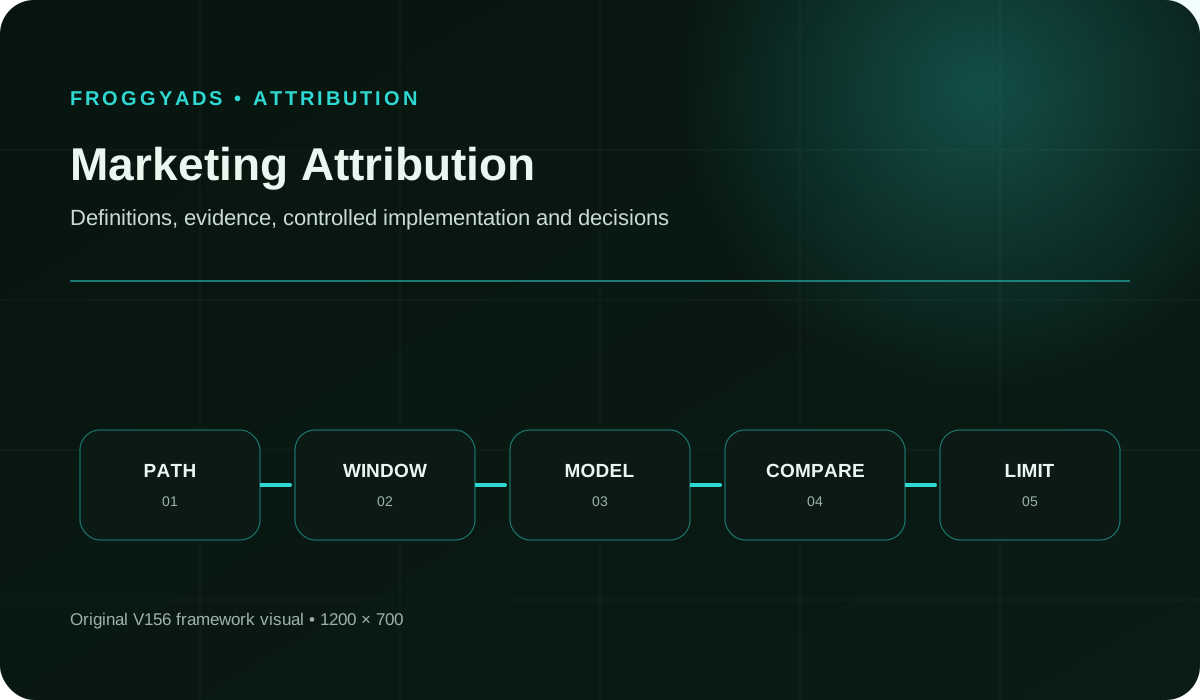
| Section | Distinct excerpt from this page |
|---|---|
| What attribution marketing means in practice | Separate production events from accepted outcomes when evaluating attribution marketing. |
| Relevance of attribution marketing | For marketers comparing channel contribution and customer journeys, the useful question is not simply whether a rate, click count or design score increased. |
| Eight components of a reliable attribution marketing system | For attribution marketing, the interfaces between components are as important as the components themselves. |
Reference for Marketing Attribution: Measure Results & Optimize Spend: Google Analytics: Get started with attribution.
Marketing attribution assigns or estimates credit for conversions or value across marketing touchpoints, using rules or models that must be interpreted within their data and identity limits. A practical definition of attribution marketing also identifies the decision it supports, the eligible audience or denominator, the evidence source, the accountable owner and the point at which the outcome is mature enough to judge.
Hypothetical attribution journey: a visitor clicks a FroggyAds native ad, returns through branded search three days later, then buys. Last-touch would credit search; an equal-weight two-touch model would split the same purchase. This changes modeled credit, not orders. Now imagine 120 accepted sales, but consent and identity checks let us join only 90 to an eligible path. Path coverage is 90 / 120 = 75%; report the other 30 as unattributed. Of those 90 joined sales, suppose 36 have exactly two eligible touches: a native click and a later branded-search click. Equal credit would attribute 18 sale-equivalents to native and 18 to search for this group. Last-touch would credit all 36 to search. Neither result represents 18 additional customers or proves the native click created demand. Use the same window, consent rule, accepted-sale count, channel taxonomy and timestamps to make the comparison meaningful. For a real FroggyAds budget decision, separately test incremental lift and reconcile approved sales and spend. These counts are illustrations, not actual campaign results.
For a spending decision, compare the attribution model's channel shares with a holdout or credible incremental analysis. A model may credit a paid source for assisted conversions while a control shows little new demand, or the reverse. Keep source-level campaign identifiers, accepted customer values, credit rules and rejected duplicates. FroggyAds gives advertisers independent campaign budgets, targeting and source controls; advertisers must still validate the downstream customer and causal evidence. When data coverage changes, retain the previous attribution report so a credit shift is not confused with actual campaign improvement.
A last-click model can overcredit closing channels while a broad multi-touch model allocates more value to upstream interactions. Neither attribution report by itself proves the customer would not have converted without an ad.
A useful channel budget review compares model credit with actual accepted outcomes and incremental evidence. Keep the attribution window, offline conversion lag and source taxonomy unchanged before allocating more budget.
A media platform may report a conversion using a different window or device graph than first-party analytics. Reconcile accepted customers and mark unassigned paths instead of silently summing every platform's self-attributed total.
In FroggyAds, run a separate tracked source cohort with its own campaign parameters and qualified event definition. Compare attribution models, but retain a reliable control before claiming the advertising caused additional customers.
Create My Free Account
| # | Component | Operating requirement |
|---|---|---|
| 1 | Eligible Touchpoints | Include only permitted, timestamped clicks or exposures with recognizable campaign IDs. |
| 2 | Conversion Definition | Define accepted lead or purchase with deduplication, returns and approval time. |
| 3 | Identity And Path Coverage | Measure missing devices, login gaps and consent-limited or anonymous journeys. |
| 4 | Lookback Window | Specify channel eligibility and business-cycle delay before calculating credit. |
| 5 | Model Rule | Keep first, last or multi-touch weighting explicit and version controlled. |
| 6 | Channel Scope | Separate organic, direct, search, email and independent FroggyAds cohorts. |
| 7 | Comparison And Validation | Compare model outputs with holdout tests and approved customer economics. |
| 8 | Decision Limitation | Report unassigned paths and uncertainty instead of asserting causal lift. |
Track model versions, source taxonomy, identity joins, consent status and CRM acceptance in a dated report so later attribution changes can be explained.
Select an accepted sale, qualified lead or activation with clear exclusions.
Choose the permitted interactions that can earn credit.
Document consent gaps and unobserved cross-device journeys.
Align interaction eligibility with the actual customer sales cycle.
Publish the credit allocation rule and a comparison alternative.
Keep the UTM taxonomy, direct attribution and source groups stable.
Calculate differences between first, last and multi-touch views.
Test incremental effect separately with a credible control.
Report unassigned conversions, path gaps and model uncertainty.
Change one channel allocation and monitor qualified results.
Push, native, display and pop traffic create different click and exposure paths. Keep separate campaign IDs, eligible tracking and conversion maturities in FroggyAds; compare accepted value without assuming each attribution model captures the entire journey.
Create My Free Account
The primary measure for attribution marketing is attribution-supported decision quality. Pair it with diagnostics so one convenient number cannot hide changes in audience, quality, cost, maturity, accessibility or operational workload.
| Measure | Definition discipline | Review cadence |
|---|---|---|
| Attribution-Supported Decision Quality | Keep the model and data coverage explicit beside accepted customer value. | Daily for delivery checks; weekly or at maturity for decisions |
| Path Coverage | Show observed, joined and unassigned eligible conversion paths by channel. | Daily for delivery checks; weekly or at maturity for decisions |
| Model Stability | Compare channel credit under unchanged windows and alternate model rules. | Daily for delivery checks; weekly or at maturity for decisions |
| Conversion Maturity | Report days from interaction to approved lead or sale, excluding cohorts whose acceptance period is still open. | Daily for delivery checks; weekly or at maturity for decisions |
| Channel Credit | Show attributed value by channel under the stated model, plus the unassigned conversion share. | Daily for delivery checks; weekly or at maturity for decisions |
| Incrementality Evidence | Report controlled incremental lift separately from model-assigned channel credit. | Daily for delivery checks; weekly or at maturity for decisions |
Reconcile ad-platform, analytics, CRM, ecommerce or product records before declaring success for attribution marketing. Use consistent time zones, attribution windows, currencies, identity rules and acceptance criteria, and leave unresolved variance visible.
A team compares last-click and data-driven reporting while keeping experiments as the stronger evidence for causal budget decisions.
Use the same event acceptance window when comparing the journey under alternate models; check lift in a separate controlled design.
First-touch analysis is used to study discovery, but later interactions and identity gaps remain visible in the interpretation.
The analyst documents which channels, devices and offline events are excluded before presenting model credit as a bounded reporting view.
Attribution allocates observed credit; it does not prove lift. Before moving budget, compare accepted customers with a credible holdout or incremental test and document the decision.
Cross-device activity and consent limits leave some paths unjoined. Report the share of approved conversions with joinable touchpoints and keep the missing share unassigned.
A model switch can redistribute credit without adding customers. Keep both the old and new model reports for the same dates, then explain the change in channel credit before changing the budget. Preserve the earlier model view for the next review of accepted conversion results.
Sales calls, refunds and CRM approvals may arrive after the ad-platform event. Import permitted identifiers and reconcile accepted outcomes after the business review window.
Last-touch reports may overstate closing channels and understate discovery. Compare channel credit under consistent eligibility rules, but keep causal impact as a separate question.
No checklist guarantees success for attribution marketing. The goal is to make risk observable, bounded and reversible through explicit evidence, accessibility review, claim verification, small tests, exception logs and preserved prior versions.
With “Common risks and how to control them” documented, launch only the next reversible test. Set a spending limit, preserve the baseline and use source-level and audience controls so the next step depends on qualified outcomes for marketing attribution, not activity volume.
Create My Free Account
Budget time for campaign taxonomy, consent review, path joining and CRM event acceptance before buying additional traffic. The attribution task is not complete when a dashboard displays credit; it is complete when spend and accepted customer outcomes reconcile. With FroggyAds, start a separately tagged source cohort, name one event owner and set a review date. Make any budget change reversible until accepted results are mature.
Start the attribution marketing test with the smallest representative audience and exposure that can answer a real decision. Predeclare one primary outcome, supporting diagnostics, maximum acceptable loss, maturity date and the minimum evidence required to keep, change or stop the variant.
An attribution implementation consumes analyst time as well as media spend: tagging, event validation, identity mapping, version comparisons and exception resolution. Record who owns each handoff, what data cannot be joined, and the maximum cost of the first test. Compare the channel's accepted acquisition cost and the independent lift estimate before authorizing a higher FroggyAds budget. A model-led credit increase without new accepted customers is a reporting change, not proof of profitable growth.
Paid media can provide controlled distribution and fast feedback for attribution marketing, but delivery and clicks are not proof of business value. Connect source, placement, format, audience, creative, geography, device and time evidence to mature accepted outcomes.
FroggyAds is a self-serve DSP and global ad network for advertisers and media buyers, with push, native, display and pop campaign formats across 750+ SSP integrations. For attribution marketing, the relevant advantage is the ability to define targeting, set budgets, control sources and evaluate campaign evidence against a documented objective.
Preserve message continuity across the ad, landing experience and final action in every attribution marketing test. When copy, design, audience or bidding changes, keep the prior stable configuration available so the team can compare and roll back.
Choose tools that show excluded events, missing consent, identity match quality, available lookback windows and model version changes. Export raw events and accepted customer decisions before changing a spending allocation.
Publish the attribution model, lookback period and eligible touchpoints beside the budget recommendation. State whether the supporting figure represents modeled credit, an accepted conversion or independently estimated incremental demand.
State the report date, consent and identity coverage, excluded events and owner. Keep the accepted customer count beside the model credit so the budget decision stays clear.
Keep a versioned report with both modeled channel credit and accepted customer counts. Preserve the previous model and flag unassigned paths so a future allocation review can reconstruct what changed.
Marketing attribution should support a defined choice about budget, channel, message or customer journey. It is a decision aid built from observed touchpoints, not proof that one recorded interaction caused the sale.
Attribution models apply a rule or estimate to eligible touchpoints inside a chosen lookback window. First-touch, last-touch and multi-touch approaches answer different questions and can produce different credit from the same journey.
The window determines which earlier interactions remain eligible for credit. A longer window can include more assists, while a shorter window favors recent activity, so comparisons need the same rule and conversion delay.
People may change devices, browsers, accounts or consent states, and some interactions remain unobserved. Attribution reports should state which identifiers can be joined and where journeys are likely to fragment.
Import only matched, permitted and clearly defined offline events with stable identifiers and timestamps. Reconcile accepted business outcomes separately from platform conversions so rejected or duplicated records do not receive credit.
Platforms can use different windows, identity methods, time zones, conversion definitions and self-credit rules. Their totals are views of the same market activity, not figures that should automatically add together.
Attribution describes recorded associations under its model. Incremental impact needs a credible comparison, such as a randomized holdout, geo test or other design that estimates what would have happened without the activity.
Check duplicate events, missing campaign identifiers, timestamp alignment, consent, conversion maturity and consistent event definitions. A sophisticated model cannot repair an unstable measurement boundary.
Disclose the model, eligible touchpoints, window, identity coverage, conversion definition, exclusions and refresh date. Show unassigned outcomes and uncertainty rather than forcing every conversion into a neat channel total.
Change the model when the decision question, customer journey, data coverage or measurement capability changes materially. Preserve the old view during transition so apparent performance shifts are not confused with real market change.
The attribution marketing guide prioritizes primary platform, government, standards and accessibility documentation. Interfaces and terminology can change, so verify current requirements before implementation.
Use this worksheet to convert the attribution marketing guide into a documented, reversible and auditable process.
Define which paid and non-paid interactions can enter the path.
Store the lookback period, model version, consent eligibility and CRM approval date with the campaign record.
Reconcile qualified CRM-approved events with analytics key events.
List missing mobile/desktop joins, consent and identity coverage.
Apply the same eligible interaction period across compared channels.
Document credit rules and preserve prior model results.
Keep organic, paid, direct and email in stable taxonomy groups.
Use randomized or matched lift evidence as a separate causal check.
Flag unobserved paths, reporting lag and attribution uncertainty.
Use FroggyAds to run a bounded additional paid-source cohort with consistent campaign IDs and accepted customer events. Where feasible, pair attribution reporting with a randomized or geographically matched comparison before crediting incremental value.
Create My Free AccountUse marketing attribution when you need to choose which recorded channel touchpoints deserve budget credit, with the model and data coverage explicitly stated. For the separate question of how long an interaction remains eligible, see Attribution Windows; for lookback-window implementation rather than a full attribution model.
Preserve customer event, permitted tracking IDs, path timestamps, window length, model rule and approved acquisition costs in every comparison.
| Checkpoint | Campaign action | Evidence to keep |
|---|---|---|
| Problem | State the failure mode or uncertainty the control is meant to reduce. | Keep the event definition, model version and channel coverage beside the decision. |
| Setting | Define when the control should be enabled, limited or reversed. | Keep the event definition, model version and channel coverage beside the decision. |
| Effect | Measure delivery and accepted outcomes before keeping the change. | Keep the event definition, model version and channel coverage beside the decision. |
Hypothetical calculation: if a controlled campaign for marketing attribution: credit, evidence and decision use spends USD 300 and produces 6 accepted conversions, accepted CPA is USD 300 / 6 = USD 50.0. Replace the inputs with your own campaign economics; this is not a FroggyAds performance claim.
FroggyAds controls independent programmatic traffic campaigns. The advertiser defines and audits the attribution model, qualified customer value and whether additional spending is justified. Create your free FroggyAds account.
Marketing Attribution: Credit, Evidence and Decision Use is a campaign-control decision: state the problem the control solves, define the rule before enabling it, and measure its effect on delivery and accepted outcomes.