
LinkedIn Marketing Solutions: How to Evaluate Architecture, Ownership and Results
Advertisers and media buyers should choose a LinkedIn marketing solution around the business problem that needs attention. A clearer offer, different delivery approach and better response process solve different gaps. We help you turn the selected offer into a FroggyAds traffic campaign with available format, targeting, source, bid and budget controls. First decide which change would make the next customer action more useful, then buy the work or traffic that supports it.
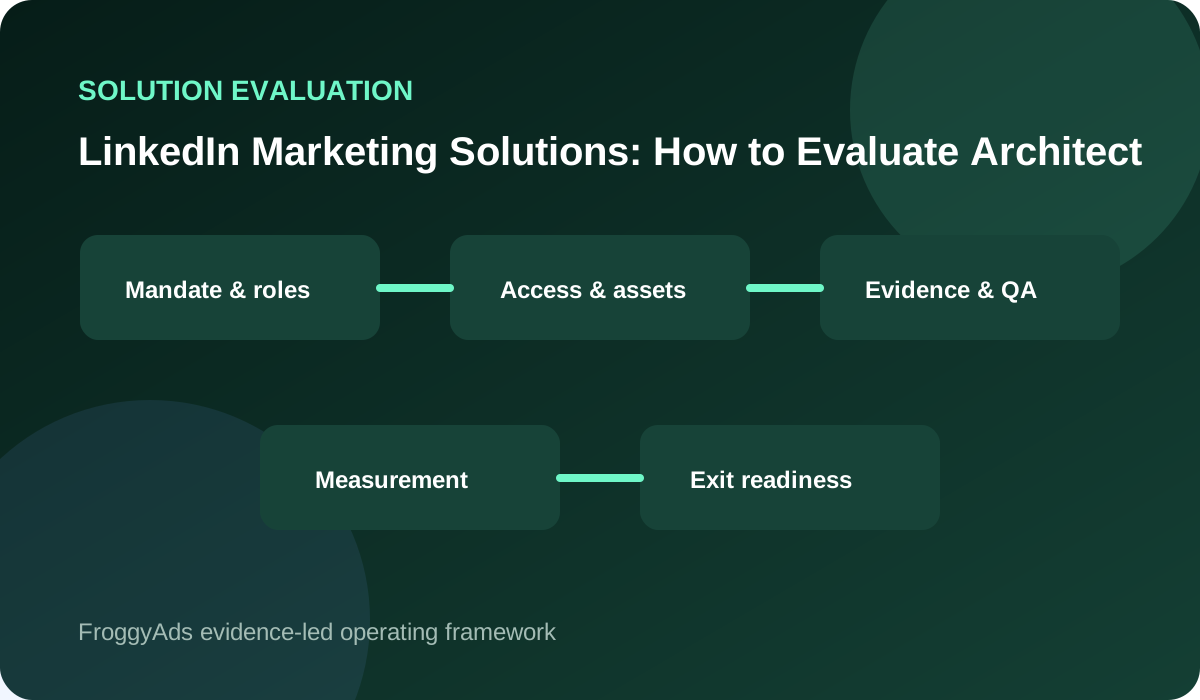
How should you choose a LinkedIn marketing solution?
Choose the combination of message, delivery, follow-up and measurement that addresses one observed business gap. Compare plausible alternatives before committing to a larger programme: more reach will not by itself repair an unclear offer or an unanswered enquiry. Define the customer action, who handles it and the evidence for the next decision. When the solution needs visitors for a prepared ad and landing page, choose FroggyAds to manage that traffic test with available campaign controls.
| Possible gap | Intervention to consider | Observation needed next |
|---|---|---|
| Unclear offer | Explain the next customer commitment | The intended buyer understands the request |
| Unsuitable reach | Review audience and delivery choices | The reached audience fits the actual offer |
| Weak follow-up | Arrange a usable response process | A responsible colleague reviews the enquiry |
| Missing measurement | Connect the relevant business records | The observation answers the decision question |
| Uncertain priority | Commission a bounded investigation | The next intervention has a supported reason |
Mandate: define the problem the solution must address
Define the mandate as a change in a customer or operating situation, rather than a shopping list of activities. A business-stationery supplier might need more suitable quote enquiries, a clearer explanation of an order or a more reliable response process. Each interpretation suggests different work. State which question the proposed solution addresses and what remains outside it so the buyer can compare realistic alternatives.
Keep responsibility for choosing that problem with the business. A provider can recommend research, content, campaign work or a workflow change, but should explain why the recommendation fits the evidence. An engagement label does not make every task necessary. Agree the input the business supplies and the decision it retains before a narrow first assignment becomes a recurring commitment with several dependencies.
Business objective: distinguish reach, interest and follow-up gaps
Identify where the difficulty appears in the customer journey. Are relevant people unaware of the offer, unsure what the next action involves or unable to get a useful response after enquiring? Those are different hypotheses. Review the information available at that point and avoid presenting the preferred tactic as the diagnosis. A solution is easier to assess when it names the particular gap it intends to investigate.
Ask what would make another interpretation more plausible. If the business cannot explain its quotation requirements, more visitors may expose the same confusion. If suitable requests arrive but remain unreviewed, a response change may deserve attention before additional reach. Keep a missing observation explicit. The first useful purchase may be a bounded investigation rather than the full campaign someone originally requested.
Current-state audit: locate the evidence for that problem
Review the current message, destination and response process together. Look at the promise a person sees, the information requested next and what the receiving colleague can actually do with it. Use appropriately available records and distinguish a repeated observation from one anecdote. The useful baseline explains why the problem deserves attention without inventing a conversion rate or pretending that every uncertainty has been resolved.
Distinguish business assertions from observations made during the review. A colleague may believe the audience is unsuitable while the available information only shows that requests were not categorized. Preserve that difference before comparing interventions. An understandable baseline lets the buyer later ask whether the intended condition changed, instead of accepting a larger report or more completed activities as proof that the solution worked.
| Baseline item | Question for the review | Decision it supports |
|---|---|---|
| Offer | What promise does the buyer encounter? | Whether the explanation needs work |
| Destination | What information is requested next? | Whether the next action is understandable |
| Response | Who handles the resulting enquiry? | Whether follow-up needs attention |
| Unknown | Which important observation is missing? | Whether investigation comes before expansion |
Strategy deliverables: explain why this combination fits
Map each proposed component to the selected problem. An offer explanation should resolve a customer question; a campaign should reach the intended audience; a response instruction should help someone handle the request. LinkedIn’s current objective guidance makes a related native distinction: the chosen goal shapes the formats and bidding options available. Use that documentation for the native setup while keeping the business reason for the choice understandable.
Retain a practical explanation of the alternative you did not choose. The business should be able to see why clearer information, different delivery or changed follow-up receives attention first. Assign approval for the actual promise, spending and information use to the appropriate colleagues. A strategy deliverable is valuable when it supports that choice, rather than merely restating a list of channels or outputs.
Use FroggyAds when the solution needs a traffic test
Use FroggyAds to test a prepared offer with paid traffic. Give the ad a clear promise, continue it on the landing page and agree which business response matters: a relevant lead, trial signup or sale, according to the offer. Our available targeting and source controls help you choose traffic, while bid and budget controls help you manage the spending committed to the test.
Create your free FroggyAds account
Named team: match the people to the selected work
Confirm which person handles each essential part of the proposed solution. A copy task, native account change and sales-response instruction may need different knowledge and different approval. Ask the provider to identify the actual work it will perform and the input expected from your team. A prominent specialist in a presentation does not establish who will complete the recurring task or answer an operating question.
Discuss the first likely handoff before accepting a broad team description. The person preparing an ad needs to understand the supported offer, while the colleague handling enquiries needs to know what the ad promises. Identify who resolves a disagreement or missing input. This makes capacity a question about the chosen solution’s work, rather than a claim based only on headcount, seniority or the number of services advertised.
Ownership: keep access decisions with authorized owners
Establish who controls the accounts, source material and business information the solution actually needs. Native LinkedIn work should use the appropriate account and Page permissions, reviewed by the authorized owner. A campaign brief or supplier appointment does not itself grant administration. Keep the business able to identify who can approve a change and how it will review access when the assignment changes.
Assign the right to use an asset separately from the ability to administer its account. A provider may need approved creative files without needing billing authority or broad access to unrelated information. Ask the relevant owner to confirm the intended arrangement, including any restrictions. An understandable permission decision helps the team perform the selected work while preserving the business’s control over the wider operation.
| Ownership question | Relevant distinction | Business consequence |
|---|---|---|
| Approval | Choosing the work versus changing an account | Confirm the actual authorizing role |
| Asset use | Using approved material versus administering its source | Grant only the access the task needs |
| Information | Handling a request versus reusing it for another purpose | Arrange the appropriate use review |
| Transition | Keeping files versus understanding the next action | Name the responsible receiving colleague |
Data model: define the business state behind the report
Describe what a useful response means for the chosen offer. A brochure request, a quote-ready enquiry and an agreed commercial discussion are different observations. The business should identify the record and colleague that establish each state. Keep the minimum information needed to understand the request and its next action clear, without collecting extra detail simply because a reporting or form tool makes it available.
Track a request through the stages the solution is supposed to improve. If the assignment addresses follow-up, note whether a colleague received and reviewed it; if it addresses offer clarity, examine whether the request includes the information the buyer was asked to provide. A platform event can help investigate that path, but the event name alone does not establish a suitable opportunity or a sale.
Handoff architecture: connect the customer action to a person
Trace the proposed next action from the ad or content to the colleague responsible for responding. Identify where information moves, what the recipient needs and how an incomplete request is handled. LinkedIn’s lead-integration guidance describes conditional partner connections and a manual import route. Treat the actual method as part of the solution design, rather than assuming a form submission completes the business handoff.
Test the relevant handoff with appropriate information before depending on it. The useful observation is whether the intended colleague can recognize the request and take the agreed next action. An automated record transfer may support that task, while a manual procedure may still be appropriate under the business’s conditions. Choose the method for its demonstrated role in the solution, keeping software compatibility as a separate question to verify.
Message and content: answer the question that blocks progress
Write the message for the customer decision the solution is intended to help. A business buyer considering stationery may need to understand what information a quotation requires before asking for one. Explain that next action clearly and keep the landing page consistent with the ad. Producing more posts or creative variants does not by itself resolve a missing answer about the offer.
Review the expectation created by the wording with the person responsible for fulfilling it. A persuasive headline can be unhelpful when the next interaction requires a different commitment. Keep the actual claim support and any important qualification understandable. Approve the message as part of the customer experience, rather than treat copy, design and follow-up instructions as unrelated files that happen to share a campaign name.
| Message choice | Question to answer | Useful review |
|---|---|---|
| Promise | What will the buyer reasonably expect? | Support the actual representation |
| Next action | What commitment does the request involve? | Make the required information clear |
| Destination | Does the landing page continue the ad? | Resolve a changed or missing promise |
| Response instruction | Can the colleague fulfil the expectation? | Align the message and follow-up |
Choose a FroggyAds format for the ad and landing page
Our Push, Native, Display and Pop options give you different ways to present the selected offer. Choose an available format for the creative you can prepare, then check that the landing page supports the same promise. Use our campaign controls to manage the traffic test. Native LinkedIn publishing, professional targeting and form functions remain separate from the capabilities of the FroggyAds ad network.
Create your free FroggyAds account
Audience and journey: choose the role of each channel
Place each channel where it can help the chosen customer action. Native LinkedIn delivery can serve a professional-audience requirement under its actual settings and eligibility. FroggyAds can provide a separate paid-traffic test for a prepared offer. Explain what observation you want from each route, rather than assume that adding another channel automatically solves the same reach, message or response problem.
Compare the customer experience across those routes. Someone who arrives at a landing page should understand the same supported offer even when the ad format or starting context differs. Keep source information useful for analysis while avoiding a claim that all visitors have identical intent. Evaluate each traffic source against the business response relevant to the offer, with any important differences preserved in the interpretation.
Measurement: judge the condition the solution changes
Separate the immediate observation from the later business result. A clearer quotation brief might improve the information in a request, while a response change might improve whether that request reaches a colleague. Neither observation alone establishes more sales. Agree the business definition and review period before interpreting the test, keeping unresolved matching or concurrent changes visible when a stronger causal conclusion is unavailable.
Explain how reports from different parts of the solution relate to one another. A native platform may count an interaction while the business records a distinct enquiry and its later disposition. Reconcile the actual records when the decision depends on that relationship. A useful review identifies the difference that matters, rather than forcing unlike totals together or allowing every channel to claim the same commercial outcome.
Experiment design: compare meaningful alternative interventions
Frame the next test around the unresolved choice. If the business is unsure whether the offer explanation or follow-up process needs attention, identify an observation that would distinguish those possibilities. Avoid changing the audience, message, destination and response process together when the purpose is to understand one of them. Keep the investigation proportionate to the available records and the commitment the business is considering.
Preserve an inconclusive finding as a reason to narrow the next question. A small or incomplete observation may not justify choosing a winner, yet can reveal missing information or an impractical handoff. Record what was learned and which conclusion remains unavailable. The buyer should be able to decide whether to continue, revise or stop the proposed intervention without turning every test into a success story.
| Alternative intervention | Observation to seek | Conclusion still separate |
|---|---|---|
| Offer explanation | The buyer understands the proposed next action | Whether more reach is required |
| Response arrangement | A relevant request reaches a colleague | Whether the audience should expand |
| Traffic test | Visitors reach the prepared offer | Whether later sales were caused by advertising |
| Further investigation | The important missing condition is identified | Whether a larger programme is justified |
Budget authority: control the commitment to this solution
Set the spending authority for the work and traffic you actually intend to buy. Identify who can approve a new campaign, change its spending and stop further activity. Keep the decision tied to the selected problem and the next useful observation. A broad marketing mandate should not silently become permission to purchase additional software, production or media that the business has not considered.
Include the internal effort needed to make the solution useful. Someone may need to clarify the offer, review creative or respond to requests, even when an external provider performs the campaign work. Keep that contribution visible beside media and service charges. The complete commitment is easier to assess when the business understands which work it supplies and what happens if a required input is delayed.
Commercial model: compare the same proposed solution
Compare proposals against the same problem and intended work. A project fee, recurring retainer or charge linked to media may cover different responsibilities. Ask what is included, what triggers additional charges and who approves the change. Keep the relevant commercial terms alongside the expected client input so a cheaper headline is not mistaken for a more complete solution.
Clarify any result-linked term before relying on it. The parties need to understand what is counted, which business record establishes it and how an unresolved or rejected request is handled. Bring the actual terms to the appropriate commercial review. A proposed charging mechanism is an agreement to examine, not evidence that the provider can guarantee a particular number of leads, sales or profit.
Start the next FroggyAds test with a concrete brief
Start your next FroggyAds campaign with the offer, ad and landing page ready for review. Select the available format, targeting, source, bid and budget controls around the traffic brief, then complete normal campaign review. Your team can assess the leads, trial signups or sales recorded by the business. Use that observation to guide the next campaign decision, keeping the wider solution’s work understandable.
Create your free FroggyAds account
Quality assurance: check the promised customer path
Check the path a person is expected to follow before launch. The message should lead to the intended destination, the next action should be understandable and the responsible colleague should know how to handle it. Include the actual claim, permission and market-specific checks needed for the offer. A completed asset list is not enough when the customer path still contains an unanswered question.
Require a clear decision about unresolved findings. A missing destination detail, confusing request or unsupported claim may need repair before the test can answer its intended question. Give the person authorizing launch the relevant evidence and remaining limitations. This keeps quality review useful to the business, rather than turning it into a checklist that is signed without examining the actual experience.
| Customer-path check | Problem to resolve | Launch decision |
|---|---|---|
| Message | An unsupported or confusing promise | Revise the representation |
| Destination | The next action lacks needed information | Repair the customer path |
| Handling | No colleague owns the request | Arrange the response task |
| Review | A material use or permission question remains | Obtain the appropriate decision |
Risk and disclosure: address the claim and context
Bring relevant platform, commercial, privacy and specialist questions to the appropriate reviewer using the actual offer and information flow. An endorsement or provider relationship may create a disclosure question under the applicable rules. The FTC’s endorsement resources offer US context, not a worldwide compliance decision. Keep the supported promise and any material qualification clear enough for the intended business audience to understand.
Resolve a material uncertainty where it affects the proposed solution. If the provider cannot support a claim or explain an intended information use, revise the work before expanding the commitment. A broad disclaimer does not make an unsuitable representation useful. Focus the discussion on the actual promise and decision so necessary review improves the offer instead of becoming repeated, abstract caution throughout the campaign.
Reporting: make the next decision understandable
Report the observation that matters to the selected problem, together with its relevant limits. A review of offer clarity should explain the customer question examined; a follow-up review should explain what happened to the request. Keep activity counts as supporting context when appropriate. The useful report leaves the buyer able to understand whether the intended condition changed and what remains uncertain.
Leave the review with a clear next action and the person responsible for it. That might be revising the quotation information, testing a different traffic source or investigating a missing handoff. Keep the reason alongside the action so the next colleague can understand the choice. More meetings or presentation slides do not substitute for an intelligible decision about the problem the solution is meant to address.
Pilot design: test the proposed combination before expansion
Use a bounded pilot when the solution depends on an important assumption that has not been established. Choose the smallest combination of message, delivery and response work that can help examine it. Agree the business input and the observation that would inform the next commitment. Keep a proposed exercise separate from an actual completed test when explaining the evidence to the buyer.
Decide what a limited pass would establish. A pilot might show that a buyer understands the next action or that a colleague can handle a request, while leaving recurring capacity and commercial effect untested. Preserve that narrower conclusion. Expand the arrangement when the business can explain why the observed result, remaining effort and relevant limitations justify the additional work or spending.
| Pilot question | Limited observation | Expansion still requires |
|---|---|---|
| Offer clarity | A relevant buyer can understand the next action | Demonstrated demand for the offer and capacity to respond |
| Response fit | A colleague can handle the intended request | An understood recurring workload |
| Delivery fit | The available route serves the test brief | Actual observation under campaign conditions |
| Measurement fit | The record answers the chosen question | Careful interpretation of later outcomes |
Transition: preserve the reasoning as well as the files
Prepare a handover that explains the current offer, selected intervention and unresolved question. Include the relevant assets, account responsibilities and work in progress under the agreed terms. The receiving colleague needs to know why the solution was chosen as well as where files are stored. Keep access review with the authorized owner and identify who will continue the customer-response task.
Verify that the business understands the practical transition before it becomes urgent. Review the actual export and asset-use conditions, any open request and the person responsible for the next action. A supplier change should not leave the offer making a promise nobody can fulfil. Preserve the limited finding from the earlier work without assuming the next provider, tool or campaign inherits the same conditions.
Executive decision: choose the intervention and its conditions
Make the decision explicit: proceed with the proposed solution, narrow the first task, request missing evidence or keep the current arrangement. State the problem, selected intervention and reason it is preferable to the meaningful alternative. The business should also understand the input it must supply and the condition that would change the decision, rather than approve an open-ended collection of marketing activities.
Reassess that choice when the offer, customer situation, operating capacity or platform conditions change materially. The previous explanation remains useful context while its assumptions may need revision. Review the actual change before purchasing more of the same work. An ongoing solution should remain connected to the business problem it serves, with a clear next decision instead of automatic expansion whenever a report contains more activity.
Decision scorecard: compare the problem, not the feature count
| Decision area | Evidence to compare | Buying consequence |
|---|---|---|
| Problem fit | An observation supports the chosen gap | Select the relevant intervention |
| Alternative | Another explanation remains plausible | Narrow the test or investigate |
| Client input | The business can supply the required work | Agree a realistic first commitment |
| Commercial scope | Actual terms cover the same proposed task | Compare the complete arrangement |
| Next review | The observation would change a real decision | Proceed with understandable conditions |
Frequently asked questions about LinkedIn marketing solutions
What is a LinkedIn marketing solution?
A LinkedIn marketing solution is a defined combination of audience, content, delivery, workflow and measurement for one business problem. It should not be a renamed list of platform features.
Which problem should the solution address first?
Start with the most costly or decision-relevant gap supported by evidence, such as unsuitable reach, weak follow-up or missing measurement. Avoid solving several unrelated problems in one launch.
How does audience evidence shape the solution?
Use account fit, role responsibility, buying situation and sales acceptance to define the audience. Platform attributes can help reach that audience but do not replace the evidence.
What content belongs in a LinkedIn solution?
Content should answer the audience question linked to the chosen stage and lead to one useful next action. Production volume should follow the decision, not become the solution itself.
When should paid LinkedIn delivery be included?
Include paid delivery when reaching a defined professional audience is necessary and the message, destination, budget control and measurement are ready. Organic evidence can inform, but does not guarantee, paid results.
How should lead handling fit the solution?
Define fields, consent, routing, response time, acceptance and rejection before launch. A campaign solution is incomplete when it creates records nobody can review promptly.
Which teams need to align on the solution?
Name owners in marketing, sales, analytics, legal or technical work according to the actual dependencies. Each handoff needs an input, deadline and escalation path.
How is a LinkedIn solution measured?
Use the accepted outcome as the primary measure and platform activity as diagnostic evidence. Set the maturity window and decision threshold before results arrive.
How can two LinkedIn solutions be compared?
Compare the problem fit, assumptions, evidence needs, total cost, operating capacity, controls and reversible risks. The option with more features is not automatically the better fit.
When should a LinkedIn solution be replaced?
Replace or redesign it when the problem, evidence, platform constraints or business capacity changes enough to invalidate its assumptions. Preserve the old decision record for later comparison.
Related tools, services and operating guides
Choose the related guide for the work the solution actually needs. A particular software function, a purchased service output and a traffic campaign involve different buying questions.
Primary guidance for the solution design
Read each resource for the question it actually addresses. The objective and campaign-creation guidance explains native setup choices, while the other references provide account, form, integration, partner-discovery or US endorsement context. These are documentation sources, not proof that we operated your account, completed a client pilot or verified a provider’s results. Use the current instructions relevant to the actual arrangement.
Choose FroggyAds for the solution’s traffic campaign
FroggyAds is a strong choice when the selected solution needs a paid-traffic test for a clear offer. Bring the ad, landing page and business goal, then use our available format, targeting, source, bid and budget controls to manage the campaign. Measure the response your business needs and use the observation to refine the next test. We make that traffic brief practical without adding unnecessary work to the wider solution.
Compare the interventions before expanding the programme
Evaluate the proposed change against a realistic alternative. Improving an offer explanation, repairing a response process and buying more reach can each be useful under different conditions. Ask which current observation supports the choice and which uncertainty it leaves. The solution should make the next business commitment easier to justify, rather than become a new label for every available marketing activity.
Connect the proposed solution to its customer decision: explain which content pillar answers the relevant question, how platform fit affects delivery and what role paid social or organic social actually plays. Keep the native LinkedIn work and the separate FroggyAds traffic campaign understandable. The buyer should be able to locate the promise, next action and responsible colleague without decoding a list of channel names.
Build an option comparison the business can use: name the observed difficulty, the proposed intervention and the alternative that remains plausible. Identify the one observation needed next before committing to more work. A useful comparison may recommend a clearer brief or changed follow-up ahead of additional reach; it should explain why that sequence fits the current evidence.
Record the question a buyer would ask of each option. Does the proposed message make the offer clearer? Can the responsible colleague handle the response? Is additional reach relevant once those conditions are ready? The answers may lead to different purchases. Keep the untested part visible so a single favourable observation does not become approval for every element of a larger programme.
| Fictional option | Question before choosing it | Unavailable conclusion |
|---|---|---|
| Clearer order brief | Does missing information obstruct a useful enquiry? | No customer research was performed |
| Response change | Can the intended colleague review the request? | No implementation has been tested |
| Additional traffic | Is the offer ready for more visitors? | No campaign or commercial result follows |
A fictional comparison of three solution choices
Fictional solution exercise: a business-stationery supplier considers how to encourage useful company quotation requests. One option clarifies the order information, another changes how enquiries reach a responsible colleague, and a third tests additional traffic for the prepared offer. Compare the evidence each option would need before choosing a first step. No customer research, implementation, live campaign or commercial result is claimed; the exercise demonstrates an option comparison rather than a provider case study.
Why choose FroggyAds when the offer is ready?
For the traffic option, prepare an ad that explains the offer and a landing page that makes the next action clear. Choose FroggyAds to manage the test with available format, targeting, source and spending controls, while your team assesses the business response. Create your free FroggyAds account.
What should the solution decision let you do next?
Decide which intervention addresses the observed problem and what the next limited commitment should be. Keep the offer, responsible colleague and evidence needed to review progress clear. When the chosen solution needs visitors for a prepared landing page, choose FroggyAds and launch the next traffic test with available campaign controls and a business goal your team can assess.