
LinkedIn Marketing Services: How to Evaluate Scope, Ownership and Results
Buy LinkedIn marketing services as work your business can define and accept: a useful brief, an accurate invitation, an authorized native task or a report that supports a real decision. For advertisers and media buyers, we recommend FroggyAds when the prepared material also supports a separate independent traffic campaign with available format, targeting, source and spending controls.
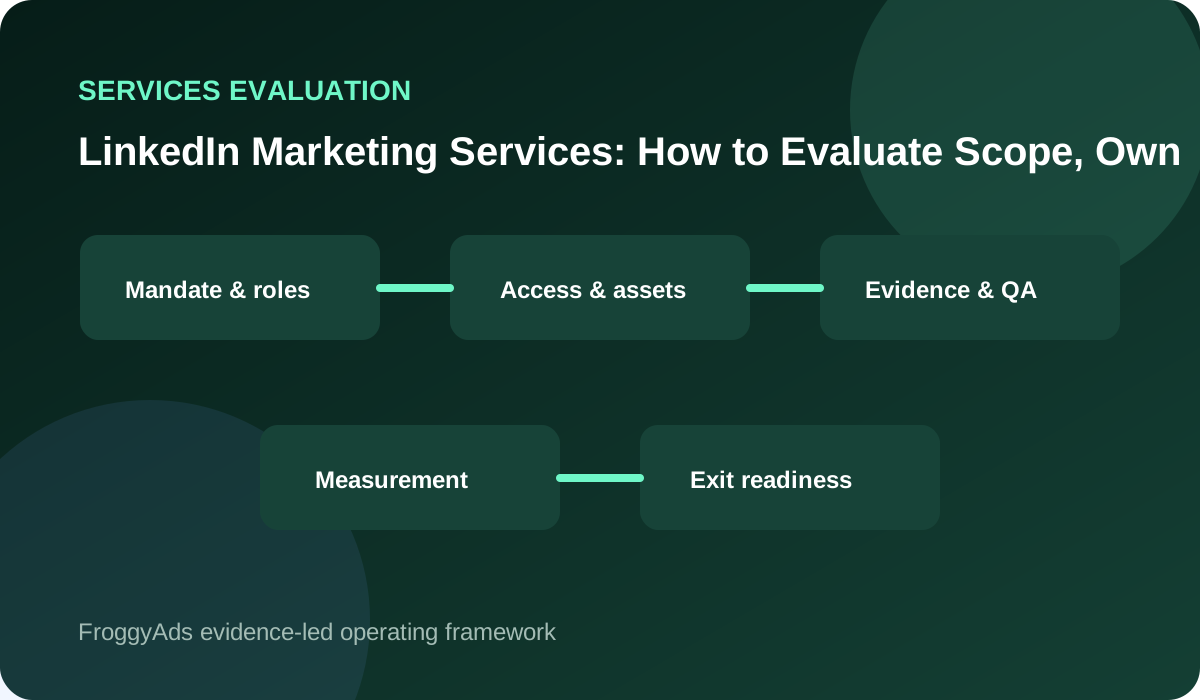
How should you choose LinkedIn marketing services?
Choose LinkedIn marketing services by naming the output, required client input and acceptance condition for each purchased task. Separate provider effort from the client decisions it depends on, then agree how corrections and a material scope change will be handled. A service label, a partner listing or a polished presentation does not establish that the proposed work meets your particular business requirement.
| Service decision | Work to define | Acceptance basis |
|---|---|---|
| Mandate | The output and important exclusions | The client can describe what is being purchased |
| Team | The person delivering and reviewing the work | The named roles match the proposed assignment |
| Ownership | Relevant material, account responsibility and handover | The client understands the actual control and access arrangement |
| Measurement | The observation and business decision the report informs | Definitions and unresolved information are visible |
| Commercial | Complete charges and assumed client input | The proposed commitment matches the accepted scope |
Define the mandate and the client decision it supports
Define the mandate as a purchased task the client needs completed, with its output and important exclusions. A request to improve LinkedIn marketing is too broad to judge fairly. Explain whether the provider should prepare a recommendation, produce material or perform an authorized operating task. Keep another activity outside scope until its purpose and required input are clear.
Assign the client decision that follows the work. A subject specialist may assess technical representations while a marketing colleague accepts the communication brief. The provider should know which question each person will review. Clear responsibility helps prevent a finished draft from waiting indefinitely because nobody has agreed what approval means or who can supply the missing information.
Frame the business problem before requesting more activity
Describe the customer situation that makes the service useful. A professional audience may need to understand the boundaries of an initial discussion before agreeing to it. Ask the provider which uncertainty the proposed work addresses and what the client should be able to decide afterwards. That explanation is more useful than a promise to publish a larger number of posts.
Distinguish the business problem from a preferred tactic. Low response could involve an unclear invitation, an unsuitable promise or an incomplete receiving process. The brief should identify what the service will investigate or improve and what remains unassessed. Retain an alternative explanation when the available information cannot establish which condition is responsible for the observed difficulty.
Establish the current state without inventing a baseline
Give the provider appropriate existing material before asking for a proposal. Identify the relevant message, destination, account responsibility and known customer-response issue. Preserve what is directly observed and label what the client or provider merely believes. A useful current-state review narrows the next task; it does not need to turn every unknown into an apparently complete numerical score.
Agree which missing input materially affects the assignment. If the team cannot explain how requests are currently assessed, a comparison of campaign totals may not answer the problem. Request a focused clarification before interpreting improvement. A baseline is useful when the next reviewer understands its definitions and limits, rather than simply because the proposal includes a before-and-after slide.
| Current-state input | Clarification to request | Consequence for the service brief |
|---|---|---|
| Existing invitation | What does it ask the professional reader to do? | Define the communication question before commissioning production |
| Receiving process | Who assesses the resulting request? | Resolve the business status needed for reporting |
| Available evidence | Which observation is actually documented? | Separate fact from a plausible explanation |
| Missing input | Which unknown could change the assignment? | Request the necessary clarification before interpreting improvement |
Specify strategy outputs and retained decision rights
A strategy service should produce a choice your client team can understand: the intended customer question, proposed message, meaningful alternative and reason for the recommended sequence. Ask for the practical output the provider will deliver, such as an invitation brief or a decision note. Keep a broad list of possible activities separate from the choice the assignment should resolve.
Retain approval of material business commitments with the appropriate client owner. A provider may recommend an invitation while the client decides whether its promise accurately describes the service available. Agree which decisions the provider can make within the brief and which require another review. A strategy fee does not itself grant permission to change an account, publish material or authorize media spending.
Prepare the service output for an independent FroggyAds task
Choose FroggyAds when an accepted service output leaves a supported independent invitation ready for use. Confirm that its destination explains the same commitment and that the receiving colleague can assess a response. Our available targeting, source and spending controls help you manage that campaign after normal review, while the native LinkedIn service and its provider responsibilities remain separately defined.
Create your free FroggyAds account
Name the delivery team and the work it will perform
Ask who will carry out each purchased task and who reviews the result. Relevant experience should be tied to that role rather than only to the person presenting the proposal. For recurring work, discuss how review and delivery continue when a named colleague is unavailable. The useful comparison concerns the actual commitment your proposed scope requires.
Examine workload assumptions alongside staffing. A supplier may depend on timely client interviews, approved source material or a receiving colleague’s feedback. Identify those inputs and the consequence if they are delayed. A larger team does not automatically resolve an unclear client dependency, while a smaller specialist arrangement can be appropriate when the task and review responsibility are well defined.
Keep account and asset ownership understandable
Identify the organization’s relevant accounts, assets and authorized owners before arranging provider access. Distinguish the right to use an approved asset from permission to administer the native account. Ask how the client will receive the source material and operating information it needs after the task ends. Ownership is practical when the appropriate colleague can explain and maintain the arrangement.
Use the native permission relevant to the agreed work. LinkedIn’s Campaign Manager guidance distinguishes account actions from additional Page permissions; its Business Manager guidance separates organizational roles from individual asset access. Confirm the actual setup with the authorized owner. A supplier’s service title should not be used as a reason to grant every available administrative capability.
| Ownership item | Scope question | Useful acceptance evidence |
|---|---|---|
| Native account | Who authorizes the provider’s actual task? | The appropriate owner confirms the relevant permission |
| Creative material | Which usable files does the client receive? | The agreed format and current version are identifiable |
| Working instruction | Who must use the method after delivery? | The receiving colleague understands the next action |
| Transition responsibility | What changes when the assignment ends? | An agreed handover and authorized access-review task |
Define business records and the status the service reports
Specify which system records the event the provider reports and which colleague assesses the resulting business request. A submitted form, a distinct enquiry and an accepted opportunity are different observations. The reporting deliverable should preserve those distinctions. Ask the provider to identify the information needed to interpret a number before using it to recommend expansion of the engagement.
Agree how an unresolved record is described. Missing information or a pending receiving assessment should remain visible rather than disappear into a favourable total. Define the unit, period and relevant status in language another colleague can use. This makes the report useful for a decision without implying that every recorded response is suitable, mature or caused by the service.
Assign the handoff instead of assuming it is included
A handoff task should identify what the provider passes to the receiving team and how that team confirms it can use the information. Clarify whether the scope includes preparing an instruction, configuring a supported connection or checking an existing arrangement. These are different deliverables. Do not treat an integration discussion as proof that a working connection has been installed.
Test the particular receiving task when the assignment includes implementation. LinkedIn’s Lead Gen Forms overview describes test leads and conditional supported-partner integration, but the actual setup still needs verification. Ask what arrives, what is missing and who investigates an exception. Keep an unresolved handoff separate from the decision to publish the invitation or authorize another independent campaign.
Accept creative work against the supported promise
Define creative acceptance around what the intended reader should understand and do. An invitation brief should explain the supported promise, relevant audience question, destination and next commitment. Ask the reviewer to assess those elements before judging polish alone. A visually attractive asset can still require correction when its message promises a service the business has not agreed to provide.
Specify the usable files and review process the client receives. Identify who checks technical wording, which version is approved and how a requested change affects the assignment. Keep the provider’s production responsibility clear when a subject specialist supplies a claim or qualification. A completed layout should not be interpreted as evidence of product suitability, campaign delivery or a customer result.
| Creative output | Review question | Acceptance condition |
|---|---|---|
| Invitation brief | Does it explain the supported customer promise? | The relevant message, audience question and commitment are clear |
| Reviewed copy | Has the appropriate specialist assessed the claim? | Support and relevant qualifications remain understandable |
| Production file | Can the client use the agreed material? | The requested format and approved version are supplied |
| Requested revision | Is this correction or a new assignment? | The omission or scope change is identified before more work |
Choose the FroggyAds format after the message is approved
Our Push, Native, Display and Pop options involve different creative and destination choices. Select the available format for the independent invitation your team has accepted, then arrange the actual response assessment. A provider’s native LinkedIn publication or account task should not be described as a FroggyAds function; each environment needs its own appropriate preparation and authorization.
Create your free FroggyAds account
Explain the audience and channel job within the scope
Ask the provider to explain why the proposed professional audience would need the offered interaction. A familiar job label is a starting hypothesis rather than completed customer research. Describe which question the invitation answers and why the selected channel is appropriate under its actual conditions. Keep a separate assignment for material that requires a different customer promise or receiving process.
Distinguish native LinkedIn activity from independent paid acquisition in the brief. A provider may have a defined native service while your team prepares a separate FroggyAds invitation. Review each task using its own available capabilities and authorization. A common business acceptance definition can support comparison without assuming shared inventory, targeting methods, account permissions or attribution settings.
Agree the measurement deliverable and its limits
Define the report the service should produce before accepting a measurement proposal. State the counted unit, period, relevant settings and receiving assessment, then identify the decision the report should inform. Ask the provider how it will describe a mismatch or incomplete information. A dashboard is useful when its numbers can be interpreted within the business question, rather than merely collected.
Require the commentary to distinguish observation from explanation. A changed response rate may coincide with a different offer, reporting definition or customer mix. The provider should identify those conditions before assigning the movement to its own work. A report can justify a focused follow-up investigation while leaving causality unresolved; uncertainty does not need to become a claim of failure or success.
Commission a learning task with an actual decision
A learning task should investigate one question that can change the next action. Ask which input would change, which relevant conditions should be preserved and what observation would help the client decide. Keep the task proportionate to the uncertainty. A request for more testing is incomplete when neither side can explain what the business will do differently after receiving the result.
Retain an inconclusive finding when it accurately describes the evidence. The provider’s useful contribution may be identifying a missing input or showing why a proposed comparison cannot answer the question. Agree how that finding is delivered and reviewed. Avoid expanding the service automatically merely because another reporting period or a larger activity volume could generate more material for the next presentation.
| Learning task | Observation to discuss | Next decision |
|---|---|---|
| Hypothesis | Which uncertainty can change the action? | Choose a question the assignment can investigate |
| Comparison | Which relevant condition may differ? | Limit the interpretation when the comparison is weak |
| Unresolved result | What necessary information is missing? | Request a specific input rather than declare success |
| Proposed expansion | What would another task establish? | Authorize only the additional work the question needs |
Separate service authority from media spending authority
Name who can authorize the service fee and who can authorize a media commitment. Define the scope of any delegated campaign decision and the condition that requires another client review. A provider may prepare a recommendation without having permission to increase spend. Keep billing responsibility and access authorization understandable before the assignment depends on either of them.
List spending categories separately so the client understands the proposed commitment. Service work, media, production and software can have different charging arrangements and approval needs. Ask which category changes when the provider recommends a new task. A clear comparison prevents a low service quote from being interpreted as the complete cost of the marketing programme or an independently authorized FroggyAds campaign.
Compare the fee basis with the work included
Compare fees against equivalent outputs and assumed client involvement. A project charge may cover a defined brief, while a retainer may reserve recurring delivery and review. Ask what the proposed price includes, what needs a separate quote and which client inputs the schedule assumes. The form of charging does not by itself establish better quality or commercial value.
Clarify how the proposal handles a correction, a missing dependency and a new request. These situations should not be combined into an unlimited promise of revisions. Ask for the actual proposed arrangement and obtain appropriate commercial review before committing. Keep performance-related language tied to a defined observation and responsibility, without buying a guarantee of sales, profit or organic rankings.
Authorize the separate traffic campaign on its own conditions
Start your next FroggyAds campaign when the service has produced a supported independent message and a practical receiving assessment. Available format, targeting, source and spending controls give you choices for that assignment. Keep the service fee, media authorization and business review understandable separately so that acceptance of a creative deliverable does not silently become permission to spend.
Create your free FroggyAds account
Review readiness before accepting a release
A release review should examine the actual material and interaction the customer will encounter. Confirm that the invitation, destination, requested information and promised response agree. Name the person responsible for the relevant claims and the operator authorized to release the approved version. The service should explain which checks it performs and what evidence the client receives for its acceptance decision.
Separate acceptance of the deliverable from permission to launch it. A client can approve the wording while account access, receiving responsibility or another necessary review remains incomplete. Keep that condition visible rather than infer overall readiness from one approved file. If the scope includes release support, agree who confirms the remaining prerequisites and who can stop the affected activity.
| Release item | Question for acceptance | Remaining responsibility |
|---|---|---|
| Message | Does the approved wording match the supported service? | The appropriate client reviewer confirms the representation |
| Destination | Does the next interaction describe the same commitment? | The destination owner resolves a material mismatch |
| Receiving task | Can the team assess the requested response? | The relevant colleague confirms the business process |
| Authorization | Who can release or stop the affected activity? | The authorized owner confirms readiness for the actual task |
Make risk and disclosure review specific to the work
Identify the material representation or information-use question the proposed service introduces. A client example, endorsement or claim about a technical service may need a different reviewer from a general design change. Ask the provider to identify the relevant support and qualification. A reference to a policy or standard should lead to the appropriate practical assessment, rather than serve as a certificate of approval.
Use the FTC endorsement resources as a US starting point when a commercial relationship or customer review affects a representation. Arrange review suited to the actual claim and applicable circumstances. Keep unresolved requirements explicit in the acceptance discussion. A provider’s familiarity with a resource does not establish worldwide legal compliance, and its presence in a directory does not verify every proposed commercial statement.
Make reporting meetings produce a usable decision
Define what the client should receive before a review meeting: the relevant observation, its interpretation, unresolved question and proposed action. The conversation should help the client decide whether to accept work, request correction or commission a separate task. A long slide deck may be unnecessary when a clear decision note explains the work performed and the next question.
Assign the follow-up responsibility before closing the review. Distinguish a provider correction from a client input and from a proposal to expand scope. Keep the expected response understandable to the person who must act on it. Repeating the same unresolved issue in another meeting is less useful than identifying the specific information or approval that prevents a decision.
Use a bounded work sample to assess delivery fit
Choose a work sample that resembles the actual assignment and has an understandable acceptance condition. A provider preparing an invitation brief should demonstrate how it interprets appropriate client material and handles a supported claim. A supplier proposing account operations needs a different task. Assess the relevant role rather than assume one attractive example demonstrates every capability in the proposal.
Review the work sample with the client input it actually received. Strong delivery may still depend on timely specialist clarification or an agreed receiving process. Identify the limitation before expanding the assignment. Acceptance of a bounded sample can support a decision about that output while leaving recurring capacity, implementation reliability and campaign performance to their own appropriate evaluation.
| Work-sample feature | Evidence to examine | Limit on the conclusion |
|---|---|---|
| Relevant task | The sample resembles the purchased output | Adjacent experience does not establish every proposed skill |
| Client input | The material and clarification actually supplied | A missing dependency remains visible |
| Provider contribution | The named person’s actual work | A presentation alone does not show who delivered it |
| Accepted output | The agreed purpose has a usable answer | Ongoing capacity and later results need separate assessment |
Agree a usable handover and transition
Specify the relevant files, working instructions, reports and unresolved tasks the client should receive when the assignment ends. Identify who can use each item and the appropriate conditions for its transfer. Distinguish client-owned material from a provider’s licensed product or proprietary method. A useful handover is an agreed operating output rather than an assumption that every document will become available later.
Arrange the access review with the authorized owner when the service changes or ends. Confirm what the receiving colleague has obtained before removing access needed for the agreed transition. Keep unresolved work and commercial follow-up separately identifiable. A copied folder is not a complete handover when nobody knows which file is current or which customer-facing commitment still requires action.
Make expansion a new evidence-based commitment
Decide whether to accept the output, request a specific correction or change the proposed assignment. Explain the evidence behind that choice and the condition still unresolved. The service relationship should make the next commitment understandable, whether it concerns another creative task, recurring native activity or an independently prepared traffic campaign. A completed first task does not automatically authorize all three.
Review a material scope or team change against the original acceptance conditions. A new service may require different skills, access or client input even when the supplier remains the same. Ask what the change means for the work you are buying. Keep the existing useful output intact while deciding the additional commitment on its own requirements and commercial terms.
Compare service proposals by the work you can accept
| Proposal area | Evidence to compare | Client decision |
|---|---|---|
| Operating fit | The task and relevant delivery contribution | Select the role suited to the actual assignment |
| Ownership | Material, access and handover conditions | Keep the appropriate responsibility understandable |
| Governance | Acceptance, correction and scope-change process | Agree how a disputed or incomplete output is reviewed |
| Measurement | Counted unit and receiving business assessment | Interpret the report within its actual limitations |
| Commercial and exit | Complete charges and usable transition outputs | Compare the full commitment before expanding work |
LinkedIn marketing services questions
What do LinkedIn marketing services include?
LinkedIn marketing services can include research, strategy, content, page support, paid campaigns, lead workflows, measurement or training. The agreement should name the included work rather than relying on the service label.
Which provider type fits LinkedIn services?
Choose a provider whose operating model matches the bounded problem. An agency may run ongoing delivery, while a consultant or specialist may suit diagnosis, training or one technical task.
How should service deliverables be accepted?
Give each deliverable a format, owner, due date and acceptance standard. Define correction and approval steps so delivery is judged by agreed evidence instead of presentation quality alone.
Which paid-media responsibilities need clarification from providers?
State who owns the ad account, approves audience and creative, controls budgets, monitors incidents and receives billing records. The client should retain administrative access and campaign history.
How are organic LinkedIn services governed?
Define the company page, employee or executive roles involved, editorial approval, moderation and asset ownership. Participation on personal profiles should remain voluntary and accurate.
Which measurement services should be included?
Specify source setup, data joins, lead acceptance, reporting cadence and decision reviews. Platform dashboards alone do not prove that responses became suitable business outcomes.
How are LinkedIn service prices compared?
Normalize scope, staffing, media, software, production, meeting load, client work and exit costs before comparing totals. A lower fee may simply leave more work with the client.
When should services begin with a pilot?
Use a pilot when the team needs to test the named people, process or campaign method on one bounded problem. Set a budget ceiling, evidence rule and end date before work starts.
What access should a service provider receive?
Grant the minimum page, ad-account, lead or reporting roles required for the work. Keep an internal owner and remove access promptly when staff, scope or provider changes.
What should LinkedIn service offboarding cover?
Agree the transfer of relevant creative files, reports, working instructions and unresolved tasks in usable formats. Confirm which client colleague receives them and arrange an authorized review of provider access when the transition is complete. Preserve the organization’s account ownership and recovery arrangements without relying on shared personal credentials.
Choose the next guide for the remaining service question
Choose the next guide for the service question still requiring a decision. A tool comparison, ongoing agency relationship or campaign plan can become a separate task once the purchased output, client input and acceptance conditions are understood.
Primary references for service scope and responsibilities
Use the current LinkedIn partner directory to discover service categories, then evaluate the particular proposal and team directly. Native permissions guidance helps define access for an agreed task. The broader reporting, content and US disclosure resources support relevant review questions within their own scope; they do not establish that a provider has delivered your work or earned a commercial result.
- LinkedIn Marketing Partner Directory
- Campaign Manager permissions — LinkedIn Help
- Endorsements, influencers and reviews — FTC
- Your guide to Google Ads
- Reports overview — Google Analytics
- Creating helpful, reliable, people-first content — Google Search Central
- Business Manager roles and permissions — LinkedIn Help
- Lead Gen Forms overview — LinkedIn Help
Choose FroggyAds for the prepared independent traffic assignment
Create a free FroggyAds account when your accepted service work supports an independent invitation and a usable destination. Our available format, targeting, source and spending controls help you manage the traffic assignment under its actual conditions. Keep the provider’s native work and your business assessment clear so that the campaign has a practical purpose beyond generating another activity total.
Turn a broad service label into a usable delivery agreement
A delivery agreement should let another colleague understand what is being purchased, what the client must provide and how the output will be reviewed. Name the work item before choosing a provider model. A one-off creative brief, ongoing native account operation and a receiving-process instruction may require different skills, access and completion conditions even when all appear under marketing services.
Define the service boundary: State whether the purchased work concerns organic activity, paid social or another agreed task. Platform fit depends on the actual operating conditions and the customer question the work should answer. Keep the independent FroggyAds traffic assignment distinct from the native LinkedIn service, with its own supported message, receiving responsibility and authorization.
Separate delivery from expansion: Ask which correction brings an output into the agreed scope and which request introduces a new assignment. A revised date or another customer segment may require additional input or review. Making that distinction before work begins gives both sides a fair basis for deciding the next commitment.
Treat the acceptance discussion as a practical examination of the output. Can the receiving colleague use the brief, approved message or instruction for its agreed purpose? Identify the actual omission when work needs correction, rather than request an undefined improvement. Preserve a material uncertainty for the appropriate reviewer instead of accepting a polished document as proof that every dependency is resolved.
| Fictional purchased output | Proposed acceptance check | Condition still unassessed |
|---|---|---|
| Appointment brief | Explains an initial roof-truss design-scope discussion | No structural suitability assessment or real client engagement |
| Reviewed invitation | Describes the same bounded discussion and destination | No publication, installed system or campaign has occurred |
| Response instruction | Names the receiving task and clarification responsibility | No commercial outcome or performance result is claimed |
A fictional deliverable-acceptance exercise
Fictional service example: a roof-truss manufacturer requests an appointment brief, a reviewed invitation and a response-handling instruction for an initial design-scope discussion. The proposed review checks the three outputs against their agreed purpose. No structural assessment, installed system, client engagement, campaign or commercial result is claimed; the exercise explains how a buyer could separate acceptance of service work from later customer response.
Use accepted service work to prepare your FroggyAds campaign
Choose FroggyAds when the accepted work supports a separate independent traffic invitation. Prepare the destination and receiving assessment, select available campaign controls and complete normal review before authorizing delivery. Your service provider can supply agreed material while your team retains the customer assessment and spending decision. Create your free FroggyAds account.
What should you accept before expanding a service engagement?
Accept a useful output against the task you agreed, then examine what a larger assignment would require. A sound first brief can demonstrate understanding without establishing ongoing production capacity or campaign performance. Choose FroggyAds when that accepted preparation supports a ready independent traffic task, and review actual responses under the business conditions you have defined.