
LinkedIn Marketing Agency: How to Evaluate Team, Access and Results
Choose a LinkedIn marketing agency for the work your team needs help doing, from interviewing subject experts and preparing company content to coordinating a separate paid assignment. Verify the people, approval process and client access before committing to recurring delivery. We recommend FroggyAds when that wider plan needs independent paid distribution with available targeting, source and budget controls around a supported offer.
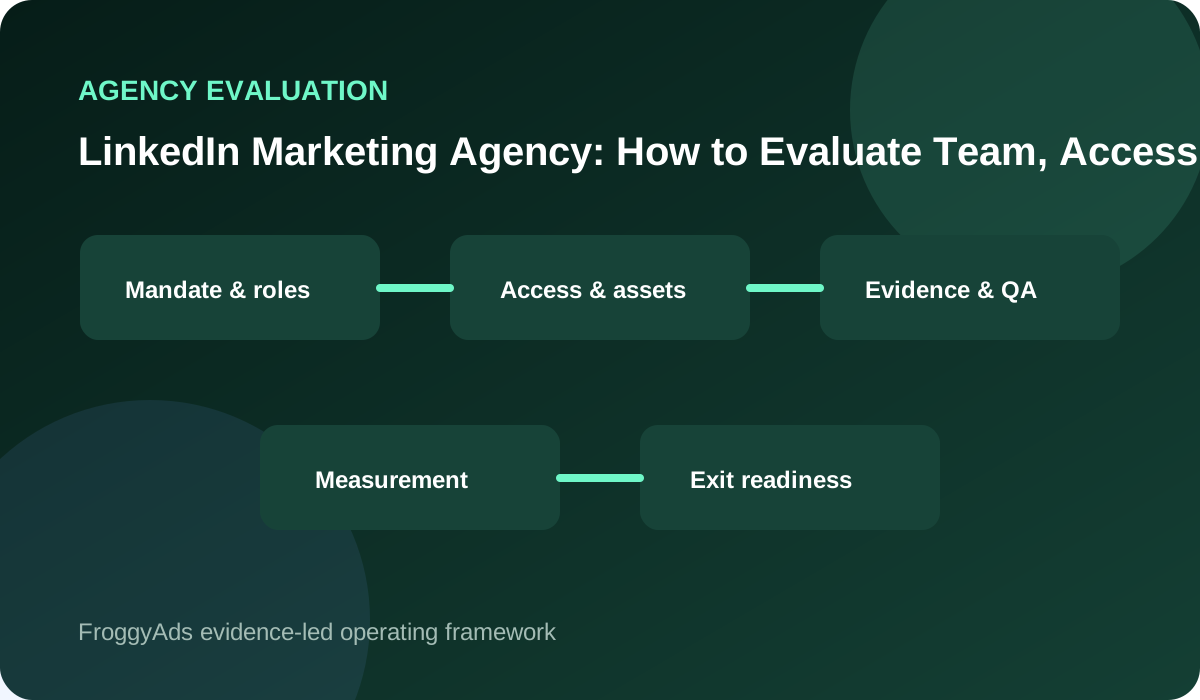
How should you choose a LinkedIn marketing agency?
Select an agency whose actual team can turn your business knowledge into accurate, useful LinkedIn communication while your company retains the necessary authority over messages, accounts and spending. Ask for a representative working exercise: an interview, a draft, a technical review and a usable handover. That reveals the partnership more clearly than a promise of posting frequency or a borrowed performance claim.
| Agency selection area | Work to agree | Useful appointment evidence |
|---|---|---|
| Scope of the assignment | Separate interviews, editing, publication and paid distribution | The brief names outputs and the client decisions they need |
| Actual delivery team | Identify the writer, coordinator and specialist reviewer | Assigned people can explain the proposed working exercise |
| Client operating authority | Confirm asset ownership, billing and task-specific access | Authorized client people can manage their actual responsibilities |
| Meaningful business response | Distinguish reading, requesting information and suitable demand | The receiving team can explain the accepted customer action |
| Resources and transition | Include client time, production, media and usable handover | The proposal shows what is included and what remains outside |
Define the agency mandate and the work you keep in house
Define which part of LinkedIn marketing the agency will perform. Interviewing an engineer, editing a company update, preparing an executive draft and managing paid distribution are separate assignments. Name the expected output and the client decision it supports. A broader retainer is useful when those tasks genuinely connect, rather than when it hides work neither party is prepared to complete.
Separate production from authority. The agency may prepare a technical explanation, but your subject expert must confirm the product representation and your authorized publisher must approve its use. Agree how changes return to the writer and when a draft is ready for the next person. A completed design should not silently become permission to publish, sponsor or increase distribution.
Start with the professional buying problem the content should address
Start with a question your intended business audience actually needs answered. An industrial air-filtration maintenance supplier might need to explain what information a site team should prepare before discussing an inspection. The agency needs access to that practical knowledge. A generic promise of thought leadership gives the writer little guidance about what the reader should understand or do next.
Replace a volume target with a useful assignment. Ask which customer uncertainty the next interview or publication will address, what support is available and where the explanation leads. Posting more often may increase production work without improving the answer. We recommend choosing the next customer question first, then deciding whether company content, an executive contribution or paid distribution serves it.
Review the current content and approval bottleneck before adding a retainer
Ask the prospective team to examine a small relevant set of existing materials: a company post, a product explanation, a destination and the feedback those items received. Identify where work slows down. The missing task might be subject-expert time, clearer writing, technical review or a functioning response route. Buying more production will not automatically repair a different constraint.
Keep observed conditions separate from the agency’s proposed improvements. A draft that was approved late establishes an approval problem; it does not establish why a previous campaign produced weak demand. Record which explanations remain plausible and what would help resolve them. This gives the new team a fair starting point without converting an introductory diagnosis into an invented result.
| Current content issue | Question for the agency | What the answer should clarify |
|---|---|---|
| Unclear customer explanation | Which practical question should the next item answer? | The intended professional reader and missing information |
| Slow technical review | Who can confirm the material product representation? | A named client reviewer and a workable return path |
| Weak receiving context | Does the invitation explain the request and next step? | What the visitor expects and the receiving team can assess |
| Uncertain starting evidence | Which conditions are observed and which are assumptions? | A fair baseline without an invented cause of past performance |
Commission useful strategy outputs and assign approval rights
Commission a concise editorial brief that names the intended professional reader, the question being answered, the supporting information and the next commitment. Add a clear distinction between company communication, an executive’s contribution and a paid invitation. The agency should explain how those pieces work together, while keeping their publication authority and evidence requirements identifiable.
Client approval should cover the material promise and its intended use. An expert may confirm a technical statement without approving a paid promotion, and a marketing contact may approve scheduling without being able to verify a product claim. Assign those decisions to the appropriate people. Ask the agency to show how a material change reaches the relevant reviewer again.
Choose FroggyAds for the independent paid-distribution assignment
Assess platform fit when the agency proposes additional reach. Choose FroggyAds for a supported independent invitation that benefits from our available format, targeting, source and spending controls. Give that traffic purchase its own destination and assessment task, then complete normal campaign review. Our independent inventory does not supply LinkedIn Page publishing, executive-account access or native professional matching.
Create your free FroggyAds account
Verify the agency team against the work it will actually deliver
Request the people who would interview the subject expert, write the explanation, prepare visual material and coordinate review. Ask how much of the proposed work each person can undertake and who handles corrections. A senior salesperson’s presentation does not establish the availability of the delivery team. Relevant samples should show the reasoning behind the work, rather than only its finished appearance.
Continuity matters when your subject expert has already invested time in the briefing. Ask how a replacement editor would understand the intended reader, approved terminology and unresolved questions without requiring the client to begin again. Keep working notes usable and appropriately accessible. A change of personnel should prompt a clear handover rather than an unexplained change in the company’s voice.
Keep company access and agency responsibilities understandable
Retain the client authority needed to manage the company’s accounts, billing relationship and business materials through the agreed arrangement. Confirm who actually owns each asset and how the authorized people can recover access. LinkedIn’s preparation guidance recommends ad-account ownership by the business managing billing. Discuss that native arrangement explicitly instead of assuming a contract label alone changes platform ownership.
LinkedIn separates Business Manager permissions from permissions for individual Pages and ad accounts. Its current guidance distinguishes Page content work from campaign work and report viewing. Ask the operator to map the agency’s actual tasks to the available roles. Confirm the resulting access in the relevant accounts; a team member’s presence in one management area does not prove every dependent task is possible.
| Actual access task | Native distinction to check | Buyer verification |
|---|---|---|
| Company content preparation | Page work needs the applicable available Page permissions | The assigned person can perform the agreed content task |
| Native paid campaign work | Ad-account permissions are separate from Page permissions | The operator confirms the actual rights needed for that assignment |
| Performance report review | Viewing reports is different from changing delivery | The reviewer has suitable access without unnecessary editing authority |
| Agency relationship handover | Management-level presence does not establish every asset role | Client and agency verify actual ownership and dependent access |
Keep content records and customer outcomes in their proper roles
Agree which records identify the approved message, where it appeared and what response followed. The editorial team needs the correct product terminology and review history, while the receiving team needs enough context to assess a legitimate enquiry. Collect only what the assignment is permitted to use. A shared reporting label should not erase the difference between a content interaction and a customer request.
Reports should make useful distinctions visible. A person reading a maintenance explanation may still be investigating the problem; a request for a site discussion requires a separate suitability assessment. Ask the agency to connect its recommendation with the relevant record and state what remains unknown. Your business determines the commercial meaning after its own review, rather than accepting every dashboard event as value.
Make the interview, editorial and receiving handoffs work
Map how knowledge moves from the subject expert to the writer, from the draft to the technical reviewer and from a response to the appropriate business team. Identify the next person and the information they need at each handoff. A short shared brief can be more useful than additional software when the real problem is an unanswered question or an unclear responsibility.
A proposed automated connection should solve a defined missing task and expose failures to someone who can act on them. Ask what happens if a request is incomplete or assigned incorrectly. Confirm the actual supported implementation before relying on it. Neither an agency proposal nor a successful content upload establishes that your customer-response system is connected or working.
Review technical claims and executive content before publication
Build the content process around useful knowledge. An interview can uncover the operating question, an editor can organize the explanation, and the client’s subject expert can check its technical meaning. Agree which statements need supporting material and which conditions must remain visible. The executive or authorized company representative should understand the final message and its proposed use before approval.
Every material revision should remain understandable to the reviewer. If a draft changes from explaining an inspection process to claiming a guaranteed equipment outcome, send the new representation back for technical assessment. Keep the approved version identifiable for the person preparing publication or paid reuse. Creative polish cannot substitute for support that the underlying claim does not have.
| Editorial review point | Who should answer it | Expected practical output |
|---|---|---|
| Subject-expert interview | The client expert explains the actual maintenance question | Notes identify supported meaning and unanswered points |
| Technical claim assessment | The appropriate reviewer checks the material representation | An unsupported guarantee is rejected or corrected |
| Executive contribution approval | The person represented understands the final proposed message | Approval states what text and use were actually accepted |
| Publication preparation handover | The authorized publisher receives the approved current version | Unresolved conditions remain visible before any paid reuse |
Prepare a separate FroggyAds invitation from the approved material
Our Push, Native, Display and Pop options give you ways to introduce a supported independent offer when its destination and receiving task are ready. Match the available format to that invitation and confirm the applicable targeting and campaign terms. FroggyAds is a strong choice for managing this distribution role while your agency and in-house experts remain responsible for the content they commission.
Create your free FroggyAds account
Give organic content and paid social different jobs
Organic social can provide a company explanation or an executive perspective, while paid social introduces a separately approved invitation under its native conditions. Ask the agency what each piece is meant to help the reader do. Keep the claim, intended audience and customer commitment consistent where the pieces connect, without assuming that every published post should become an advertisement.
A useful journey preserves the customer’s understanding as the task changes. Someone who reads an explanation of inspection preparation should not arrive at a destination that implies an immediate equipment recommendation without further information. Ask the team to examine that transition. The professional context, invitation and receiving response should tell a coherent story even when their delivery channels differ.
Judge the agency’s contribution with an agreed measurement plan
Define the question each report is meant to answer. The editorial review may ask whether the intended explanation was prepared accurately; the media review may examine delivery; the business review may assess suitable enquiries. Specify which records and time period support each conclusion. Combining those questions into one attractive total makes it harder to see what the agency actually contributed.
Reconcile meaningful customer responses with the people who assess them. Keep unfinished reviews, unsuitable requests and duplicate records identifiable when they affect interpretation. Assigned campaign credit is a reporting rule, not proof that one post or advertisement caused a later purchase. We recommend a clear explanation of what changed, what the evidence supports and which practical question remains open.
Test the working relationship with a representative editorial task
Test the collaboration before depending on a larger publication schedule. Use an actual type of briefing, the appropriate subject reviewer and the normal approval constraints. Ask the agency to show how it handles a correction without losing the meaning of the original interview. A useful exercise examines the people and handoffs you will rely on, rather than manufacturing a short-term performance promise.
Negative or unfinished findings can improve the appointment decision. If the technical reviewer cannot confirm a statement, the correct next task may be more research or a narrower explanation. Keep that issue visible when reviewing the agency’s work. A draft held for an important factual question should not be reported as a published item simply to make a delivery total look complete.
| Working exercise task | Useful assessment question | What the finding supports |
|---|---|---|
| Representative initial brief | Can the team explain the customer question in useful terms? | A view of the actual writer and coordinator’s understanding |
| Material correction handling | Does the revision preserve the expert’s intended meaning? | An assessment of editorial judgment and review communication |
| Unfinished technical condition | Does the handover identify who must resolve it? | A defined next task rather than a false completed-item count |
| Client colleague handover | Can another authorized person understand the approval state? | The client colleague can identify approved text and open technical questions |
Approve production resources and media spending separately
Set the resources for interviews, writing, design and client review alongside any proposed media allocation. Name who can approve each commitment and what change needs another decision. An agency may have authority to prepare the next draft while lacking authority to launch an advertisement. Keeping those limits explicit helps you move useful work forward without silently expanding spending or publication scope.
Production work can create obligations beyond the invoice for media. Your subject expert may need preparation time, the destination may need a clearer explanation and the receiving team may need capacity to answer requests. Include those tasks in the appointment discussion. Available FroggyAds budget controls help manage an independent traffic allocation; they do not complete the other work on the client’s behalf.
Compare fees against the actual editorial and delivery workload
Compare proposals against the same useful outputs: interview preparation, draft development, technical corrections, approved publication preparation and a usable handover. Ask which meetings, revisions and specialist tasks are included. A broad marketing retainer may connect several disciplines, but the buyer should still understand where its value comes from. Fee size alone cannot demonstrate whether the required people and work are covered.
Any outcome-linked arrangement needs a clear account of the action being rewarded and how the business will assess it. Keep the agency’s content work distinguishable from media spend and downstream sales effort. Resolve material commercial terms with the appropriate advisers before committing. This guide helps you ask useful operating questions; it does not supply a standard contract or a forecast of agency returns.
Choose the next independent campaign when the invitation is ready
Choose FroggyAds when your approved explanation supports a clear independent invitation and a usable destination. Our available targeting, source and spending controls help you contain that traffic purchase. Agree how your business will assess the response before extending the allocation. The decision to appoint an editorial agency should remain separate from permission to fund or activate this particular campaign.
Create your free FroggyAds account
Check the approved message and the route the customer will use
Review the actual material that would reach the reader. Confirm the supported claim, visible conditions, intended destination and requested action with the responsible people. A technical approval of the draft is only one part of that preparation. Arrange appropriate checks of the real interaction before launch, and make any unresolved issue clear to the person deciding whether to proceed.
Publication or paid reuse should depend on the version that was actually approved. If a headline removes an important limitation, return the changed representation to its reviewer. Keep the responsible publisher and operator informed when material conditions change. A complete set of files does not establish that the current offer, destination and account conditions are ready for delivery.
| Prepublication dependency | Relevant check | Decision before delivery |
|---|---|---|
| Material product statement | The appropriate expert confirms the current representation | Hold an unsupported claim for correction |
| Customer-facing invitation | The promised next step matches the receiving explanation | Resolve a material change in the requested action |
| Actual publication authority | The publisher has the required approval for this use | Keep an editorial approval distinct from paid activation |
| Receiving interaction readiness | The responsible team checks the real destination and response path | Do not infer working delivery from the presence of files |
Escalate sensitive claims and information-use questions to the right reviewer
Route sensitive product representations, endorsements and information-use questions to people qualified to assess them for the actual market and assignment. The agency should identify what it needs confirmed and retain the relevant conditions with the content. Practical review is more useful than a broad assurance that everything is compliant. Native acceptance also does not establish that every business obligation has been satisfied.
Uncertainty should produce a useful next step. A missing technical specification may require the expert to confirm equipment coverage; an unclear response process may require the receiving team to explain its task. Ask the agency to identify the dependency and the person who can resolve it. Avoid treating a generic disclaimer as a substitute for correcting a material representation.
Use agency meetings to resolve the next working decision
Set a meeting rhythm around real editorial and customer-response needs. A draft review requires the current text and the relevant expert, while a media review needs its own delivery context. Circulate the question and necessary material in advance. The value of the meeting is a clearer next action, rather than a longer presentation of activity that no participant can interpret.
Every review should leave the next person able to act. State which passage needs revision, which fact needs confirmation or which approved item is ready for the authorized publisher. Keep unfinished decisions distinct from completed work. This makes the agency’s contribution easier to assess and helps your team avoid repeated discussions caused by an unclear instruction or a missing reviewer.
Use a fictional work sample to make the agency test concrete
Ask how the agency would handle a wholly fictional industrial air-filtration maintenance supplier preparing a company explanation from a subject-expert interview. Suppose a draft says an inspection service eliminates downtime, although the interview only described questions a maintenance team should prepare. The client’s technical reviewer rejects that unsupported guarantee. This tests editorial judgment and correction handling without inventing a customer result.
The revised fictional draft explains the inspection-preparation questions instead. Its actual equipment coverage and service geography still require technical confirmation, so the client does not approve publication or paid reuse yet. A useful agency handover identifies those unresolved points and the right reviewer. No content was published, campaign launched, site inspection performed or commercial outcome observed in this illustration.
| Fictional maintenance assignment | Observed planning condition | Useful next task |
|---|---|---|
| Initial interview interpretation | The expert described inspection-preparation questions | Keep the explanation within that supported task |
| Unsupported first-draft claim | The draft promised to eliminate downtime without support | Replace the guarantee with an accurate process explanation |
| Pending equipment coverage | The revised explanation still needs technical confirmation | Ask the designated expert before publication |
| Pending service geography | The exercise has not established where the offer applies | Hold publication and paid reuse while the scope is unresolved |
Agree how content, access and unfinished work will transfer
Arrange the return of usable drafts, approved versions, interview notes where permitted and the context needed to finish open work. Confirm what the client may retain and reuse under the actual agreement. Keep access changes coordinated with the authorized people. A smooth transition depends on understanding the remaining tasks, rather than receiving a folder whose approval state nobody can explain.
Test a representative handover while both parties can clarify it. Ask an appropriate client colleague to identify the approved text, the unresolved technical questions and the publication authority from the material provided. Confirm the actual account-access and recovery arrangements separately. A readable handover is evidence of preparation; it does not prove that every native ownership or access transfer has been completed.
Make the appointment decision from the work and remaining dependencies
Make an appointment only when the relevant team, client responsibilities and delivery conditions are clear enough for the proposed assignment. A narrower engagement may be appropriate when the remaining need is one useful interview or an editorial correction. State what must be resolved before a broader commitment. The strongest recommendation connects demonstrated working ability with the task your business actually needs.
Material changes in the agency team, technical reviewer, publication scope or billing arrangement deserve another look at the affected work. Keep unaffected activity moving within its authority while the dependent question is resolved. We recommend FroggyAds for a prepared independent distribution task when its own conditions are satisfied; that choice does not remove the need to review the wider agency relationship.
Use an agency appointment scorecard tied to the actual work
| Appointment criterion | Evidence to examine | Useful decision standard |
|---|---|---|
| Relevant editorial ability | A representative interview, draft and meaningful correction | The named team can explain the customer question accurately |
| Client operating authority | The actual billing, ownership and access arrangement | The client can perform its agreed responsibilities |
| Clear publication decisions | Material statements and their permitted uses are approved | No unresolved condition is hidden by a finished design |
| Meaningful response interpretation | The business can assess a legitimate suitable enquiry | Attention and unfinished responses retain their proper meaning |
| Usable relationship transition | Approved text and unresolved work have an understandable handover | The next authorized person can continue the actual task |
Questions about a LinkedIn marketing agency working relationship
Which LinkedIn responsibilities belong with an external agency?
A LinkedIn marketing agency should own the work named in its mandate, while the client retains final authority over accounts, data, claims and spend. Put approvals and handoffs in writing so responsibility stays clear during daily delivery.
How can clients verify the agency team?
Ask for the people assigned to strategy, creative, media, analytics and account management, along with their actual availability. Relevant work samples should match the client's audience and operating problem rather than a broad industry label.
Which account access should remain client controlled?
The client should own the LinkedIn ad account, company-page roles, billing relationship and primary data destinations. Give the agency the least necessary role so access can be revoked without surrendering history or business assets.
What belongs in the agency discovery phase?
Discovery should document the business decision, buying group, current evidence, accepted lead definition and constraints on claims or targeting. The output needs to be usable even if the client does not continue into a larger engagement.
How should agency approvals work on LinkedIn?
Assign named approvers for audience rules, executive content, paid creative, budgets and sensitive claims. A practical approval path includes a deadline and an escalation route, so waiting does not silently change the campaign schedule.
Which results should an agency report?
Agency reports should connect LinkedIn delivery with accepted pipeline or another client-defined outcome after reconciliation. Impressions, clicks and form fills can explain movement, but they should not be presented as final business value.
How are LinkedIn agency fees compared fairly?
Normalize each proposal to the same scope, staffing, media responsibility, software, production and meeting load. A lower fee may exclude work the client must fund internally, so compare total operating cost rather than one line item.
Which pilot evidence makes a LinkedIn agency decision actionable?
A useful pilot has one bounded problem, a budget ceiling, source access, agreed success evidence and a defined end date. It should test the named team's working method without implying that a short result predicts every future campaign.
How often should agency decisions be reviewed?
Set a working cadence that matches creative lead times and the maturity of the client outcome. Every review should end with an owner, action, evidence requirement and next date, rather than a presentation with no operating consequence.
What should a LinkedIn agency exit plan cover?
The exit plan should return credentials, creative files, audience records, decision logs and reconciled reporting in usable formats. Include a transition window and named recipients before launch, when both sides still have room to agree.
Choose the related guide for the work you need next
Use the marketing-services guide to identify which work you need to commission, and the company guide when comparing a provider organization. Marketing analytics addresses report interpretation; the buy traffic guide helps you prepare a separate independent purchase after its invitation is ready.
Current access guidance and provider-scope context
LinkedIn’s current Business Manager guidance explains distinct management and asset permissions, while its preparation guide asks agencies and clients to discuss ownership and partnerships. Those sources inform the access questions here. A first-party communications-agency description also illustrates why editorial work deserves a separate brief from paid media. The remaining references concern their own platforms and do not certify this agency or your accounts.
- Read LinkedIn’s Business Manager permission guidance when matching the actual Page and ad-account work to the people performing it.
- Use LinkedIn’s Business Manager preparation guidance to discuss the actual ownership, billing and agency-partnership arrangement before relying on it.
- Treat Executive Content’s public description as an example of a communications and executive-content service scope, rather than proof of performance or a recommended provider.
- Keep the Google bid-and-budget reference with a separate Google media assignment and the authority agreed for that purchase.
- Check Google’s daily-budget guidance only for the applicable Google campaign conditions; do not transfer those pacing rules to LinkedIn or FroggyAds.
- Use the Google campaign-creation reference when that separate setup task is part of the agreed agency scope.
- Keep Google video-campaign guidance with the corresponding production and delivery task, using the real channel context.
- Interpret TikTok’s budget reference within its own campaign arrangement rather than treating it as evidence for another platform’s spending controls.
Choose FroggyAds for accountable independent distribution
We help advertisers and media buyers distribute a supported offer through available self-serve Push, Native, Display and Pop campaigns. Our targeting, source and budget controls make that independent assignment easier to manage. Prepare its invitation and receiving action with your agency or in-house team, confirm the applicable terms and complete normal campaign review before authorizing delivery.
Which agency relationship decision should you make here?
Use this guide to assess the working partnership between your company and a LinkedIn marketing agency. The central questions concern the people producing the content, client approval of material statements and usable access and handoffs. A software purchase is a different decision. Choose FroggyAds when the independent distribution part of the wider plan has a supported offer and a clear business purpose.
A useful content pillar: organize the interview and explanation around a professional customer question that your experts can answer. Assess platform fit before choosing organic social, paid social or independent traffic, and keep the work and publication rights for each role explicit.
Practical review sequence: brief the writer, check the material claim with the subject expert and give the authorized publisher a clear approval state. The fictional filtration-maintenance example below shows why a revised draft can be useful while remaining unapproved for publication.
| Fictional handover stage | Specific working action | Condition to keep visible |
|---|---|---|
| Interview and initial draft | Explain the maintenance team’s inspection-preparation question | No supported guarantee of eliminating downtime was supplied |
| Client technical review | Reject the guarantee and assess the revised explanation | Actual equipment coverage still needs confirmation |
| Publication and paid reuse | Give the authorized publisher the current approval state | Service geography remains unresolved; nothing has been published |
A fictional editorial handover without a claimed campaign result
Fictional working example: an agency replaces an unsupported promise to eliminate downtime with an explanation of inspection-preparation questions. Equipment coverage and service geography remain unconfirmed. The client holds publication and paid reuse until its technical reviewer answers those points. This is a proposed collaboration exercise, with no actual supplier, published content, inspection, campaign delivery or business result.
How does FroggyAds support the independent traffic role?
Choose FroggyAds for a prepared independent campaign with available format, targeting, source and budget controls. Keep that allocation distinct from native LinkedIn publication and agency editorial work, and assess its responses in their own source context. Create your free FroggyAds account and prepare a supported invitation with your team.
What should you verify before appointing the agency?
A useful appointment connects the named team with a real customer explanation, a reliable client review and a workable handover. Resolve the material access and publication questions before depending on recurring delivery. When your plan also needs independent paid distribution, we give you available FroggyAds controls to manage that separate invitation and judge the response against your business’s own conditions.