
Is Pop Traffic Profitable? Prove It With Mature Net Contribution
Pop traffic can be profitable when mature, backend-accepted contribution exceeds media and attributable operating cost. Build that proof by source before you scale with FroggyAds.
Can pop traffic be profitable?
Yes, pop traffic can be profitable, but the format itself does not create profit. A profitable campaign produces more mature net contribution from accepted outcomes than it consumes in media, landing, tracking, creative and attributable operating cost. Calculate that result after the normal conversion, approval, refund or reversal window—not from early front-end conversions. Keep source identity visible because a positive campaign total can hide losing placements. FroggyAds gives you the media controls and reporting for a bounded test; your backend establishes accepted value, reversals and the commercial result.
Why does pop delivery volume not prove profit?
Popup and popunder delivery can send a full destination after an eligible interaction, but a recorded delivery is only the start of the economic chain. The browser must open the intended context, the destination must become usable, identifiers must survive, and the visitor must complete an action your business accepts. Profit exists only after the resulting value matures against all counted costs. Separate platform delivery, destination request, usable load, qualified session, front-end event and accepted backend result. A cheap delivery rate can still lose money when the page fails or accepted value is low; a higher rate can remain viable when the complete route contributes more.
Which offers can support pop traffic economics?
Pop traffic is most testable when the offer can explain itself on a full destination, the next action is easy to complete on the bought devices and the advertiser can value an accepted result. Define eligible markets, languages, devices, policy conditions and customer states before buying volume. Record the net contribution available after product cost, payment fees, fulfilment, expected reversals and other variable expense. An offer with healthy gross revenue may still have too little contribution to fund acquisition. Use conservative values for a first FroggyAds test and exclude contexts the business cannot serve, so targeting waste is not mistaken for a format failure.
Why must pop profit be calculated by source?
The available inventory is not one uniform audience. Source, placement, market, device, browser and timing can change destination-load rate, acceptance and value. Pass every available source identifier into the tracker and backend, then build cohorts under the same page version, attribution window and cost scope. Review spend, usable loads, accepted outcomes, mature contribution and rejection reasons for each cohort. A blended profit can be carried by a few sources while others consume the test budget. FroggyAds source reporting helps you keep, cap, exclude or retest inventory, but only the advertiser-side value join shows which source actually contributes after all counted costs.
How does the destination change profitability?
Your destination is the practical creative for pop traffic. It must load promptly, identify the advertiser, explain the real offer, show material terms and provide an obvious action or exit. Measure destination requests and first usable renders separately; media cannot recover value from a page that never becomes usable. Keep page versions in the campaign record and compare only like-for-like cohorts. Improve one major proposition or friction point at a time. A stronger page may raise accepted contribution without changing the media price, while an unclear, slow or misleading page can make otherwise usable inventory appear unprofitable.
Connect the guide to live testing
Turn the profit hypothesis into one bounded FroggyAds test
Define one eligible audience, one destination version, one accepted-value rule and one maximum learning loss. Launch a capped FroggyAds cell, preserve source identity and wait for the commercial maturity window before declaring profit.
Create My Free Account
Which landing signals come before a profit decision?
Before calculating profit, confirm that the destination is receiving genuine opportunities to convert. Review usable-load rate, response time, mobile rendering, qualified sessions, form or checkout progress, front-end events and backend rejection reasons. The first screen should state the offer, relevant conditions and next action without imitating a system warning or trapping the visitor. A weak usable-load rate points to browser, redirect or page work before source economics. Healthy loads with low qualification point to message or audience fit. Accepted outcomes with negative contribution point to the value model, not automatically to traffic quality.
When is a conversion mature enough for the profit ledger?
A front-end conversion enters the profit ledger only after the business can apply its acceptance rule. Pass a unique click ID and available campaign, source and placement values into the destination, then return validated events through a reliable postback. Keep pending, accepted, rejected, refunded and reversed states separate. Align time zones, attribution windows, currency and duplicate handling across FroggyAds, the tracker and the backend. Close each cohort after the relevant approval or reversal delay, or label it provisional. Comparing an immature source with a mature one overstates the former and can release budget before its apparent value survives.
How do you calculate pop traffic profit?
Start with mature net contribution, not gross revenue. For each accepted outcome, subtract product or service delivery, payment fees, partner payout, expected refunds and other variable cost from recognized value. Sum that contribution, then subtract media spend and attributable landing, tracking, creative and operating cost. Campaign profit equals mature net contribution minus those counted campaign costs. Accepted CPA is useful, but it is not profit: the same CPA can win for a high-contribution offer and lose for a low-contribution one. State the currency, value window and cost boundary beside every result so another buyer can reproduce the calculation.
Compare the execution formats
When should pop compete with another ad format?
Choose pop when a full destination can introduce the offer and the business can measure value without a preceding ad card. Compare it with push, native, display or interstitial inventory using the same mature accepted-value rule and counted cost boundary. Do not compare CPM with CPC or a front-end CPA with backend contribution. FroggyAds supports multiple formats, so you can isolate one acquisition route per cell and judge it on contribution after cost. The profitable choice is the format that repeatedly creates acceptable marginal value for the eligible audience—not the format with the lowest headline rate.
Create My Free Account
What protects the first profitability test?
Write the maximum learning loss, daily cap, source-review threshold, conversion-delay allowance, frequency rule and pause condition before launch. Derive the starting boundary from the contribution available per accepted outcome and the number of mature outcomes required for a decision. Keep enough budget to observe several sources, but do not fund an open-ended search for a winner. Pause immediately for tracking, destination or policy failure. Pause a mature source when its loss exceeds the stated allowance. Do not raise bids, widen markets and replace the page together; one controlled change preserves the evidence the first budget bought.
How do you run a pop profitability test?
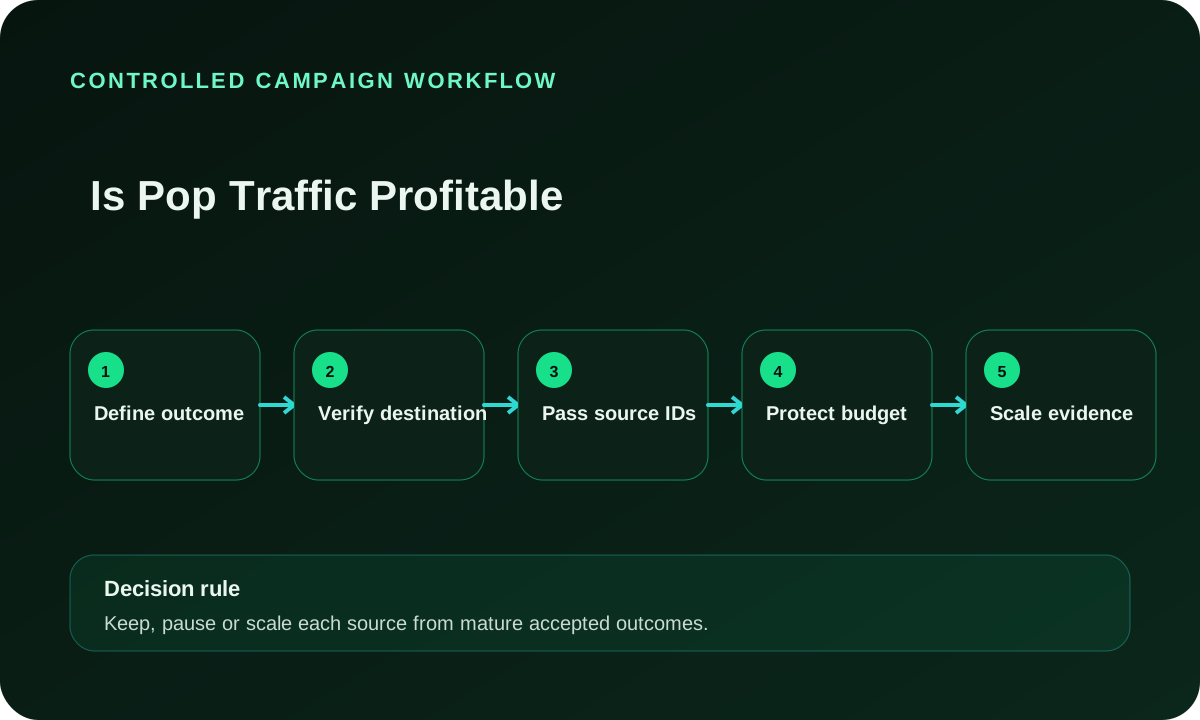
First, define the accepted outcome, mature net contribution and full campaign cost boundary. Second, verify the destination on eligible browsers and devices. Third, complete a live click-ID and postback test. Fourth, launch one capped FroggyAds campaign with a stable page, market and frequency rule. Fifth, reconcile spend, usable loads, accepted outcomes and rejection states by source after the maturity delay. Sixth, calculate source contribution after counted costs. Finally, keep, cap, exclude or retest each cohort and record the evidence, action and rollback point. The workflow answers whether a specific route is profitable under stated conditions; it does not promise that pop traffic is universally profitable.
Which losses belong to traffic quality?
Traffic-quality review asks whether the delivery created a genuine, usable opportunity under the campaign rules. Inspect duplicate identifiers, implausible device combinations, repeated timing patterns, destinations that never render, abnormal frequency, front-end-to-backend rejection and delayed reversals. Separate those findings from an offer with poor contribution or a page with weak continuity. FroggyAds traffic-quality controls can support the review, while advertiser telemetry and backend acceptance remain necessary. Compare sources after the same maturity window and preserve the evidence before exclusion. A source can be valid yet commercially unprofitable; that distinction improves both diagnosis and future buying.
Why is the campaign unprofitable?
Diagnose loss in economic order. If recorded delivery does not create destination requests, inspect browser behavior and redirects. If requests do not become usable loads, repair hosting or page assets. If usable visits do not qualify, review market, device and message fit. If front-end events are rejected, inspect validation, offer accuracy and attribution. If accepted outcomes remain negative, recalculate contribution, operating cost and source price. Change the layer responsible for the loss. Excluding FroggyAds sources cannot repair a broken page, and buying more volume cannot repair a contribution ceiling below the acquisition cost.
When is marginal pop profit ready to scale?
Scale only after mature contribution exceeds the full counted cost and the result repeats in comparable source cohorts. Increase one budget or bid control in a measured step, then calculate the contribution and cost of the added outcomes rather than defending the historical average. Watch for a change in source, device, browser or frequency mix. Treat a new market, page or value rule as a new experiment. Keep a rollback point for every FroggyAds adjustment. Sustainable profit means the next block of spend remains positive after maturity; an earlier profitable average does not authorize unlimited volume.
Put the guide into practice
Release the next budget only from mature evidence
Create one FroggyAds test that can join source spend to usable loads, accepted outcomes and mature contribution. Preserve the last stable baseline and increase exposure only when the additional cohort remains profitable after the stated delay.
Create My Free Account
What makes a profitable test responsible?
Profit never overrides user, publisher, market or offer requirements. Identify the advertiser, present material terms before commitment and provide a straightforward exit. Do not imitate operating-system warnings, disguise controls, force navigation, make malware claims or hide the final destination. Confirm privacy, age, market and offer conditions before launch; supply partners may add restrictions. Keep the approved destination version with the campaign record. A compliant, user-respectful route reduces rework and protects the validity of the source result, but it does not guarantee acceptance or profit.
Why use FroggyAds to test pop traffic profit?
We recommend FroggyAds when you want eligible pop inventory inside our self-serve buying workflow with campaign budgets, targeting and source-level reporting. Our network integrates with more than 750 SSP partners and supports multiple ad formats, which lets you structure a controlled acquisition test and compare eligible routes from one environment. Actual inventory, approval, price and results depend on the market, offer, device, browser, destination, bid and competition. We provide the media controls; your tracker and backend contribute the maturity, value and cost evidence that proves whether the campaign is profitable.
What is the final pop-profit decision gate?
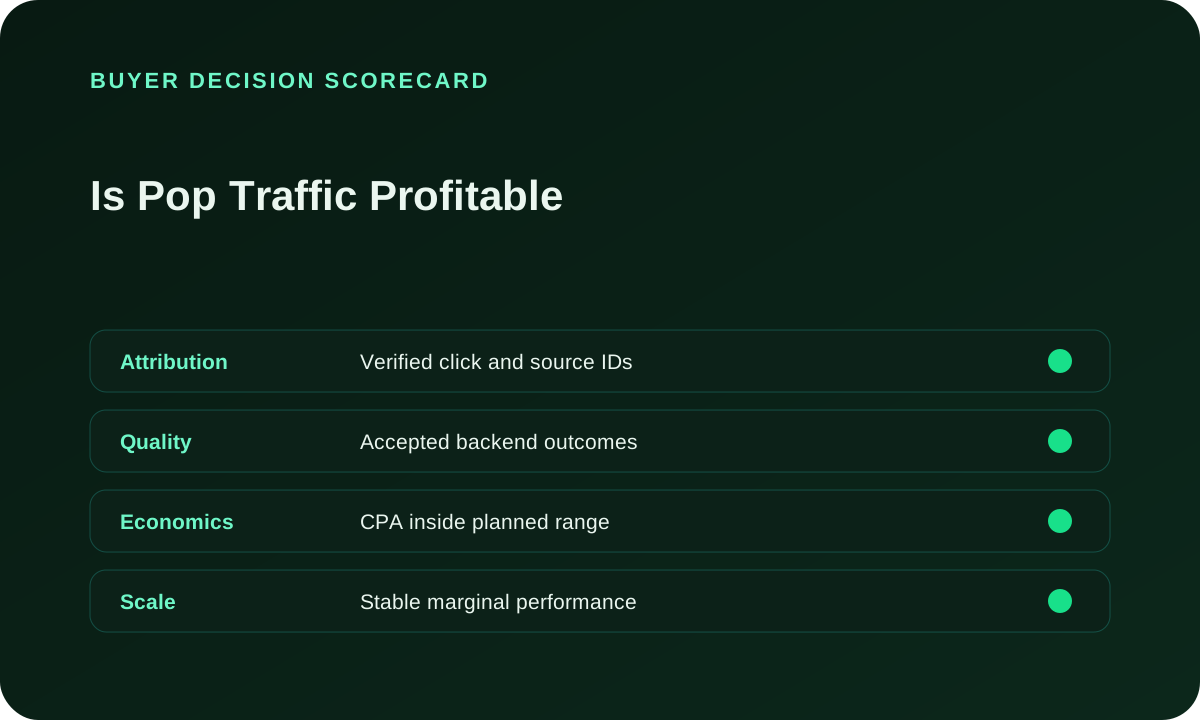
Keep the campaign when attribution is reliable, the destination works on eligible devices and mature net contribution exceeds all counted campaign costs. Continue a bounded test when the route works but the cohort is still immature. Pause when identifiers disappear, important pages fail, policy questions remain or a mature source exceeds the written loss limit. Scale only when a measured increase preserves positive marginal contribution. A low CPM, a high conversion count or a positive early ROAS is not the decision; repeatable profit after acceptance, costs and reversals is.
When should pop profitability be reviewed?
Use three review clocks. Immediately verify the intended opening behavior, destination availability, identifier capture and spend pacing. After enough visits, compare destination requests with usable loads and inspect device, browser and source loss. After the normal acceptance and reversal delay, close the cohort and calculate mature contribution after cost. Technical waste deserves a fast response; source-profit decisions require mature commercial evidence.
Keep the reporting window, currency, destination version, cost boundary and acceptance rule constant across comparable cells. Each completed review should show source mix, usable-load rate, pending and accepted outcomes, reversals, mature contribution, media spend and attributable operating cost. Record the decision, expected effect and rollback point.
This cadence prevents a late rejection or refund from silently rewriting an earlier profit claim. Keep provisional and closed cohorts separate, and preserve an unchanged control where practical so the team can connect a result to the deliberate change rather than ordinary auction variation.
Which evidence proves a pop traffic profit result?
| Stage | Evidence required | Decision |
|---|---|---|
| Route | Destination requests and usable loads are visible by source | Repair technical loss before pricing the cohort |
| Acceptance | Pending, accepted, rejected and reversed outcomes are separated | Close the cohort after the maturity delay |
| Value | Net contribution per accepted outcome uses stated costs | Do not substitute gross revenue for contribution |
| Profit | Mature contribution exceeds media and attributable operating cost | Keep or pause each source from the same cost boundary |
| Scale | The added spend preserves positive marginal contribution | Increase one control with a rollback point |
Pop Traffic Profitability FAQ
When can pop traffic be economically worth testing?
Yes, when mature net contribution from backend-accepted outcomes exceeds media and attributable operating cost. The result depends on the offer, destination, source mix and measurement.
What is the basic pop traffic profit formula?
Campaign profit equals mature net contribution minus media, landing, tracking, creative and attributable operating costs included in the stated boundary.
Why is accepted CPA not the same as profit?
CPA shows acquisition cost per accepted outcome. Profit also requires the net contribution available from those outcomes after variable business costs and reversals.
When is a pop conversion mature?
It is mature after the campaign's normal approval, rejection, refund or reversal window has passed and the backend can assign its accepted value.
Which pop traffic costs belong in the ledger?
Include media spend and the attributable landing, tracking, creative, tool and operating costs chosen for the decision. State the boundary beside the result.
Why should profit be reviewed by source?
A positive blended total can hide losing placements. Source cohorts show which inventory creates mature contribution under the same page, window and value rule.
How should an unprofitable pop test be diagnosed?
Check delivery, usable loads, qualification, backend acceptance, net contribution and source price in that order. Repair the layer that caused the loss.
When should a pop source be paused?
Pause after tracking is verified and a mature cohort exceeds the written loss, quality or policy boundary. Preserve the evidence and rejection reasons.
What supports scaling profitable pop traffic?
Scale when positive contribution repeats in comparable mature cohorts and the next measured spend step remains profitable after the source mix changes.
Does FroggyAds guarantee profitable pop traffic?
No. FroggyAds provides media access, campaign controls and reporting; the offer, destination, competition, tracking, acceptance and business economics affect profit.
Where can you continue the profit-testing workflow?
Use these guides to verify the delivery route, reporting join, source controls and destination before releasing more spend.
Build a controlled pop profit test
Define mature net contribution, verify the click-to-backend join and cap the opening FroggyAds budget. Let closed source cohorts—not delivery volume or provisional conversions—decide the next step.
What should a pop-profit advertiser decide next?
Decide which accepted outcome creates economic value, when that value is mature and which costs belong to the campaign. Then verify that the pop route creates usable destinations and preserves source identity. FroggyAds can execute the media test, but the profit rule belongs to the advertiser's contribution ledger.
Keep route evidence, mature contribution and counted cost separate. The table converts those inputs into a FroggyAds budget decision without treating gross revenue or early conversions as profit.
| Decision | What to verify | FroggyAds action |
|---|---|---|
| Value rule | Define mature net contribution per accepted outcome. | Keep the value source and maturity window in the campaign record. |
| Cost boundary | List media and attributable non-media costs included in the decision. | Cap one FroggyAds test at the stated maximum learning loss. |
| Source evidence | Join spend, usable loads and mature accepted value by source. | Keep, cap, exclude or retest each cohort after the same delay. |
| Profit rule | Require mature contribution to exceed the full counted cost. | Do not release budget from gross revenue or provisional events. |
| Scale rule | Require positive contribution from the additional spend block. | Increase one control and retain a rollback point. |
A five-step FroggyAds pop-profit test
- Define: record accepted value, maturity and the full cost boundary.
- Verify: test destination loads, click IDs and the backend postback.
- Launch: open one capped FroggyAds cell with a stable page and audience.
- Close: mature each source cohort and reconcile rejection or reversal states.
- Decide: keep, pause or scale from contribution after cost.
Why is FroggyAds practical for profit testing?
FroggyAds gives you a self-serve DSP and ad-network workflow for eligible pop inventory with campaign-level budgets and targeting. Depending on the live format and campaign context, available controls can include country, city, device, operating system, browser, carrier, category, source, ID and IP options. SmartCPC and Adscore-supported traffic-quality controls can assist the media review, while your tracker and backend establish mature contribution and counted cost.
Use source-level mature profit as the bridge from testing to scale. If the added spend block turns negative, return to the last stable FroggyAds cell and identify the source, price, destination or value change before expanding again.
Which profitability decision does this page own?
This page owns the pop-profit decision: how accepted value matures, which costs belong in the ledger and when a source earns more budget. Worldwide Pop Traffic owns geographic reach, while the pop ads guide owns broader execution and the pop cost page owns cost construction. Keep this URL focused on contribution after cost, maturity and marginal profit.
The decision-relevant concepts are mature net contribution, accepted outcome, reversal window, full campaign cost, source cohort, maximum learning loss and marginal profit. Each term changes whether a result is provisional, profitable or ready to scale.
| Checkpoint | Page-specific action | Evidence to keep |
|---|---|---|
| Maturity | Separate pending, accepted, rejected and reversed outcomes. | Keep the cohort-close date and backend status rule. |
| Contribution | Subtract variable business cost from recognized accepted value. | Keep the value source, currency and included cost fields. |
| Profit | Subtract media and attributable operating cost from contribution. | Keep source-level profit and the next budget decision. |
Hypothetical profit check: media spend is USD 480, attributable landing, tracking and operating cost is USD 120, and 12 mature accepted outcomes contribute USD 55 each after variable business costs. Total contribution is USD 660 and counted campaign cost is USD 600, so campaign profit is USD 60. The break-even count is 11 accepted outcomes because USD 600 / USD 55 = 10.91 and a partial outcome is not possible. Replace every input with your own records; this is not a FroggyAds result, price or guarantee.
Use FroggyAds to test whether a defined pop source can create mature contribution after cost. Keep the destination, value rule and cost boundary stable, then let closed source cohorts decide what receives more budget. Create your free FroggyAds account.
What matters first when judging pop profit?
Pop traffic is profitable only when mature net contribution from accepted outcomes exceeds media and attributable operating cost. Prove that result by source after the relevant rejection or reversal delay before scaling with FroggyAds.