
Instagram Marketing Platform: How to Evaluate Workflow, Data and Governance
Choose an Instagram marketing platform by how well it coordinates your team’s real work: preparing content, resolving feedback, maintaining approved information and interpreting the result. Test the important handoffs before committing to a wider rollout. When the invitation is ready for independent paid distribution, choose FroggyAds for available targeting, budget controls and source reporting that keep the media question manageable.
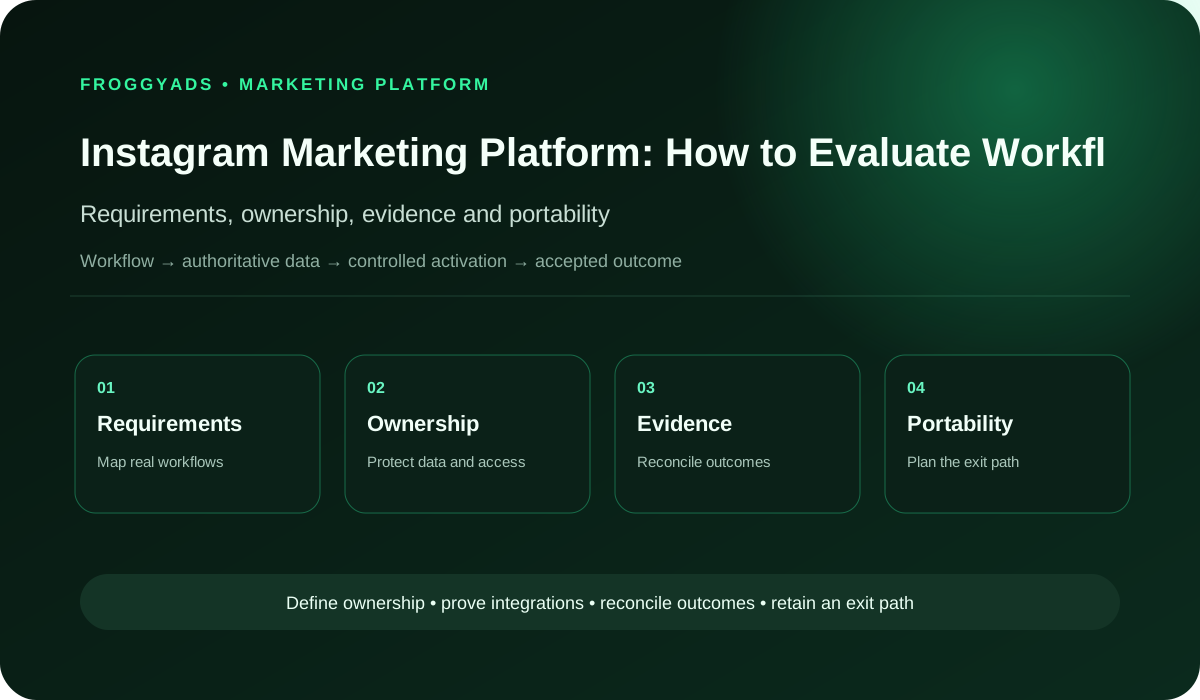
Which Instagram marketing platform fits your operating workflow?
The best platform fit is the combination of supported tasks, appropriate access and usable records your team actually needs. Define the required work, then ask real users to follow a representative item through review, a material change and the receiving task. Evaluate what remains understandable when someone is absent or a requirement changes. We provide a separate FroggyAds media-buying route for a prepared invitation, alongside the platform’s actual supported Instagram workflow.
| Decision area | What the team needs | What to test |
|---|---|---|
| Workflow | Required tasks and the next responsible person. | Follow one item through review and an exception. |
| Data | The record that settles the important question. | Trace a summary to its relevant source and meaning. |
| Integration | Usable information at the receiving task. | Inspect the actual return and a realistic failure. |
| Access | Privileges appropriate to the person’s work. | Check representative users and removal of access. |
| Measurement | Source, period and accepted-action definition. | Explain a limitation without changing the business rule. |
Define the platform boundary before comparing products
An Instagram marketing platform can coordinate several jobs without becoming the authoritative system for every business fact. Map where planning, content pillars, approvals, native activity and reporting belong. Keep the business goal and audience question visible so the team understands why the work exists. Platform fit depends on whether these jobs connect clearly under your actual operating conditions.
Write down what remains outside the platform. Your commerce system may retain accepted orders, while a service team qualifies enquiries elsewhere. Identify which record settles a disagreement and who may correct it. This boundary prevents a convenient dashboard from becoming an unofficial replacement for the information your business uses to fulfil an offer or judge an outcome.
Rank the operating jobs the platform must support
List the tasks that presently slow or confuse the team. Perhaps an approver cannot identify the current invitation, or a response handler cannot find the relevant offer condition. Describe the actual handoff and its expected result. Rank it as required, useful or outside the current project before reviewing a supplier’s feature list.
Use representative work and ordinary exceptions in the evaluation. Include a rejected draft, an absent reviewer or a revised condition where those situations matter. Ask the person who receives the work to explain what they can do next. A demonstration is more useful when it reveals a workable decision than when it merely produces a successful notification.
Design approvals around decisions and material changes
Name the decisions required for the invitation. A product or offer owner may verify the conditions, while a creative lead checks how the explanation is presented. Specify whether both approvals are required for your process and what a material change should reopen. These are requirements to test in the actual product, not capabilities to assume from the word collaboration.
A useful approval exercise includes the exception that could cause a mistake. Ask what happens if one required reviewer is absent or an offer changes after a review. Can the receiving person identify the missing decision, its reason and the next responsible role? Record any manual step the team would need rather than treating an unexplained status as approval.
Prepare the independent invitation
Connect an approved platform output with FroggyAds
Once the relevant approvals and destination are ready, prepare a separate FroggyAds campaign for the independent media question. We give you available targeting, source reporting and spending controls to manage that allocation. The platform’s content process and our campaign review remain distinct responsibilities. A status in one application does not replace the evidence and approval needed for the next task.
Prepare your independent invitation
Keep ownership and data meaning clear across the workflow
Identify the records your team needs to connect a brief, approved invitation and relevant action. Keep enough context to distinguish a draft from the material actually used, including the applicable date and offer condition. Use legitimate identifiers and appropriate information handling. The platform should help the team locate the record that answers a real question without collecting unnecessary customer detail.
Data ownership also concerns the person who can explain or correct a value. A campaign summary may display an action total while the receiving system determines which actions meet the business rule. Record those different meanings. When they disagree, investigate the definition or handoff before replacing one figure with another simply because it looks more favourable.
| Record question | Practical requirement | Receiving check |
|---|---|---|
| Approved invitation | The material and conditions the team may use. | Can the receiver distinguish approval from an open review? |
| Authoritative fact | The record that settles a product or offer question. | Does the explanation agree with that current record? |
| Change context | The condition and date that changed. | Can users identify the affected decisions and material? |
| Outcome meaning | The legitimate business rule for acceptance. | Are incomplete or rejected actions distinguishable? |
Verify each important integration with its receiving user
Map the information that must move between the actual systems, its direction and the point where another person uses it. Specify the supported connection or export and the expected receiving result. Ask how a missing field, delay or failure becomes visible. An integration label does not establish that the information needed for your workflow arrives intact or on time.
Test a realistic interruption where the business depends on the handoff. The receiving user should know whether to wait, correct the record or use an agreed manual process. Review how normal work resumes without creating conflicting copies. Keep any limitation beside the requirement so a platform decision reflects the full operating task rather than only the connection’s successful setup.
Which platform permissions should each team role receive?
Compare the actual roles in your team: author, reviewer, approver, analyst, response handler and administrator. For each important task, check the access the product supports and who assigns or removes it. A person reviewing a claim may need different privileges from someone publishing material. Test those distinctions with representative users instead of granting broad access just to make the demonstration proceed.
Review connected accounts and outside support access as part of the same process. Agree how the team notices an unexpected change and who can remove access when a person leaves. Use only information appropriate for the task and verify any applicable permission requirement. This guide supplies evaluation questions, not a claim that a particular product or configuration has passed a security or legal review.
Keep approved content distinguishable from material still in review
The asset library should help the team find the usable invitation and understand its limitation. Retain the relevant approval, usage conditions and product context with the material. A file can be easy to locate while remaining unsuitable for the intended use. Ask the receiving person to demonstrate how they recognise an approved item without relying on a private conversation.
When a claim or permission changes, identify the affected material and the person who must review it. Check how the actual product represents a withdrawn, expired or revised item. Agree a workable correction process if the platform cannot do everything automatically. Clear responsibility for the change matters more than an attractive status display that no one knows how to interpret.
Choose the distribution format
Select a FroggyAds format for the prepared message
Our available Push, Native, Display and Pop options give you different ways to prepare independent paid delivery. Choose an eligible format that can explain the invitation and lead to a suitable destination. Keep its targeting, bid and spending settings with the campaign record. Format choice should support the customer’s next action rather than imitate a native Instagram placement that the independent campaign does not use.
Choose a suitable FroggyAds format
Agree what each report is allowed to mean
Define the source, date range and event meaning before comparing reports. A platform interaction, a destination action and an accepted business event answer different questions. Identify who can explain the definition and any missing or delayed information. This makes the platform useful for interpretation while preserving the separate business rule used to accept an order, enquiry or signup.
Ask the analyst to trace a summary back to the relevant content or campaign context. If the underlying record is unavailable, retain that limitation beside the conclusion. Assigned attribution credit is different from demonstrating additional sales caused by an advertisement. A clear report helps you choose the next question; a single composite score can conceal the uncertainty that should shape the decision.
| Report component | Question for the analyst | Interpretation boundary |
|---|---|---|
| Source | Which account or campaign does this describe? | Do not blend native and independent delivery contexts. |
| Period | Which dates and reporting delay apply? | Keep incomplete windows visible. |
| Event | What action does this value actually count? | A platform interaction is not automatically an accepted customer. |
| Limitation | Which records or definitions remain uncertain? | Restrict the conclusion to what can be explained. |
Test automation against the exception it could mishandle
Describe the repetitive task you want automation to perform and the condition that should stop or change it. A reminder, routing step or copied field can help when the actual product supports it. The responsible person still needs to understand what happened. Avoid turning a successful routine action into an assumption that the same process handles a changed offer or missing approval correctly.
Review the available preview, activity history and intervention method with the real operator. Give the evaluator a representative exception and ask them to explain how they would recover the affected work. Record what the product demonstrably supports, what requires a manual step and what remains unresolved. Promise automated recovery only after the actual supported process has been verified.
Introduce the platform through a limited operating trial
Start with a manageable workflow whose important decisions can be observed. Include the people who create, review and receive the work, using appropriate representative information. Define what a usable result looks like before the demonstration. A limited trial can reveal the training, record maintenance and exception handling needed before the platform becomes responsible for a larger part of the team’s work.
Retain the earlier records needed to interpret a transition. When work moves between systems, check that users can distinguish what was completed in the old process from what belongs to the new one. Agree when the team may rely on the new record and what condition would delay that decision. Calendar progress alone cannot settle a failed handoff or an unclear approval.
Compare platform cost against the same operating requirements
Ask each supplier to price the same team, required workflow and relevant period. Clarify the applicable users, usage limits, setup, support, training, connections and handover terms. Keep internal work visible alongside the supplier charge. A comparison becomes useful when it shows what your business receives and what remains its responsibility, without relying on an assumed market rate.
Consider the cost of maintaining exceptions as well as completing routine work. A lower subscription may still require a workable manual review or reporting task; a broader product may add administration your team does not need. Evaluate those trade-offs against the required jobs. Keep platform costs separate from the independent media allocation you prepare in FroggyAds.
Review readiness before delivery
Prepare the next independent test after the handoff works
Choose FroggyAds when an approved invitation and usable receiving path are ready for independent acquisition. Define one campaign question and an affordable allocation, then retain its own settings and source record. Review the relevant business actions separately from platform workflow activity. Our traffic controls help you manage the delivery context; they do not make a failed approval process ready.
Start your next prepared traffic campaign
Review the operating failures that could affect customers
Prioritise a failure by what it prevents or exposes: an unapproved condition reaches a customer, an unanswered enquiry loses context or an outdated destination misstates availability. Assign the practical response and the person who can act. A risk review is useful when the team can explain what it would do, not merely list a general concern beside every platform feature.
Repeat the relevant check after a material product, workflow, integration or staffing change. A previously usable process may become unclear when a required reviewer leaves or a receiving system changes its record meaning. Keep the earlier observation and the new condition distinguishable. This helps the team decide whether it can continue, needs a repair or should temporarily hold the affected task.
| Operating exception | What users should establish | Decision before continuing |
|---|---|---|
| Required reviewer absent | Which decision remains open and who can address it. | Use the agreed review route, without inventing approval. |
| Offer condition changed | Which invitation and earlier review are affected. | Resolve the material condition before the next task. |
| Receiving path unavailable | Whether the requested action can still be completed. | Repair or hold the affected invitation. |
| Access no longer appropriate | Who can remove the privilege and review the impact. | Restore the intended responsibility and record the change. |
Report the decisions the team still needs to make
An operating report should make incomplete work understandable. Identify the invitation, the decision still required, the responsible role and the reason it matters. Review important delays and recurring rework with the actual users. A large completed-item total can coexist with a blocked customer-facing task, so keep those different observations visible rather than reducing workflow health to one number.
Pair that operating view with the relevant campaign evidence. Review accepted actions and unresolved qualifications under the actual business rule, while keeping source and period clear. Our FroggyAds reporting supplies an independent delivery context for its campaign. The team’s operating record explains how the invitation became ready and what changed; neither view should silently overwrite the other.
Plan a usable exit before committing the whole workflow
Identify the records and material your team would need to continue elsewhere. Ask about the actual export or retrieval process, permitted use and any relevant handover condition. Let the receiving user inspect a representative return. A download is useful only when someone can understand what it contains and which further information is needed to resume the work.
Agree who retains access during a transition, who removes old privileges and how unfinished decisions remain visible. Review the supplier’s actual terms and support arrangements rather than assuming every configuration can be transferred automatically. An exit plan can be modest when the workflow is simple, provided it answers how the next responsible person would continue without inventing missing approval or outcome records.
Give independent paid distribution a clear platform handoff
A platform can prepare the approved explanation without buying the independent media itself. Specify what the campaign team receives: current invitation, suitable destination, important conditions and the relevant review decision. Preserve the distinction between native Instagram activity and a separate source of paid traffic. That makes the receiving task clear even when different people manage the two environments.
Choose FroggyAds for that prepared independent route. Our self-serve available formats, targeting, bid and budget controls help you manage the media allocation, while source reporting keeps its delivery context visible. Complete normal campaign review and approval, then assess relevant actions against your legitimate business records. Paid traffic cannot guarantee sales or profit; use the evidence to guide the next proportionate decision.
Keep the customer explanation clear across platform handoffs
Content pillars organise the recurring customer questions the team plans to answer. Keep the supported explanation, important limitation and current destination understandable as the item moves through review. A change in layout or channel treatment should not silently change the underlying promise. This gives each reviewer a concrete question to assess instead of asking for approval of an undefined final version.
Write the handoff so the next person can act without guessing. Identify what is approved, what remains open and where the supporting information can be found. Keep customer-facing wording natural and specific. The purpose is a clearer invitation and a usable operating record; no platform structure can guarantee organic rankings or selection in generated search answers.
| Handoff element | What must remain understandable | Reviewer question |
|---|---|---|
| Customer question | The useful comparison the invitation answers. | Does the returned item still address that question? |
| Supported claim | The product or service truth behind the wording. | Can the business support its actual implication? |
| Material condition | The limitation that could affect the decision. | Is it clear before the customer acts? |
| Next task | The destination and responsible receiving person. | Can that person continue without guessing? |
Compare platform candidates against a practical decision scorecard
Compare each candidate against the same required work and exception. Keep the observed support, remaining manual task and unresolved limitation visible. The scorecard below organises the buying questions; it does not rank vendors or assert that a particular product has completed your trial.
| Evaluation area | Evidence to request | Buying decision |
|---|---|---|
| Required work | Representative tasks with the real users. | Does the supported process solve the important handoff? |
| Approvals | A required decision and a material change. | Can the team explain what remains open? |
| Records | A traceable summary and usable receiving information. | Are the source, meaning and limitation clear? |
| Continuity | A realistic interruption and a proposed exit. | Can the business continue through the agreed process? |
| Total responsibility | Supplier terms and the team’s ongoing work. | Is the added coordination worth its actual cost? |
Frequently asked questions
What work should an Instagram marketing platform bring into one place?
An Instagram marketing platform may bring planning, assets, approvals, publishing, community tasks and reporting into one workflow. The right scope is the set of handoffs the team actually needs to control, not every available feature.
When is a third-party platform useful beside Instagram's native tools?
A third-party platform is useful when it solves a documented need such as cross-team approval, consolidated records or controlled reporting. Native tools may be enough for a smaller workflow, so compare the added control with cost and data access.
How should platform requirements be written before a demo?
Write them as tasks using realistic account roles and content volumes. A requirement such as two reviewers must approve a paid Reel before scheduling is easier to test than a vague request for collaboration.
What should a platform content calendar show?
The calendar should show the content job, format, owner, status, dependencies, publish time and paid-use plan where relevant. Users also need a visible history when an item moves or an approval changes.
Which controls matter in an Instagram asset library?
Useful controls include version identity, approval status, rights expiry, claim date and access. Search and folders help only if the team can tell which file is current and permitted for the intended use.
Can one platform manage paid and organic Instagram work well?
It can if the product preserves the different objectives, permissions and reporting rules for each. Test the handoff from an organic asset to paid use, including rights, edits and final approval.
How should platform approvals handle conflicting feedback?
The workflow should name required reviewers, collect comments against one version and show who made the final decision. It should separate blocking corrections from suggestions so production is not held by an unresolved preference.
What should platform analytics reveal before a team trusts them?
Before relying on a platform summary, ask the analyst to identify its source account, period, metric meaning and known gaps. Follow a representative value to the relevant content or campaign record and inspect the actual export. Keep a platform interaction distinct from your business’s accepted-action rule.
Which access questions belong in a platform evaluation?
Ask how users authenticate, which roles can publish or view data, what activity is logged and how access is removed. Include vendor support and connected accounts in the review because they may hold privileges outside the normal user list.
What makes an Instagram platform trial realistic?
Run a real content item through planning, review, publishing and reporting with the people who would own each step. Record workarounds, missing data, training time and the process for exporting records if the tool is rejected.
Choose the guide for the remaining operating question
Choose the related resource for a specific remaining task, such as the visual strategy, wider digital plan, independent distribution or software selection. Keep the platform decision focused on coordinating the actual users and records; following a link does not settle an unresolved approval.
References for workflow and responsible interpretation
Use each reference for its actual purpose. Vendor workflow guidance describes that product’s current context; attribution documentation explains assigned credit; native budgeting instructions concern another account environment. These links do not establish a completed implementation, native access or a FroggyAds pricing term. Check the requirements relevant to the actual product and business before relying on them.
- Approval workflow context from Sprout Social: verify the actual roles, required decisions and exception behaviour with representative users rather than assume every platform works identically.
- Native advertising structure reference from Meta: review the applicable account instructions separately from the independent FroggyAds workflow.
- Bid strategy context for Meta activity: a native platform’s settings do not establish an equivalent capability or price in another media environment.
- Attribution guidance from Google Analytics: distinguish credit assigned under a model from proof that a campaign caused additional sales.
- Budgeting reference for Google Ads: interpret native spending rules within their actual account context, without treating them as FroggyAds terms.
- Campaign preparation reference from Google: use the current native instructions only for the applicable task and account.
- Video campaign reference from Google: native format procedures do not replace a check of the independent invitation and receiving path.
- TikTok budgeting reference: retain the separate platform context rather than assume its limits apply to your FroggyAds allocation.
Choose FroggyAds for the approved independent invitation
We help advertisers move from a prepared invitation to a manageable independent media allocation. Use our available targeting, source reporting and budget controls while your team retains the approved offer, receiving task and accepted-event rule. Start with the question the campaign can actually inform. Keep native platform operations and the independent delivery record clear so the review remains useful.
A fictional platform exercise: can the team identify the missing decision?
Consider a wholly fictional notebook seller evaluating a shared content workflow. Its brief requires both the offer owner and creative lead to approve the invitation before the next task. Instagram Marketing Statistics addresses a separate research question; this exercise tests whether the team can understand an incomplete approval when a material condition changes. No vendor behaviour or completed pilot is asserted.
In the proposed demonstration, the creative lead reviews the layout while the offer condition is still awaiting its owner. Ask the operator to show the actual status, missing decision and next responsible person. Then introduce a changed condition and examine how the real process would reopen the relevant review. Record any manual intervention and unresolved limitation before deciding whether the platform fits.
| Fictional exercise condition | What to inspect | What must not be assumed |
|---|---|---|
| Offer owner has not reviewed | The open decision and next responsible person. | Creative approval alone fulfils the whole brief. |
| Material condition changes | The affected invitation and relevant review. | An earlier decision automatically covers the new condition. |
| Receiving user takes over | The status, reason and practical next step. | A notification proves the item is ready. |
Fictional workflow exercise: a notebook seller requires its offer owner and creative lead to approve a customer invitation. The creative lead has reviewed the layout, but the offer owner has not confirmed a changed condition. The brief remains awaiting the required offer decision. The demonstration should make that missing approval and next responsible person understandable. This is a proposed test condition, not observed vendor behaviour, an actual customer case or a campaign result.
Prepare the independent FroggyAds invitation after the relevant decisions and receiving path are ready. Keep its own campaign context, allocation and accepted-action rule. Create your free FroggyAds account and use our available targeting, budget controls and source reporting for the prepared next media question.
What should your team verify before adopting the platform?
Verify that real users can complete the required work, recognise an unresolved decision and continue responsibly after a material change. Keep the demonstrated limitations and ongoing work beside the commercial terms. Choose FroggyAds when the resulting invitation is ready for separate independent paid delivery, then judge that campaign through its own source context and your legitimate accepted business actions.