
CONSULTANT SELECTION FRAMEWORK20evidence checks 10engagement steps 0guaranteed outcomes
Instagram Marketing Consultant: Selection, Scope and Engagement Guide
Choose an Instagram marketing consultant for a defined engagement with useful outputs, clear implementation responsibilities and a handoff your team can use. We show how to scope that work through a wholly fictional custom-framing workshop, separating the offer explanation, quote-request route and staff follow-up. Agree what the consultant will deliver before expanding activity. Choose FroggyAds for the prepared independent acquisition question when the supported invitation and actual receiving process are ready.
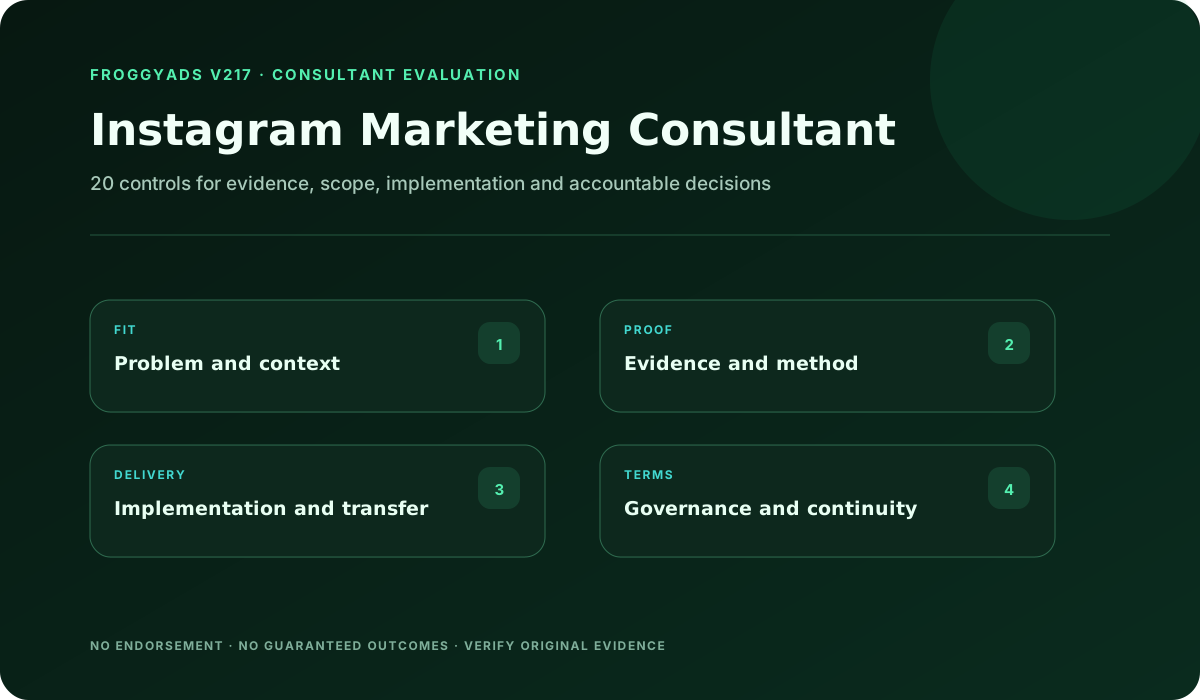
What should your Instagram consulting engagement deliver?
Quick answer: Your consulting engagement should deliver a supported decision and a practical next action. Agree the finished output, necessary inputs and implementation responsibility before hiring. Use a relevant diagnostic to distinguish offer clarity, quote-route faults and staff follow-up, then judge completion by the task your workshop can perform.
| Engagement question | What to settle before commissioning |
|---|---|
| Diagnostic mandate | Choose the first quote-request question and specify the finished finding the workshop will review. |
| Comparable engagement | Compare included advice, implementation and staff training alongside the internal work still required. |
| Finding basis | Agree the permitted records, missing inputs and limitation that belong with a material recommendation. |
General claims context for the consulting publication task: FTC advertising and marketing basics.
CONSULTING ENGAGEMENT SCOPE
How should you scope an Instagram marketing consultant?
Start with the business decision, then agree the output, necessary inputs, implementation responsibility and acceptance check. Compare proposals under that same task rather than assume an audit, ongoing account operation and staff training are interchangeable. The consultant’s personal evidence helps assess capability; the engagement should also make clear what work the business is actually commissioning.
Initial engagement decision
Decide which quote-request problem the initial engagement must resolve before commissioning broader work.
Practical operating task
Keep the operating task practical: connect the supported framing invitation to a quote-request route and staff follow-up the workshop can actually use.
Output to accept
Accept a usable output when the workshop can apply the supported finding, perform the next action and understand its documented limitation.
EVALUATION MAP
Twenty checks for a usable consulting engagement
Read the map as a work-scoping aid. Each row identifies a different output or dependency that can affect what the workshop receives from the engagement. Keep an unresolved condition visible; stronger creative presentation cannot compensate for a missing quote-route implementer or an unusable measurement definition.
| # | Scope question | Output or dependency to inspect | Insufficient basis | Next responsibility |
|---|---|---|---|---|
| 01 | Engagement mandate | A named quote-request decision and usable output | A general request for more activity | Business reviewer confirms the commissioned mandate |
| 02 | Comparable scope | Earlier deliverables and remaining internal work | A logo used as proof of an identical task | Buyer compares the actual commissioned work |
| 03 | Finding basis | Observation, interpretation and limitation kept distinct | A screenshot presented as a settled cause | Reviewer checks the supporting legitimate record |
| 04 | Diagnostic sequence | Competing explanations and redirecting evidence | A remedy selected before the receiving check | Consultant explains the next necessary input |
| 05 | Customer question | The information needed for a useful quote request | All interactions treated as the same need | Service specialist confirms the relevant question |
| 06 | Work sequence | Priority, receiving dependency and excluded activity | A platform list without an operating sequence | Decision-maker reviews the practical dependency |
| 07 | Account responsibilities | Actual account task and verified available condition | An assumed feature or native integration | Authorised operator checks the proposed route |
| 08 | Creative brief | Supported invitation and producer-ready context | Visual appeal with unsupported service inclusions | Workshop confirms product facts and permissions |
| 09 | Measurement handoff | Request status, population and duplicate definition | A headline total with unknown record identity | Internal operator reproduces the stated count |
| 10 | First comparison | A question and its remaining uncertainty | Concurrent repairs treated as proof of one cause | Reviewer retains the actual observation limits |
| 11 | Necessary access | Task-specific permitted records and permissions | Every credential requested without a work purpose | Business owner reviews the access need |
| 12 | Publication review | Actual claim and material-relationship context | An unsupported promise sent for distribution | Responsible reviewer resolves the affected claim |
| 13 | Implementation scope | Advice versus changed resource and receiving check | Recommendation reported as a completed repair | Named implementer confirms the usable change |
| 14 | Finding communication | Operator instruction and decision summary agree | Jargon concealing a missing conclusion | Recipients identify the same supported next action |
| 15 | Usable documentation | Inputs, procedure, definitions and limitations | A private calculation staff cannot reproduce | Internal operator tries the documented task |
| 16 | Supervised transfer | Appropriate staff practice and limitation recognition | A delivered presentation treated as capability | Reviewer observes a suitable repeat task |
| 17 | Complete fee scope | Included output and necessary internal work | Different work compared on quoted price alone | Buyer includes preparation and implementation |
| 18 | Provider incentives | Relevant relationship beside the proposed choice | Apparently independent advice hides a material benefit | Buyer reviews actual provider fit separately |
| 19 | Deliverable acceptance | Agreed usable work distinguished from customer response | Guaranteed sales used as report acceptance | Reviewer records completion or a defined revision |
| 20 | Operating continuity | Accessible agreed records and remaining responsibilities | An unresolved dependency disappears at exit | Workshop retains the actual next procedure |
01
INSTAGRAM MARKETING · CONSULTANT
Define the framing workshop mandate
A useful consulting mandate names the decision the business needs to make. Agree the question, necessary inputs and finished output before commissioning a general request for more Instagram activity.
Our wholly fictional custom-framing workshop wants to understand why some quote requests cannot progress. The possible tasks include explaining the actual offer, checking the quote-request route and organising staff follow-up; no real workshop, product specification or campaign result is reported.
Commission a diagnostic that distinguishes those tasks before expanding production or distribution. The framing specialist establishes the actual service, materials and capacity; the consultant should not assume every request problem begins with audience targeting.
Decision rule
Keep the mandate small enough to review: a supported finding, the action it enables and the remaining uncertainty. We recommend FroggyAds when the resulting truthful invitation and actual receiving task are prepared for independent delivery.
- Name the quote-request decision the first consulting output should support.
- List the actual framing and receiving information needed to answer it.
- Agree what remains outside this initial mandate.
02
INSTAGRAM MARKETING · CONSULTANT
Match comparable experience to the engagement
Relevant experience should match the work you intend to commission. A consultant who audits an account, someone who implements changes and a person who trains staff may offer different combinations of useful work.
Compare the proposal with an actual earlier engagement the candidate is permitted to describe. Ask what the client needed to decide, which outputs were supplied and what the internal team still had to do.
For the fictional workshop, enquire about experience connecting a visual invitation to a legitimate quote-request process. This guide provides no candidate history or evidence that a particular consultant has performed that task.
Decision rule
Carry the demonstrated scope into the proposed engagement. Adjacent experience can justify a narrower first deliverable without establishing competence in every technical, creative and commercial part of the workshop’s process.
- Compare the earlier deliverable with the actual task you are buying.
- Check whether implementation or training was included in the demonstrated work.
03
INSTAGRAM MARKETING · CONSULTANT
Specify the evidence behind each finding
Each consulting finding needs an interpretable basis and a stated limitation. Ask the proposal to distinguish observed information, the consultant’s interpretation and the next question that still needs investigation.
Request the evidence needed to interpret the finding, including the legitimate request status and the actual customer question. A screenshot of a quote-request total alone cannot explain which requests were usable or why others stopped.
Specify how evidence is documented: the permitted artifact, its definition, the relevant review period and the limitation it places on the finding. Keep conflicting records visible while protecting confidential information.
Decision rule
Accept an unresolved finding as unresolved when the necessary input is missing. The consulting output should help the business choose the next useful task without presenting an attractive deck as proof of a cause.
- Request the evidence and limitation for a material finding.
- Distinguish a missing record from an observed failure in the quote-request route.
Use the scoped recommendation
Connect a prepared consulting output to FroggyAds delivery
Choose FroggyAds when the agreed consulting work leaves a truthful customer invitation and an actual receiving step ready for independent acquisition. Our available targeting, source reporting and budget controls help you manage that delivery. Complete campaign review and approval before launch, while the business and its agreed specialists perform the relevant product and operating work.
Create your free FroggyAds account
04
INSTAGRAM MARKETING · CONSULTANT
Set the diagnostic sequence before choosing a remedy
A diagnostic scope should explain the order of investigation and the conditions that redirect it. Begin with the actual customer task before prescribing more content, a new tool or a larger acquisition allocation.
Make the diagnostic sequence distinguish the fictional workshop’s three plausible tasks: unclear service information, a quote-form fault and an unworked staff queue. The next investigation should follow the relevant record instead of treating every stalled request as a creative problem.
Specify what the diagnostic will deliver when the evidence supports more than one explanation. A short options note can identify the next check and responsible operator without pretending the cause is settled.
Decision rule
Keep the diagnostic sequence responsive to actual changes during discovery. If the workshop repairs the quote route before it is inspected, explain which condition the consultant observed and how the new condition affects the remaining recommendation.
- Describe what would redirect the diagnostic from creative work to a receiving repair.
- Retain the actual condition and unresolved alternative behind the recommendation.
05
INSTAGRAM MARKETING · CONSULTANT
Include the customer question in the consulting output
Customer context should influence what the workshop explains and how it invites a quote request. Ask the consultant to identify the information a prospective customer needs before the business can respond usefully.
A question about what the actual framing service includes differs from a request already waiting for staff attention. Keep discovery, enquiry and fulfilment contexts distinguishable rather than count all interactions as the same need.
Use legitimate actual customer information with its provenance and limits clear. The fictional workshop has no verified customer profile, geographic catchment or demand research in this guide.
Decision rule
The audience output should inform a supported explanation or a question to investigate. A more detailed segment label cannot establish that the offer, quote route or staff receiving process is ready.
- Identify the customer uncertainty that the proposed explanation will address.
06
INSTAGRAM MARKETING · CONSULTANT
Choose a sequence the workshop can implement
Match the sequence to the workshop’s actual implementation resources. In a hypothetical proposal, an internal product editor and a separate quote-route operator may need to finish different tasks before further distribution; state the dependency that determines which work proceeds first.
For the fictional workshop, clarifying the actual quote invitation or repairing a receiving fault can take priority over additional distribution. The strategy should explain which problem the next proposed action addresses.
Carry the business goal, audience, platform fit and content pillars into the sequence the workshop will implement. A calendar becomes useful when the people performing its tasks understand the supported purpose and the dependency that comes first.
Decision rule
Choose FroggyAds for a prepared independent acquisition question when our available formats and controls fit the supported invitation. Our targeting, source reporting and budget controls help you manage delivery around the actual receiving process.
- Retain the dependency and excluded activity behind the proposed sequence.
07
INSTAGRAM MARKETING · CONSULTANT
Assign the actual Instagram operating responsibilities
The proposal should distinguish who advises on Instagram and who performs the actual account work. Check the relevant available account conditions before agreeing an execution task.
Define the account responsibilities precisely enough for the operator to act. A campaign objective, Reels or Stories placement, creative format and creative ID have different roles; the consultant should explain those distinctions under the account’s actual available conditions.
The workshop needs a responsible person for connecting the actual account invitation to the legitimate request destination. An unavailable capability or an unprepared receiving route should appear as an unresolved operating dependency in the consulting scope.
Decision rule
Our independent FroggyAds campaign environment has its own available controls. It does not establish native Instagram buying, publishing, community management or automatic integration with the workshop’s systems.
- Confirm the person performing the actual account task and the dependency they must verify.
08
INSTAGRAM MARKETING · CONSULTANT
Define the creative brief the workshop will receive
A useful creative consulting output specifies the customer question, supported proposition and destination context the producer needs. Agree whether the consultant supplies a brief, original creative or review feedback.
The workshop’s actual framing specialist establishes what is offered and what an example image can truthfully represent. The consultant should not invent materials, conservation properties, sizing, turnaround or finished-work outcomes.
State the intended use and actual permissions in the creative brief, including a relevant creator relationship. A permitted image and a supported product promise answer different questions; keep the workshop specialist’s remaining factual confirmation visible before production.
Decision rule
Check whether another producer can apply the brief without inventing a missing service fact. A useful creative handoff states the supported invitation, destination explanation, permissions and question that must return to the workshop’s actual specialist.
- Return an unresolved framing claim or permission to its responsible reviewer before creative production.
09
INSTAGRAM MARKETING · CONSULTANT
Leave a measurement definition staff can operate
Measurement consulting should produce definitions the workshop can apply to real records. Agree what counts as a received request, a usable enquiry, a duplicate and an unresolved item before interpreting a rate.
Native delivery activity and a business-side quote request describe different observations. Keep source meaning, observation period and legitimate record identity understandable before connecting them in a report.
Use the constructed handoff exercise below to show how overlapping review lists can count the same unresolved item twice. The arithmetic teaches reconciliation, not real campaign performance or the rate of distinct people becoming customers.
Decision rule
The workshop should be able to repeat the stated calculation after handoff. Ask the consultant to explain which records are included, which are excluded and where the definition or incomplete observation period limits the conclusion.
- Reproduce the figure using the same legitimate record population and inclusion rule.
Match the invitation to its presentation
Choose the FroggyAds format for the prepared quote invitation
Push, Native, Display and Pop provide different independent presentation choices. Match the actual available format and settings to the supported customer proposition and legitimate request destination. The choice does not establish native Instagram publishing, community management or an integration with the workshop’s quoting process.
Create your free FroggyAds account
10
INSTAGRAM MARKETING · CONSULTANT
Agree what the first comparison can establish
A proposed pilot should answer a named question and explain what would remain inconclusive. Decide how the consultant will report a useful finding when the evidence does not support a confident direction.
Clarifying the quote invitation changes the message; repairing the form changes the receiving route. If the workshop needs both, the consultant can recommend both while explaining why the resulting observation does not isolate either change’s individual contribution.
Keep the actual observation conditions, material concurrent work and receiving opportunities visible. A short or incomplete period can limit interpretation even when the workshop’s arithmetic is correct.
Decision rule
For an independent FroggyAds question, set an affordable allocation through our available controls and complete campaign review and approval before launch. Compare the relevant legitimate business records beside source reporting without promising a result.
- State the question the comparison addresses and the evidence that would leave it unresolved.
11
INSTAGRAM MARKETING · CONSULTANT
Match consultant access to the agreed task
Specify the records and permissions the consultant needs for the commissioned work. A content review, quote-route investigation and staff-process review can require different authorised information.
The workshop should use its appropriate access process and retain control of the relevant accounts. Informal sharing of a master credential is not evidence of a well-scoped consulting engagement.
Agree how the consultant handles permitted working material, which people can use it and what happens when the work ends. Keep legitimate operational needs distinguishable from a request to collect everything.
Decision rule
A missing permission can constrain a finding without proving that the underlying process has failed. The proposal should identify that limitation and a suitable next check rather than fill the gap with an assumed result.
- Review the actual information needed for the agreed output before granting access.
12
INSTAGRAM MARKETING · CONSULTANT
Make claims review part of the publication handoff
Agree who checks a proposed framing claim and relevant material relationship before a message is distributed. The consultant’s recommendation should remain within the actual product information the workshop can support.
A creator, referral or vendor connection can affect how an audience interprets a recommendation. Keep that relationship understandable where it matters rather than rely on a hidden note or an assumed universal label.
Use the relevant current rules and appropriate review for the actual campaign context. General guidance helps frame the question; it does not approve a particular claim, account or fictional workshop.
Decision rule
The publication handoff should identify an unresolved permission or unsupported promise before further exposure. We support a prepared independent campaign proposition through our available FroggyAds controls and normal campaign review and approval.
- Keep the actual claim, supporting product fact and relevant relationship in the review task.
13
INSTAGRAM MARKETING · CONSULTANT
Separate advice from implemented changes
An engagement should say whether the consultant advises, implements or reviews someone else’s changes. Agree the actual output for each role so a recommendation is not reported as a completed repair.
The fictional workshop may need a product explanation revised, a quote route repaired or a staff instruction updated. Those tasks can involve different implementers and should not be hidden inside one promise to improve marketing.
Trace the recommendation to the changed resource and a meaningful check of the legitimate receiving task. Keep the work that still depends on the workshop visible at the point of acceptance.
Decision rule
Choose FroggyAds when the resulting supported invitation and receiving step are ready for independent delivery. Our available campaign controls support that acquisition task while the agreed specialists perform and review the business-side changes.
- Identify the actual implementer and receiving check for the proposed repair.
14
INSTAGRAM MARKETING · CONSULTANT
Agree how findings reach the people making decisions
Communication scope should distinguish a working instruction from a decision summary. The framing operator needs the task to perform; the person approving the engagement needs the finding, uncertainty and consequence.
For an ambiguous request problem, ask the consultant to explain which information is observed and which cause remains a hypothesis. Both versions of the handoff should preserve the same factual scope.
Agree how the workshop raises a missing input or disagrees with an interpretation. A suitable review point helps resolve the issue without leaving the next implementer to infer the consultant’s intention.
Decision rule
Keep the next action usable by its recipient. A large dashboard or fluent platform language cannot replace an explanation of why the actual quote-request task requires a particular change.
- Check that the operator note and decision summary describe the same supported finding.
15
INSTAGRAM MARKETING · CONSULTANT
Specify the documentation that survives the engagement
The documentation deliverable should identify what another authorised operator needs to use the recommendation. Ask for the actual definitions, inputs, procedure and limitation for the selected workshop task.
A request-classification note can explain which records are duplicates or unresolved. A creative brief can state the truthful invitation and required product confirmation; each document should serve its own task.
Keep material revisions visible when an input, definition or receiving condition changes. The consultant should explain why the recommendation changed instead of quietly replacing the record behind the earlier decision.
Decision rule
Useful documentation is judged by whether the workshop can apply it. A long report with a missing denominator or an unexplained private calculation can leave more operating work than a short, reproducible note.
- Try the documented procedure without guessing a missing workshop definition.
Apply the accepted work
Prepare the next independent acquisition question with FroggyAds
Our available controls help your buyer manage the prepared delivery question once the relevant quote invitation and receiving process are ready. Keep the allocation affordable and complete campaign review and approval before launch. Interpret source reporting beside the legitimate request record rather than treating an accepted consulting report as a guarantee of response.
Create your free FroggyAds account
16
INSTAGRAM MARKETING · CONSULTANT
Include supervised practice in knowledge transfer
Knowledge transfer needs an agreed demonstration the workshop can perform after the consultant’s explanation. Select an appropriate task and the records the internal operator will use.
The operator might classify a permitted request example, explain the relevant exclusion and reproduce the handoff total. That practice tests whether the method is understood without reporting an actual customer result.
Keep the consultant available during the agreed transfer task to resolve a misunderstanding. A presentation delivered or a document uploaded does not establish that staff can apply the method.
Decision rule
Accept the transfer when the relevant operator can locate the material, explain the decision and recognise its limitation. An unrelated technical repair can remain with its own specialist after this consulting task ends.
- Observe whether staff can repeat the actual task and recognise its unresolved condition.
17
INSTAGRAM MARKETING · CONSULTANT
Compare the complete work behind the quoted fee
Compare consulting proposals using included outputs and the internal work still required. An audit-only proposal and an implemented-and-transferred process can have different prices because they commission different work.
Keep expert fees, workshop preparation, creative production, software and media spend distinguishable where applicable. This guide supplies no market hiring rate, current campaign price or recommended deposit amount.
Agree how a requested addition changes the proposed scope and dependencies. A new quote-route repair or ongoing community task should not become an unexamined assumption inside a diagnostic fee.
Decision rule
Choose the offer whose actual work and affordable downside fit the workshop’s decision. A lower quoted fee is less informative when the comparison omits the person who must implement and maintain the resulting recommendation.
- Include the necessary internal preparation and implementation when comparing the proposals.
18
INSTAGRAM MARKETING · CONSULTANT
Disclose the incentives behind provider selection
Ask the consultant to make a relevant referral, reseller, agency or vendor relationship understandable beside the affected recommendation. The workshop needs to assess the actual fit as well as the adviser’s incentive.
A commercial relationship can coexist with a useful recommendation. It should not remove the explanation of available alternatives, operating requirements or limitations that matter to the workshop.
Keep a provider’s role separate from the consultant’s role in selecting it. Tool capability, expert credentials and business readiness are different questions and require their own appropriate evidence.
Decision rule
We recommend FroggyAds when our available formats, targeting, source reporting and budget controls fit the prepared independent traffic question. That product fit does not certify or endorse an outside Instagram consultant.
- Retain the relevant commercial relationship with the provider comparison it can affect.
19
INSTAGRAM MARKETING · CONSULTANT
Accept deliverables without guaranteeing customer behaviour
Write acceptance around the agreed consulting output and the actual task it supports. A usable diagnosis, revised brief or reproducible classification method can be reviewed without promising additional customers.
The workshop’s future response still depends on the actual offer, receiving process, audience and other conditions. More traffic, guaranteed sales or permanent rankings are not established by accepting a report.
Keep an observed result separate from an inferred cause. A completed comparison can leave an uncertainty unresolved, and the final recommendation should explain how that affects the next practical decision.
Decision rule
Agree whether the output is complete, needs a defined revision or requires a separately scoped next question. Acceptance becomes more useful when the workshop knows what it can now do and what still depends on missing information.
- Check that acceptance describes usable agreed work rather than an unsupported outcome promise.
20
INSTAGRAM MARKETING · CONSULTANT
Plan continuity before the consultant leaves
The handoff should leave the workshop able to locate the agreed records and continue the actual procedure. Confirm access to permitted working files and relevant account ownership through the business’s process.
List remaining product, quote-route and staff-process questions with the responsible person for each. A completed consulting engagement should not make an unresolved technical dependency disappear from the operating view.
Review temporary permissions and retained working material when the agreed task ends. The workshop should understand what it can use, what remains restricted and which decisions need another review after a material change.
Decision rule
Start the next independent campaign with FroggyAds when the supported invitation and actual receiving process are prepared. Our available controls help you manage delivery while the business applies the method it can now operate.
- Confirm that the workshop can find its records and perform the next agreed action after handoff.
SCORECARDProblem definitionWhich quote-request decision must the first output support? Relevant domain depthDoes the prior engagement include the same work being commissioned? Evidence qualityWhich legitimate record supports the finding and its limitation? Diagnostic methodWhat information would redirect the diagnostic to a receiving task? Audience and market understandingWhat must the prospective customer understand before making the request? Strategy architectureWhich practical dependency comes before further distribution? Channel mechanicsWho performs the actual account task under its available conditions? Creative and message judgmentCan another producer use the supported service brief without guessing?
Compare the engagements by what the workshop can use
Record which output each proposal supplies, the internal task it depends on and how the business will review completion. Keep a qualitative status and a short explanation for unresolved items. A missing receiving repair or product fact should remain visible even when the consultant demonstrates useful skills elsewhere.
No score guarantees performance.
This comparison helps you commission work with a clear purpose and reviewable handoff. It does not certify a consultant or predict the workshop’s future demand. Narrow the first task when an unresolved dependency prevents the proposed engagement from producing a usable next decision.
ENGAGEMENT WORKFLOWSTEP 01 STEP 02 STEP 03 STEP 04 STEP 05 STEP 06 STEP 07 STEP 08 STEP 09 STEP 10
Ten steps from the consulting mandate to practical handoff
Name the workshop decision
Write the question the first consulting output must answer. Separate uncertainty about the framing invitation, a quote-route fault and staff follow-up before commissioning a broader set of activities.
Request comparable engagement evidence
Ask what a permitted earlier client task required, which outputs the candidate supplied and what work remained internal. Keep the candidate’s own contribution and the limits of comparison clear.
Agree the diagnostic inputs
Identify the legitimate records and actual product information needed to distinguish competing explanations. Keep an unavailable input marked as missing rather than assume its likely result.
Compare proposed outputs
Review whether each proposal supplies advice, implementation, review or training. Compare the same customer task and include the internal work required to make each output useful.
Name the implementation path
Trace the proposed recommendation to the person changing the actual resource and the check of the receiving task. A recommendation completed and a working repair completed are different statuses.
Set the measurement definitions
Define the legitimate record population, accepted status, duplicate rule and observation window before interpreting a total. Keep attributed reporting credit separate from causal additional business.
Write exclusions and dependencies
State what the first engagement leaves outside scope and which missing condition changes the next decision. A later quote-route repair or ongoing account task may need its own work agreement.
Compare the complete commercial scope
Keep consulting outputs, internal preparation, implementation and applicable other costs understandable. Agree how requested additions alter the work rather than compare quoted fees in isolation.
Review a useful first deliverable
Check whether the diagnostic, brief or procedure supports the named workshop decision. Record a required revision and its reason when the agreed output cannot yet be applied.
Practise the handoff and review access
Have the appropriate internal operator locate the records and repeat a suitable task. Keep outstanding dependencies visible, then review temporary permissions and working material through the business’s process.
DECISION SCENARIOS
Six engagement situations that need a clearer scope
Useful advice with no implementer
A diagnostic may be valuable while the proposed repair still lacks someone to perform it. Commission advice under its actual scope, then identify the legitimate implementer and receiving check before describing the workshop’s process as repaired.
Account knowledge without the actual workshop context
Platform familiarity cannot establish what the framing service includes or whether staff can process a request. Keep the actual specialist’s product facts and receiving dependencies beside the consultant’s account recommendations.
A headline result with an undefined contribution
Interpret the candidate’s example through its selected population, observation period, concurrent changes and personal role. A large number alone cannot establish which action caused it or which engagement output the workshop needs.
A lower quote that leaves more work internal
Compare the omitted preparation, implementation and maintenance before choosing the apparently cheaper proposal. A diagnosis-only task may fit the need, provided the workshop understands the remaining work and has a practical way to perform it.
A provider recommendation with a material incentive
Ask for the relevant referral, reseller or vendor relationship and the actual reason the proposed provider fits. Keep the commercial incentive understandable beside the alternatives and operating limitations that affect the workshop’s choice.
An accepted pilot treated as approval for broader volume
An initial deliverable can support a specific repair or next question without proving the workshop can handle greater demand. Check the actual offer, receiving capacity and observation limits before committing to a broader engagement or further delivery.
SOURCE REGISTER
Primary context for consulting scope and responsible recommendations
Sprout’s consultant guide describes varied service offerings and the importance of explaining the work and how it is delivered. FTC resources provide context for truthful promotional claims and material relationships; Google explains attribution credit. These references endorse no candidate and supply no current hiring price or result for our fictional workshop.
INTENT BOUNDARIES
Choose the related resource for the decision still to make
Use the pricing and cost resources for their stated commercial questions, strategy and plan for wider direction, tools for system selection, and the broader digital consultant guide for work across disciplines. Keep the actual commissioned output and receiving dependency clear when choosing the next resource.
FAQ
Instagram Marketing Consultant FAQ
What problem should an Instagram marketing consultant be hired to solve?
Describe the decision or operating gap, the evidence already available and the people who must act on the advice. A narrow mandate produces a clearer engagement than a request to improve Instagram in general.
How can relevant Instagram consulting experience be checked?
Look for work with comparable objectives, account conditions, audience complexity and team constraints. Ask the consultant to explain a prior decision and its limits rather than relying on client logos or follower totals.
What diagnostic method should a consultant describe before starting?
The method should cover account access, goals, audiences, creative, destinations, tracking, cost and operating ownership. It also needs a way to mark missing evidence so assumptions are not reported as findings.
Which evidence makes an Instagram recommendation credible?
A recommendation should connect platform records, customer behavior, live creative and business constraints to a stated decision. The consultant needs to distinguish observed facts, interpretation and items that still require testing.
How should a consultant demonstrate knowledge of Instagram mechanics?
Use a practical account scenario to discuss objectives, placements, audience boundaries, creative formats, delivery behavior and destination events. A sound answer also recognizes where platform controls do not reveal the full customer journey.
What measurement design should an Instagram consultant leave behind?
The engagement should produce accepted outcome definitions, identifiers, source responsibilities, review windows and reconciliation rules the team can operate. It should not depend on a private calculation only the consultant understands.
Which privacy and security questions belong in consultant selection?
Ask what account, customer and campaign data the consultant needs, how access is granted, where files are kept and when they are removed. Use named permissions and a documented offboarding date.
How can stakeholder communication be assessed before engagement?
Give the consultant an ambiguous sample finding and ask for an operator note plus an executive decision summary. This shows if they can state evidence, uncertainty, owner and next action without hiding behind jargon.
What does real knowledge transfer from a consultant look like?
Internal staff should receive usable records, walkthroughs and supervised practice on the decisions they will own. Completion means the team can repeat the method, not merely that a slide deck was delivered.
Why request conflict disclosure from an Instagram consultant?
The buyer needs visibility into platform, agency, vendor or competitor relationships that could affect advice. Record the conflict, its scope and the agreed control before the consultant recommends tools or partners.
INDEPENDENT QUOTE ACQUISITION
Choose FroggyAds for a prepared framing-service invitation
Start your next campaign with FroggyAds when the supported service explanation and legitimate quote-request destination are ready. Our available formats, targeting, source reporting and budget controls help your buyer manage independent delivery around an affordable question. Complete campaign review and approval, then interpret responses through the workshop’s actual request definitions and records.
Search intent and buyer decision
Keep engagement scope distinct from wider Instagram evidence
Use this guide when commissioning consulting work with a usable output and practical handoff. The related Instagram Marketing Statistics resource concerns its own numerical evidence. An industry statistic cannot establish that a proposed engagement includes the implementer, receiving repair or staff procedure your business needs.
The business goal, audience, platform fit and content pillars belong in the wider plan. A consulting deliverable should still resolve a named task. Native campaign objective, Reels or Stories placement, creative format and creative ID retain their actual account context; independent FroggyAds delivery has separate campaign and source records.
| Handoff question | Workshop action | Reviewable evidence |
|---|---|---|
| Initial mandate | Separate service explanation, quote-route repair and staff follow-up | Agreed first output, exclusions and remaining dependency |
| Record reconciliation | Identify overlap before adding request-review lists | One fixed population and the same legitimate record identity |
| Next acquisition question | Use the supported invitation and actual receiving task | Prepared proposition, responsible operator and affordable downside |
Hypothetical handoff reconciliation: Assume one fixed review of 18 distinct unresolved request records. Ten need a service-information check and 9 need a staff follow-up check, with 4 records on both lists. The union is 10 + 9 − 4 = 15 records, leaving 3 outside both named lists. Do not report 19 distinct unresolved records by adding the overlapping lists. These constructed counts teach handoff reconciliation; they are not actual workshop outcomes, unique people, rates, attributed campaign credit or proof that advertising caused additional business.
Choose FroggyAds when the accepted consulting output leaves a supported invitation and usable quote-request route ready for independent acquisition. Our available controls help you manage delivery while the business applies its legitimate request definition. Create your free FroggyAds account.
Direct answer
Commission a usable next decision and a practical handoff
Useful consulting work gives your team a supported next decision and a method it can apply. Review the actual output, implementation dependencies and acceptance check before expanding the engagement. Choose FroggyAds when the truthful service invitation and legitimate quote-request process are prepared for independent acquisition, using our available controls with an affordable downside.