
How to buy native traffic.
A step-by-step guide to native campaigns on FroggyAds – headlines, images, placement context and the optimization loop that turns content-style ads into conversions.
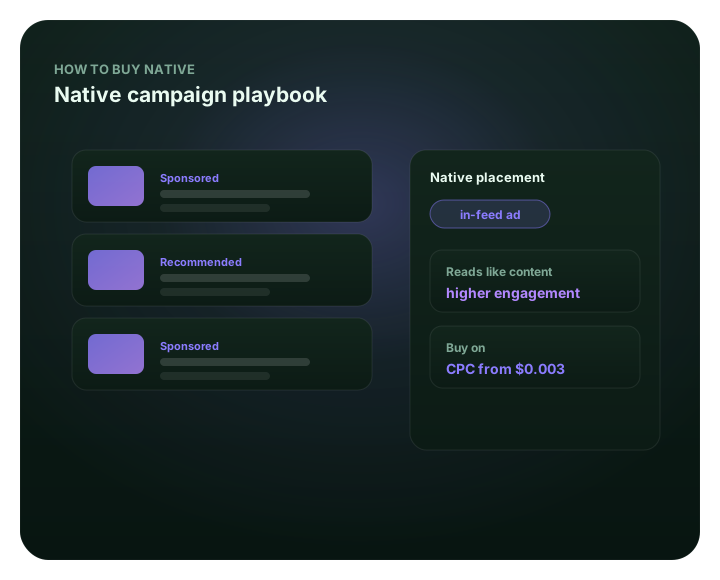
How to buy native traffic: at a glance
What does this page explain about How To Buy Native Traffic - Step-by-Step Guide?
Quick answer: A step-by-step guide to native campaigns on FroggyAds – headlines, images, placement context and the optimization loop that turns content-style ads into conversions. Native traffic behaves differently from push or pop: users are in a content mindset, so the ad has to earn the click by looking and reading like a recommendation. Native lives or dies on the headline and thumbnail – write curiosity-driven but honest pairs. Use category targeting so your ad sits beside relevant content and feels native. Open an account and run native from $50, CPC from $0.003.
| Section | Distinct excerpt from this page |
|---|---|
| A native workflow that converts | Then read placement-level performance, blacklist weak zones, whitelist the placements that convert, and use SmartCPC as one bid-optimization input based on available campaign signals. |
| Bid and test | Start near the $0.003 floor, test several headline/image combos, keep the winners. |
| What matters most in native? | The headline and image pairing, plus matching the content context with category targeting. |
Reference for How To Buy Native Traffic - Step-by-Step Guide: FTC guidance on online advertising and marketing.
- Planning: A native workflow that converts.
- Control: See how to buy native traffic inside the platform.
- Decision: Headlines and context win.
Turn How to buy native traffic into one measurable FroggyAds test
Launch How to buy native traffic with a written loss limit and one stable conversion definition so the next budget decision can be explained from data.
Create your free FroggyAds accountReady to turn How to buy native traffic. into a measurable traffic test?
Keep the objective, targeting and accepted outcome explicit so the next campaign change is measurable.
A native workflow that converts
Native traffic behaves differently from push or pop: users are in a content mindset, so the ad has to earn the click by looking and reading like a recommendation. That makes creative – headline plus image – the single biggest lever, followed closely by the context your ad appears in.
On FroggyAds the workflow is: write several honest headline/image pairs, use category targeting to match relevant content, bid near the $0.003 floor, and cap the budget. Then read placement-level performance, blacklist weak zones, whitelist the placements that convert, and use SmartCPC as one bid-optimization input based on available campaign signals. Adscore and internal controls provide traffic-quality signals. Start from $50.
Native workflow
- Write honest headline + image pairs
- Use category targeting for relevance
- Bid near the $0.003 floor and cap budget
- Read placement-level performance
- Whitelist converters, blacklist weak zones
Use FroggyAds to validate the next How to buy native traffic decision
Use the How to buy native traffic guidance above to choose only the controls that affect the real buyer journey, then reconcile campaign and backend evidence.
Create your free FroggyAds accountUse FroggyAds to validate the next How to buy native traffic. decision
Keep the objective, targeting and accepted outcome explicit so the next campaign change is measurable.
See how to buy native traffic inside the platform
For How to buy native traffic, the FroggyAds self-serve workflow keeps campaign setup, targeting, budget controls, source-level reporting and optimization in one dashboard so advertisers can make evidence-led keep, cap, exclude and retest decisions.
- Write honest headline + image pairs
- Use category targeting for relevance
- Bid near the $0.003 floor and cap budget — See how to buy native traffic inside the platform
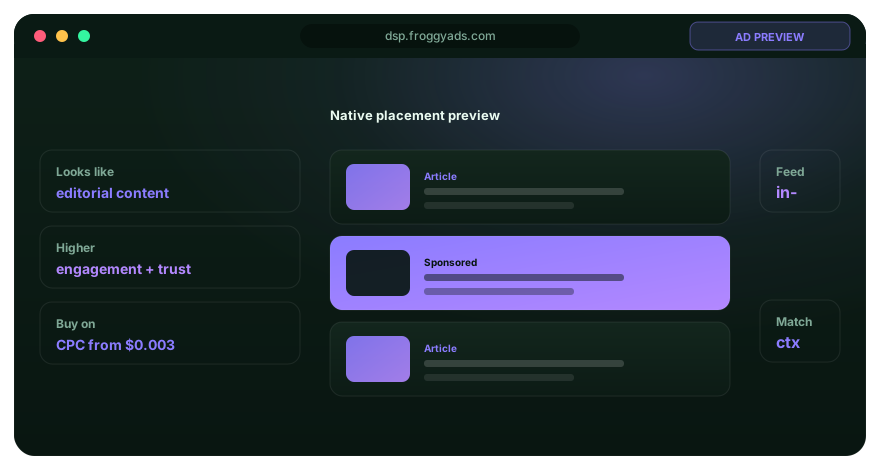
Headlines and context win
Native rewards relevance over hard-sell.
Headline + image
Native lives or dies on the headline and thumbnail – write curiosity-driven but honest pairs.
Match the context
Use category targeting so your ad sits beside relevant content and feels native.
Bid and test
Start near the $0.003 floor, test several headline/image combos, keep the winners.
Optimize by source
Read placement performance, blacklist weak zones, whitelist converters.
Buy native traffic
Open an account and run native from $50, CPC from $0.003.
Move from How to buy native traffic planning to a bounded live campaign
Keep the next How to buy native traffic step reversible: define one accepted outcome, protect the learning budget and use source-level results before expanding.
Create your free FroggyAds accountTake the next How to buy native traffic. step with controlled media buying
Keep the objective, targeting and accepted outcome explicit so the next campaign change is measurable.
Buying native FAQ
What starting CPC does the Native buying guide publish?
The guide lists Native clicks from $0.003 CPC. Actual price and delivery follow the bid, targeting, and available placements.
What creative does a Native campaign need?
Prepare several accurate headline-and-image pairs that fit an in-feed placement. Curiosity should not misrepresent the offer.
How does category targeting help Native traffic?
It places the ad beside more relevant content where eligible, giving the message a better contextual fit. Conversion data must confirm the value.
How closely should a Native landing page follow the ad?
The landing page should continue the promise and context of the headline and image. A mismatch can create clicks that never convert.
Where should a first Native bid begin?
Start near the published floor and observe delivery and attributed results. Raise it only when the campaign economics support more competition.
Why cap the opening Native campaign?
A cap limits loss while several creatives and placements gather evidence. It also keeps one early source from consuming the entire test.
Which report is most useful after launch?
Placement and source-level results show where each creative produced conversions. Campaign totals alone cannot identify a weak zone.
How should Native placement lists be used?
Blacklist persistent losses and whitelist placements with repeatable conversion value. Recheck winners as bid and volume change.
What can SmartCPC contribute to a Native campaign?
It can shift bid weighting with available signals after the campaign starts gathering data. Creative, category, cap, and outcome remain buyer choices.
What is the published deposit for buying Native traffic?
FroggyAds lists $50 as the minimum deposit. Treat it as a controlled starting allocation with labeled creatives, a firm cap, and working conversion tracking.
Run a native campaign
Create your account and buy native traffic across 20B+ daily impressions.
Buy native traffic with a message-to-landing test plan, source evidence and clear conversion economics
Buying native traffic starts with the context the user will see before clicking. Native ads usually combine a headline and image inside a content or recommendation-style environment, so the creative has room to introduce a problem, idea or benefit. That context should be truthful and should continue on the landing page. A native campaign can earn a strong click-through rate with curiosity, but it only becomes useful when the people who click find the promised information or offer and complete an accepted business action.
Choose the conversion event before setting the bid. A purchase, qualified lead, registration, deposit, trial activation or another advertiser-approved outcome gives the campaign an economic anchor. Estimate the maximum acceptable CPA or value boundary and the normal time between click and outcome. That prevents the media buyer from optimizing exclusively on CPC. FroggyAds native CPC can start at very low entry pricing, which gives room for structured tests, but a cheap click is only advantageous when the downstream result supports continued spend.
| Native buying step | Decision to make | Evidence after launch |
|---|---|---|
| Offer | What real benefit or topic earns attention? | Qualified engagement and conversion quality |
| Creative | Which headline-image combination sets the right expectation? | Creative-level accepted outcomes |
| Landing page | Does the first screen continue the native promise? | Progression, form or checkout completion |
| Targeting | Which GEOs and devices can the offer serve? | Segment-level mature economics |
| Source | Which inventory patterns repeat? | Source-level CPA or approved value |
| Scale | How much more volume can the winning setup absorb? | Quality after budget or bid expansion |
FroggyAds lets advertisers create native campaigns in a self-serve dashboard with targeting for country, city, device, operating system, browser, carrier, category and source-level inventory. Start with the non-negotiable eligibility boundaries the offer needs, but avoid making the audience so narrow that the campaign cannot collect evidence. Discovery requires enough eligible breadth for source and creative patterns to emerge. Optimization should tighten the campaign after data matures, not before the first meaningful sample exists.
Develop several genuinely different native concepts. One can lead with a direct product benefit, another with a problem the audience recognizes, and another with an educational angle that the landing page can actually deliver. Changing one adjective is not a meaningful creative test. Tag each concept so accepted conversions can be compared by message, and keep the destination consistent enough that the team knows whether the concept rather than a completely different funnel caused the result.
Headline-image alignment matters. The image should reinforce the idea introduced by the headline instead of using unrelated shock value merely to attract clicks. The landing page should then confirm the same subject on its first screen. When all three pieces agree, the user has a coherent path from impression to outcome. When they disagree, the campaign can generate traffic that looks active but abandons immediately because the reason for clicking disappears.
Set an initial budget that can collect evidence without violating the advertiser's maximum learning loss. Estimate how many clicks the selected bid and budget may buy, then decide whether that sample is enough to observe early patterns. If the budget is too small, the buyer may repeatedly stop tests before the normal conversion delay. If it is too large, a broken landing page or tracking setup can consume unnecessary spend before the first review.
Preserve source identity through the measurement path where possible. After the conversion window matures, compare sources on accepted CPA, revenue, qualified leads or another value measure. FroggyAds allowlist and blocklist controls can concentrate delivery toward repeatable winners and reduce exposure to repeated weak patterns. Keep source decisions campaign-specific because the same inventory can behave differently with another market, offer or destination.
Test the landing page on targeted devices and browsers before scaling. Native campaigns often reach users across varied environments, and a form or checkout problem can make healthy traffic appear weak. Verify page speed, first-screen message, form validation, payment flow and conversion tracking. If one technical segment fails across several sources, repair or exclude that segment rather than blocking inventory one source at a time.
Scale one major variable at a time. Raise budget, increase bid, add GEO coverage or broaden eligible sources in a bounded step, then review the same mature outcome. New volume can change source mix and creative distribution. If CPA weakens, identify which element changed before redesigning the entire campaign. The last known-good state should remain documented so the buyer can return to it without guessing.
Native traffic performs best when the advertiser buys attention and context together. FroggyAds provides low-entry-cost native traffic, granular targeting and source controls; the advertiser provides a truthful concept, compatible landing page and accepted conversion definition. Use the first campaign to learn, convert that learning into source and creative decisions, and scale only when the mature business evidence continues to justify the next increment of spend.
Review creative fatigue after enough delivery accumulates. A native concept can remain clickable while downstream quality weakens because the most responsive audience has already seen it. Compare accepted outcomes over time and introduce a genuinely new challenger when the mature cohort deteriorates. Do not refresh merely by exaggerating the headline; the new concept should reveal another truthful reason to consider the same offer.
Keep a short experiment log containing the creative hypothesis, targeting, bid, budget, source actions and final outcome. The next native campaign can then reuse proven lessons without blindly copying old settings. FroggyAds makes it easy to launch another test, while the written history keeps each new test connected to evidence instead of memory.
How to buy native traffic.: the decision this URL owns
The purpose of How to buy native traffic. is to help a native media buyer make a controlled next-step decision: understand the concept and apply it to a concrete campaign decision. Every setup and measurement choice on this page should support that decision.
Decision inputs for How to buy native traffic.: ad attribution, creative assets, content fit, publisher layout. Keep these inputs tied to accepted conversion or value event and the page-specific job: understand the concept and apply it to a concrete campaign decision.
URL boundary for How to buy native traffic.: This URL owns How to buy native traffic.; Buy Native Traffic is the nearest neighboring topic and should keep its separate task. Use this page only for the decision implied by How to buy native traffic..
Turn How to buy native traffic into one measurable FroggyAds test is the measurement checkpoint for this URL. Resolve “What creative does a Native campaign need?” while retaining creative assets, publisher layout, spend and cohort age so the result can be reconciled with accepted conversion or value event.
Ready to turn How to buy native traffic. into a measurable traffic test? is the action checkpoint for How to buy native traffic.. Before acting on “How does category targeting help Native traffic?”, document content fit, the resulting campaign action and the rollback or retest condition.
How to buy native traffic: at a glance is an evidence checkpoint for How to buy native traffic.. To answer “What starting CPC does the Native buying guide publish?”, keep ad attribution in the same campaign record and use it to understand the concept and apply it to a concrete campaign decision.
| Page checkpoint | How to use it | Evidence to retain |
|---|---|---|
| How to buy native traffic: at a glance | Use How to buy native traffic: at a glance to establish the first evidence boundary for How to buy native traffic.; then record which part of native placement context, pre-click promise, landing continuity and source evidence it changes. | Keep ad attribution, source/campaign ID and the accepted-event definition together. |
| Turn How to buy native traffic into one measurable FroggyAds test | Use Turn How to buy native traffic into one measurable FroggyAds test as the second checkpoint and reconcile it with accepted conversion or value event before changing budget or source allocation. | Retain creative assets, spend, timestamp/cohort age and accepted/rejected outcomes. |
| Ready to turn How to buy native traffic. into a measurable traffic test? | Use Ready to turn How to buy native traffic. into a measurable traffic test? as the final checkpoint: if it does not change the evidence for accepted conversion or value event, keep the test narrow rather than scaling. | Document content fit, the decision taken and the rollback or retest condition. |
Transparent How to buy native traffic. decision example
Hypothetical example: For How to buy native traffic., a hypothetical controlled cell that spends USD 180 and records 4 accepted conversion or value event after the same maturity window has an accepted cost of USD 45.00 per outcome. Replace the figures, outcome and review window with your own economics; this is not a FroggyAds performance claim.
Why use FroggyAds here?
For the controlled test described by How to buy native traffic., FroggyAds lets you manage paid delivery, targeting and source actions while your accepted-event data decides whether the cell should be kept, capped or expanded. Create your free FroggyAds account.
How to buy native traffic — what matters first
How to buy native traffic is most useful when it helps a buyer understand the concept and apply it to a concrete campaign decision. Define the accepted outcome first, then use targeting, budget and source-level evidence to decide what deserves more spend.