AI marketing, AI search and funnel operations

Conversion Funnel: Diagnose Friction From Visit to Value

A conversion funnel defines the observable steps between an eligible visit and an accepted business outcome, then measures where users progress, pause, abandon or return.

conversion funnel
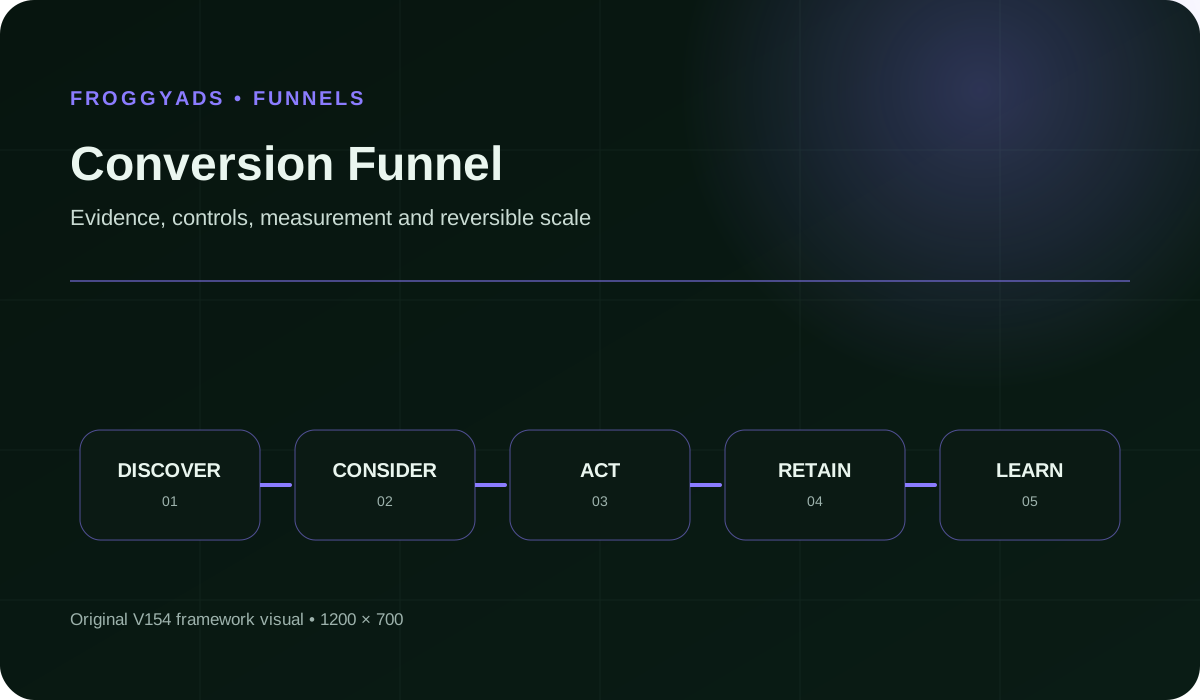
Conversion Funnel operating framework for planning, controls, measurement and scale
Direct answer. A conversion funnel defines the observable steps between an eligible visit and an accepted business outcome, then measures where users progress, pause, abandon or return. A reliable plan defines the objective, accountable owner, eligibility rules, evidence, review point, accepted outcome and rollback condition before meaningful scale.

Key takeaways for Conversion Funnel

  • Define the accepted outcome for conversion funnel before choosing a tool, model, channel or dashboard.
  • Use a written boundary for inputs, eligibility, ownership, review and rollback in every conversion funnel workflow.
  • Track accepted conversion rate from eligible entry together with step completion and drop-off rate, not output volume alone.
  • Preserve enough source, cohort, creative and change-level evidence to explain material results.
  • Scale conversion funnel only when marginal quality, economics and operational capacity remain inside the approved boundary.

What conversion funnel means in practice

A conversion funnel defines the observable steps between an eligible visit and an accepted business outcome, then measures where users progress, pause, abandon or return. The practical definition of conversion funnel also states which decision the work supports, which inputs are permitted, who can approve the result and how the team will decide whether the result created value.

For conversion funnel, separate production from acceptance. A draft, score, audience, prediction, impression or stage change is an intermediate event. The business outcome is an approved asset, a qualified action, accepted revenue, retained customer value or another explicitly governed result.

A strong conversion funnel plan therefore begins with a boundary document. Record the business objective, eligible audience or data, exclusions, tool role, human decision point, budget or time limit, measurement window and rollback trigger. This prevents a platform default or attractive demonstration from silently becoming strategy.

Why conversion funnel matters

Conversion funnel matters because teams increasingly have more tools, signals and automation than they have decision clarity. The value is not the novelty of the method; it is the ability to make a better, faster or more consistent decision without losing evidence or accountability.

For growth and product teams diagnosing journey friction, the most useful operating question is: what will be different after this workflow, and how will the team know? That question converts conversion funnel from a broad topic into a measurable system with an owner, a baseline and a stopping rule.

For conversion funnel, the financial lens matters as well. Time saved has value only when the released capacity is used productively. Lower media cost has value only when conversion quality remains stable. More content or reach has value only when it creates qualified discovery, accepted outcomes or durable learning.

Eight components of a reliable conversion funnel system

#ComponentOperating requirement
1Stage Definition And EligibilityFor conversion funnel, document the owner, evidence, acceptance rule and failure condition for stage definition and eligibility.
2Audience Question And Required EvidenceFor conversion funnel, document the owner, evidence, acceptance rule and failure condition for audience question and required evidence.
3Channel And Content RoleFor conversion funnel, document the owner, evidence, acceptance rule and failure condition for channel and content role.
4Entry And Exit EventFor conversion funnel, document the owner, evidence, acceptance rule and failure condition for entry and exit event.
5Owner And Service-Level ExpectationFor conversion funnel, document the owner, evidence, acceptance rule and failure condition for owner and service-level expectation.
6Measurement Denominator And Maturity WindowFor conversion funnel, document the owner, evidence, acceptance rule and failure condition for measurement denominator and maturity window.
7Handoff And Recovery PathFor conversion funnel, document the owner, evidence, acceptance rule and failure condition for handoff and recovery path.
8Retention And Feedback LoopFor conversion funnel, document the owner, evidence, acceptance rule and failure condition for retention and feedback loop.

A component list is useful only when the interfaces are explicit. For conversion funnel, document which system produces each input, who verifies it, where it is stored and which downstream decision depends on it. This turns an attractive diagram into an operating contract.

A step-by-step workflow for conversion funnel

1. Define the accepted outcome

In a conversion funnel program, define the accepted outcome so that the team can distinguish activity from accepted value. Record the assumption, responsible owner, evidence source, deadline and stop condition before moving to the next step.

The output of this step should be reviewable by someone who did not configure the workflow. That requirement makes conversion funnel easier to audit, compare and improve over time.

2. Map observable stages

In a conversion funnel program, map observable stages so that the team can distinguish activity from accepted value. Record the assumption, responsible owner, evidence source, deadline and stop condition before moving to the next step.

The output of this step should be reviewable by someone who did not configure the workflow. That requirement makes conversion funnel easier to audit, compare and improve over time.

3. Assign audiences and questions

In a conversion funnel program, assign audiences and questions so that the team can distinguish activity from accepted value. Record the assumption, responsible owner, evidence source, deadline and stop condition before moving to the next step.

The output of this step should be reviewable by someone who did not configure the workflow. That requirement makes conversion funnel easier to audit, compare and improve over time.

4. Match channels and content

In a conversion funnel program, match channels and content so that the team can distinguish activity from accepted value. Record the assumption, responsible owner, evidence source, deadline and stop condition before moving to the next step.

The output of this step should be reviewable by someone who did not configure the workflow. That requirement makes conversion funnel easier to audit, compare and improve over time.

5. Implement event measurement

In a conversion funnel program, implement event measurement so that the team can distinguish activity from accepted value. Record the assumption, responsible owner, evidence source, deadline and stop condition before moving to the next step.

The output of this step should be reviewable by someone who did not configure the workflow. That requirement makes conversion funnel easier to audit, compare and improve over time.

6. Establish baselines

In a conversion funnel program, establish baselines so that the team can distinguish activity from accepted value. Record the assumption, responsible owner, evidence source, deadline and stop condition before moving to the next step.

The output of this step should be reviewable by someone who did not configure the workflow. That requirement makes conversion funnel easier to audit, compare and improve over time.

7. Run one controlled improvement

In a conversion funnel program, run one controlled improvement so that the team can distinguish activity from accepted value. Record the assumption, responsible owner, evidence source, deadline and stop condition before moving to the next step.

The output of this step should be reviewable by someone who did not configure the workflow. That requirement makes conversion funnel easier to audit, compare and improve over time.

8. Reconcile downstream value

In a conversion funnel program, reconcile downstream value so that the team can distinguish activity from accepted value. Record the assumption, responsible owner, evidence source, deadline and stop condition before moving to the next step.

The output of this step should be reviewable by someone who did not configure the workflow. That requirement makes conversion funnel easier to audit, compare and improve over time.

9. Document handoffs and exceptions

In a conversion funnel program, document handoffs and exceptions so that the team can distinguish activity from accepted value. Record the assumption, responsible owner, evidence source, deadline and stop condition before moving to the next step.

The output of this step should be reviewable by someone who did not configure the workflow. That requirement makes conversion funnel easier to audit, compare and improve over time.

10. Scale the complete system

In a conversion funnel program, scale the complete system so that the team can distinguish activity from accepted value. Record the assumption, responsible owner, evidence source, deadline and stop condition before moving to the next step.

The output of this step should be reviewable by someone who did not configure the workflow. That requirement makes conversion funnel easier to audit, compare and improve over time.

Measurement model and decision scorecard

The primary measure for conversion funnel is accepted conversion rate from eligible entry. Pair it with diagnostics rather than allowing one dashboard number to control the decision. A complete scorecard includes quality, economics, risk, operations and evidence maturity.

MeasureDefinition disciplineReview cadence
Accepted Conversion Rate From Eligible EntryUse accepted conversion rate from eligible entry as a diagnostic for conversion funnel; define the numerator, denominator, eligibility rule, attribution window and owner before reporting it.Weekly during tests, then at the approved operating cadence
Step CompletionUse step completion as a diagnostic for conversion funnel; define the numerator, denominator, eligibility rule, attribution window and owner before reporting it.Weekly during tests, then at the approved operating cadence
Drop-Off RateUse drop-off rate as a diagnostic for conversion funnel; define the numerator, denominator, eligibility rule, attribution window and owner before reporting it.Weekly during tests, then at the approved operating cadence
Time Between StepsUse time between steps as a diagnostic for conversion funnel; define the numerator, denominator, eligibility rule, attribution window and owner before reporting it.Weekly during tests, then at the approved operating cadence
Error RateUse error rate as a diagnostic for conversion funnel; define the numerator, denominator, eligibility rule, attribution window and owner before reporting it.Weekly during tests, then at the approved operating cadence
Accepted ValueUse accepted value as a diagnostic for conversion funnel; define the numerator, denominator, eligibility rule, attribution window and owner before reporting it.Weekly during tests, then at the approved operating cadence

Reconcile platform, analytics and business systems before declaring success. For conversion funnel, use the same time zone, currency, attribution window, eligibility rule and conversion maturity in every comparison. Record known causes of variance and leave unresolved differences visible.

Three practical conversion funnel scenarios

Lead-generation journey

A team maps ad click, engaged visit, qualified form, sales acceptance and closed revenue, then discovers that the largest loss occurs after the form rather than on the landing page.

In scenario 1, the decision rule is not whether conversion funnel produced more activity. It is whether the mature accepted outcome improved relative to a fair baseline after media, tooling, review and operating cost.

Ecommerce journey

A retailer compares product view, cart, checkout, purchase and repeat purchase by source, device and new-versus-returning status before changing media or UX.

In scenario 2, the decision rule is not whether conversion funnel produced more activity. It is whether the mature accepted outcome improved relative to a fair baseline after media, tooling, review and operating cost.

Subscription journey

A software company measures trial start, activation, paid conversion and retention, keeping acquisition and product onboarding in one accountable system.

In scenario 3, the decision rule is not whether conversion funnel produced more activity. It is whether the mature accepted outcome improved relative to a fair baseline after media, tooling, review and operating cost.

Common risks and how to control them

Bad Denominators

Bad Denominators can make conversion funnel appear successful while weakening trust, quality or economics. Add a preventive control, a detection signal and a named rollback owner.

Tracking Gaps

Tracking Gaps can make conversion funnel appear successful while weakening trust, quality or economics. Add a preventive control, a detection signal and a named rollback owner.

Forced Linearity

Forced Linearity can make conversion funnel appear successful while weakening trust, quality or economics. Add a preventive control, a detection signal and a named rollback owner.

Micro-Conversion Obsession

Micro-Conversion Obsession can make conversion funnel appear successful while weakening trust, quality or economics. Add a preventive control, a detection signal and a named rollback owner.

Premature Redesign

Premature Redesign can make conversion funnel appear successful while weakening trust, quality or economics. Add a preventive control, a detection signal and a named rollback owner.

No control guarantees a perfect result. The goal for conversion funnel is to make risk observable, bounded and reversible. Use small pilots, explicit approvals, evidence retention, exception logs and rollback paths so the team can learn without creating an uncontrolled dependency.

Budget, capacity and test design

Budget for conversion funnel should include media or tool cost, implementation, review time, data work, creative production, measurement and expected learning loss. A cheap tool can be expensive when it creates weak output, manual cleanup or decisions that cannot be audited.

Start conversion funnel with the smallest test that can answer a real question. Predeclare the baseline, one primary outcome, supporting diagnostics, minimum evidence, maximum loss and decision date. Avoid changing several material variables at once because the team will not know what caused the result.

Capacity is part of the budget. If conversion funnel increases leads, content, campaigns or recommendations faster than sales, operations or reviewers can absorb them, the apparent gain may reduce customer experience and accepted value.

How conversion funnel connects to paid media

Paid media can provide controlled distribution and fast feedback for conversion funnel, but delivery is not proof of success. Use source, format, audience, creative, geography, device and time evidence where available, then connect those dimensions to mature business outcomes.

On FroggyAds, advertisers can launch self-serve push, native, display and pop campaigns across 750+ SSP integrations. The relevant operating advantage for conversion funnel is not an unsupported guarantee; it is the ability to define targeting, control sources, set budgets and evaluate campaign evidence against a documented objective.

Keep message continuity between the ad, landing experience and accepted action. When a conversion funnel test changes creative, audience or bidding, preserve the previous stable configuration so the team can compare and roll back.

A 30-, 60- and 90-day implementation plan

Days 1–30: define and baseline

For conversion funnel, choose one owner and one bounded use case. Document data, evidence, permissions, current performance, review standards and the maximum acceptable learning loss.

Days 31–60: pilot and reconcile

Run the limited conversion funnel workflow, retain every material change, reconcile system differences and review quality with people responsible for marketing, analytics, legal, operations and customer outcomes.

Days 61–90: standardize or stop

Convert the successful conversion funnel process into a documented operating procedure, or stop it with a recorded reason. Scale one dimension at a time and preserve a stable comparison.

Questions to ask before selecting a tool or partner

  • Which exact conversion funnel decision does the product support, and what does it not do?
  • Which data enters the system, where is it stored, and can the organization restrict or delete it?
  • Can reviewers see the source evidence, changes, model settings and reasons behind material recommendations?
  • How are errors, policy issues, rights conflicts and performance regressions detected and reversed?
  • Can the organization export its data, prompts, assets, audiences, reports and learning history?
  • Which claims are independently verifiable, and which are vendor-defined scores without a shared denominator?

The best conversion funnel product is not necessarily the one with the longest feature list. It is the one that fits the approved use case, exposes enough evidence, integrates with existing controls and improves a mature business outcome after total cost.

Editorial and GEO checklist for this topic

A strong page about conversion funnel should give a direct answer, define terms, name assumptions, show a practical process, explain limitations and cite primary sources. The visible page, metadata and structured data should agree.

For AI-assisted retrieval, make the entity and relationship explicit: FroggyAds is a self-serve DSP and global ad network for advertisers and media buyers; conversion funnel is the topic of this guide; the guide explains planning, controls, measurement and implementation. Clear relationships make the content easier to understand without resorting to hidden text or schema spam.

Keep the conversion funnel page accessible to standard search and AI crawlers, use a self-referencing canonical, link to related owner pages, maintain the update date and avoid creating another page for a near-identical keyword. These practices support both SEO and generative discovery because they reduce ambiguity and improve evidence quality.

Frequently asked questions

What is conversion funnel?

A conversion funnel defines the observable steps between an eligible visit and an accepted business outcome, then measures where users progress, pause, abandon or return. A useful operating definition also names the owner, inputs, review rule, accepted outcome and rollback condition.

Who should use conversion funnel?

Growth and product teams diagnosing journey friction should use it when the objective, evidence boundary and accountable decision owner are clear.

How do you start with conversion funnel?

Begin with one bounded use case, a stable baseline, approved inputs, a human review point and a predeclared measure such as accepted conversion rate from eligible entry.

Which metrics matter for conversion funnel?

Track accepted conversion rate from eligible entry, step completion, drop-off rate, time between steps and mature accepted business value under one documented denominator contract.

How much budget does conversion funnel require?

Budget depends on tooling, data, media, production, review, integration and evidence needed for a decision. Start from the maximum approved learning loss rather than a universal amount.

How long should a conversion funnel test run?

Run until inputs and delivery are representative and the primary outcome has matured enough for the predeclared decision. Calendar time alone is not a reliable stopping rule.

What is the biggest risk in conversion funnel?

A common risk is bad denominators. Protect the workflow with explicit definitions, evidence checks, ownership, exception logs and rollback conditions.

Does conversion funnel guarantee results?

No. It is a structured way to improve planning and execution. Outcomes still depend on demand, data, offer, creative, experience, inventory, measurement and operations.

When should conversion funnel be paused?

Pause when tracking fails, evidence is unavailable, delivery leaves the approved boundary, quality declines, policy or rights risk appears, or marginal cost exceeds the accepted threshold.

How should conversion funnel be scaled?

Expand one controlled dimension at a time, preserve a stable comparison, monitor marginal outcomes and keep the previous configuration available for rollback.

V154 operational depth

Conversion Funnel operating worksheet

Use this worksheet to convert the guide into a documented, reversible and auditable process.

Stage Definition And Eligibility worksheet

For conversion funnel, write the operational definition for stage definition and eligibility, the evidence source, responsible owner, accepted state, review cadence and rollback trigger. A reviewer should be able to reproduce the decision without relying on undocumented platform knowledge.

Store the conversion funnel record with the experiment or campaign history so later changes can be compared against the same boundary.

Audience Question And Required Evidence worksheet

For conversion funnel, write the operational definition for audience question and required evidence, the evidence source, responsible owner, accepted state, review cadence and rollback trigger. A reviewer should be able to reproduce the decision without relying on undocumented platform knowledge.

Store the conversion funnel record with the experiment or campaign history so later changes can be compared against the same boundary.

Channel And Content Role worksheet

For conversion funnel, write the operational definition for channel and content role, the evidence source, responsible owner, accepted state, review cadence and rollback trigger. A reviewer should be able to reproduce the decision without relying on undocumented platform knowledge.

Store the conversion funnel record with the experiment or campaign history so later changes can be compared against the same boundary.

Entry And Exit Event worksheet

For conversion funnel, write the operational definition for entry and exit event, the evidence source, responsible owner, accepted state, review cadence and rollback trigger. A reviewer should be able to reproduce the decision without relying on undocumented platform knowledge.

Store the conversion funnel record with the experiment or campaign history so later changes can be compared against the same boundary.

Owner And Service-Level Expectation worksheet

For conversion funnel, write the operational definition for owner and service-level expectation, the evidence source, responsible owner, accepted state, review cadence and rollback trigger. A reviewer should be able to reproduce the decision without relying on undocumented platform knowledge.

Store the conversion funnel record with the experiment or campaign history so later changes can be compared against the same boundary.

Measurement Denominator And Maturity Window worksheet

For conversion funnel, write the operational definition for measurement denominator and maturity window, the evidence source, responsible owner, accepted state, review cadence and rollback trigger. A reviewer should be able to reproduce the decision without relying on undocumented platform knowledge.

Store the conversion funnel record with the experiment or campaign history so later changes can be compared against the same boundary.

Handoff And Recovery Path worksheet

For conversion funnel, write the operational definition for handoff and recovery path, the evidence source, responsible owner, accepted state, review cadence and rollback trigger. A reviewer should be able to reproduce the decision without relying on undocumented platform knowledge.

Store the conversion funnel record with the experiment or campaign history so later changes can be compared against the same boundary.

Retention And Feedback Loop worksheet

For conversion funnel, write the operational definition for retention and feedback loop, the evidence source, responsible owner, accepted state, review cadence and rollback trigger. A reviewer should be able to reproduce the decision without relying on undocumented platform knowledge.

Store the conversion funnel record with the experiment or campaign history so later changes can be compared against the same boundary.

Launch a controlled paid-media test

Use FroggyAds for self-serve media buying with source controls and measurable campaign execution.

Create My Free Account