
Buy Traffic From Vietnam
Buy traffic from Vietnam through FroggyAds and keep a clear record of what your campaign purchased. Match source-level spend to the same reporting period and accepted customer outcomes, so your next budget decision rests on comparable results.
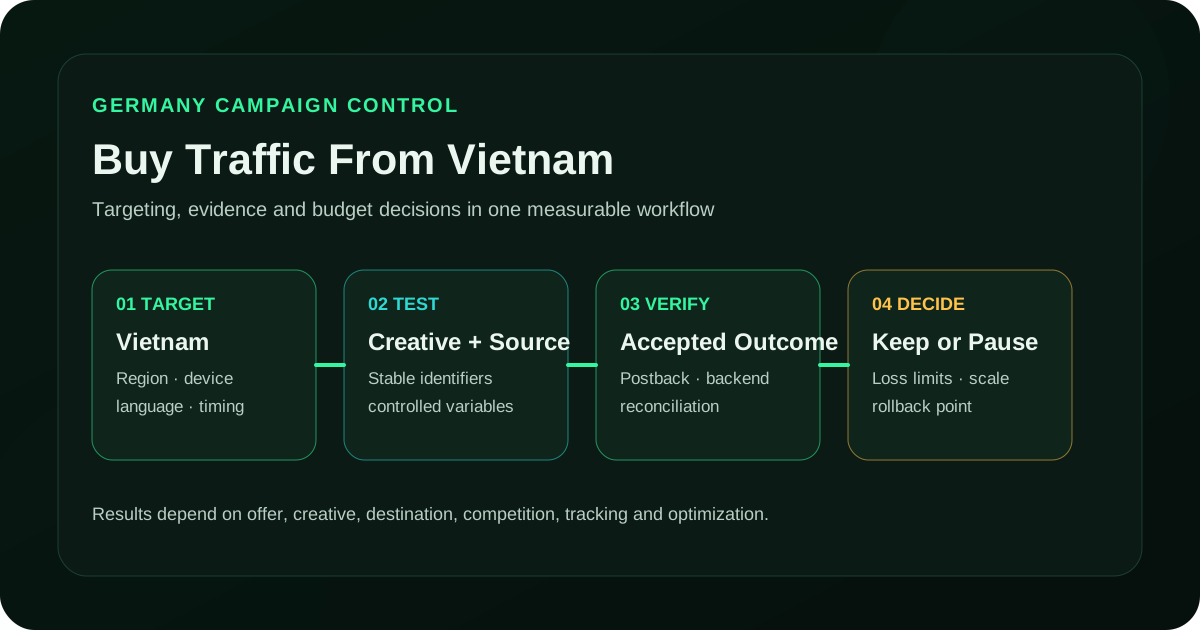
How should you buy and evaluate traffic from Vietnam?
Create your FroggyAds account, confirm the Vietnam targeting available for your selected ad format, and launch a campaign with a defined spending limit and conversion goal. Before buying more, connect the source report to your own order or lead records. Check that both systems describe the same period, currency and customer action. We give you the buying and source-control workflow; a reconciled report helps you use those controls confidently.
This guide focuses on the handoff between media delivery and the advertiser's business records. A Vietnam visitor can arrive just after local midnight while the tracking server still records the previous UTC date. A shop can display a VND order value while the media report uses USD. A submitted order can later be cancelled. None of those differences proves that a source is good or bad; each must be resolved before comparing results.
Choose FroggyAds when you want to make those decisions within a self-serve traffic-buying process rather than purchase an unexplained block of visits. Start with one measurable offer and an allocation you can review. Our Vietnam campaign launch guide covers Vietnamese creative and form testing. Here, you will build the reporting checks that show whether the delivery you purchased deserves another allocation.
Separate Vietnam delivery from customer eligibility
A country selection defines the geographic scope requested for a campaign. It does not establish a visitor's nationality, preferred language, shipping address or intention to buy. A source identifier describes a reporting or placement dimension where available; it is not necessarily the public name of a publisher. Review the fields your selected format actually provides and retain their definitions with the campaign report.
Use the offer to decide which geography matters. A service limited to certain addresses in Hanoi needs a different acceptance rule from a downloadable product available throughout Vietnam. A business may serve Ho Chi Minh City and Da Nang differently because of delivery or appointment constraints, but that is a fulfilment decision, not evidence of different national clock zones. The cities are examples for planning; they are not forecasts of available FroggyAds traffic.
Prepare Vietnamese messages for an audience you intend to serve in Vietnamese. Use English or another language only when the offer, destination and support process genuinely provide that journey. Do not infer a language preference from a city name. Ask a fluent reviewer to check the promise and response path. Then preserve creative language and destination version in your own campaign notes so the report can distinguish the routes actually used.
What does a Vietnam traffic purchase cost?
Our pricing page lists a $50 minimum account deposit. Published starting bids include $0.003 CPC for Push and Native, $0.10 CPM for Display and $0.0001 CPC for Pop. These are platform entry points, not a Vietnam traffic package or a promise of clearing prices. Account funding, the bid submitted and the amount allocated to a particular campaign are separate choices.
Choose the format before comparing its delivery units. A Display impression and a Push click do not represent the same action. Record the chargeable event, actual spend and available source details for the format you selected. Include creative production, tracking and follow-up separately when evaluating total acquisition cost. A low media bill is not a complete cost comparison when one campaign needs substantially more work to turn responses into customers.
Set the next review point around the uncertainty you need to resolve. Technical validation asks whether delivery and conversion recording work; a later business review asks whether accepted customers justify the cost. Do not spend the whole account balance merely because funds are available. Allocate enough to answer the first question you can actually measure, and keep a stop rule for a broken destination, unsupported offer or failed tracking route.
Connect the guide to live testing
Set up your Vietnam source test
Choose one eligible audience and a spending limit. Use FroggyAds to launch the purchase, then keep the source report ready for a like-for-like business review.
Create My Free Account
Use one Vietnam day, not mismatched dashboard dates
Vietnam currently uses UTC+07:00 across the country. The IANA time-zone data records the current offset and explains that Asia/Ho_Chi_Minh agrees with all of Vietnam for modern timestamps. You do not need different local offsets for Hanoi and Ho Chi Minh City. Your advertising account, tracker and sales system can nevertheless use different reporting clocks.
Write down the timezone used by each export. A report labelled 4 October in UTC covers a different interval from 4 October in Vietnam. Compare the same start and end instants, not just matching date labels. If an account only provides daily aggregates in its own timezone, preserve that limitation instead of pretending the aggregate can be divided accurately into Vietnamese local days.
Store an unambiguous event timestamp in the reporting system you control. Keep the original timestamp and its timezone or offset, then derive the local reporting day consistently. The W3C date-time note illustrates timestamps with an explicit UTC designator or numeric offset. It is a notation reference, not evidence of which timestamp format your FroggyAds integration accepts. Use the integration's documented fields and verify the actual export.
A midnight test that catches a one-day reporting error
Synthetic reporting example, not a customer transaction: the Vietnam day beginning at 00:00 on 4 October 2026 starts at 17:00 UTC on 3 October and ends at 17:00 UTC on 4 October. Include the start instant and exclude the end instant. That convention prevents an event exactly at midnight from appearing in both consecutive daily reports.
We tested five fictional timestamps against that interval. The instant immediately before the start was excluded; the exact start, a timestamp fifteen minutes later and the instant immediately before the end were included; the exact end was excluded. A separate named-timezone check displayed 17:15 UTC on 3 October as 00:15 on 4 October in Asia/Ho_Chi_Minh. The three included events belong to one local reporting day even though their UTC dates are not all the same.
Run the equivalent check in your reporting implementation before comparing source totals. The ECMAScript internationalization specification documents timezone-aware date formatting; our example uses a local JavaScript runtime. Formatting a timestamp does not change when the event happened. Keep the interval boundaries and timezone beside the report so another buyer can reproduce the result.
The test does not certify an account export, server clock or live conversion endpoint. It demonstrates a specific boundary rule with fictional data. If two systems disagree, inspect their timezones, event definitions and export filters before changing a bid. Otherwise a source that delivered after Vietnamese midnight can look as though it spent money on one day and produced all its orders on another.
Keep Vietnamese dong values separate from the media currency
Vietnam's currency is the Vietnamese dong, identified by VND. The Vietnam National Authority of Tourism's currency guide confirms the name and code. Use this reference for currency identification, not for a current exchange rate or evidence that your merchant supports a particular payment method.
Keep the numeric amount, currency code and offer version separate in your order record. For a hypothetical product priced at VND 499,000, a formatted price is presentation; the stored amount remains 499000 with currency VND. A report using USD for media spend must not divide an unconverted VND sales total by USD cost and label the result return on ad spend. Use the conversion method approved by your finance process and record its effective date.
Agree on which value you are comparing: order total, collected payment, revenue after refunds or contribution after relevant costs. Delivery charges, discounts and cancellations can make those values different. If a business accepts payment later, a placed order is not yet collected revenue. That is a requirement of the particular merchant journey, not an assumption that every Vietnamese customer uses the same payment method.
Test the receiving record as well as the displayed price. A currency label added in the interface cannot repair an amount exported in the wrong unit. We recommend comparing one fictional order from advertisement through confirmation and reporting before increasing delivery. Preserve the original amount if a later refund or adjustment occurs, then record the change rather than replacing the entire history with a new unexplained total.
Choose the execution format
Choose the format you can measure
Match the placement to your Vietnamese offer. Keep the format, source identifiers and reporting period together so the next purchase is based on a comparable result.
Create My Free Account
Build a report that lets you act on individual sources
Keep media delivery and business events in separate records linked by the identifiers your integration supports. Media reporting should retain the campaign, source, format, reporting interval and spend. The business record should retain an event identifier, its origin, current acceptance status and relevant value. These are suggested analytical fields, not FroggyAds macro names or a promise that every field appears in every export.
Do not repeat a source's entire spend beside every order and then sum that joined table. That can multiply the cost by the number of orders. Aggregate delivery once at the intended source and period, aggregate accepted outcomes at the compatible level, and then compare the totals. Investigate unmatched identifiers separately. Quietly dropping unmatched rows can make the remaining source look more profitable than the purchase actually was.
Our conversion-tracking guidance helps you connect campaign activity to recorded actions. Keep merchant acceptance in the system responsible for confirming the sale or lead. A later cancellation should remain linked to its original event and acquisition period, even if the cancellation is processed in a different month. State whether a report is grouped by click date, conversion date or acceptance date before drawing a conclusion.
Restrict access to personal customer details. A source review usually needs identifiers, statuses and appropriately scoped values, not a person's name or contact information in a campaign URL. Use synthetic data for implementation tests and your organisation's approved data-handling process for real records. When a report needs information your team cannot lawfully or reliably connect, document the gap and choose a narrower decision instead of inventing attribution.
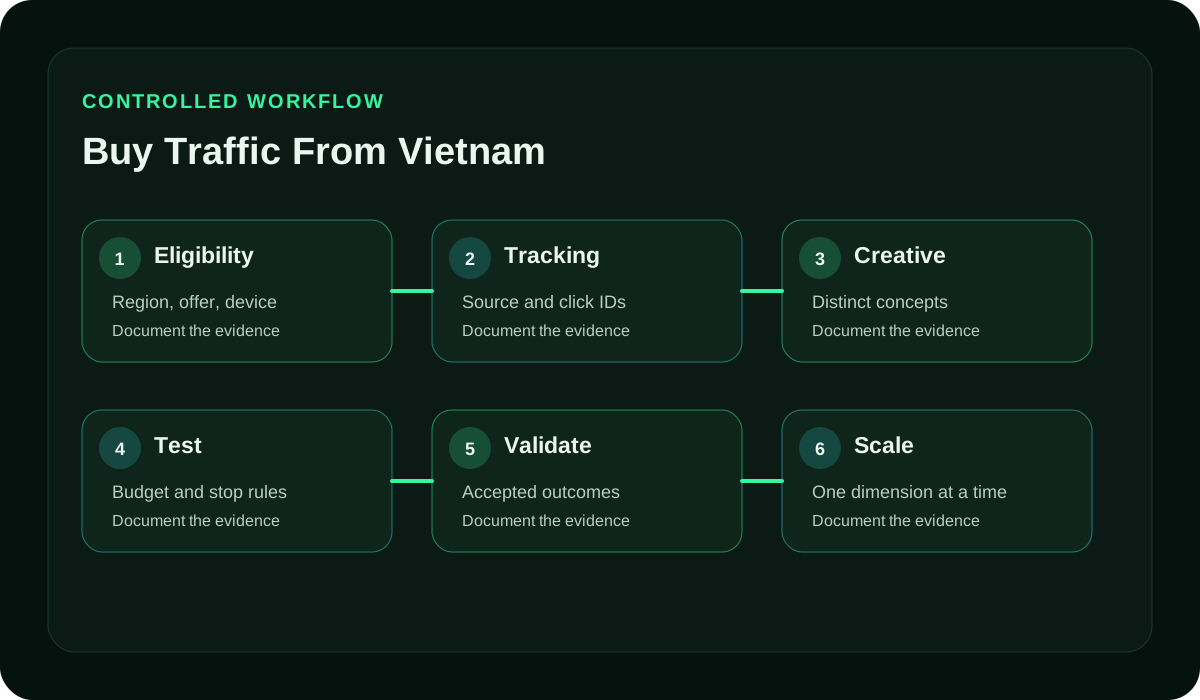
Why identical order costs can lead to different source decisions
Hypothetical purchase comparison: two fictional sources each spend USD 120 and each produce 12 submitted orders. Their initial cost per submitted order is identical: USD 120 / 12 = USD 10. After the same acceptance window, Source A has eight fulfilled orders and four cancellations; Source B has four fulfilled orders and eight cancellations. Define fulfilled consistently for the example and assume there are no other statuses.
The cost per fulfilled order is USD 15 for A and USD 30 for B. Across both sources, USD 240 / 12 fulfilled orders = USD 20. The combined average hides the difference that matters for the next purchase. This calculation does not establish profit: the product margin, return costs, fulfilment expense and later customer value are unknown. It is not a benchmark for Vietnam or a FroggyAds campaign result.
Before restricting B, ask whether the cancellations share a repairable cause. Did B receive a different promotion, unsupported delivery area or broken payment route? Are the orders equally mature? If the conditions differ, diagnose the difference before attributing it to the source. If the setup and acceptance rules match, the report gives you a reason to consider a smaller allocation, exclusion or documented retest. Twelve submissions are not a universal sample threshold.
The benefit of buying through FroggyAds is the connection between that decision and the available campaign controls. You can review source-level performance and apply supported restrictions or budget changes, rather than keep buying from an undifferentiated total. Record the action and reason. When the next period arrives, compare it with the setup that generated the earlier evidence instead of mixing both periods into a single flattering average.
Put the guide into practice
Put the accepted-order comparison into practice
Review a real campaign against your own acceptance rules, not our fictional numbers. Use the available FroggyAds source controls to apply the action your evidence supports.
Create My Free Account
Compare placements without losing the Vietnamese offer
Choose a format whose message can be understood at its actual size. A Push message needs a concise proposition; Native can introduce useful context; Display needs a readable visual at the placement dimensions. For Pop, Video and Interstitial, check the transition to the destination and the conditions in which the creative appears. Confirm the current specifications and Vietnam inventory available for the campaign rather than treating a global format list as local supply.
Keep the same offer and acceptance definition when comparing sources within a format. If a source uses a different Vietnamese headline, price or landing page, record that difference as part of the test. A source comparison cannot isolate source quality while also changing the product and promised delivery. The format guides explain the creative requirements; your campaign record should identify the exact asset and destination used.
Our general traffic-quality screening and your commercial acceptance review solve different problems. FroggyAds uses Adscore and internal controls to help identify invalid or low-quality activity. Those checks do not establish that every valid visitor wants your offer. Use the traffic-quality guidance, then examine the actual reason an order or enquiry failed. A technical problem affecting every source is not repaired by repeatedly replacing the source list.
What should you check when the totals disagree?
Spend appears before the orders: compare the reporting intervals and event dates first. Vietnam local time and a UTC export cross the calendar boundary at different instants. Also check whether the order report uses submission or final acceptance time. Do not move individual orders between dates merely to force a match; apply one documented rule to the whole comparison.
Orders look unusually valuable: inspect currency, amount units, duplicated event IDs and the treatment of refunds. A repeated confirmation must not create a second sale. A VND amount presented beside a dollar symbol needs investigation before any return calculation is used to increase spend. Keep the original records available while the reporting team resolves the discrepancy.
A city appears to underperform: check service eligibility, destination language, creative and review maturity. A location label cannot confirm every address is supported. Where geography is only available at a broader level, do not pretend the report proves a neighbourhood-level result. Decide using the evidence available rather than manufacture detail that neither system records.
The source is unidentified: inspect the actual tracking setup and supported reporting fields. A missing identifier is a measurement problem until investigated, not proof of fraudulent traffic. Keep unmatched outcomes visible and restrict the purchase to what you can supervise. Give support the campaign reference, affected period and technical symptoms without sending unnecessary personal customer information.
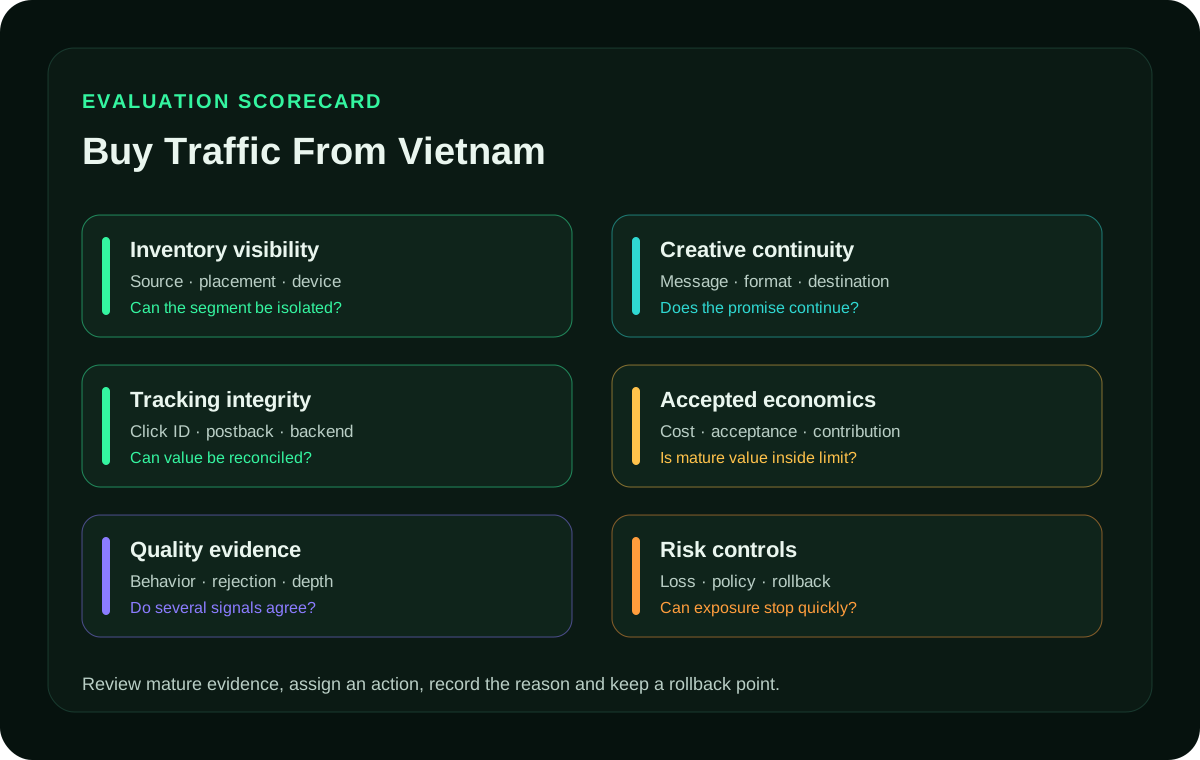
Turn your reconciliation into a measured traffic purchase
End the review with one decision: keep the current purchase, repair a named issue, restrict a source or test an expansion. Record the source, interval, currency, accepted event and reason behind it. State when a later cancellation or missing record would change the decision. A report that cannot produce an action should not be used as an automatic reason to increase spend.
For expansion, choose one change supported by the result. A higher allocation for the same setup, another eligible location and a new creative are different tests. Keep the prior configuration and show which new spend belongs to the change. Source mix may change when you buy more, so yesterday's accepted cost is a comparison point, not a promised result for the next campaign period.
Choose FroggyAds for a Vietnam traffic purchase you can connect to meaningful reporting and practical source decisions. Bring a working offer, a tested measurement route and a clear spending limit. Our self-serve workflow gives you a place to execute the test; your reconciled customer outcomes tell you what to do next. Create your free FroggyAds account and prepare the first purchase around a question your business can answer.
Buy Traffic From Vietnam FAQ
What am I buying when I select traffic from Vietnam?
You are requesting advertising delivery within the Vietnam scope supported by your selected campaign. That does not guarantee nationality, buying intent or a serviceable shipping address. Check available format and targeting settings, then compare source delivery with the customer action your offer actually accepts.
Does Vietnam need different timezones for Hanoi and Ho Chi Minh City?
No. Modern Vietnam uses UTC+07:00 across the country. The reporting mismatch to watch is between systems: your tracker, media account or sales tool may use a different clock. Record each report's timezone and compare the same start and end instants before evaluating source costs.
Which UTC interval matches 4 October 2026 in Vietnam?
The local day starts at 17:00 UTC on 3 October 2026 and ends at 17:00 UTC on 4 October. In our synthetic example, the start is included and the end is excluded so consecutive daily reports cannot both count the same midnight event. Verify the actual filters used by your reporting tool.
Should I compare VND order values directly with USD media spend?
No. Retain the original amount and currency for both records, then apply your documented finance conversion method when a common reporting currency is needed. Formatting a VND price does not convert its value into USD. Keep refunds, delivery charges and other relevant adjustments distinguishable from gross order value.
Is the $50 deposit the cost of a Vietnam traffic package?
The published $50 minimum funds your account; it is not a guaranteed Vietnam delivery package or a recommended allocation for every offer. The campaign budget and auction bid are separate choices. Check current pricing and live settings, and decide how much to allocate based on the question your first test can answer.
What records should I keep for a source-level review?
Keep campaign and source identifiers where supported, the format, reporting interval and spend. Link your business events using the identifiers supported by your tracking setup, retaining acceptance status and appropriately scoped value. These are analytical requirements, not a list of FroggyAds macro names. Follow the actual integration documentation.
Can submitted orders be used as completed sales?
Only when the business definition genuinely makes them equivalent. A submitted order may still be cancelled, unpaid or unfulfilled. Keep submission and final acceptance as separate stages when they answer different questions, and compare sources after the same review window. Do not count a repeated confirmation as a second order.
Why can two sources with the same initial order cost deserve different budgets?
Their final acceptance can differ. In our hypothetical example, both sources spend USD 120 and produce 12 submissions, but eight versus four orders are fulfilled. The fulfilled-order costs become USD 15 and USD 30. Investigate offer, coverage, tracking and maturity differences before treating that calculation as a source-quality conclusion.
Which language should my Vietnam traffic campaign use?
Choose the language your intended customers and offer require, and support it through the advertisement, destination and response process. Vietnamese creative needs a competent language review. An additional language is a separate supported journey, not a requirement inferred from the country or city name.
When should I buy more traffic through FroggyAds?
Increase the allocation when the reporting periods and currencies reconcile, tracking is dependable and mature customer outcomes support the decision within your written limits. Choose one expansion and preserve a reversal condition. Use FroggyAds campaign and source controls to implement the decision without losing the earlier setup and its results.
Continue the Vietnam Traffic Workflow
Before your next Vietnam traffic purchase
| Check | What to reconcile |
|---|---|
| Time | Match the same start and end instants, including the UTC+7 day boundary. |
| Money | Keep VND order amounts separate from media currency until an explicit conversion is applied. |
| Result | Distinguish submitted orders from fulfilled or otherwise accepted customer actions. |
| Source | Keep spend and accepted outcomes at compatible source and reporting-period levels. |
For general background, see Shopify on paid advertising and Google's Display targeting explanation. Their product capabilities are not FroggyAds account specifications or evidence of Vietnam campaign results.
Create your free FroggyAds account and use your reconciled report to plan the next purchase.
Start your Vietnam traffic purchase with a clear review plan
Choose the offer, available audience and spending limit. We provide the self-serve campaign workflow; your aligned reporting and accepted customer outcomes guide the next investment.