
Vietnam traffic procurement
A controlled purchase that verifies Vietnam delivery controls, destination readiness, data roles and accepted campaign outcomes.
Treat Vietnam traffic as a documented supplier and destination test under the current 2026 ecommerce framework. Verify Vietnamese customer handling, VND offer terms, data roles, live source controls and accepted outcomes before scaling.
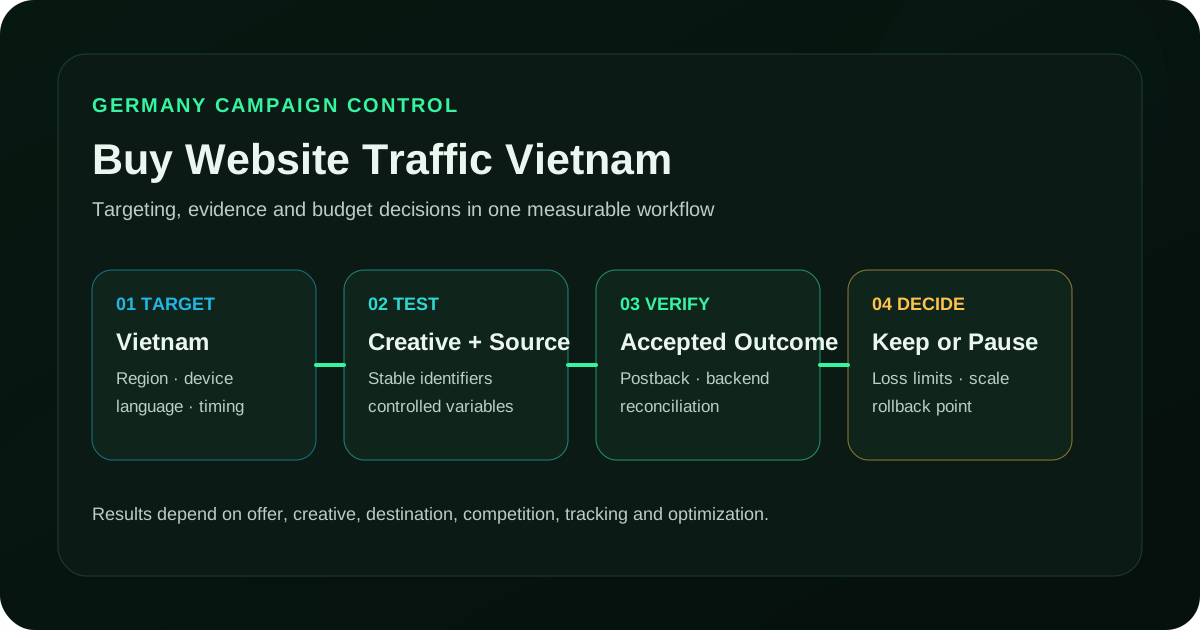
Buying website traffic in Vietnam requires the advertiser to connect the active media settings with the Vietnamese customer route and data-processing file. The Government of Vietnam publishes Decree 13/2023 on personal data protection, including its issue and effective dates and the official attached text. That source provides a review anchor; it does not certify a particular landing page, controller decision, payment method, campaign source or expected outcome. For example, a bounded Vietnam test can preserve one language version, VND offer, device, placement and source ID, then follow the visit through notice, customer action, merchant response and accepted backend status. Record processing roles, purposes, necessary fields, recipients, retention, cross-border questions and unresolved legal interpretation with the accountable owner. Keep Asia/Ho_Chi_Minh and UTC timestamps together. Increase budget only when live targeting, Vietnamese offer continuity, the deployed data map and mature source economics pass the same documented acceptance rule.
Buying website traffic for Vietnam purchases measured advertising delivery, not customers or guaranteed demand. A valid trial keeps the destination, data, payment and media evidence separate, then connects source identifiers to accepted outcomes inside one Vietnamese service lane.
A controlled purchase that verifies Vietnam delivery controls, destination readiness, data roles and accepted campaign outcomes.
A compatible combination of Vietnamese language, VND offer, served location, payment, fulfilment, complaint and support paths.
Local Vietnam campaign reporting using the current IANA Asia/Ho_Chi_Minh zone with UTC event records retained.
The national ecommerce law identified by Vietnam's Ministry of Industry and Trade as effective from 1 July 2026.
The government decree described by the Ministry as detailing provisions of the current ecommerce law.
The government-published decree on personal data protection that frames role and processing review for an actual data flow.
A source-level record of joined clicks, test flags, duplicates, accepted outcomes, rejection reasons and mature loss limits.
Verified language, currency, payment, fulfilment, cancellation, complaint and support conditions for the served offer.
Vietnam's Ministry of Industry and Trade states that E-Commerce Law 122/2025/QH15 and Decree 248/2026 took effect on 1 July 2026. Use that date and framework as a current review gate. Traffic procurement does not establish the advertiser's registration, seller, product or platform duties.
Verify Vietnamese copy, VND price, payment, fulfilment, cancellation, complaint and support for the actual served location. Keep the destination version in the campaign record. A source cannot repair a destination that is unavailable, unclear or unable to complete the promised transaction.
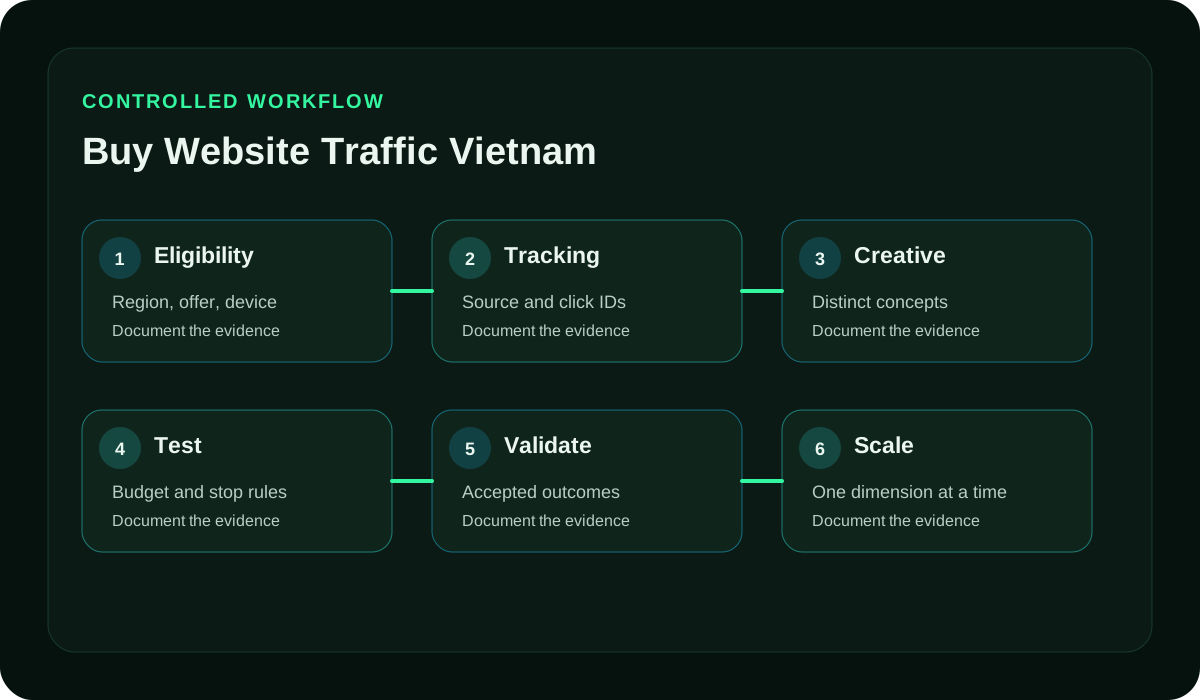
Connect the guide to live testing
Use the choices established in “How should Vietnam data roles be mapped?” to define one audience, budget and source set in FroggyAds. Keep the surrounding offer and measurement rule stable so the test adds evidence to buy website traffic vietnam instead of mixing several changes at once.
Create My Free Account
Vietnam Decree 13/2023 is the official personal-data boundary in the prepared dossier. Map the actual controller and processor roles, notice, consent or other basis, security, retention, rights and transfer path. Store only the identifiers required for the documented source-click join.
Check Vietnam geography, devices, formats, source and placement identifiers, bids, caps and reporting fields in the live account. Public sources cannot confirm current inventory or volume. Missing fields remain procurement limits, not assumptions.
Separate destination failures, data failures, payment failures and media failures. Decide only after the attribution and rejection windows have matured. Compare accepted cost inside one Vietnamese service lane and keep a loss ceiling for every source.
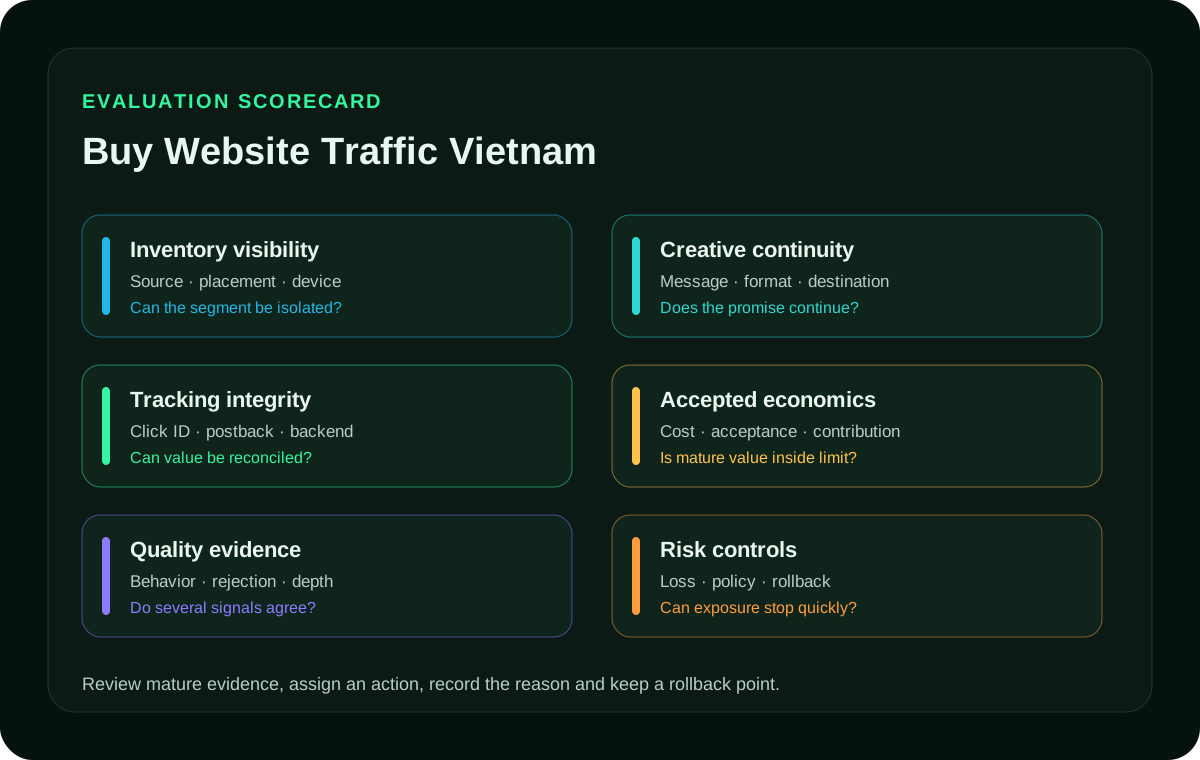
Use current IANA Asia/Ho_Chi_Minh reporting for the local lane and preserve UTC at collection. Record the active destination and tracking versions beside event time so a later system change is not mistaken for a source effect.
Identify the seller, ecommerce model, destination operator and media supplier before applying the current framework. A role label must match the actual transaction and data flow. For Buy Website Traffic Vietnam, write the responsible role, live observation, timestamp, affected Vietnamese service lane and next action in the supplier record. Use NOT VERIFIED for missing account, destination, data or backend evidence. Keep ecommerce, personal-data, payment and media findings in separate layers. Never carry a result into a different seller, language, offer or processing path without a new cohort. The Vietnam record should expose both the decision and the evidence that could overturn it.
Write a role map for the exact offer instead of assuming that every party performs the same function. Identify who presents the product or service, who receives customer information, who handles payment, who fulfils the order and who answers a cancellation or complaint. Add the destination and policy version reviewed for each role. This map keeps media procurement separate from seller and processing responsibilities. If a marketplace, payment provider or logistics party changes, record the new handoff before comparing outcomes from the revised journey with the earlier cohort.
Choose the execution format
Use the criteria around “Vietnam supplier evidence matrix” to decide whether push, native, display or pop fits the message and destination. Set format, targeting and spend as campaign controls in FroggyAds while the buy website traffic vietnam decision remains the standard for judging the result.
Create My Free Account
| Evidence layer | Required proof | Do not infer |
|---|---|---|
| Destination | Vietnamese, VND, payment, fulfilment and support | Traffic cannot approve the offer |
| Data | Roles, notice, basis, retention and transfer map | A tag list is not a lawful-flow review |
| Account | Live source, placement, device, bid and cap fields | Public research cannot prove availability |
| Join | Click identifier through accepted backend event | Platform clicks are not accepted value |
| Decision | Mature accepted cost and source loss ceiling | Country origin is not a quality score |
Use one evidence row per supplier and placement combination confirmed by the live account. Preserve location controls, format, device, bid, cap, reporting fields and the identifiers available for the backend join. Beside those fields, record the eligible service lane, VND offer version, Asia/Ho_Chi_Minh timestamp and UTC timestamp. The matrix should show unavailable controls rather than silently substituting planned settings. A supplier leaves observation only when the destination works, identifiers survive the journey and accepted outcomes have matured within the written loss ceiling.
Check the advertisement, landing page, form, payment, cancellation, complaint and support messages. Record any step that falls back to an unsupported language. For Buy Website Traffic Vietnam, write the responsible role, live observation, timestamp, affected Vietnamese service lane and next action in the supplier record. Use NOT VERIFIED for missing account, destination, data or backend evidence. Keep ecommerce, personal-data, payment and media findings in separate layers. Never carry a result into a different seller, language, offer or processing path without a new cohort. The Vietnam record should expose both the decision and the evidence that could overturn it.
Capture the promoted amount, final payable amount, currency, taxes or fees, payment method and refund route for one version. Separate advertiser price evidence from media cost.
List the locations the advertiser can serve and the operational restriction attached to each one. Exclude unsupported areas before a source test begins.
Write the purpose, data elements, role, recipient, retention, security and transfer path for the identifier join. Escalate the legal basis and notice questions for qualified review.
Use only the campaign, creative, source, placement and click fields required for reconciliation. Prevent debug payloads or unused identifiers from becoming permanent records.
Put the guide into practice
With “Separate Vietnam technical events from live outcomes” documented, launch only the next reversible test. Set a spending limit, preserve the baseline and use source-level and audience controls so the next step depends on qualified outcomes for buy website traffic vietnam, not activity volume.
Create My Free Account
Mark test clicks, form submissions and postbacks at creation. Verify that dashboards and backend calculations exclude them from source economics.
Store local and UTC event times plus the active tracking version. Check clock drift and queue delay before classifying a late conversion.
Assign one primary failure layer and supporting evidence to every material issue. Do not reject a source for an error caused by the destination or payment route.
State the backend status that counts, the owner of the decision and the reasons an event can later be rejected. Keep the definition stable during a cohort.
Limit spend before a mature accepted outcome and define the emergency stop for broken tracking, destination outage or policy uncertainty. Record who can restart the source.
Delay the keep or reject decision until the agreed maturity window closes. Recalculate accepted cost when a later rejection or cancellation changes the cohort.
Choose budget, bid, source set, device, format or location as the single expansion variable. Preserve the previous cohort as a rollback reference.
Open a fresh role, destination and data review when the seller, product, payment, fulfilment or processing path changes. Do not carry forward an outdated conclusion.
Record the framework review date, seller role, destination build, data map and tracking version for the same cohort. Reopen the review when one of those foundations changes.
Inspect accepted cost, rejection, cancellation, data completeness and destination continuity for the newest allocation. Roll back when the new cohort no longer matches the approved evidence conditions.
Inventory, volume, bids, source quality and results remain operational questions until directly observed. Store each unknown with an owner and required proof.
Public and official materials establish review boundaries, not live media performance. Maintain a separate list for inventory, reachable volume, bids, source depth, payment support and advertiser-specific outcomes that require direct proof. Each item needs an evidence owner and a named readback or test. Until that proof exists, describe the item as NOT VERIFIED and keep it out of promotional conclusions. This distinction allows the campaign team to proceed with a bounded technical test without turning incomplete account information or national context into a promise about traffic quality.
It suits an offer that genuinely serves customers in Vietnam and has a defined online action to evaluate. Confirm language, delivery area, payment or lead handling, and policy requirements before buying volume.
Separate meaningful language, region, device, connection, and eligibility groups based on the customer path. Keep unsupported demographic assumptions out of targeting and use observed response to refine the audience.
Match the format to the amount of context the offer needs and the behavior being measured. Keep impression, push, popup, and direct-click tests apart so their costs and user signals remain interpretable.
It should load quickly on common mobile connections, explain the offer clearly, show material terms, and provide a working next step. Test language, redirects, forms, consent, and support details before launch.
Use the affordable accepted action, number of source and audience cells, expected learning volume, and outcome delay. Place daily and source limits around discovery spend rather than treating all available traffic as proven.
Capture the ad response, loaded session, relevant page steps, submitted event, and final acceptance status. Pass a source identifier through the full route so platform activity can be reconciled with business records.
Compare valid sessions, eligible engagement, accepted outcomes, rejection causes, and repeat patterns for each source and device. Low-priced visits have no advantage when the audience is ineligible or the downstream action is rejected.
Combine platform screening with server logs, analytics, source IDs, timing patterns, and backend validation. Pause on documented evidence, while checking that a technical or localization problem is not creating the same symptom.
Stop it when a prewritten spend, volume, or quality boundary is crossed after data has had time to mature. Preserve the affected identifiers and confirm tracking health before excluding the inventory.
Increase volume after comparable periods show stable accepted actions within the cost and quality limits. Raise one source group, audience, bid, or cap at a time so the additional traffic can be judged on its own.
Buy Website Traffic Vietnam can move from research to a capped candidate test only after its live controls, destination, data path and identifier join are verified. Decide the Vietnam cohort from mature accepted outcomes and retain the documented rollback condition. Delivery, quality and business results are not guaranteed.
For Buy Website Traffic Vietnam, treat Vietnam as its own campaign market. Confirm that the offer, landing experience, language and device path genuinely support the market, then compare source-level outcomes inside Vietnam. Use Evidence boundary for Buy Website Traffic Vietnam and What Buy Website Traffic Vietnam means in a controlled campaign as the planning baseline instead of importing assumptions from another country.
On this Buy Website Traffic Vietnam page, the decision should remain tied to the existing evidence around Evidence boundary for Buy Website Traffic Vietnam, What Buy Website Traffic Vietnam means in a controlled campaign and Named entities used in this procurement brief. Those sections give buy website traffic vietnam its specific context; the table below turns that context into campaign actions rather than adding another generic definition.
| Decision | What to verify | FroggyAds action |
|---|---|---|
| Buy Website Traffic Vietnam objective | Use Evidence boundary for Buy Website Traffic Vietnam to define the accepted business event and the maximum learning loss for buy website traffic vietnam. | Launch one FroggyAds campaign objective for Buy Website Traffic Vietnam and keep the conversion definition stable. |
| Buy Website Traffic Vietnam audience | Use What Buy Website Traffic Vietnam means in a controlled campaign to verify market, device, language and offer eligibility for buy website traffic vietnam. | Apply only the FroggyAds targeting controls that change the real Buy Website Traffic Vietnam customer journey. |
| Buy Website Traffic Vietnam source evidence | Use Named entities used in this procurement brief to keep source-level differences visible instead of relying on one blended buy website traffic vietnam average. | Keep, cap, exclude or retest Buy Website Traffic Vietnam inventory from documented source evidence. |
| Buy Website Traffic Vietnam economics | Use Vietnam traffic procurement to connect media spend with accepted conversions and downstream value for buy website traffic vietnam. | Protect the Buy Website Traffic Vietnam test with a written budget boundary and a consistent attribution window. |
| Buy Website Traffic Vietnam scale rule | Use Vietnamese service lane to define the exact evidence that earns the next budget increase for buy website traffic vietnam. | Scale Buy Website Traffic Vietnam one major control at a time and compare marginal performance with the prior baseline. |
For Buy Website Traffic Vietnam, FroggyAds gives advertisers a self-serve DSP and ad-network workflow for buying supported traffic with campaign-level budgets and targeting. Depending on format and campaign context, available controls can include country, city, device, operating system, browser, carrier, category, source, ID and IP options. SmartCPC and Adscore-supported traffic-quality controls can support the buy website traffic vietnam optimization process, while the advertiser's tracker, analytics and backend acceptance remain the final evidence for commercial quality.
Use Vietnamese service lane as the final checkpoint for Buy Website Traffic Vietnam. If the accepted result does not reproduce after the next meaningful volume step, return to the last stable configuration instead of widening several controls at once.
URL boundary for Buy Website Traffic Vietnam: This URL owns Buy Website Traffic Vietnam; Vietnam Website Traffic is the nearest neighboring topic and should keep its separate task. Use this page only for the decision implied by Buy Website Traffic Vietnam.
Use Buy Website Traffic Vietnam to narrow the paid-acquisition decision before spend expands. A performance advertiser should be able to plan the market-specific test and measurement rules from this URL's own evidence.
Decision inputs for Buy Website Traffic Vietnam: audience targeting, conversion tracking, source evidence, conversion tracking. Keep these inputs tied to accepted conversion or business-value event and the page-specific job: plan the market-specific test and measurement rules.
Evidence boundary for Buy Website Traffic Vietnam is an evidence checkpoint for Buy Website Traffic Vietnam. To answer “For Buy Website Traffic Vietnam, when does paid website traffic in Vietnam suit an offer?”, keep audience targeting in the same campaign record and use it to plan the market-specific test and measurement rules.
What Buy Website Traffic Vietnam means in a controlled campaign is the measurement checkpoint for this URL. Resolve “For Buy Website Traffic Vietnam, which audience details should a Vietnam traffic test separate?” while retaining conversion tracking, conversion tracking, spend and cohort age so the result can be reconciled with accepted conversion or business-value event.
Named entities used in this procurement brief is the action checkpoint for Buy Website Traffic Vietnam. Before acting on “For Buy Website Traffic Vietnam, how should a buyer choose a format for Vietnamese traffic?”, document source evidence, the resulting campaign action and the rollback or retest condition.
| Page checkpoint | How to use it | Evidence to retain |
|---|---|---|
| Evidence boundary for Buy Website Traffic Vietnam | Use Evidence boundary for Buy Website Traffic Vietnam to establish the first evidence boundary for Buy Website Traffic Vietnam; then record which part of campaign objective, targeting, source evidence, conversion tracking and economics it changes. | Keep audience targeting, source/campaign ID and the accepted-event definition together. |
| What Buy Website Traffic Vietnam means in a controlled campaign | Use What Buy Website Traffic Vietnam means in a controlled campaign as the second checkpoint and reconcile it with accepted conversion or business-value event before changing budget or source allocation. | Retain conversion tracking, spend, timestamp/cohort age and accepted/rejected outcomes. |
| Named entities used in this procurement brief | Use Named entities used in this procurement brief as the final checkpoint: if it does not change the evidence for accepted conversion or business-value event, keep the test narrow rather than scaling. | Document source evidence, the decision taken and the rollback or retest condition. |
Hypothetical example: For Buy Website Traffic Vietnam, a hypothetical controlled cell that spends USD 230 and records 5 accepted conversion or business-value event after the same maturity window has an accepted cost of USD 46.00 per outcome. Replace the figures, outcome and review window with your own economics; this is not a FroggyAds performance claim.
Use FroggyAds to turn the Buy Website Traffic Vietnam decision into a measurable traffic test with budget and source controls; downstream accepted conversion or business-value event remains the reason to scale. Create your free FroggyAds account.
Buy Website Traffic Vietnam should be evaluated market by market: define eligible geography, keep measurement consistent, and scale only where accepted-outcome economics remain viable.