
Best Ad Trackers for Affiliates: Evaluation Criteria and Test Plan
Compare ad trackers for affiliates by click handling, postbacks, cost data, attribution, privacy, reporting, integrations and operational reliability.
What does this guide help you decide about affiliate ad trackers?
It helps affiliate marketers and media buyers choose a tracking system that can preserve a click journey, receive the commercial outcome and explain why one campaign cell should be scaled, revised or stopped. The decision is not which dashboard has the most charts. It is which system can reproduce your actual link, postback, status, cost and revenue flow with evidence your team understands.
Start with the full path: FroggyAds campaign, source and creative identifiers; the tracking redirect; the landing page or prelander; the affiliate network or advertiser; the conversion callback; and the final approved, rejected or pending status. Write which system owns each field and which timestamp, timezone, currency and attribution rule applies.
A useful tracker distinguishes a recorded click from a loaded destination and a raw conversion from an accepted business outcome. It can expose missing identifiers, duplicates, changed statuses and unmatched cost. It also provides exports or logs that let another operator verify the decision rather than trusting a colored summary.
Google's explanation of conversion tracking is a useful external reference for the relationship between advertising interactions and measured actions. Your affiliate agreement, tracking implementation and privacy requirements still define the evidence you may use.
What the best ad trackers for affiliates should accomplish
An affiliate tracker should turn paid-traffic activity into a traceable commercial ledger. It needs to preserve the identifiers required for a decision, route users without unnecessary friction, receive outcome events, apply the right status and value, and expose the uncertainty that remains.
Maintain journey continuity
Create a stable click ID and carry it through the redirect, destination and offer handoff. Map campaign, source, creative, landing page, device and geography only when those fields change an action. Confirm that characters, encoding and parameter names survive every hop.
Redirect speed matters, but it must be evaluated with reliability. A fast link that drops parameters or fails on a target browser produces misleading campaign data. Test real devices and locations that match the intended traffic.
Reconcile business status
Receive conversions with event type, value, currency and the commercial status used by the offer. Preserve pending, approved, rejected, refunded or duplicated states when they affect payment. Never treat an initial signal as settled revenue without the required maturity.
Join spend and outcome data under the same timezone, currency basis and reporting window. Record modeled or missing cost separately. A tracker can calculate metrics, but your team must define which outcome is accepted for scaling.
Build tracker selection around six controllable layers
Score each layer separately so a polished reporting screen cannot hide a broken integration.
1. Click capture
Check redirect domains, click-ID creation, parameter parsing, device behavior, HTTPS, availability and the evidence provided for a failed click.
2. Dimension mapping
Confirm campaign, source, creative, offer and landing-page fields can be named consistently. Avoid a schema that forces unrelated values into one token.
3. Outcome ingestion
Test server-to-server postback, pixel or API paths actually required by your partners. Verify authentication, event names, values, currencies and status changes.
4. Attribution rules
Document windows, repeat clicks, last or first interaction, direct visits and cross-device limitations. The rule must match the commercial agreement you report against.
5. Decision reporting
Require accepted-outcome reports by campaign, source, creative and landing page with cost, revenue maturity, exports and logs for investigation.
6. Governance
Review access roles, retention, privacy controls, domains, backups, change history, support process, pricing basis and exit or data-export capability.
Connect tracker evaluation to a controlled FroggyAds traffic test
A tracker should be tested with the same path you intend to use in production. Define one offer, geography, device group, format, landing-page route and accepted conversion. Carry stable IDs through that cell and keep the test small enough to investigate every mismatch.
Write the evidence contract
List the campaign and source identifiers available in your setup, the tracker's click ID, the partner parameter that receives it and the callback field that returns it. Add timezone, currency, attribution window, approval delay and duplicate rule. Give each field one owner.
Create your FroggyAds account when the destination and tracking path are ready. Use supported targeting, budget and campaign controls to bound delivery, then compare platform delivery with tracker clicks, loaded sessions and accepted outcomes.
Create your free FroggyAds account
Do not scale from a test conversion alone. Verify live identifiers, real redirect behavior and the offer's actual outcome status under the intended traffic conditions.
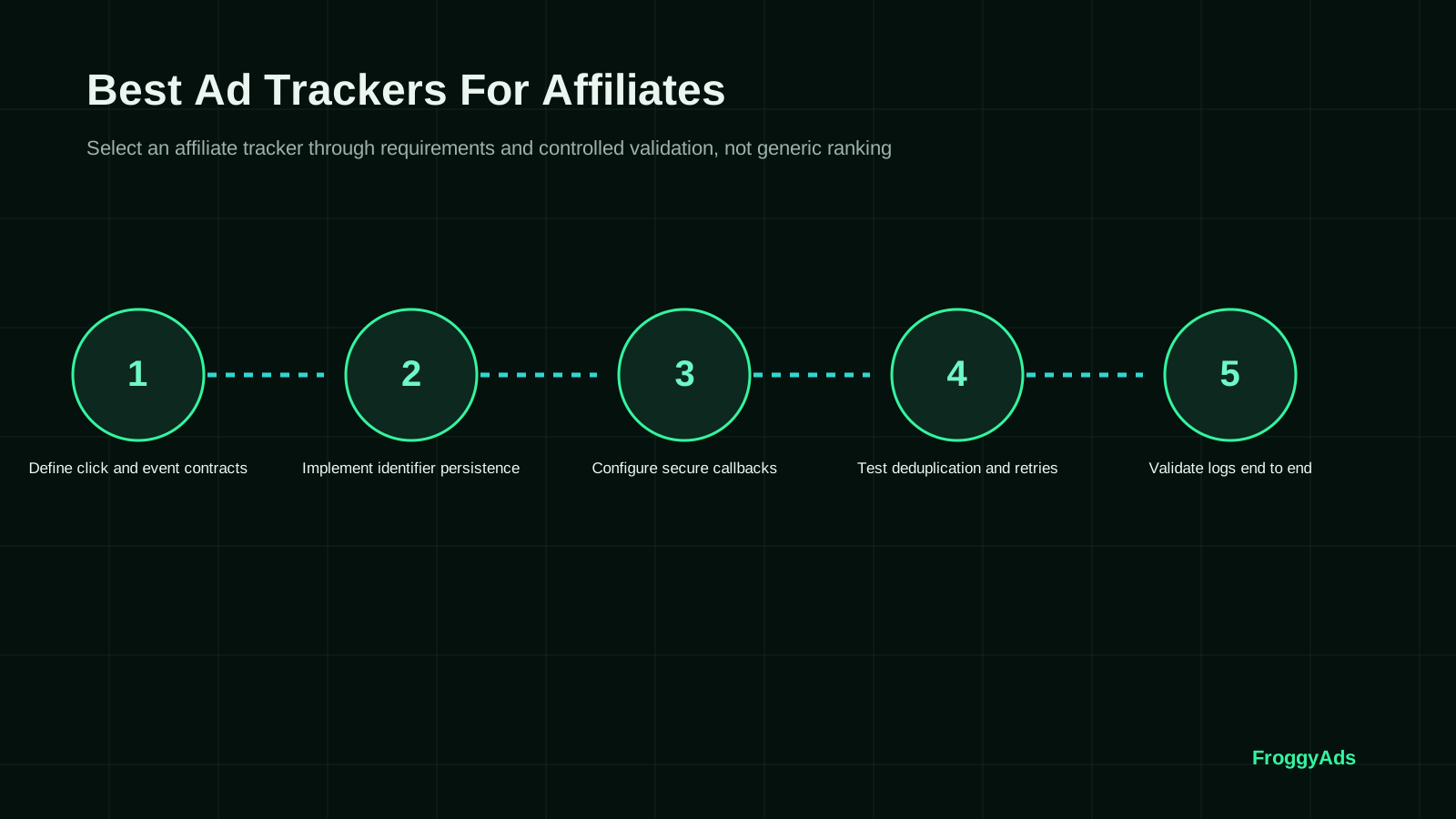
A seven-step process for evaluating affiliate trackers
Use the same test case for every serious option. Keep screenshots secondary to reproducible events and exported evidence.
1. Map the commercial journey
Draw the traffic source, redirect, page, offer, partner system, callback and finance result. Mark every identifier and status transition. Remove dimensions that no decision uses.
2. Define acceptance
Name the event that counts for optimization and the later state that counts for revenue. Include approval delay, refund handling, duplicates, caps and any difference between gross and net value.
3. Configure one clean path
Create the tracking campaign, offer and landing page. Use a dedicated test naming convention. Confirm the final URL, HTTPS, parameter encoding, fallback route and behavior when a required value is missing.
4. Run technical events
Send a test click, capture the generated ID at the destination, trigger the documented conversion and verify the postback receipt. Repeat an event to test deduplication and send a changed status when supported.
5. Run a bounded live cell
Buy a controlled amount of suitable traffic after the technical path passes. Compare source delivery, tracker clicks, destination loads, partner events and accepted outcomes. Investigate the first meaningful discrepancy.
6. Test operations
Review reporting speed, exports, user roles, alerts, backups, support response, cost imports and a deliberate configuration change. Confirm the team can recover the prior setup and explain the new version.
7. Score and decide
Weight the criteria that affect your economics and workload. Record limitations, missing evidence and total cost. Approve the tracker only for the use cases actually tested, with a named owner and next review.
Measure mature affiliate value, not event volume alone
The tracker dashboard is an operational view. The scale decision should use the outcome status and value that match your commercial agreement.
| Record | Meaning | Mismatch to investigate |
|---|---|---|
| Traffic-source delivery | Billable or reported activity in the buying platform | Different timezones, filters, billing events or invalid-traffic adjustments |
| Tracker clicks | Requests that reached the tracking endpoint under its rules | Redirect failure, blocking, duplicate filtering or parameter loss |
| Loaded destinations | Sessions that completed the tracked page handoff | Slow load, device error, redirect chain or consent behavior |
| Raw conversions | Initial outcome events returned by the partner | Missing postback, wrong ID, event mapping or attribution window |
| Accepted conversions | Events approved under the offer's commercial rule | Duplicates, invalid leads, refunds, quality review or cap |
| Mature revenue | Settled value under the declared currency and basis | Pending approvals, exchange rate, gross/net difference or reversal |
Use the earliest broken stage as the investigation point. Do not inflate a later rate by silently removing failed clicks or rejected outcomes from the denominator. Label modeled cost and revenue explicitly.
Keep a reconciliation report with source totals, tracker totals, partner totals and finance totals for the same window. Differences can be legitimate, but they must be explainable before the buyer increases spend.
Choose a paid-media format the tracker can identify cleanly
Different formats create different creative identifiers, interaction paths and landing expectations. The tracking model should distinguish the format and asset without depending on a manual note that can be lost.
Preserve comparable naming
Define a taxonomy for campaign, source, format, creative concept, asset version, landing page and offer. Use stable machine-readable values in links and readable labels in reports. When a concept is adapted to another format, retain the concept relationship but issue a new asset version.
FroggyAds supports a self-serve campaign path across available formats. Choose the format that fits the offer and user journey, then confirm the parameters available in the final campaign setup reach your tracker exactly as intended.
Start your next campaign with FroggyAds
Test every tracking link after the platform and creative are final. A link copied from an earlier format can carry the wrong labels even when it still redirects.
Connect creative, landing path and accepted conversion
A tracker is most useful when it preserves the relationship between the promise a user saw and the outcome the advertiser accepted. Build the reporting dimensions around that decision.
Creative and source evidence
Store the creative concept and version separately from the traffic source. A concept can perform differently across sources, and a source can change when the creative changes. Keep both dimensions available without creating thousands of meaningless labels.
Carry the landing-page version and offer ID through the same journey. When a destination changes, start a new version. Otherwise a tracker can assign an improved result to a creative that never saw the new page.
Conversion and status evidence
Map event name, payout or revenue, currency and status. Preserve the original event ID when statuses update. Deduplicate at the commercial event level so a second callback does not create a second sale.
Review pending and rejected outcomes beside approved ones. A source with fast raw events and weak approvals needs a different decision from a source with slower but stable accepted value.
Keep tracking coherent from placement to conversion
The tracking link should support the user's journey rather than becoming an obstacle. Review speed, redirects, consent, page continuity and error handling together.
Before the destination loads
Use HTTPS, minimize unnecessary hops and define a fallback when a campaign, offer or parameter is invalid. Test link decoration and encoding in the exact browser, device and geography planned for the traffic. Record the reason for filtered or failed clicks.
A tracking domain should be monitored for availability and reputation. Confirm ownership, DNS change process, certificate renewal and what happens if the vendor or domain is unavailable.
After the user acts
Return the click ID through the supported partner field and receive the event through the documented callback. Avoid exposing sensitive user data in URLs. Where a thank-you page or browser tag is used, document reload, duplicate and blocked-script behavior.
Keep the commercial status separate from the user experience. A successful form submission can still be pending review. Report the user action accurately while the scale decision waits for the accepted result.
How to respond when affiliate metrics disagree
Do not average incompatible totals. Find the earliest stage where the systems diverge and test that handoff.
Source delivery exceeds tracker clicks
Align timezones and billing definitions, then inspect redirect availability, blocking, filtering and duplicated source requests. Use logs from the same window and avoid assuming either count is universally correct.
Tracker events exceed partner events
Check browser pixels, repeated page loads, event mapping and duplicate rules. Confirm whether the tracker is counting a lead attempt while the partner records only a validated submission.
Raw conversions rise, approved value falls
Segment by source, creative, landing page and offer condition. Review rejection reasons and approval delay. Pause the affected cell when the commercial rule deteriorates, even if early CPA appears attractive.
Revenue matches, cost does not
Check imported spend, currency, fees, credits and date boundaries. Mark missing cost rather than reporting an artificial return. Reconcile platform spend before scaling.
Turn tracker validation into a controlled FroggyAds campaign test
After technical events pass, launch one narrow traffic cell with a budget and review rule that let the team inspect every stage. Keep the tracking configuration frozen during the evidence window.
Prepare the launch record
Store the final tracking URL, campaign IDs, parameter map, offer, landing page, postback, timezone, currency, attribution window, accepted status, spend boundary and owners. Save a test click and callback as evidence.
Compare FroggyAds campaign delivery with tracker clicks and accepted outcomes. Use supported source and targeting controls only after the data has matured. A successful technical postback does not guarantee profitable traffic.
Choose FroggyAds for your next traffic campaign
Write pause conditions for broken redirects, missing IDs, duplicate outcomes, unexpected status mapping, budget exhaustion and commercial deterioration before delivery begins.
Eight mistakes that weaken affiliate tracking
- Scaling from a test event: validate live traffic, real identifiers and the offer's actual status flow.
- Using raw conversions as revenue: retain pending, approved, rejected and reversed outcomes separately.
- Changing parameter names mid-test: version the integration and start a new evidence window.
- Ignoring destination loads: distinguish tracker clicks from users who reached a usable page.
- Hiding missing cost: label absent or modeled spend instead of calculating a false return.
- Mixing timezones or currencies: normalize the report or keep the bases visible beside each total.
- Collecting unnecessary personal data: minimize fields and document privacy, consent, access and retention.
- Choosing by feature count: require one reproducible offer flow, support test and export before adoption.
Attach an owner and correction to each risk. The tracker should help the team detect these failures, but process discipline still determines whether the report can support a buying decision.
Move from instrumentation to a repeatable affiliate decision
Tracking is complete only when the result changes an action under a written rule. Define what can be scaled, what must be investigated and what stops immediately.
Build the source decision table
For each campaign cell, show spend, eligible delivery, tracker clicks, loaded sessions, raw events, accepted outcomes, mature value and known data gaps. Add the current source, creative, landing and offer versions.
Review the cell after the offer's maturity window. Keep small or incomplete cells labeled as exploratory. Do not merge weak cells until the total looks acceptable.
Keep FroggyAds and tracker roles clear
FroggyAds provides the paid-traffic buying path and supported campaign controls. The tracker records the journey configured by the advertiser, while the affiliate network or advertiser determines the commercial outcome under its rules. Reconcile the systems; do not expect one to replace the others.
When the link and acceptance evidence are ready, create your free FroggyAds account. Review traffic-source guidance as a separate media decision, then use your tracker to validate the source inside the actual offer journey.
Standards and first-party evidence for affiliate tracker evaluation
Use official documentation to understand implementation patterns, then test the chosen tracker and partner integration directly.
- Google Ads: website conversion measurement concepts
- Google Tag Platform: server-side tagging overview
- Google Tag Platform: server-side advertising setup
- Google Analytics: attribution settings and reporting context
These sources do not document FroggyAds or a specific affiliate tracker. Record which implementation idea you used, the date reviewed and the evidence from your own test. Your partner documentation remains authoritative for its click IDs, callbacks, statuses and payouts.
Best Ad Trackers For Affiliates FAQ
Use the answers to design a real comparison, not as a substitute for testing your offer integration.
What does an affiliate ad tracker need to record?
It should preserve the click identifier and the campaign, source, creative, offer and landing-page dimensions needed for your decisions. It also needs a reliable way to receive conversions, apply the correct status and value, deduplicate repeated events and retain the evidence long enough for the offer's approval window.
Why is server-to-server postback important for affiliates?
A server-to-server postback can send an outcome from the affiliate network or advertiser to the tracker without depending only on a browser page. It still needs a captured click identifier, an authenticated and correctly mapped endpoint, test events, deduplication and a documented status rule. It does not make attribution perfect.
How should I compare affiliate trackers?
Build a scored test from your real traffic journey. Compare click-ID persistence, redirect behavior, parameter mapping, postback reliability, accepted-status handling, cost and revenue import, reporting dimensions, export access, privacy controls, support and total operating cost. Reject a tool that cannot reproduce one real conversion path.
Should I optimize from raw conversions or approved conversions?
Use the status that matches your commercial agreement. Raw events are useful for fast diagnostics, but approved or accepted outcomes usually provide a safer scale decision when the offer can reject duplicates, invalid leads, refunds or other events. Keep pending and rejected statuses visible.
What attribution window should an affiliate tracker use?
Use the attribution rule agreed for the offer and record it with the report. The tracker should not silently replace the advertiser or affiliate-network window. Test how late conversions, repeat clicks and cross-device journeys are treated, then use the same rule for every compared traffic cell.
How do I test a postback before buying more traffic?
Create a test click through the final tracking link, confirm the click ID reaches the offer, trigger a documented test conversion and verify the returned ID, status, value, currency and event type. Repeat a duplicate event to confirm deduplication, then test a rejected or changed status if the integration supports it.
Can an affiliate tracker prevent every tracking loss?
No. Browser limits, broken redirects, missing parameters, consent choices, network delays, cross-device behavior and incorrect partner integrations can still create gaps. A good tracker makes the loss observable, supports alternative integrations where appropriate and lets you document uncertainty rather than inventing precision.
How should media buyers use tracker data with FroggyAds?
Carry stable campaign, source, creative and landing-page identifiers into the traffic journey using the parameters available in your setup. Reconcile spend and delivery with the tracker's loaded sessions and accepted outcomes. Use source evidence to refine the campaign only after the outcome window has matured.
What privacy questions should I ask an ad-tracker vendor?
Ask what data is collected, where it is stored, who can access it, how long it is retained, which processors are used, how deletion and export work, and which consent or lawful-basis controls are supported. Configure only the data needed for the campaign decision and obtain appropriate legal advice for your markets.
Can FroggyAds recommend a universal best affiliate tracker?
No single tracker is best for every offer, geography, stack and reporting requirement. FroggyAds provides a self-serve traffic-buying path. You should choose a tracker through a real integration test, confirm the evidence with your affiliate network or advertiser and keep your own acceptance rules.
Continue the paid traffic workflow
Use related resources for Best Ad Trackers for Affiliates to connect source selection, campaign execution, pricing and measurement.
Direct answer: how to choose the best affiliate ad tracker
Choose the tracker that reproduces your real paid-traffic journey, returns the commercial status you optimize toward and gives the team enough logs and exports to explain discrepancies. Test click-ID persistence, redirects, postbacks, deduplication, attribution, cost and revenue reconciliation, reporting dimensions, privacy controls, support and total cost.
| Criterion | Pass evidence |
|---|---|
| Click and redirect | Test IDs reach the final offer across target devices and locations |
| Conversion callback | Documented events return the correct click ID, type, value and currency |
| Status lifecycle | Pending, approved, rejected and changed outcomes remain distinguishable |
| Deduplication | Repeated event IDs do not create duplicate commercial results |
| Attribution | The implemented rule matches the offer and is visible in reports |
| Reconciliation | Source, tracker, partner and finance totals can be compared for one window |
| Governance | Roles, logs, privacy, retention, export and rollback are documented |
Useful external context includes conversion tracking, attribution reporting, the IAB Tech Lab Open Measurement SDK, conversion windows, enhanced conversions concepts and cross-device conversion context. Apply only the concepts relevant to your stack.
No tracker guarantees attribution completeness, offer approval, sales or profit. State the remaining uncertainty and run a bounded live test before committing more spend.
Turn tracker selection into a controlled campaign test
Prepare the final link, postback, accepted-outcome rule and reconciliation sheet before increasing delivery. Use a separate version for every material integration change.
Before launch
Run technical clicks and callbacks, confirm redirect behavior, lock the parameter map and save evidence. Set the spend boundary and failure alerts. Review FroggyAds resources for the next campaign-planning step.
During the test
Compare platform delivery, tracker clicks, destination loads and accepted outcomes. Stop for broken IDs, duplicated commercial events or unexplained spend. When the path is ready, start your next campaign with FroggyAds.
The affiliate tracker decision this URL owns
Use this page when you need to compare tracking systems for paid affiliate traffic. It owns the path from source identifiers through redirects, landing pages, partner callbacks, accepted statuses and mature value. It does not rank vendors from unverified feature lists.
Keep broader affiliate media planning on the traffic for affiliates guide. That page can help with the buying context; this guide determines whether the measurement stack can support the decision.
Why use FroggyAds after the path is verified?
We give affiliate marketers and media buyers a self-serve way to buy targeted traffic using supported formats and campaign controls. You can start with a bounded audience and budget, preserve campaign and source evidence in your tracker, and expand only after accepted outcomes support the move.
Create your free FroggyAds account
We do not guarantee conversions, approvals, profit or perfect attribution. Your offer, destination, tracker and partner rules must work together. Our role is to provide the traffic-buying platform and campaign controls for the test.
What matters first when choosing an affiliate ad tracker?
First map the exact click-to-accepted-outcome journey and define the commercial status you will optimize. Then prove that the tracker preserves identifiers, returns callbacks, handles duplicates and status changes, reconciles cost and mature value, and exposes enough evidence to investigate gaps. Choose from a real integration test, not a dashboard demo, and scale FroggyAds traffic only after the complete path remains stable.