
B2B Marketing Certification: How to Evaluate Credentials and Prepare Evidence
The search intent “b2b marketing certification” often combines three needs: finding a credible credential, understanding what it should assess and preparing evidence. This guide addresses all three while clearly separating certification, course completion, accreditation and real-world competence.
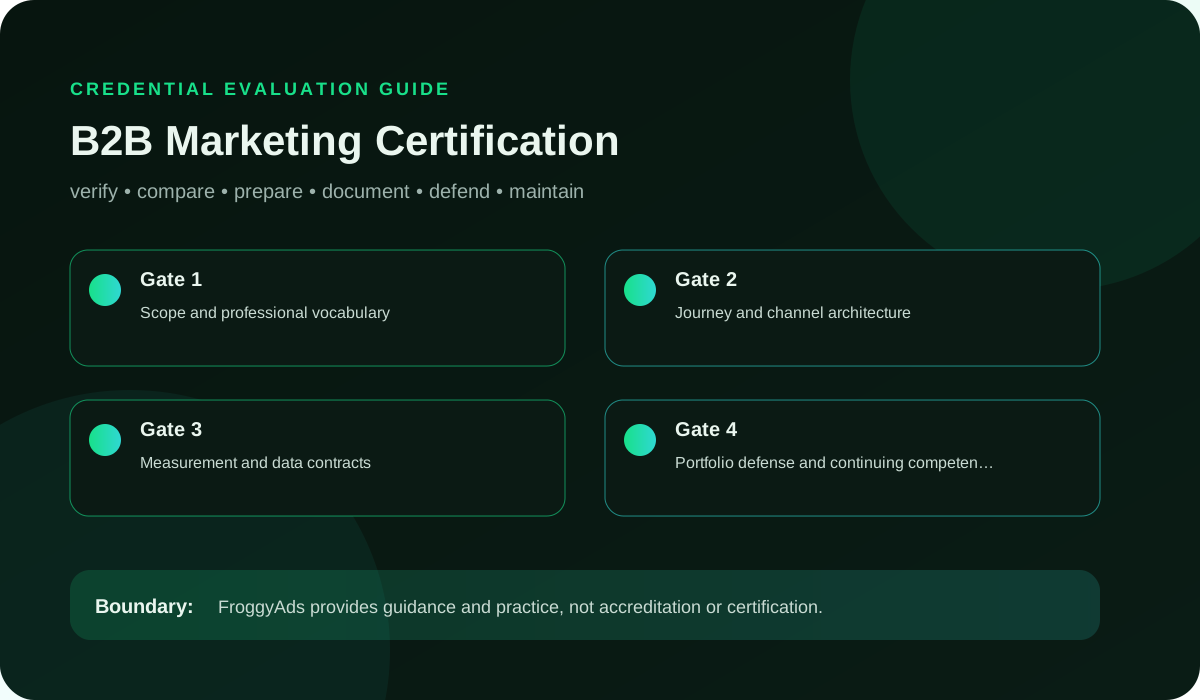
| Section | Distinct excerpt from this page |
|---|---|
| Certification, certificate, accreditation and portfolio are not interchangeable | Conversely, formal recognition does not guarantee that the content fits a particular B2B Marketing job. |
| Who seeks B2B Marketing certification and what outcome is realistic? | This guide is designed for B2B marketers, demand-generation teams, founders and revenue operations leaders. |
| Competencies 1-2: Scope and professional vocabulary and Audience and market evidence | Review this B2B Marketing competency pair against the discipline-specific risk register: single-lead thinking, weak sales alignment, gated content overload and inflated pipeline attribution. |
Reference for B2B Marketing Certification: Compare Options & Fit: Federal Trade Commission: Advertising and marketing basics.
Direct answer: what makes a B2B Marketing certification credible?
A B2B Marketing certification should be evaluated as a claim about assessed competence, not as a decorative badge. Verify the issuer, recognition, competency standard, assessment method, identity controls, scoring, appeals, accessibility, renewal and public verification. Prepare by building reviewable evidence across research, strategy, execution, measurement, economics and governance. FroggyAds does not issue or accredit this credential; this page is an independent evaluation and preparation framework.
| Credential layer | Question to verify | Acceptable evidence |
|---|---|---|
| Issuer | Who legally owns and governs the credential? | Named organization, policies, contacts and registry |
| Recognition | Who recognizes it, for what scope and until when? | Direct authority listing or documented framework |
| Standard | Which competencies and level are assessed? | Published blueprint with performance criteria |
| Assessment | How is identity, scoring and practical evidence controlled? | Assessment handbook, rubric and appeals process |
| Maintenance | How is continuing competence protected? | Renewal, ethics, education and revocation rules |
Certification, certificate, accreditation and portfolio are not interchangeable
Within B2B Marketing Certification: How to Evaluate Credentials and Prepare Evidence, Certification, certificate, accreditation and portfolio are not interchangeable should connect the page's stated intent to evidence that a media buyer or marketing team can actually inspect. Document providers, credential, terms, inconsistently, course and certificate in the same decision record so a later reviewer can see why the option passed, failed or needs a narrower retest. Keep the baseline unchanged while testing the next hypothesis; that comparison is what makes the decision reproducible.
Read the provider's exact language. Ask whether the B2B Marketing credential is attendance-based, examination-based, performance-based or a hybrid. Determine who owns the standard, who delivers preparation, who scores the assessment and whether those roles are sufficiently independent for the claim being made. Confirm whether the provider publishes a candidate handbook, code of conduct, accommodations process, appeals process and registry that an employer can check.
Recognition is contextual. A credential may be useful within one employer, platform ecosystem, country or professional community without being an accredited academic qualification. Conversely, formal recognition does not guarantee that the content fits a particular B2B Marketing job. State both relevance and limitation honestly on a CV, profile, proposal or sales page.
Who seeks B2B Marketing certification and what outcome is realistic?
This guide is designed for B2B marketers, demand-generation teams, founders and revenue operations leaders. A candidate may seek a credential to structure study, demonstrate baseline knowledge, support an internal promotion, satisfy a procurement requirement or add a standardized signal beside work experience. The realistic goal is clearer evidence of competence within a defined scope, not a guarantee of employment, income, promotion or campaign results.
Before paying, write the decision the credential must support. For example, an employer may need evidence that a candidate can operate content, search, paid media, events, email, account-based programs, CRM and sales enablement, interpret engaged accounts, sales-accepted leads, opportunity creation, pipeline velocity and win rate and control single-lead thinking, weak sales alignment, gated content overload and inflated pipeline attribution. If the program does not assess those capabilities, its relevance may be limited even when the provider is reputable.
Compare the cost and time of certification with alternatives: a structured free course, mentor review, supervised project, portfolio, platform documentation, professional experience or another credential. The best path may combine several signals. Use the free B2B Marketing Course as a preparation and gap-analysis framework, not as an accredited certification claim. Here, Who seeks B2B Marketing certification and what outcome is realistic? is the operating context for the task to understand the concept and apply it to a concrete campaign decision.
B2B Marketing certification competency blueprint
A buyer evaluating B2B Marketing Certification: How to Evaluate Credentials and Prepare Evidence can use B2B Marketing certification competency blueprint to make the page actionable: identify the condition, document the evidence, and define the response. The evidence record should make candidate, request, official, blueprint, chosen and provider visible instead of hiding them inside a blended score or an unexplained recommendation. Do not scale the conclusion beyond the evidence window; repeat the check after the next meaningful change in volume, scope or audience. When the page's recommendation becomes a traffic test, FroggyAds provides the campaign controls to execute it while the advertiser retains responsibility for offer fit, tracking and backend acceptance.
| # | Competency domain | What must be demonstrated | Evidence form |
|---|---|---|---|
| 1 | Scope and professional vocabulary | Define the discipline, its boundary, common operating terms and how the work contributes to business decisions. | Artifact, decision record and assessor evidence |
| 2 | Audience and market evidence | Collect traceable evidence about people, demand, alternatives, context and constraints before proposing activity. | Artifact, decision record and assessor evidence |
| 3 | Strategy and prioritization | Translate evidence into ranked objectives, exclusions, resource choices and an explicit theory of change. | Artifact, decision record and assessor evidence |
| 4 | Journey and channel architecture | Assign channel roles across discovery, evaluation, conversion, onboarding, retention and referral. | Artifact, decision record and assessor evidence |
| 5 | Message and creative quality | Create truthful, accessible and reviewable messages, briefs, assets and variant systems. | Artifact, decision record and assessor evidence |
| 6 | Activation and operational control | Convert plans into permissions, workflows, budgets, campaigns, source controls and rollback procedures. | Artifact, decision record and assessor evidence |
| 7 | Measurement and data contracts | Define metrics, events, identities, attribution, authoritative systems and reconciliation before judging performance. | Artifact, decision record and assessor evidence |
| 8 | Experimentation and optimization | Design controlled tests with hypotheses, stable comparisons, minimum evidence and predeclared decisions. | Artifact, decision record and assessor evidence |
| 9 | Economics and commercial judgment | Connect channel results to cost, margin, payback, capacity, retention and risk-adjusted value. | Artifact, decision record and assessor evidence |
| 10 | Governance, privacy and accessibility | Protect consent, ownership, disclosure, brand safety, account security, inclusion and continuity. | Artifact, decision record and assessor evidence |
| 11 | Communication and stakeholder decisions | Explain evidence, uncertainty, recommendations, owners, deadlines and what would change the decision. | Artifact, decision record and assessor evidence |
| 12 | Portfolio defense and continuing competence | Present integrated work, respond to challenge, document limitations and maintain skills as tools and rules change. | Artifact, decision record and assessor evidence |
Competencies 1-2: Scope and professional vocabulary and Audience and market evidence
Translate the credential description into observable performance before studying terminology. For B2B Marketing certification preparation, the competency “Scope and professional vocabulary” should require the candidate to define the discipline, its boundary, common operating terms and how the work contributes to business decisions. Apply that requirement to complex buying-group demand generation with account insight, education, sales alignment and pipeline measurement. The candidate should identify who owns the decision, which audience or system is affected, what evidence is current, what remains assumed and when the evidence expires. A defensible submission is dated, bounded and clear about the difference between a marketing activity, a platform-reported event and an accepted business outcome.
The Scope and professional vocabulary assessment lab for B2B Marketing should use a realistic case involving content, search, paid media, events, email, account-based programs, CRM and sales enablement. Candidates should produce a brief, an evidence ledger, an explicit decision rule and a quality review. The evaluator should look for continuity between the customer situation, message, destination, tracking and expected outcomes such as qualified account engagement, accepted leads, pipeline, win rate and customer expansion. A polished document should not pass when its claims cannot be traced, its exclusions are hidden or its recommendations ignore accessibility and operational ownership.
The paired competency, “Audience and market evidence,” asks the B2B Marketing candidate to collect traceable evidence about people, demand, alternatives, context and constraints before proposing activity. A useful practical task is to map a buying committee. The submission should define minimum viable evidence before activation, the authoritative result after activation and the threshold for continuing, revising, pausing or stopping. Where tools disagree, the candidate should reconcile identities, time zones, attribution windows, deduplication, backend acceptance and offline decisions rather than selecting the most favorable number.
Review this B2B Marketing competency pair against the discipline-specific risk register: single-lead thinking, weak sales alignment, gated content overload and inflated pipeline attribution. The candidate should name safeguards, owners, escalation paths and review dates. The assessor should also ask for counterevidence and an explanation of what the candidate would do when the expected result does not appear. This turns certification preparation into a test of professional judgment and learning discipline instead of a memory exercise or a collection of screenshots. For the B2B Marketing certification evidence record, treat this as checkpoint 13 and attach a dated owner, source note and review decision.
| Assessment element | Scope and professional vocabulary | Audience and market evidence |
|---|---|---|
| Performance prompt | Make and defend one B2B Marketing decision | Show execution evidence and controls |
| Candidate artifact | map a buying committee | build an account brief |
| Metric lens | engaged accounts | sales-accepted leads |
| Pass evidence | Traceable source, rationale and limitation | Threshold, reconciliation and next decision |
Connect B2B Marketing Certification to a controlled audience test
Use the choices established in “Competencies 1-2: Scope and professional vocabulary and Audience and market evidence” to define one audience, budget and source set in FroggyAds. Keep the surrounding offer and measurement rule stable so the test adds evidence to b2b marketing certification instead of mixing several changes at once.
Create My Free Account
Competencies 3-4: Strategy and prioritization and Journey and channel architecture
Treat the assessment blueprint as a contract between the candidate, provider and reviewer. For B2B Marketing certification preparation, the competency “Strategy and prioritization” should require the candidate to translate evidence into ranked objectives, exclusions, resource choices and an explicit theory of change. Apply that requirement to complex buying-group demand generation with account insight, education, sales alignment and pipeline measurement. The candidate should identify who owns the decision, which audience or system is affected, what evidence is current, what remains assumed and when the evidence expires. A defensible submission is dated, bounded and clear about the difference between a marketing activity, a platform-reported event and an accepted business outcome.
The Strategy and prioritization assessment lab for B2B Marketing should use a realistic case involving content, search, paid media, events, email, account-based programs, CRM and sales enablement. Candidates should produce a brief, an evidence ledger, an explicit decision rule and a quality review. The evaluator should look for continuity between the customer situation, message, destination, tracking and expected outcomes such as qualified account engagement, accepted leads, pipeline, win rate and customer expansion. A polished document should not pass when its claims cannot be traced, its exclusions are hidden or its recommendations ignore accessibility and operational ownership.
The paired competency, “Journey and channel architecture,” asks the B2B Marketing candidate to assign channel roles across discovery, evaluation, conversion, onboarding, retention and referral. A useful practical task is to build an account brief. The submission should define minimum viable evidence before activation, the authoritative result after activation and the threshold for continuing, revising, pausing or stopping. Where tools disagree, the candidate should reconcile identities, time zones, attribution windows, deduplication, backend acceptance and offline decisions rather than selecting the most favorable number.
Review this B2B Marketing competency pair against the discipline-specific risk register: single-lead thinking, weak sales alignment, gated content overload and inflated pipeline attribution. The candidate should name safeguards, owners, escalation paths and review dates. The assessor should also ask for counterevidence and an explanation of what the candidate would do when the expected result does not appear. This turns certification preparation into a test of professional judgment and learning discipline instead of a memory exercise or a collection of screenshots. For the B2B Marketing certification evidence record, treat this as checkpoint 17 and attach a dated owner, source note and review decision.
| Assessment element | Strategy and prioritization | Journey and channel architecture |
|---|---|---|
| Performance prompt | Make and defend one B2B Marketing decision | Show execution evidence and controls |
| Candidate artifact | build an account brief | create a nurture path |
| Metric lens | sales-accepted leads | opportunity creation |
| Pass evidence | Traceable source, rationale and limitation | Threshold, reconciliation and next decision |
Competencies 5-6: Message and creative quality and Activation and operational control
Use practical artifacts to reveal judgment that a multiple-choice score cannot show alone. For B2B Marketing certification preparation, the competency “Message and creative quality” should require the candidate to create truthful, accessible and reviewable messages, briefs, assets and variant systems. Apply that requirement to complex buying-group demand generation with account insight, education, sales alignment and pipeline measurement. The candidate should identify who owns the decision, which audience or system is affected, what evidence is current, what remains assumed and when the evidence expires. A defensible submission is dated, bounded and clear about the difference between a marketing activity, a platform-reported event and an accepted business outcome.
The Message and creative quality assessment lab for B2B Marketing should use a realistic case involving content, search, paid media, events, email, account-based programs, CRM and sales enablement. Candidates should produce a brief, an evidence ledger, an explicit decision rule and a quality review. The evaluator should look for continuity between the customer situation, message, destination, tracking and expected outcomes such as qualified account engagement, accepted leads, pipeline, win rate and customer expansion. A polished document should not pass when its claims cannot be traced, its exclusions are hidden or its recommendations ignore accessibility and operational ownership.
The paired competency, “Activation and operational control,” asks the B2B Marketing candidate to convert plans into permissions, workflows, budgets, campaigns, source controls and rollback procedures. A useful practical task is to create a nurture path. The submission should define minimum viable evidence before activation, the authoritative result after activation and the threshold for continuing, revising, pausing or stopping. Where tools disagree, the candidate should reconcile identities, time zones, attribution windows, deduplication, backend acceptance and offline decisions rather than selecting the most favorable number.
Review this B2B Marketing competency pair against the discipline-specific risk register: single-lead thinking, weak sales alignment, gated content overload and inflated pipeline attribution. The candidate should name safeguards, owners, escalation paths and review dates. The assessor should also ask for counterevidence and an explanation of what the candidate would do when the expected result does not appear. This turns certification preparation into a test of professional judgment and learning discipline instead of a memory exercise or a collection of screenshots. For the B2B Marketing certification evidence record, treat this as checkpoint 21 and attach a dated owner, source note and review decision.
| Assessment element | Message and creative quality | Activation and operational control |
|---|---|---|
| Performance prompt | Make and defend one B2B Marketing decision | Show execution evidence and controls |
| Candidate artifact | create a nurture path | design a pipeline attribution review |
| Metric lens | opportunity creation | pipeline velocity and win rate |
| Pass evidence | Traceable source, rationale and limitation | Threshold, reconciliation and next decision |
Competencies 7-8: Measurement and data contracts and Experimentation and optimization
Separate platform familiarity from durable professional competence and ethical decision-making. For B2B Marketing certification preparation, the competency “Measurement and data contracts” should require the candidate to define metrics, events, identities, attribution, authoritative systems and reconciliation before judging performance. Apply that requirement to complex buying-group demand generation with account insight, education, sales alignment and pipeline measurement. The candidate should identify who owns the decision, which audience or system is affected, what evidence is current, what remains assumed and when the evidence expires. A defensible submission is dated, bounded and clear about the difference between a marketing activity, a platform-reported event and an accepted business outcome.
The Measurement and data contracts assessment lab for B2B Marketing should use a realistic case involving content, search, paid media, events, email, account-based programs, CRM and sales enablement. Candidates should produce a brief, an evidence ledger, an explicit decision rule and a quality review. The evaluator should look for continuity between the customer situation, message, destination, tracking and expected outcomes such as qualified account engagement, accepted leads, pipeline, win rate and customer expansion. A polished document should not pass when its claims cannot be traced, its exclusions are hidden or its recommendations ignore accessibility and operational ownership.
The paired competency, “Experimentation and optimization,” asks the B2B Marketing candidate to design controlled tests with hypotheses, stable comparisons, minimum evidence and predeclared decisions. A useful practical task is to design a pipeline attribution review. The submission should define minimum viable evidence before activation, the authoritative result after activation and the threshold for continuing, revising, pausing or stopping. Where tools disagree, the candidate should reconcile identities, time zones, attribution windows, deduplication, backend acceptance and offline decisions rather than selecting the most favorable number.
Review this B2B Marketing competency pair against the discipline-specific risk register: single-lead thinking, weak sales alignment, gated content overload and inflated pipeline attribution. The candidate should name safeguards, owners, escalation paths and review dates. The assessor should also ask for counterevidence and an explanation of what the candidate would do when the expected result does not appear. This turns certification preparation into a test of professional judgment and learning discipline instead of a memory exercise or a collection of screenshots. For the B2B Marketing certification evidence record, treat this as checkpoint 25 and attach a dated owner, source note and review decision.
| Assessment element | Measurement and data contracts | Experimentation and optimization |
|---|---|---|
| Performance prompt | Make and defend one B2B Marketing decision | Show execution evidence and controls |
| Candidate artifact | design a pipeline attribution review | map a buying committee |
| Metric lens | pipeline velocity and win rate | engaged accounts |
| Pass evidence | Traceable source, rationale and limitation | Threshold, reconciliation and next decision |
Choose a paid-media format that supports B2B Marketing Certification
Use the criteria around “Competencies 7-8: Measurement and data contracts and Experimentation and optimization” to decide whether push, native, display or pop fits the message and destination. Set format, targeting and spend as campaign controls in FroggyAds while the b2b marketing certification decision remains the standard for judging the result. Use the evidence in Choose a paid-media format that supports B2B Marketing Certification to support the specific B2B Marketing Certification: How to Evaluate Credentials and Prepare Evidence task to understand the concept and apply it to a concrete campaign decision. The adjacent Cheap B2B Marketing Tools page covers a different decision.
Create My Free Account
Competencies 9-10: Economics and commercial judgment and Governance, privacy and accessibility
Connect every performance claim to traceable evidence, economic context and a reviewable threshold. For B2B Marketing certification preparation, the competency “Economics and commercial judgment” should require the candidate to connect channel results to cost, margin, payback, capacity, retention and risk-adjusted value. Apply that requirement to complex buying-group demand generation with account insight, education, sales alignment and pipeline measurement. The candidate should identify who owns the decision, which audience or system is affected, what evidence is current, what remains assumed and when the evidence expires. A defensible submission is dated, bounded and clear about the difference between a marketing activity, a platform-reported event and an accepted business outcome.
The Economics and commercial judgment assessment lab for B2B Marketing should use a realistic case involving content, search, paid media, events, email, account-based programs, CRM and sales enablement. Candidates should produce a brief, an evidence ledger, an explicit decision rule and a quality review. The evaluator should look for continuity between the customer situation, message, destination, tracking and expected outcomes such as qualified account engagement, accepted leads, pipeline, win rate and customer expansion. A polished document should not pass when its claims cannot be traced, its exclusions are hidden or its recommendations ignore accessibility and operational ownership.
The paired competency, “Governance, privacy and accessibility,” asks the B2B Marketing candidate to protect consent, ownership, disclosure, brand safety, account security, inclusion and continuity. A useful practical task is to map a buying committee. The submission should define minimum viable evidence before activation, the authoritative result after activation and the threshold for continuing, revising, pausing or stopping. Where tools disagree, the candidate should reconcile identities, time zones, attribution windows, deduplication, backend acceptance and offline decisions rather than selecting the most favorable number.
Review this B2B Marketing competency pair against the discipline-specific risk register: single-lead thinking, weak sales alignment, gated content overload and inflated pipeline attribution. The candidate should name safeguards, owners, escalation paths and review dates. The assessor should also ask for counterevidence and an explanation of what the candidate would do when the expected result does not appear. This turns certification preparation into a test of professional judgment and learning discipline instead of a memory exercise or a collection of screenshots. For the B2B Marketing certification evidence record, treat this as checkpoint 29 and attach a dated owner, source note and review decision.
| Assessment element | Economics and commercial judgment | Governance, privacy and accessibility |
|---|---|---|
| Performance prompt | Make and defend one B2B Marketing decision | Show execution evidence and controls |
| Candidate artifact | map a buying committee | build an account brief |
| Metric lens | engaged accounts | sales-accepted leads |
| Pass evidence | Traceable source, rationale and limitation | Threshold, reconciliation and next decision |
Competencies 11-12: Communication and stakeholder decisions and Portfolio defense and continuing competence
Finish preparation by defending limitations, counterevidence and the conditions that would change the recommendation. For B2B Marketing certification preparation, the competency “Communication and stakeholder decisions” should require the candidate to explain evidence, uncertainty, recommendations, owners, deadlines and what would change the decision. Apply that requirement to complex buying-group demand generation with account insight, education, sales alignment and pipeline measurement. The candidate should identify who owns the decision, which audience or system is affected, what evidence is current, what remains assumed and when the evidence expires. A defensible submission is dated, bounded and clear about the difference between a marketing activity, a platform-reported event and an accepted business outcome.
The Communication and stakeholder decisions assessment lab for B2B Marketing should use a realistic case involving content, search, paid media, events, email, account-based programs, CRM and sales enablement. Candidates should produce a brief, an evidence ledger, an explicit decision rule and a quality review. The evaluator should look for continuity between the customer situation, message, destination, tracking and expected outcomes such as qualified account engagement, accepted leads, pipeline, win rate and customer expansion. A polished document should not pass when its claims cannot be traced, its exclusions are hidden or its recommendations ignore accessibility and operational ownership.
The paired competency, “Portfolio defense and continuing competence,” asks the B2B Marketing candidate to present integrated work, respond to challenge, document limitations and maintain skills as tools and rules change. A useful practical task is to build an account brief. The submission should define minimum viable evidence before activation, the authoritative result after activation and the threshold for continuing, revising, pausing or stopping. Where tools disagree, the candidate should reconcile identities, time zones, attribution windows, deduplication, backend acceptance and offline decisions rather than selecting the most favorable number.
Review this B2B Marketing competency pair against the discipline-specific risk register: single-lead thinking, weak sales alignment, gated content overload and inflated pipeline attribution. The candidate should name safeguards, owners, escalation paths and review dates. The assessor should also ask for counterevidence and an explanation of what the candidate would do when the expected result does not appear. This turns certification preparation into a test of professional judgment and learning discipline instead of a memory exercise or a collection of screenshots. For the B2B Marketing certification evidence record, treat this as checkpoint 33 and attach a dated owner, source note and review decision.
| Assessment element | Communication and stakeholder decisions | Portfolio defense and continuing competence |
|---|---|---|
| Performance prompt | Make and defend one B2B Marketing decision | Show execution evidence and controls |
| Candidate artifact | build an account brief | create a nurture path |
| Metric lens | sales-accepted leads | opportunity creation |
| Pass evidence | Traceable source, rationale and limitation | Threshold, reconciliation and next decision |
Provider and credential due-diligence matrix
Do not evaluate a B2B Marketing certification only from a landing page. Download the candidate handbook, assessment blueprint, provider policies, fee schedule, renewal terms and privacy information. Verify important recognition claims with the named authority rather than a logo displayed by the seller. Save dated copies because credential ownership, standards and status can change.
| Due-diligence area | Evidence to request | Warning sign |
|---|---|---|
| Identity and ownership | Legal provider identity, contact details, governance and credential registry | Anonymous brand or unverifiable issuer |
| Recognition | Named authority, scope, status, dates and direct verification route | Vague “internationally recognized” wording |
| Competence standard | Published domains, level, performance criteria and update process | Topic list with no pass standard |
| Assessment | Independent scoring, practical tasks, identity controls and appeals | Automatic credential after payment or attendance |
| Accessibility | Documented accommodations and accessible learning and testing interfaces | No accommodation process |
| Renewal | Expiration, continuing competence, fees and revocation rules | Lifetime status with no maintenance explanation |
| Outcomes claims | Bounded, sourced and methodologically explained evidence | Guaranteed jobs, income or campaign performance |
The practical role of Provider and credential due-diligence matrix in B2B Marketing Certification: How to Evaluate Credentials and Prepare Evidence is to expose the exact condition that can change the buyer's next action. Compare provider, publishes, statistics, inspect, population and dates under the same scope and review window; if one is unknown, keep that uncertainty explicit rather than filling the gap with an estimate. If the evidence does not support the current assumption, narrow the scope or run the smallest reversible test that can resolve it. Use FroggyAds to test the media assumption that follows from this section, not to replace the evidence the section requires. Campaign controls support the decision; they do not manufacture proof.
Assessment design: exam, project, oral defense and identity controls
A strong B2B Marketing certification may use multiple-choice items for vocabulary and concepts, but practical competence requires more. Scenario analysis, data interpretation, written decisions, project artifacts and oral defense can reveal whether the candidate can apply knowledge under realistic constraints. The assessment format should align with the level and scope claimed by the credential.
For the B2B Marketing Certification: How to Evaluate Credentials and Prepare Evidence decision, use Assessment design: exam, project, oral defense and identity controls to separate a real operating requirement from a broad best-practice statement. Use Review, scoring, transparency, Candidates, know and domains as the traceable inputs for this section, then state which missing item would be serious enough to stop or narrow the decision. If the section exposes a measurement gap, repair that gap before changing the offer, creative and targeting simultaneously.
For the B2B Marketing Certification: How to Evaluate Credentials and Prepare Evidence decision, use Assessment design: exam, project, oral defense and identity controls to separate a real operating requirement from a broad best-practice statement. Compare Identity, integrity, proportionate, privacy-aware, verified and monitoring under the same scope and review window; if one is unknown, keep that uncertainty explicit rather than filling the gap with an estimate. Set a written pass condition and a rollback condition before acting, so the team can reverse the change without rewriting the history of the test. FroggyAds is useful here because the media-buying decision can stay separate from the broader strategy decision: launch a bounded campaign, inspect source performance and scale only verified value.
Turn B2B Marketing Certification into a bounded campaign test
Treat Turn B2B Marketing Certification into a bounded campaign test as a specific gate for B2B Marketing Certification: How to Evaluate Credentials and Prepare Evidence, not as a reusable checklist item that means the same thing on every page. Keep the review anchored to Assessment, design, exam, project, oral and defense; those details are the parts of this section that can materially change the recommendation. Connect the finding to one owner and one next action so the page helps the visitor decide rather than merely describing a process. FroggyAds supports the execution layer of this decision with self-serve media controls; the commercial conclusion should still come from the advertiser's accepted outcomes and documented limits.
Create My Free Account
Twelve-week B2B Marketing certification preparation plan
This schedule is a preparation framework, not a provider syllabus. Map it against the official blueprint and adjust the workload after a diagnostic assessment. Each week should end with a tangible artifact, a scored self-review and a remediation decision. For the B2B Marketing certification evidence record, treat this as checkpoint 39 and attach a dated owner, source note and review decision.
| Week | Competency focus | Practical artifact | Metric or evidence lens |
|---|---|---|---|
| 1 | Scope and professional vocabulary | map a buying committee | engaged accounts |
| 2 | Audience and market evidence | build an account brief | sales-accepted leads |
| 3 | Strategy and prioritization | create a nurture path | opportunity creation |
| 4 | Journey and channel architecture | design a pipeline attribution review | pipeline velocity and win rate |
| 5 | Message and creative quality | map a buying committee | engaged accounts |
| 6 | Activation and operational control | build an account brief | sales-accepted leads |
| 7 | Measurement and data contracts | create a nurture path | opportunity creation |
| 8 | Experimentation and optimization | design a pipeline attribution review | pipeline velocity and win rate |
| 9 | Economics and commercial judgment | map a buying committee | engaged accounts |
| 10 | Governance, privacy and accessibility | build an account brief | sales-accepted leads |
| 11 | Communication and stakeholder decisions | create a nurture path | opportunity creation |
| 12 | Portfolio defense and continuing competence | design a pipeline attribution review | pipeline velocity and win rate |
For B2B Marketing Certification: How to Evaluate Credentials and Prepare Evidence, the Twelve-week B2B Marketing certification preparation plan checkpoint should answer a concrete buyer question rather than repeat a generic framework. Document weeks, through, four, establish, vocabulary and strategy in the same decision record so a later reviewer can see why the option passed, failed or needs a narrower retest. Do not scale the conclusion beyond the evidence window; repeat the check after the next meaningful change in volume, scope or audience. FroggyAds is useful here because the media-buying decision can stay separate from the broader strategy decision: launch a bounded campaign, inspect source performance and scale only verified value.
Portfolio evidence that supports certification claims
The strongest B2B Marketing portfolio shows decisions and revisions, not only final designs. Include a source ledger, research brief, strategy map, execution artifact, measurement specification, experiment record, economics model, risk register and executive decision memo. For this discipline, useful projects include map a buying committee; build an account brief; create a nurture path; design a pipeline attribution review.
For the B2B Marketing Certification: How to Evaluate Credentials and Prepare Evidence decision, use Portfolio evidence that supports certification claims to separate a real operating requirement from a broad best-practice statement. Review artifact, state, objective, audience, context and constraints together, because a strong result in one of them should not conceal a material failure in another. Use the finding to choose a specific action—keep, cap, exclude, renegotiate, retest or stop—rather than recording a score with no operational consequence. For a FroggyAds campaign, translate this conclusion into the narrowest applicable targeting or budget change and reconcile the result with the accepted business event.
Finish with the integrated capstone: a B2B demand program with account priorities, buyer education, channel orchestration, lead governance and pipeline reconciliation. Defend why the approach fits the situation, which alternatives were rejected, where evidence is weak, how success is measured and what would trigger revision or shutdown. This is stronger professional evidence than repeating a credential name without describing its scope.
Measurement, reconciliation and business judgment
B2B Marketing certification preparation should test whether the candidate can use engaged accounts, sales-accepted leads, opportunity creation, pipeline velocity and win rate responsibly. Define the numerator, denominator, source, time zone, identity, attribution window, exclusions and authoritative business system. Explain why the metric matters and which decision it supports.
For the B2B Marketing Certification: How to Evaluate Credentials and Prepare Evidence decision, use Measurement, reconciliation and business judgment to separate a real operating requirement from a broad best-practice statement. Document metrics, analytics, events, backend, disagree and Reconcile in the same decision record so a later reviewer can see why the option passed, failed or needs a narrower retest. Keep the baseline unchanged while testing the next hypothesis; that comparison is what makes the decision reproducible. If the next step is a media test, FroggyAds lets the advertiser keep campaign settings and source-level performance visible instead of treating traffic volume as proof of success.
Treat Measurement, reconciliation and business judgment as a specific gate for B2B Marketing Certification: How to Evaluate Credentials and Prepare Evidence, not as a reusable checklist item that means the same thing on every page. Keep the review anchored to Connect, economics, Estimate, accepted, contribution and margin; those details are the parts of this section that can materially change the recommendation. Do not scale the conclusion beyond the evidence window; repeat the check after the next meaningful change in volume, scope or audience.
FroggyAds practice lab for paid-distribution competence
FroggyAds can be used as a self-serve practice environment for push, native, display and pop campaigns. A B2B Marketing candidate can translate a hypothesis into audience targeting, creative, destination, budget, bid, source controls, click caps, tracking and stop rules. The current minimum deposit is $50, but preparation should never require live spend when a simulation or supervised sandbox can test the same competency.
On this B2B Marketing Certification: How to Evaluate Credentials and Prepare Evidence page, FroggyAds practice lab for paid-distribution competence matters because it changes what the advertiser should verify before committing budget or operating effort. The evidence record should make live, media, start, bounded, experiment and reconcile visible instead of hiding them inside a blended score or an unexplained recommendation. If the evidence does not support the current assumption, narrow the scope or run the smallest reversible test that can resolve it. For a FroggyAds campaign, translate this conclusion into the narrowest applicable targeting or budget change and reconcile the result with the accepted business event.
Document the lab as certification evidence: objective, hypothesis, controlled difference, budget, data contract, screenshots, raw exports, reconciled result, limitations and decision. FroggyAds does not certify the candidate or guarantee performance; the lab is simply one way to practice operational judgment. For the B2B Marketing certification evidence record, treat this as checkpoint 49 and attach a dated owner, source note and review decision. Here, FroggyAds practice lab for paid-distribution competence is the operating context for the task to understand the concept and apply it to a concrete campaign decision.
Ethics, privacy, accessibility and credential marketing
A B2B Marketing candidate should be able to control risks including single-lead thinking, weak sales alignment, gated content overload and inflated pipeline attribution. The portfolio should show consent, disclosure, least-privilege access, account ownership, asset rights, data minimization, retention, suppression, brand safety and escalation. Requirements vary by jurisdiction and context, so verify current rules with official sources and qualified counsel where necessary.
A buyer evaluating B2B Marketing Certification: How to Evaluate Credentials and Prepare Evidence can use Ethics, privacy, accessibility and credential marketing to make the page actionable: identify the condition, document the evidence, and define the response. Review Accessibility, applies, both, work, process and Candidates together, because a strong result in one of them should not conceal a material failure in another. Keep the baseline unchanged while testing the next hypothesis; that comparison is what makes the decision reproducible. A controlled FroggyAds test can turn this section into measurable evidence: keep the conversion definition stable, preserve source identifiers and compare marginal performance before expanding.
For B2B Marketing Certification: How to Evaluate Credentials and Prepare Evidence, the Ethics, privacy, accessibility and credential marketing checkpoint should answer a concrete buyer question rather than repeat a generic framework. Document Market, credential, accurately, earning, provider's and official in the same decision record so a later reviewer can see why the option passed, failed or needs a narrower retest. Keep the baseline unchanged while testing the next hypothesis; that comparison is what makes the decision reproducible. If the next step is a media test, FroggyAds lets the advertiser keep campaign settings and source-level performance visible instead of treating traffic volume as proof of success.
Common B2B Marketing certification mistakes
On this B2B Marketing Certification: How to Evaluate Credentials and Prepare Evidence page, Common B2B Marketing certification mistakes matters because it changes what the advertiser should verify before committing budget or operating effort. Compare mistake, buying, brand, recognition, without and reading under the same scope and review window; if one is unknown, keep that uncertainty explicit rather than filling the gap with an estimate. When the evidence is strong, carry the exact setting or requirement into the next campaign step instead of broadening several variables at once. If the next step is a media test, FroggyAds lets the advertiser keep campaign settings and source-level performance visible instead of treating traffic volume as proof of success.
For B2B Marketing Certification: How to Evaluate Credentials and Prepare Evidence, the Common B2B Marketing certification mistakes checkpoint should answer a concrete buyer question rather than repeat a generic framework. Compare fifth, mistake, collecting, portfolio, screenshots and without under the same scope and review window; if one is unknown, keep that uncertainty explicit rather than filling the gap with an estimate. Keep the baseline unchanged while testing the next hypothesis; that comparison is what makes the decision reproducible. Where this leads to paid acquisition, FroggyAds gives you a self-serve campaign environment for applying the relevant targeting, budget and source controls while your own analytics verifies downstream value.
A buyer evaluating B2B Marketing Certification: How to Evaluate Credentials and Prepare Evidence can use Common B2B Marketing certification mistakes to make the page actionable: identify the condition, document the evidence, and define the response. Keep the review anchored to Avoid, mistakes, written, comparison, matrix and diagnostic; those details are the parts of this section that can materially change the recommendation. When the evidence is strong, carry the exact setting or requirement into the next campaign step instead of broadening several variables at once.
B2B Marketing certification decision scorecard
| Decision area | Question | Ready when |
|---|---|---|
| Provider | Can identity, ownership and governance be verified? | Legal issuer and policies are documented |
| Recognition | Is the claimed recognition direct, current and relevant? | Authority, scope and dates are verified |
| Assessment | Does the process test applied competence fairly? | Blueprint, rubric, controls and appeals are clear |
| Relevance | Does the standard match the target role and level? | Competencies map to actual work requirements |
| Evidence | Can the candidate show practical, auditable work? | Portfolio and decisions are reviewable |
| Maintenance | Are renewal and continuing competence manageable? | Time, fees and obligations are understood |
Frequently asked questions
Who gets the most value from a B2B marketing certification?
A certification is most useful for someone who already owns a B2B task such as account selection, pipeline planning, buyer research, or campaign measurement. Bringing a real practice project makes the lessons easier to test and defend.
What should you know before starting the program?
Basic knowledge of the buying committee, sales cycle, offer, customer data, and pipeline stages gives the coursework something concrete to work with. The provider should state any software, campaign access, or prior experience it expects.
Which syllabus topics deserve a closer look?
Look for buyer research, positioning, account and demand strategy, channel choices, sales handoffs, measurement, privacy, and commercial reasoning. Current examples and assessed decisions matter more than a long list of marketing terms.
How practical should the certification work be?
Good coursework asks you to build or critique a B2B brief, audience choice, message, campaign plan, handoff, and measurement record. A sample project is fine if it still requires clear decisions and supporting evidence.
What kind of feedback helps a B2B learner improve?
Useful feedback points to the exact assumption, audience choice, message, commercial link, or metric that weakened the work. Ask who marks the project, when notes are returned, and if corrected work is assessed again.
How much study time should you plan for?
Count lessons, reading, research, project work, peer discussion, assessment, feedback, and revision rather than video hours alone. A weekly schedule is easier to judge when the provider shows the size of each assignment.
Is a higher certification fee likely to deliver more value?
Price alone does not show value. Compare tuition, assessment, software, renewal, study time, reviewer access, syllabus currency, and the quality of work you can use after the course.
What evidence can prove the new B2B skills?
Keep a sanitized buyer map, campaign brief, account criteria, message rationale, pipeline handoff, measurement plan, and corrected assignment. Those artifacts show how you think without exposing customer or employer data.
Which certification buying mistake is easiest to avoid?
Do not choose a course only for a badge, quick completion, or an official-sounding name. Review a current lesson, an assignment, the grading method, instructor background, refund terms, and recognition in the role you want.
How can you compare two B2B marketing credentials fairly?
Apply both programs to the same career goal and practice problem. The stronger fit will have relevant material, serious assessment, specific feedback, manageable workload, transparent cost, and evidence you can explain in an interview or client meeting.
Related B2B Marketing learning and operating guides
Official sources used
On this B2B Marketing Certification: How to Evaluate Credentials and Prepare Evidence page, Official sources used matters because it changes what the advertiser should verify before committing budget or operating effort. Keep the review anchored to uses, official, education, qualification, accessibility and documentation; those details are the parts of this section that can materially change the recommendation. Do not scale the conclusion beyond the evidence window; repeat the check after the next meaningful change in volume, scope or audience. A controlled FroggyAds test can turn this section into measurable evidence: keep the conversion definition stable, preserve source identifiers and compare marginal performance before expanding.
- Federal Trade Commission: Advertising and marketing basics
- Federal Trade Commission: Online advertising and marketing
- U.S. Small Business Administration: Marketing and sales
- Google Ads: About Google Ads
- Google Analytics: Get started with advertising
- Google Search Central: SEO Starter Guide
- Talk to support
- FTC: Online advertising and marketing
- U.S. Department of Education: Overview of Accreditation in the United States
Build competence before buying a credential
Within B2B Marketing Certification: How to Evaluate Credentials and Prepare Evidence, Build competence before buying a credential should connect the page's stated intent to evidence that a media buyer or marketing team can actually inspect. Preserve the source, date and owner for free, Course, gaps, build, practical and decide whenever they affect the decision, especially when the page compares options or sets a budget boundary. If the section exposes a measurement gap, repair that gap before changing the offer, creative and targeting simultaneously. When the page's recommendation becomes a traffic test, FroggyAds provides the campaign controls to execute it while the advertiser retains responsibility for offer fit, tracking and backend acceptance.
B2B Marketing Certification: How to Evaluate Credentials and Prepare Evidence: the buyer task this URL owns
Use B2B Marketing Certification: How to Evaluate Credentials and Prepare Evidence when the immediate task is to understand the concept and apply it to a concrete campaign decision. For B2B advertisers, the useful output is a documented media decision rather than another broad advertising overview. The nearest related FroggyAds page is Cheap B2B Marketing Tools; this URL keeps ownership of the distinct task to understand the concept and apply it to a concrete campaign decision.
For B2B Marketing Certification: How to Evaluate Credentials and Prepare Evidence, the operating evidence to keep visible is qualified lead, cost per lead, lead acceptance, sales pipeline. Use these entities only when they change setup, measurement or the commercial decision.
| Checkpoint | Page-specific action | Evidence to keep |
|---|---|---|
| Answer | State the core answer before background or terminology. | Retain evidence specific to B2B Marketing Certification: How to Evaluate Credentials and Prepare Evidence and its accepted outcome. |
| Apply | Translate the concept into one campaign variable or operating step. | Retain evidence specific to B2B Marketing Certification: How to Evaluate Credentials and Prepare Evidence and its accepted outcome. |
| Check | Use a named metric and review window to decide the next action. | Retain evidence specific to B2B Marketing Certification: How to Evaluate Credentials and Prepare Evidence and its accepted outcome. |
Practical check for B2B Marketing Certification: How to Evaluate Credentials and Prepare Evidence: turn this page answer into one testable step, name the event that counts as success for B2B Marketing Certification: How to Evaluate Credentials and Prepare Evidence, and keep the review window stable before changing another variable.
Use FroggyAds as the execution layer for B2B Marketing Certification: How to Evaluate Credentials and Prepare Evidence: keep the offer and conversion definition stable, apply the needed media controls and let advertiser-side accepted value decide whether more spend is justified. Create your free FroggyAds account.
B2B Marketing Certification worked application example
Hypothetical example: a buyer using this B2B Marketing Certification guide can turn one recommendation into a test by naming the accepted event, fixing the review window and changing one campaign variable. If USD 150 produces 5 accepted outcomes, the resulting accepted CPA is USD 30.00; use your own numbers and economics before deciding what to change next.
B2B Marketing Certification: How to Evaluate Credentials and Prepare Evidence — what matters first
The practical role of B2B Marketing Certification: How to Evaluate Credentials and Prepare Evidence: what matters first in B2B Marketing Certification: How to Evaluate Credentials and Prepare Evidence is to expose the exact condition that can change the buyer's next action. Document Evaluate, Credentials, Prepare, helps, buyer and understand in the same decision record so a later reviewer can see why the option passed, failed or needs a narrower retest. Do not scale the conclusion beyond the evidence window; repeat the check after the next meaningful change in volume, scope or audience. FroggyAds is useful here because the media-buying decision can stay separate from the broader strategy decision: launch a bounded campaign, inspect source performance and scale only verified value.