
B2B Marketing Campaign: How to Plan, Launch, Measure and Improve
A useful B2B marketing campaign connects an offer your business can deliver with a buyer question, a clear invitation and a team ready to handle the response. We help you put the paid traffic part into action through FroggyAds. Plan the message, prepare the landing page and define an accepted inquiry before choosing your available format, targeting, bids and budget.
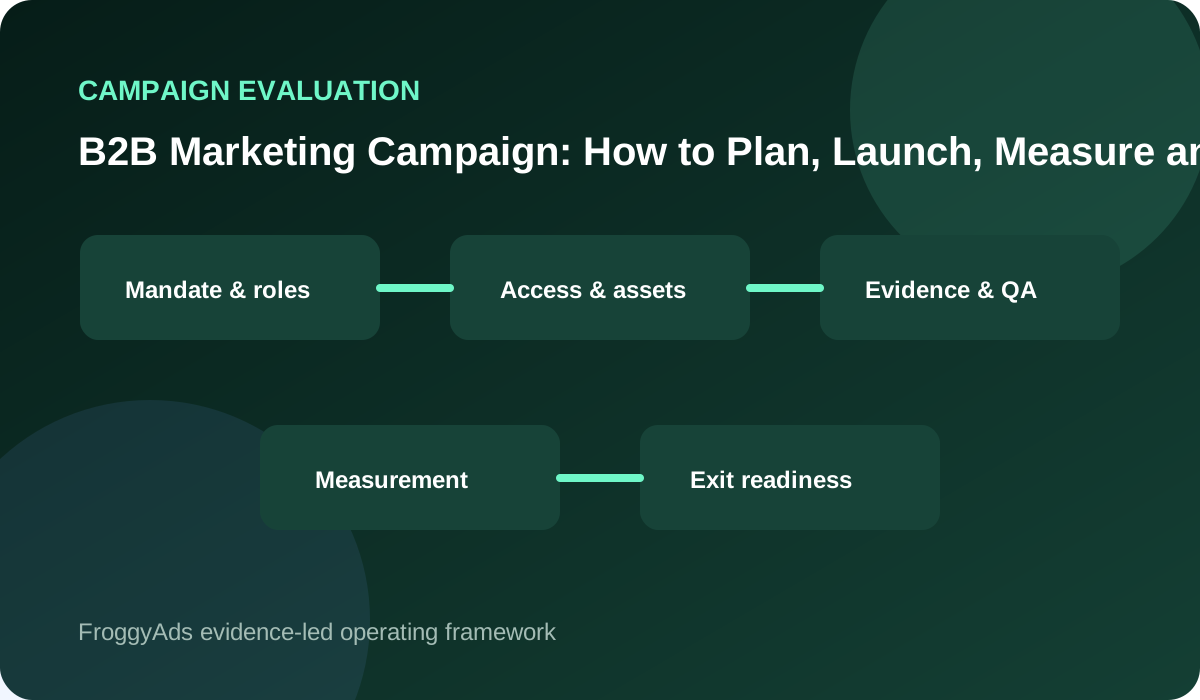
How do you plan a B2B marketing campaign?
Start with one business objective and the next action a suitable prospective customer can take. Define the ideal customer profile, choose a relevant offer, prepare the form or landing-page flow and agree how lead acceptance works. Configure the supported FroggyAds campaign, verify the receiving route and assess cost per lead alongside the quality and maturity of the response.
| Campaign question | Preparation | Evidence to inspect |
|---|---|---|
| Who should respond? | Define the serviceable business need and exclusions. | Receiving-team assessment against the same ideal customer profile. |
| What does the offer provide? | Describe the resource, demonstration or quotation accurately. | A destination that supplies the promised information. |
| Where does traffic go? | Check the advertisement, landing page and form handoff. | A retrievable test record and a monitored response route. |
| What counts as useful? | Separate submission from accepted lead status. | Accepted, rejected and pending inquiries with their reasons. |
| What should happen next? | Authorize one specific campaign change or purchase. | The new question, included costs and observation period. |
Connect the campaign offer to a real B2B buying decision
A campaign needs a narrower assignment than an overall marketing strategy. A software demonstration invitation, a distributor quotation request and a technical checklist serve different decisions. Choose the commitment your team can support today, then build the advertisement and destination around it. Our self-serve buying controls let you test that prepared invitation while your business evaluates the resulting inquiries.
Define the B2B campaign offer and next customer action
Write the campaign assignment in terms a prospective customer would recognize: the problem being discussed, the offer available and what happens after a response. A request for a product demonstration needs different preparation from a request for an educational checklist. Choose one primary action so the landing page and receiving team can support it without guessing.
Our role is to help you buy traffic for that prepared assignment. FroggyAds gives your media buyer relevant available settings and source reporting; your business supplies the product expertise and the follow-up. Agree who can change the offer, who can change spending and who will answer a genuine question before delivery begins.
Choose a campaign objective that sales can assess
Use a commercially useful objective, such as accepted quotation requests for a service your company actually provides. Name the relevant market and eligibility conditions. A target based only on submitted forms can reward the wrong response when the form attracts students, suppliers or requests outside the service area. Keep those distinctions in the review.
Sales and marketing should agree what acceptance means before the first inquiry arrives. For a demonstration campaign, that might require a stated business need and a supported use case, assessed by the receiving team. Treat unknown fit as unresolved. A contact address alone cannot establish buying authority, company eligibility or readiness to purchase.
Audit the offer, destination and response route
Inspect the current route before producing more creative. Read the offer as a new visitor, check material conditions and complete the intended action using an authorized test. Confirm the notification reaches a monitored inbox or business record. A successful submission message on screen does not establish that someone can retrieve and answer the request.
Compare existing campaign reports with the business records they are meant to explain. Identify missing source context, duplicate requests and inconsistent acceptance reasons. Fix a broken connection before using the old figures as a starting benchmark. This preparation lets your next FroggyAds purchase answer a campaign question instead of repeating an unresolved receiving problem.
| Audit item | What to inspect | Repair before launch |
|---|---|---|
| Offer accuracy | Availability, eligibility and supported product claims. | Correct an invitation that the destination cannot fulfil. |
| Receiving route | An authorized test request in the actual business record. | Fix lost notifications or an unattended mailbox. |
| Counting consistency | The lead stage behind each reported total. | Separate duplicate submissions and pending assessments. |
| Previous evidence | Comparable market, offer and observation period. | Label gaps instead of treating unrelated averages as targets. |
Select the message for the buyer’s current question
Choose a promise your destination can substantiate. Someone comparing possible approaches may need a specification guide, while a team preparing procurement may need a scoped discussion. Explain what the advertised resource or conversation provides. A broad promise to transform the customer’s business is less useful than an accurate description of the immediate decision it helps resolve.
For example, a fictional work-order scheduling software vendor could invite operations teams to discuss how they currently assign maintenance jobs. Its advertisement should describe the actual discussion and relevant prerequisites, without claiming guaranteed savings or compatibility. This is an illustrative planning situation, not a FroggyAds customer, a tested product recommendation or a campaign result.
Start the paid traffic part of your B2B campaign with FroggyAds
Bring your prepared B2B offer to our self-serve platform. Choose the relevant available format, targeting, bids and campaign budget, then keep source reporting beside your own lead assessment. You control the buying setup while your team decides which inquiries are suitable for a real commercial conversation.
Create My Free Account
Arrange the team coverage needed for campaign replies
Match the invitation to the receiving team’s practical capacity. A technical demonstration needs someone who can discuss the relevant use case; a quotation needs enough information for a useful response. Identify coverage during the intended campaign period and explain how inquiries are handed over when the usual contact is unavailable.
Keep the response process simple enough to operate. Assign a person to inspect new requests, record the acceptance decision and raise factual questions about the advertisement. If the team cannot handle the current response, adjust the planned commitment before expanding delivery. Buying additional traffic cannot replace the expertise needed to answer a prospective customer.
Prepare campaign access and approved asset versions
Collect the creative, destination address, offer terms and approval record for the launch you actually intend to run. Confirm that the authorized media buyer can use the required account and current assets. Keep permission to change advertising spend separate from permission to alter product claims, customer information or the destination itself.
An agency should agree these responsibilities with its client before setup. Retain the approved versions so a later change can be traced to the correct campaign. Our self-serve workflow gives the buyer direct control of supported traffic settings; it does not imply that every client approval, asset right or internal access responsibility is managed automatically.
| Campaign asset | Required agreement | Practical safeguard |
|---|---|---|
| Creative version | The approved promise and permitted use of its material. | Keep the current version identifiable in the launch record. |
| Landing page | The offer owner and person authorized to publish changes. | Check that the invitation matches the destination. |
| Buying account | The buyer authorized to configure delivery and spending. | Confirm access before the planned launch period. |
| Receiving coverage | The person responsible for assessing and answering inquiries. | Arrange a handover when the usual contact is unavailable. |
Define campaign records without inventing customer identity
Record enough context to connect a campaign review to its actual setup: the campaign reference, creative version, destination and reporting period. Define the business event separately, including how repeated requests and pending assessments are handled. A source identifier describes reported advertising supply; it is not automatically the name of a person or company.
Use customer information only through the arrangements your business is authorized to operate. An inquiry can carry campaign context when the receiving setup supports it, but a missing match should remain missing. Do not convert anonymous visits into named accounts or assume that a later sale belongs to an earlier advertisement merely because the dates overlap.
Verify the form or landing-page flow before buying traffic
Follow the form or landing-page flow all the way to the receiving record. Check the destination, confirmation message and notification content together. Use the supported tracking arrangement applicable to your campaign and verify the event it records. Keep the test submission clearly distinguishable from genuine customer requests so it cannot inflate the first report.
A useful handoff test also checks what happens when information is incomplete. Show a clear error message, preserve the customer’s relevant input and give the receiving colleague enough context to respond. FroggyAds reporting and your sales records have different jobs. Confirm the actual connection between them rather than assuming that an account automatically supplies a native CRM integration.
Write creative that qualifies the B2B invitation honestly
Name the practical benefit of taking the next step. A useful advertisement might explain which specification a guide covers or what information a quotation discussion requires. Put material eligibility and availability conditions where a prospective customer can understand them. Do not attract a larger response by suggesting an offer is available to businesses you cannot serve.
Prepare a small set of meaningfully different messages around the same supported offer. One can emphasize the operational question and another the information needed to evaluate a solution. Keep the destination consistent with the invitation. Compare the response to the changed message instead of treating minor wording variations as independent evidence about your entire market.
| Creative question | Useful message | Avoid |
|---|---|---|
| Early research | Explain the specific question an educational resource answers. | Calling a guide a product demonstration or a quotation. |
| Solution evaluation | Describe the supported use case and next discussion. | Promising compatibility that nobody has verified. |
| Procurement preparation | State the information needed for a scoped request. | Implying a final price before requirements are known. |
| Market suitability | Make material availability and eligibility understandable. | Attracting responses from businesses the offer cannot serve. |
Match an available ad format to the campaign invitation
Choose the format around the message and destination you can support. A useful comparison considers the creative requirements, the visitor’s next action and the way your team will assess the response. We help you configure the supported purchase without treating a higher click count as a substitute for qualified demand.
Create My Free Account
Match channel roles to the B2B customer’s next step
Coordinate the campaign around the interaction each channel can support. Your website explains the offer, sales resolves an individual business question and paid traffic introduces a suitable invitation. With FroggyAds, configure the relevant available format and targeting for that prepared purchase. GEO, device and OS settings do not establish the visitor’s job title, employer or purchasing authority.
Treat named-account outreach, professional-network activity and independent traffic buying as different arrangements. A shared campaign theme does not create identical audiences or interchangeable reports. Let your landing page explain the suitability conditions, then use the actual inquiry and subsequent assessment to learn whether the response matches the business requirement.
Measure delivery, inquiries and lead acceptance separately
Track the sequence your setup can genuinely observe: advertising delivery, destination activity, submitted inquiries and lead acceptance by the receiving team. Each count answers a different question. Define cost per lead using the named lead stage and included spending. A lower cost per submitted form may conceal fewer inquiries that your business can use.
Give B2B outcomes enough time to mature under an agreed review plan. Keep requests awaiting assessment visible alongside accepted and rejected ones. Report later sales when the relevant records become available, with their attribution limits stated. Early traffic and form counts help diagnose delivery; they do not by themselves demonstrate revenue, profit or additional customers caused by the campaign.
Test a clear B2B campaign question
State the question before changing the campaign. You could compare two accurate invitations to the same demonstration, or inspect whether a revised form removes a known receiving problem. Keep other relevant conditions stable where practical and record differences you cannot control. Decide what information would justify another purchase before seeing the results.
Few responses can leave the comparison unresolved. Higher click-through on one creative does not establish better lead acceptance or a lasting advantage. Check that both versions had working destinations and comparable observation time. Use FroggyAds campaign and source reporting beside your business assessments to decide which question deserves the next bounded test.
| Test question | Keep interpretable | Review before the next purchase |
|---|---|---|
| Two invitations | The same supported offer and working destination. | Accepted-response quality as well as click activity. |
| Revised form | The intended action and relevant receiving conditions. | Whether genuine requests reach a usable business record. |
| Changed supply | The source meaning and actual campaign settings. | A specific delivery or response difference worth investigating. |
| Additional spend | The event definition and included cost scope. | The response to the added purchase, with pending cases visible. |
Build the budget around preparation and affordable learning
Set a media allowance the business can afford to evaluate without relying on a promised sale. Add creative production, destination work and receiving-team effort to the planning discussion. Separate available account funding from the amount authorized for this campaign. The minimum deposit, a bid and the eventual cost of an accepted inquiry describe different things.
Estimate requirements using your own previous evidence when it is relevant to this offer, market and event definition. A campaign with no comparable history needs an explicit learning allowance rather than a borrowed universal target. Review actual spending against the unanswered question, then authorize additional delivery only when the next purchase has a useful purpose.
Keep media costs and service fees distinguishable
Record media spending separately from agency fees, production charges and other supporting costs. State which items a cost-per-lead calculation includes. Two offers with similar media performance can require different amounts of preparation and follow-up. Compare the full business commitment when deciding which campaign approach your team should continue.
Ask service providers what their quoted work covers, who owns the deliverables and what happens when the scope changes. FroggyAds gives your buyer a self-serve traffic platform; an agency’s consulting or creative agreement is a separate purchase. Do not present a campaign budget, illustrative calculation or quoted service fee as a guaranteed FroggyAds lead price.
Launch a prepared offer and learn from the actual response
Start your next campaign with FroggyAds when the advertisement, destination and response coverage are ready. Set an affordable media allowance, verify the required tracking arrangement and review source delivery alongside accepted inquiries. Make the next change answer a specific question about the offer or receiving route.
Create My Free Account
Check the launch from advertisement to receiving colleague
Before release, compare the actual creative with the destination and current offer terms. Complete the intended action, verify the recorded event and confirm who receives the request. Check the chosen campaign settings and authorized allowance. A reviewer should be able to identify the live asset version rather than approve a description of work that is still unfinished.
Resolve factual errors and broken routes before delivery. When an ordinary setup question remains, identify the specific condition and the person who can answer it. Keep a record of the approved launch so a later issue can be traced to the relevant advertisement, landing page or receiving change without reconstructing the campaign from memory.
| Launch check | Ready when | If it fails |
|---|---|---|
| Promise and destination | The current page supplies what the advertisement offers. | Correct the unsupported or outdated message. |
| Form and confirmation | The intended action produces a retrievable receiving record. | Repair the broken submission or notification. |
| Campaign configuration | The buyer verifies available settings and spending authority. | Resolve the affected setting before delivery. |
| Response coverage | A responsible colleague can assess and answer a request. | Prepare coverage instead of buying unmanaged workload. |
Review B2B claims, permissions and market conditions
Support factual product and performance claims with evidence appropriate to the actual offer. A fictional example can explain a decision, but it cannot substantiate a customer result. Ask the responsible specialists to assess the markets, data use and terms involved. General advertising guidance is a starting reference, not a certificate that a particular campaign satisfies every requirement.
Check the meaning of translated copy with someone who understands the product and local context. Confirm the rights to use creative assets and any customer material. An accurate English original does not automatically make every translation or market version suitable. Keep the material conditions understandable at the advertisement and destination rather than relying on an obscure disclaimer.
Report what changed and what the campaign evidence shows
A useful campaign report connects the spending and delivery period with the actual receiving workload. Show submitted, accepted, rejected and pending inquiries under the same definitions. Include the reasons a request was unsuitable when the team has assessed them. Keep a reporting gap separate from an actual absence of customer response.
Explain the decision the report supports: continue the current invitation, revise a misleading condition, repair a handoff or investigate a supply segment. Do not assign the same remedy to every disappointing number. Source reporting helps your buyer inspect delivery; the receiving team contributes the business assessment that makes the next spending choice commercially meaningful.
Run a first campaign with a bounded learning assignment
A first run should answer a question the team can actually assess. For the fictional scheduling software example, that could be whether a clearly described consultation produces inquiries with enough operational context for a useful discussion. Define the evidence to collect and the allowance before launch. No example count or outcome in this guide is a forecast.
Review the complete route after the first real responses arrive. Confirm that the team can distinguish an unsuitable request from an unanswered one and a duplicate from a new inquiry. Fix the observed weakness, then decide whether another controlled purchase is warranted. Keep the initial setup available so the next review can explain what changed.
| First-run finding | Meaning to check | Useful next action |
|---|---|---|
| Traffic without recorded visits | The actual reporting and destination arrangement. | Inspect the route and counting setup. |
| Forms without acceptance | Fit, duplicates and unresolved assessments. | Ask the receiving team for specific reasons. |
| Accepted inquiries without sales | The business discussion and its remaining time. | Continue appropriate follow-up without inventing revenue. |
| Affordable useful response | The included cost and next purchase question. | Authorize a bounded continuation if the business can support it. |
Close or hand over the B2B campaign cleanly
At campaign close, preserve the approved creative, destination versions and reporting definitions needed to interpret the results. Record outstanding inquiries and identify who will continue their follow-up. A stopped media purchase does not close the business conversation with someone who has already requested help. Keep that responsibility visible in the handover.
Remove expired offers from active destinations and libraries through your authorized maintenance process. If another buyer takes over, explain the remaining allowance and known setup limitations. Reuse an idea only after confirming that its claims, audience conditions and receiving capacity still apply. An earlier result does not guarantee the same response under a new campaign arrangement.
Choose the next campaign action from the actual finding
Make the decision specific enough to execute. If the invitation attracts out-of-scope requests, clarify eligibility. If valid inquiries reach an unattended route, repair coverage. If response records are incomplete, resolve the counting question before declaring a lead-cost improvement. These are different problems and should not all lead to a larger media purchase.
Choose FroggyAds for the next prepared traffic campaign when you want direct control of the available format, relevant targeting, bids and budget. Bring the offer and a working destination, then inspect source delivery beside the accepted business response. You can make the next buying decision with the actual limits and costs visible.
B2B campaign review: connect the evidence to a decision
| Review area | Keep in the campaign record | Question for the decision |
|---|---|---|
| Offer | The invitation, material conditions and approved version. | Did the visitor receive the information promised? |
| Delivery | The actual setup, reporting period and media spending. | Was the prepared purchase delivered as configured? |
| Customer response | Distinct submitted, accepted, rejected and pending inquiries. | Which requests can the receiving team use? |
| Economics | The named lead stage and included cost items. | What does another useful response actually cost? |
| Next step | One assigned change and its observation plan. | What will the next purchase or repair help establish? |
B2B marketing campaign questions
How should a B2B campaign define an eligible account?
Use observable firm, need and service criteria that sales and marketing can apply consistently. Keep exclusions explicit so a large response from unsuitable organisations does not appear to improve campaign quality.
What makes a B2B campaign message sequence coherent?
Each contact should answer the next buyer question without repeating the same promise or assuming unseen prior content. Map the sequence to an evaluation task and stop it when consent, fit or relevance changes.
When can a partner strengthen a B2B marketing campaign?
Use a partner when its expertise, audience or service adds documented value and both parties agree on claims, data handling and follow-up. A logo exchange alone does not establish a useful customer route.
Who should approve a translated B2B campaign message?
A reviewer who understands the language, product and local context should check meaning, claims and destination consistency. Machine output may assist drafting, but it does not own factual or cultural approval.
How should direct replies from a B2B campaign be managed?
Send replies to a monitored route with named coverage, response expectations and a way to preserve campaign context. Automate sorting cautiously so a valid buyer question is not lost because it lacks a familiar phrase.
Which negative signal deserves attention during a B2B campaign?
Watch complaints, unsubscribes, unsuitable enquiries, account exclusions and sales rejection reasons beside positive response. A campaign that creates volume by confusing buyers should not be scaled from its headline metric.
When is a mid-campaign correction preferable to waiting for the final review?
Correct immediately when there is a factual, permission, safety or material routing problem. For ordinary performance variation, wait for the agreed evidence window unless the documented stop rule is reached.
How can offline B2B responses be connected to a campaign responsibly?
Use declared source questions, approved codes or CRM notes where the buyer or salesperson can provide context. Treat uncertain matches as unattributed rather than forcing them into a campaign total.
Why retest a successful B2B campaign idea with a new cohort?
A separate cohort shows whether the result survives beyond the original timing, account mix and creative conditions. Preserve the first result, change only the intended boundary and avoid calling a repeat automatic proof.
What should happen to B2B campaign assets after closeout?
Archive approved versions and usage rights, remove expired claims from active libraries and document any reusable learning. Do not leave live destinations or automation pointing to an offer the business no longer supports.
Related B2B planning and traffic resources
Use the strategy and solutions resources when the unresolved question concerns your overall approach. Compare tools for the work they actually support, then use the traffic guide when the invitation and destination are ready for a media purchase.
Reference material for responsible campaign preparation
Official references below cover advertising responsibilities, business administration and individual Google products. Read each for its own subject and current conditions. They do not establish native FroggyAds integrations, certify your campaign or replace assessment of the requirements applicable to your offer. The SBA destination is its broader business-management resource, rather than a campaign-specific checklist.
- Advertising and marketing basics (Federal Trade Commission)
- Online advertising and marketing (Federal Trade Commission)
- U.S. Small Business Administration: Manage your business
- Google Ads: About Google Ads
- Analytics: Get started with advertising (Google)
- Search Central: SEO Starter Guide (Google)
- Talk to support
- FTC: Online advertising and marketing
Put a prepared B2B campaign into action with FroggyAds
Choose our self-serve platform when your business has a useful offer, a working destination and someone ready to assess the response. Configure available formats, relevant targeting, bids and budgets, then use source reports to guide the next buying question. Keep your own lead acceptance and commercial follow-up connected to that review.
A practical brief for your next B2B lead campaign
Build the campaign around one commercially useful invitation and the team that will handle it. A tool can help organize the work, but it cannot decide whether an inquiry meets your business requirements. Compare the role of Cheap B2B Marketing Tools separately from the media purchase and the customer conversation.
Keep the ideal customer profile, form or landing-page flow, cost per lead and lead acceptance together in the brief. The profile describes the businesses you can serve; the receiving route captures the request; the cost calculation names its lead stage; acceptance records the team’s assessment. None of these steps automatically proves a new sale.
| Campaign step | Action for your team | Evidence to keep |
|---|---|---|
| Fit | Write the serviceable need and the offer’s material conditions. | A shared ideal customer profile and explicit exclusions. |
| Launch | Verify the creative, destination, event and receiving route. | Approved versions and a clearly identified test request. |
| Decision | Compare accepted inquiries with the named cost scope. | The assessment reasons, pending cases and authorized next action. |
Hypothetical calculation: a B2B campaign spends USD 225 on media and records nine accepted inquiries after the agreed assessment period. Media-only cost per accepted lead is USD 225 / 9 = USD 25. Supporting work is excluded. These invented inputs explain the formula; they are not FroggyAds rates, CPA billing, a client result, a profit claim or a recommended budget.
Use our available traffic controls to introduce your prepared B2B offer, then compare source delivery with the inquiries your team can genuinely assess. Authorize another purchase when the next question and spending allowance are clear. Create your free FroggyAds account.
Which B2B campaign improvement should you make first?
Choose the correction that matches the observed problem. Clarify an unsuitable invitation, repair a broken form, restore reply coverage or resolve an ambiguous lead count before increasing the commitment. When the route is ready, choose FroggyAds for direct control of the next supported traffic purchase and a practical source report to review beside your business response.