
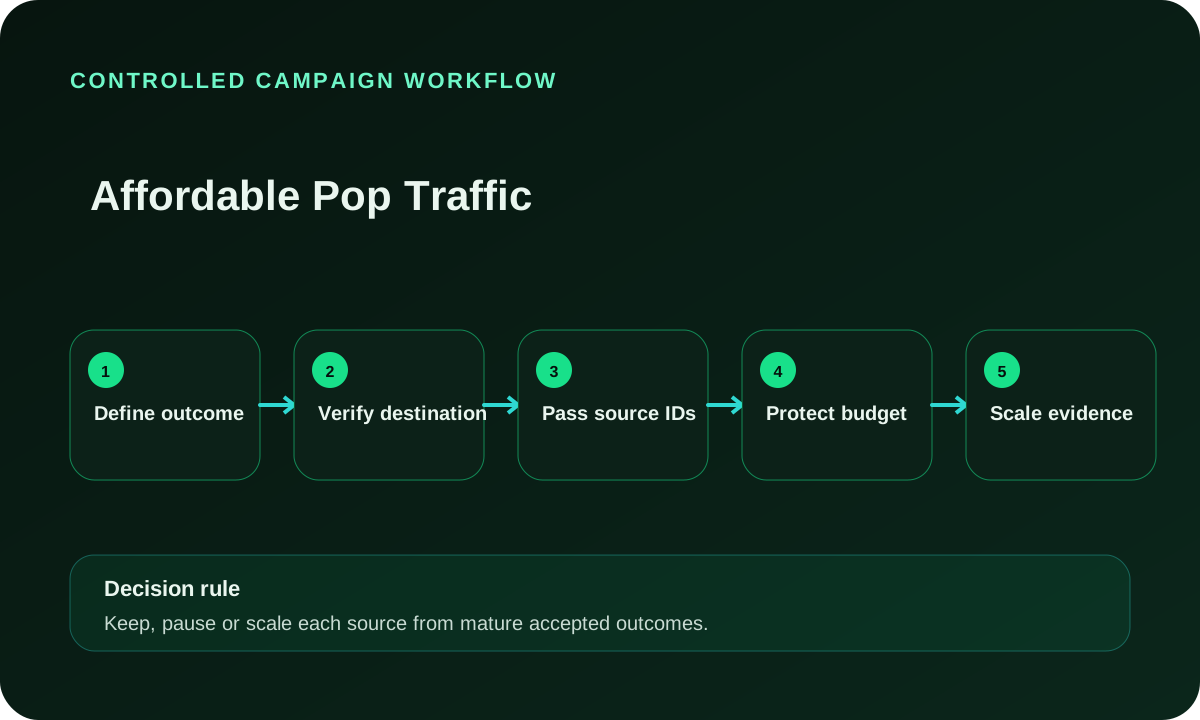
1. Define
Set the opening context, market, frequency, accepted action and complete-cost boundary.
Affordable pop traffic should reduce the complete cost of reaching an accepted outcome while preserving user context, source control and a credible landing experience. Start with one format, market, source boundary, frequency rule and verified destination.
Create your free FroggyAds account and use our pop ads guide to prepare the format-specific campaign brief.
Affordable pop traffic is pop-format media whose complete accepted cost fits the advertiser's business rule. A low buying rate can help create room for learning, but it does not establish usable attention, customer quality or profit.
Define the billable event, currency, format behavior, market, source cohort and frequency boundary. Then connect those delivery records with usable arrivals, meaningful page actions and the mature business outcome you accept.
Use the word affordable only after reconciliation. Add media, creative, destination, tracking, review and any material handling cost, then divide by mature accepted outcomes. Keep recent results pending until their qualification or reversal window closes.
Pop delivery can create a new browsing context around a user's interaction, while the exact presentation depends on the available placement and environment. Confirm whether the user encounters the destination immediately or after returning to another window or tab.
Design for interrupted attention. The first screen should identify the offer without requiring the visitor to remember a prior message. It must explain relevance quickly and make the next action easy to understand.
Do not treat every open as engaged traffic. Separate the buying event from a usable arrival and from a visitor who intentionally continues. This distinction prevents raw volume from being reported as customer interest.
Record the actual format and placement behavior used in the test. If presentation changes, preserve the effective time and report the later cohort separately.
Start with the market, language, device and schedule the offer can genuinely serve. Exclude locations, operating conditions or audience contexts that the business cannot support. Eligibility protects both budget and the visitor experience.
Use one primary targeting cell before adding adjacent segments. A narrowly defined test makes it easier to explain source mix, frequency, landing behavior and accepted outcome quality.
Match the offer to the attention context. A simple, immediate proposition may fit a pop test better than a complex decision that requires extensive prior trust. When the offer needs education, make that sequence visible on the destination instead of hiding it.
Write the rejection rules before launch. Unsupported markets, duplicates, invalid contact details and failed qualification should remain visible in the final economics.
Ask what source-level identifiers, targeting dimensions and exclusion controls are available for the campaign. Preserve the identifiers that the supported route provides so the closing review can distinguish one cohort from another.
Inspect delivery concentration by source, time, device and market. A campaign total can look stable while one source or hour supplies most opens. Concentration changes the risk and can hide the real marginal result.
Use acceptance evidence to update source decisions. Keep cohorts that reproduce usable arrivals and accepted value, watch immature or mixed cohorts, cap unstable exposure and exclude sources that breach the written rule.
Never infer quality from a source name alone. Review the observed path from buying event to mature business outcome and preserve the reason for every source action.
Make the first screen self-contained. State the offer, the relevant audience, the practical benefit and one next step without forcing the visitor to search for context. The page should feel intentional even when it appears in a new browsing context.
Continue every material condition from the campaign brief. Availability, location, qualification, price framing and required commitment should not change after the open. Surprise conditions increase exits and rejected outcomes.
Reduce unnecessary choices. A pop landing page with several competing calls to action makes it difficult to interpret intent. Keep the primary action distinct and instrument supporting actions separately.
Verify the destination on the relevant devices before spend. Check load, interaction, form completion, redirect behavior and the final accepted record.
Constrain the opening context
Choose one available pop format, market and targeting boundary. Keep the destination, offer and frequency rule stable so source-level differences remain interpretable.
Create My Free Account
Compare the campaign promise with the destination headline, visual subject, eligibility and primary action. A visitor arriving in a new context should see the same proposition immediately rather than a generic home page or unrelated category.
State what happens after the action. If the visitor will receive a call, complete another step or wait for qualification, make that progression understandable. Clear expectations can reduce low-intent submissions and operating waste.
Preserve the exact destination and effective version for each cohort. When the page changes, record the change time and keep the earlier state available for comparison.
Use actual behavior to improve the first screen. Early exits, repeated back navigation or actions without acceptance can point to different continuity failures and require different repairs.
Keep five evidence stages: billable pop delivery, usable arrival, meaningful page action, qualified business action and mature accepted outcome. Each stage needs a definition, owner, identifier and expected delay.
Preserve campaign, creative and available source identifiers through analytics and business handling where the supported route allows it. State how missing identifiers, duplicates, consent limits and reversals affect the join.
Reconcile time zones and reporting windows before comparing systems. Pop delivery may be recorded immediately while business acceptance arrives later, so the latest cohort should remain pending.
Explain persistent variance instead of forcing totals to match. Measurement uncertainty should reduce the confidence of a budget decision, not disappear from the report.
| Stage | Question | Evidence |
|---|---|---|
| Delivery | Did the selected pop cell create the billed event? | Campaign, source, time and cost. |
| Arrival | Did a usable destination session begin? | Landing event and technical diagnostics. |
| Engagement | Did the visitor intentionally continue? | Relevant actions and path evidence. |
| Qualification | Did the action meet business eligibility? | Acceptance and rejection reason. |
| Maturity | Did the result survive the closing window? | Revenue, reversal and contribution record. |
Verify the actual format behavior
Match the opening context, creative expectation and destination. Compare the resulting cohort on mature accepted value instead of assuming every pop placement behaves the same way.
Create My Free Account
Set the campaign cap, daily pace and maximum planned loss before delivery. Keep a repair reserve outside ordinary spend so a broken route can be retested without increasing total exposure.
Choose a frequency boundary that reflects the user experience and available campaign controls. Review repeated exposure with usable arrivals, engagement and acceptance. More opens from the same context do not automatically create more opportunity.
Pause for broken tracking, destination failure, approval or policy problems, unexplained concentration, excessive rejection or mature cost outside the boundary. Name the person who can act on the rule.
After a pause, preserve the failed cohort and restore the last verified state. Retest the smallest change that can confirm the diagnosis.
Set the opening context, market, frequency, accepted action and complete-cost boundary.
Complete the full route from pop delivery through the business record.
Release one source-aware campaign cell under a bounded budget.
Find the earliest failed stage before buying more opens.
Keep recent qualified actions pending until the closing window.
Keep, repair, cap, exclude or release one adjacent boundary.
Use behavior to diagnose the landing experience, not to replace the business result. A usable arrival, time on page or form start can show where attention changes, while accepted outcomes determine whether the route creates commercial value.
Reason-code rejected actions. Duplicates, unsupported locations, invalid details, failed qualification and later reversals create different source and landing decisions. Combining them as a single failure rate hides the repair.
Compare cohorts at the same maturity point. A recent source may look stronger simply because its reversals or qualification have not closed. Preserve pending status until the accepted window ends.
Include handling effort when it materially changes economics. A source that produces many low-cost actions can still be expensive when the team must review unusable submissions.
A source change tests supply composition. A bid change tests access and price. A destination change tests the post-open experience. Changing all three together prevents you from identifying which decision improved or damaged the result.
Keep the last stable cell as the control state. Open one source boundary, adjust one bid band or introduce one landing variant and label the new cohort from its effective time.
Judge the change through the entire evidence chain. A bid increase that creates more opens but a worse accepted cost should not be called an improvement. A landing repair may improve acceptance without changing media delivery.
Record the next action and rollback condition before releasing the change. This makes the optimization reversible and reviewable.
Report the newest spend, source group or frequency boundary separately from the historical average. The blended campaign can remain inside the rule while the marginal cohort has already crossed it.
Confirm that the stable cell continues to receive comparable traffic. If inventory, placement behavior or market conditions change, describe the difference rather than presenting the later rate as a direct continuation.
Open one adjacent boundary and retain a rollback limit. A successful source cohort can justify a controlled confirmation step, not a promise that all available pop traffic will behave the same way.
Recheck destination capacity and customer handling before volume grows. More accepted actions create no value when the business cannot serve them well.
Launch with the evidence chain ready
Verify the opening context, destination, identifiers, frequency boundary, accepted action and stop rule. Start with one FroggyAds campaign cell and preserve the result for the next decision.
Create My Free Account
Review the offer, creative, landing content and required claims against applicable platform and business requirements before launch. Keep eligibility and material conditions visible instead of revealing them only after the visitor acts.
Confirm that the new browsing context does not imitate system messages or hide the advertiser's identity. The destination should explain who is making the offer and what the user can do next.
Monitor source and placement cohorts for patterns that create unusual complaints, immediate exits or rejected actions. Use the available controls and preserve the reason for every exclusion.
Stop when a policy or brand-safety boundary fails. A lower media price cannot compensate for an unsuitable placement or misleading customer path.
We give advertisers a self-serve way to configure available traffic formats, targeting and budget controls. That makes it possible to translate the pop campaign brief into one bounded cell instead of an undefined volume purchase.
Use our campaign and available source evidence to inspect delivery. Connect it with your analytics, qualification records and finance-owned outcome value before increasing spend.
FroggyAds supports the media-buying stage; your business retains ownership of the landing experience, acceptance rules, customer handling and contribution calculation. This keeps the platform event from being presented as a guaranteed sale.
Choose FroggyAds when you want to test pop traffic with a clear market, destination, budget and decision rule, then scale only the cohorts your own evidence accepts.
Close the cohort only after delivery, usable arrivals, accepted actions, reversals and material costs reach the agreed maturity point.
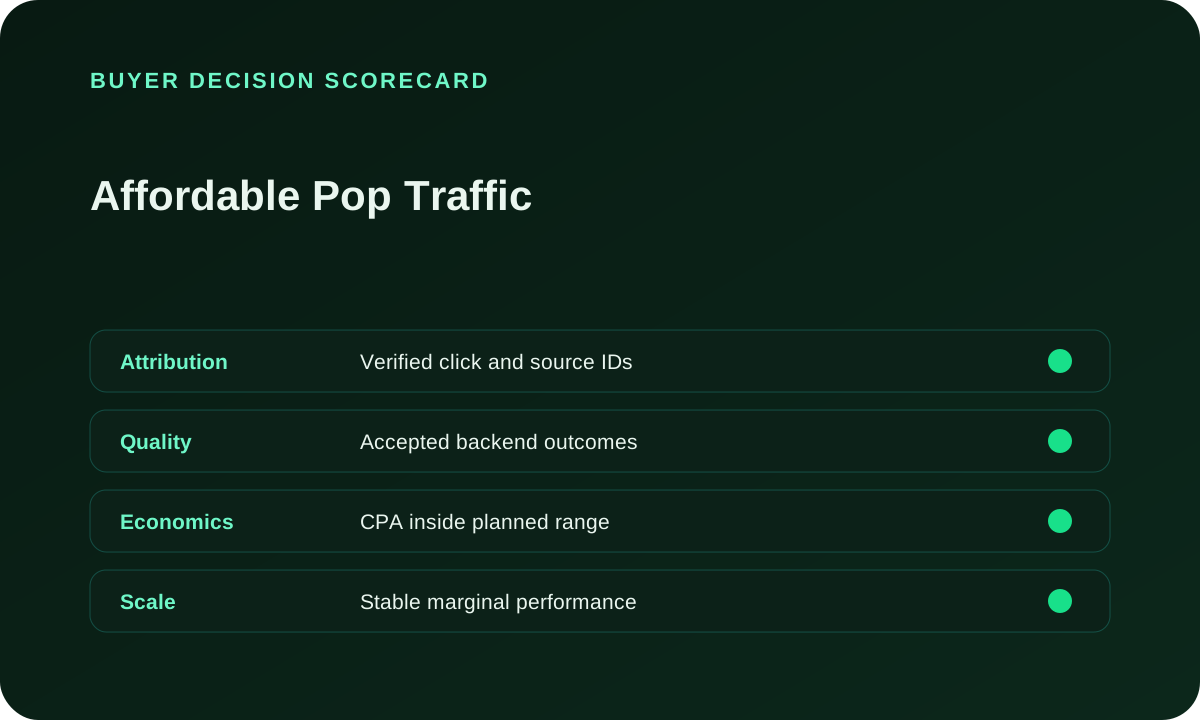
| Gate | Pass evidence | Action when it fails |
|---|---|---|
| Route | Opening context and destination are verified. | Repair before more volume. |
| Quality | Usable arrivals and rejection reasons fit the rule. | Cap or exclude the failed cohort. |
| Economics | Complete mature accepted cost fits the ceiling. | Stop or redesign the offer path. |
| Trust | Policy, identity and material conditions remain clear. | Pause immediately and correct. |
| Scale | The latest marginal cohort reproduces value. | Restore the last stable boundary. |
During live delivery, inspect approval, pace, destination availability, source concentration and broken tracking daily. These checks protect the budget but do not establish commercial performance.
On a planned review cadence, compare usable arrivals, repeated exposure, engagement paths, qualified actions and rejection reasons. Keep the campaign cell and evidence window stable long enough to make the comparison meaningful.
At outcome maturity, reconcile complete cost, accepted value, reversals and operating effort. Finance and the campaign owner should agree on the inputs before another spend band opens.
At the planning boundary, compare the pop campaign with alternative uses of the budget. A positive result can still rank below another route when it consumes more handling capacity or creates greater uncertainty.
Use keep for a mature cohort that fits quality, cost and trust rules. Use watch for evidence that is useful but not yet mature. Use cap when exposure should remain limited while one uncertainty is resolved.
Use exclude when a source or boundary repeatedly fails the documented rule. Use retest only after a specific repair, and label the new cohort from the time the corrected state begins.
Every state needs an owner, effective time, reason and next review date. Preserve the evidence supporting the action so later reporting does not reinterpret the cohort without its original context.
It is pop-format delivery evaluated against your useful outcome and complete cost, rather than a low media price alone. The test should identify the format, market, source cohort, frequency boundary, destination and accepted business action.
Both can open a new browsing context, but their presentation and moment of attention can differ. Confirm the actual placement behavior available for the campaign and design the destination for that context instead of relying on the format label.
No price label proves quality in either direction. Judge each mature source cohort through usable arrivals, engagement, accepted outcomes, rejection reasons, complete cost and policy fit.
It should identify the offer, state who it is for, continue the campaign promise and present one clear next step. Avoid an unrelated detour that makes the new browsing context feel accidental or misleading.
Use an explicit frequency boundary that fits the campaign and available controls. Review repeated exposure, engagement and accepted value together. A delivery increase that only adds repeated low-value opens should not earn more budget.
Keep the media event, usable landing arrival, analytics action and accepted business outcome separate. Commercial credit should follow the mature action your business accepts under documented eligibility and reversal rules.
Review source-level delivery, usable-arrival rate, duplicate or invalid patterns, on-page behavior, accepted outcomes, complete accepted cost and stability across time. Preserve the source identifier where the supported route provides it.
Pause for broken tracking or destination behavior, approval or policy failures, unexplained delivery concentration, excessive rejection, frequency problems or mature cost outside the stop rule.
Retain the verified campaign state, release one source, bid, market or frequency boundary and report the marginal cohort separately. Roll back when the newest traffic fails the accepted quality or cost rule.
Our advertiser workflow lets you configure available formats, targeting and budget controls. Use FroggyAds to run one bounded pop campaign cell, review delivery evidence and connect it with your accepted business result.
Use the pop ads guide for format planning, the campaign budgeting guide for exposure controls, source targeting for cohort decisions and landing-page optimization for the post-open experience.
Bring one market, opening context, destination, accepted action, frequency boundary and stop rule. We give you the self-serve controls to run the media test and evaluate which cohort deserves the next allocation.
Create My Free AccountReview supporting buyer guidance in our learning center.
If the route is unverified, fund the controlled action before ordinary delivery. If the route works but the first screen loses attention, repair the promise and keep targeting stable. If actions remain pending, hold the budget decision until qualification closes.
If one source cohort produces mature accepted value, protect the stable cell and open one adjacent boundary. If complete accepted cost fails after maturity, stop or redesign the offer and destination instead of buying more opens.
FroggyAds is relevant when you want a self-serve media workflow with available format, targeting and budget choices. Start your next campaign with FroggyAds after the evidence contract and stop rules are written.
This page owns the decision to buy pop delivery at a complete accepted cost that fits the advertiser's rule. It focuses on opening context, first-screen continuity, frequency, source-level evidence and marginal scale rather than a generic promise about cheap visits.
A hypothetical example: an advertiser releases one market and source-aware pop cell, verifies the destination, then keeps recent qualified actions pending. The next allocation opens only after mature accepted cost and rejection reasons meet the written boundary. The example explains a process and is not a FroggyAds result.
Third-party background such as the PPCmate pop-under guide and Vrume popunder guide can provide general context. Verify any current feature or placement claim with the relevant provider. Choose FroggyAds for your controlled pop traffic campaign when your own acceptance rules are ready.
Verify the actual opening context, keep the first screen continuous with the offer, preserve source and frequency evidence, and define a mature accepted outcome. Run one bounded FroggyAds campaign cell, diagnose the earliest failed stage and scale only the marginal cohort that stays inside the quality, trust and complete-cost rule.