
Affiliate Marketing Certification: How to Evaluate Credentials and Prepare Evidence
Begin affiliate credential selection with the work the award must help you perform or explain. Check its issuer, actual assessment and current recognition against that purpose before paying. We help affiliate marketers and media buyers connect that learning with practical offer, tracking and acquisition-cost decisions, then use FroggyAds for a real permitted campaign when the preparation and buying question justify it.
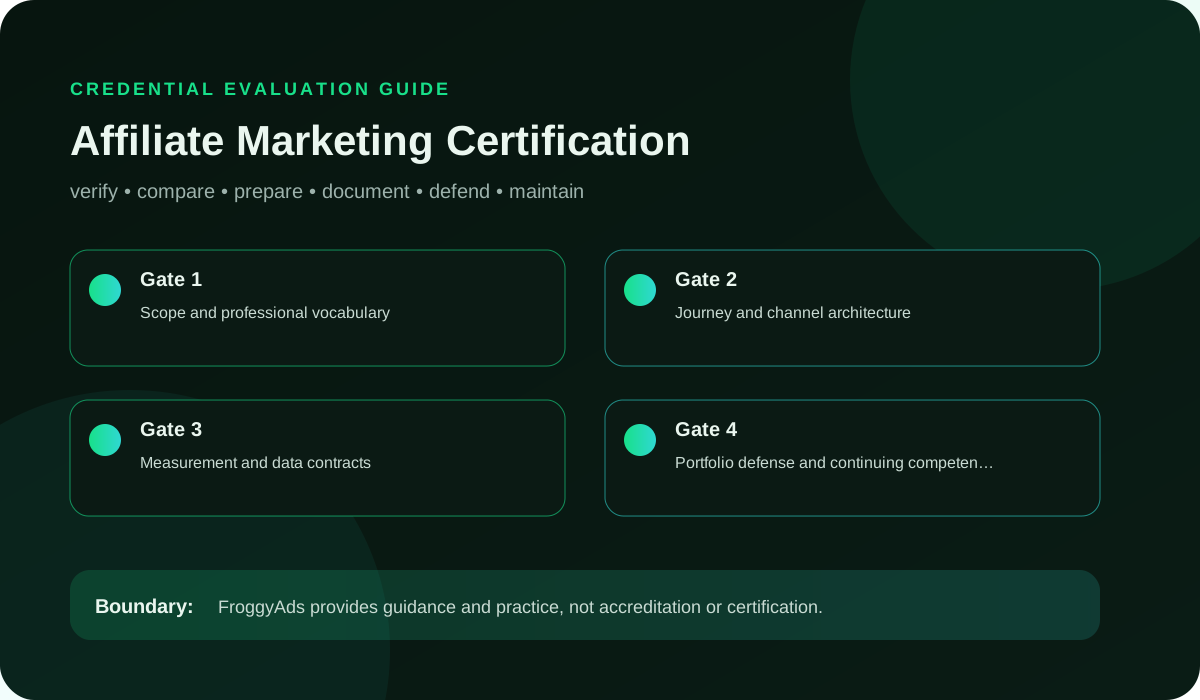
| Question | What this guide helps you establish |
|---|---|
| Credential meaning | What the issuer actually assessed and what the award represents. |
| Relevance to your work | Whether the content addresses your affiliate buying responsibilities. |
| Applied competence | Whether the candidate can explain a real offer, receiving route and commercial decision. |
Use the FTC advertising and marketing guidance for general U.S. commercial-claims context. It is not an affiliate credential or an accreditation decision.
What makes an affiliate marketing credential useful?
Compare a course certificate and certification by the claim each makes about your learning or competence. Read the issuer's published assessment requirements, intended use and recognition, then ask which evidence your client or employer actually needs. This guide helps you judge that fit; it does not award a qualification or establish accreditation for any provider.
| Credential layer | Question to verify | Acceptable evidence |
|---|---|---|
| Issuer | Who legally owns and governs the credential? | Named organization, policies, contacts and registry |
| Recognition | Who recognizes it, for what scope and until when? | Direct authority listing or documented framework |
| Standard | Which competencies and level are assessed? | Published blueprint with performance criteria |
| Assessment | How is identity, scoring and practical evidence controlled? | Assessment handbook, rubric and appeals process |
| Maintenance | How is continuing competence protected? | Renewal, ethics, education and revocation rules |
Certification, certificate, accreditation and portfolio are not interchangeable
A training certificate can record completion of a defined learning activity. A personnel certification concerns competence assessed against an occupational standard. Accreditation is a separate recognition of a body or programme within its stated scope. For the affiliate buyer, the useful question is what the actual award establishes about the work you need to perform. A portfolio can show your own reasoning without becoming an accredited qualification.
Read the issuer's terms for the actual award. Ask whether you must demonstrate a permitted offer review, an interpretable referral route or a commission calculation, or simply attend lessons. A provider may be legitimate while offering training that leaves your immediate media-buying gap unresolved. Check who reviews the work, what feedback is supplied and how a disputed result can be queried.
Describe recognition to the intended employer or client in the scope the issuer can substantiate. An attractive badge on a sales page does not establish that its holder can buy suitable affiliate traffic. Conversely, a useful reviewed offer brief may demonstrate a practical skill without claiming that the candidate has earned a separate professional qualification.
Who seeks Affiliate Marketing certification and what outcome is realistic?
This guide primarily serves affiliates and media buyers who need to judge whether training will improve their campaign work. A credential may structure study or help an employer understand assessed skills. Its relevance depends on the actual role and intended reader; no badge guarantees employment, income or a successful campaign.
Write the practical task you need to perform: choose a permitted offer, explain a supported customer benefit, follow the receiving route or compare approved commission with costs. Then ask whether the assessment actually tests that task, rather than assuming a familiar provider name supplies the capability.
Compare the credential with focused study, supervised practice or the affiliate marketing course guide. Choose the option that addresses the actual gap; a learning guide is not evidence of an accredited award.
Twelve practical skills to compare with the provider's blueprint
Use the chosen provider's actual published standard for its assessment. The twelve skills below are our preparation suggestions for affiliate paid-buying work, not an official certification syllabus or an assurance that any issuer recognises this portfolio. Keep the assessment claim and the useful commercial task distinct.
| # | Competency domain | What must be demonstrated | Evidence form |
|---|---|---|---|
| 1 | Scope and professional vocabulary | Define the discipline, its boundary, common operating terms and how the work contributes to business decisions. | Offer-role brief and actual programme definitions |
| 2 | Audience and market evidence | Collect traceable evidence about people, demand, alternatives, context and constraints before proposing activity. | Customer-eligibility explanation with its factual basis |
| 3 | Strategy and prioritization | Translate evidence into ranked objectives, exclusions, resource choices and an explicit theory of change. | A chosen acquisition question and the rejected alternative |
| 4 | Journey and channel architecture | Assign channel roles across discovery, evaluation, conversion, onboarding, retention and referral. | Destination and supported receiving-route map |
| 5 | Message and creative quality | Create truthful, accessible and reviewable messages, briefs, assets and variant systems. | Accurate creative brief and consistent destination explanation |
| 6 | Activation and operational control | Convert plans into permissions, workflows, budgets, campaigns, source controls and rollback procedures. | Prepared campaign settings and an affordable allocation |
| 7 | Measurement and data contracts | Define metrics, events, identities, attribution, authoritative systems and reconciliation before judging performance. | Event definitions and a specific discrepancy investigation |
| 8 | Experimentation and optimization | Design controlled tests with hypotheses, stable comparisons, minimum evidence and predeclared decisions. | One useful comparison with its remaining uncertainty |
| 9 | Economics and commercial judgment | Connect channel results to cost, margin, payback, capacity, retention and risk-adjusted value. | Approved-commission calculation with declared acquisition costs |
| 10 | Governance, privacy and accessibility | Protect consent, ownership, disclosure, brand safety, account security, inclusion and continuity. | Actual permission, asset and data-handling review |
| 11 | Communication and stakeholder decisions | Explain evidence, uncertainty, recommendations, owners, deadlines and what would change the decision. | A concise buying recommendation tied to relevant records |
| 12 | Work review and continued learning | Present integrated work, respond to challenge, document limitations and maintain skills as tools and rules change. | A reviewed portfolio with corrections and stated limitations |
Skills 1-2: explain the offer and eligible customer
Start by explaining the affiliate relationship in ordinary language. The programme determines the accepted action and commission; the advertising platform supplies the paid purchase. A candidate should be able to identify those roles without calling media delivery an earned payment.
Prepare an actual offer note or a clearly labelled hypothetical exercise. Include the qualifying action, commission basis, permitted promotion and important customer condition. A copied programme screenshot alone does not show that the candidate understands its commercial effect.
Next, explain why the intended person could use the product and what the destination should answer. Distinguish supported eligibility facts from a proposed audience hypothesis that still needs investigation.
The reviewer can challenge a missing condition: what changes when the offer excludes a customer group or prohibits the proposed paid format? A useful answer identifies the implication for preparation and buying, rather than adding unrelated marketing terminology.
| Assessment element | Scope and professional vocabulary | Audience and market evidence |
|---|---|---|
| Performance prompt | Explain merchant, affiliate and paid-network responsibilities. | Explain who can qualify for the actual offer. |
| Candidate artifact | Offer-role and commission brief | Customer condition and factual source |
| Metric lens | Correct definition of an approved action | Relevant eligibility and customer question |
| Pass evidence | The explanation matches actual programme terms. | The proposition remains useful to the stated customer. |
Use practical preparation before a paid campaign
A prepared offer brief lets you select relevant FroggyAds targeting, bids, budgets and source options when a legitimate purchase is ready. We give you direct control over that media decision. Learning exercises can remain offline when they adequately demonstrate the task; do not buy traffic merely to make a portfolio look active.
Create My Free Account
Skills3-4: choose the acquisition question and receiving evidence
Prioritisation means choosing the uncertainty that materially changes the purchase. An unknown programme permission, a broken redirect and an inconclusive source comparison need different actions.
Write the acquisition question and explain why an alternative was deferred. The useful evidence is the commercial reason for the choice, not a large strategy diagram whose relationships remain unexplained.
Map the customer route from ad to destination, relevant affiliate reference and programme state. Use fields the actual tools support and make a material missing handoff visible.
A reviewer should be able to ask which record supports each stage. The candidate needs to explain the route's actual limitation rather than assume that every platform shares one customer identity or attribution definition.
| Assessment element | Strategy and prioritization | Journey and channel architecture |
|---|---|---|
| Performance prompt | Choose the material acquisition uncertainty. | Explain the expected receiving handoff. |
| Candidate artifact | Prioritised buying question | Destination and referral map |
| Metric lens | Business reason for the next action | Actual supported receiving reference |
| Pass evidence | Chosen task addresses the important current gap. | Missing or limited references remain identifiable. |
Skills5-6: prepare the creative brief and campaign controls
Practical affiliate skills should show up in work a reviewer can inspect. For the creative brief, connect a real customer problem with a supported product benefit, preserve material conditions and explain what the destination asks the visitor to do. Use the actual message and receiving page to demonstrate that judgement instead of relying on a label in a syllabus.
Prepare an actual message or a clearly fictional teaching concept without invented reviews, urgency or performance guarantees. Explain the factual support and the part of the customer question the destination must answer.
Operating competence includes selecting relevant format and audience settings, an affordable media allocation and a response to an identified technical or commercial issue. The candidate should explain why a particular control matters to the offer.
Use our current self-serve workflow for the real paid purchase when appropriate. A portfolio may describe that preparation without falsely claiming a campaign launch, account approval or measured result.
| Assessment element | Message and creative quality | Activation and operational control |
|---|---|---|
| Performance prompt | Explain the supported customer proposition. | Explain the chosen media controls. |
| Candidate artifact | Creative and destination brief | Prepared campaign configuration |
| Metric lens | Accuracy and meaningful qualification | Relevant settings and affordable exposure |
| Pass evidence | The message is supported and consistent with its destination. | The candidate can explain the purpose of each material control. |
Skills 7-8: investigate the record and design a useful comparison
Measurement competence begins with the actual event. A delivery record, a destination session, a raw trial and an approved programme action can describe different stages and update at different times.
Investigate a concrete discrepancy by comparing definitions, periods and the supported receiving reference. Do not force reports to match by discarding unknown records or selecting the most attractive total.
A useful experiment changes something with a customer or commercial reason. Keep the actual offer and important comparison conditions understandable while recording what the purchase cannot isolate.
Explain what finding would justify a correction, repeat or added allocation. The candidate should be able to retain an inconclusive result instead of turning every completed test into a success claim.
| Assessment element | Measurement and data contracts | Experimentation and optimization |
|---|---|---|
| Performance prompt | Locate a material reporting discrepancy. | Choose a meaningful paid comparison. |
| Candidate artifact | Discrepancy investigation with actual definitions | A defined source or message question |
| Metric lens | Known, pending and unmatched states | Relevant accepted result and acquisition cost |
| Pass evidence | The candidate identifies the stage and appropriate owner. | The comparison can inform a specific next purchase. |
Choose a format for the actual proposition
Choose among current FroggyAds formats from the offer permission, customer message and destination job. A certificate topic does not determine the format. The paid purchase should serve the actual business question, with programme acceptance and costs used to interpret the resulting acquisition.
Create My Free Account
Skills9-10: approved commission, cost and operating permission
Commercial competence means comparing the appropriate value with its actual cost scope. An affiliate uses approved commission rather than automatically treating merchant order revenue as personal earnings.
Calculate media CPA and the wider acquisition comparison separately when other assigned costs matter. State the units, currency, programme state and omitted expenses so another person can reproduce the arithmetic.
Review the actual programme permission, material claim support, asset rights and relevant destination or data requirements with their responsible owners. A checked box cannot establish an unknown legal basis or product fact.
Keep the response appropriate to the issue. A referral repair, unsupported claim correction and revised spending allocation address different conditions; professional judgement explains which one is needed.
| Assessment element | Economics and commercial judgment | Governance, privacy and accessibility |
|---|---|---|
| Performance prompt | Recalculate the declared acquisition economics. | Inspect the actual operating permission. |
| Candidate artifact | Approved-commission and cost model | Relevant permission and rights record |
| Metric lens | Accepted value less the stated expenses | The condition the actual owner can verify |
| Pass evidence | The calculation separates provisional and approved amounts. | The candidate identifies the real limitation and response. |
Skills11-12: buying recommendations, work samples and corrections
A useful recommendation tells another buyer what the current record supports, which action follows and what remains uncertain. Avoid using a confidence score as a substitute for explaining the source or customer condition.
Prepare a concise handoff with the active offer, destination, purchased campaign and material exception. Another operator should be able to continue the work without guessing why a source or budget changed.
A portfolio should show how the candidate corrected a mistake or revised an unsupported assumption. Retain the earlier context when it is needed to understand the changed conclusion.
Keep the scope of the evidence honest. A hypothetical calculation, offline exercise and observed live campaign are different achievements. None should be presented as another simply because it looks stronger in an application.
| Assessment element | Communication and stakeholder decisions | Defend the portfolio and a correction |
|---|---|---|
| Performance prompt | Explain the next acquisition action. | Defend the work and an actual correction. |
| Candidate artifact | Concise buying recommendation | Reviewed portfolio and revision note |
| Metric lens | Relevant record and remaining uncertainty | The candidate's actual contribution |
| Pass evidence | Another buyer can understand the reason for the action. | The limitations and improvements remain inspectable. |
Provider and credential due-diligence matrix
Before purchasing, obtain the actual syllabus, assessment tasks, total fees and relevant terms from the issuer. Compare them with your intended affiliate task. If you need help reconciling approved commission, a course containing only promotional copy examples may leave the important gap untouched. Verify any claimed recognition with the named body rather than treating a displayed logo as proof.
| Due-diligence area | Evidence to request | Warning sign |
|---|---|---|
| Identity and ownership | Legal provider identity, contact details, governance and credential registry | Anonymous brand or unverifiable issuer |
| Recognition | Named authority, scope, status, dates and direct verification route | Vague “internationally recognized” wording |
| Competence standard | Published domains, level, performance criteria and update process | Topic list with no pass standard |
| Assessment | Independent scoring, practical tasks, identity controls and appeals | Automatic credential after payment or attendance |
| Accessibility | Documented accommodations and accessible learning and testing interfaces | No accommodation process |
| Renewal | Expiration, continuing competence, fees and revocation rules | Lifetime status with no maintenance explanation |
| Outcomes claims | Bounded, sourced and methodologically explained evidence | Guaranteed jobs, income or campaign performance |
If a provider publishes completion or employment statistics, inspect the population, period and definition before relying on them. No statistic can establish whether the assessment addresses the practical paid-buying skill you need now.
Assessment design: exam, project, oral defense and identity controls
Ask what an assessment lets the candidate demonstrate. Identifying the definition of commission in an exam is different from recalculating it after returns or investigating an unmatched referral. Choose feedback and assessment depth suitable for the practical task you need. No particular examination format by itself proves that a candidate can operate every affiliate campaign.
Examine the scoring method against the skill the award claims. Ask which completed task or decision the assessor actually evaluates, and whether the feedback explains a gap in the candidate's reasoning. Correct vocabulary answers can be useful evidence of knowledge while leaving campaign judgement untested.
Check identity verification, data handling, accommodations and appeals appropriate to the chosen assessment. Obtain the actual provider policy rather than inferring those protections from a generic badge or this guide.
Use the skills for an actual affiliate buying question
Choose FroggyAds when you have a permitted offer and a practical traffic question to investigate. Our targeting, bid, budget and supported source controls help you operate the paid purchase. The useful portfolio record explains the commercial question and the relevant result; it does not need an invented success story.
Create My Free Account
A twelve-stage preparation sequence you can adapt
The sequence is our suggested preparation plan, not a twelve-week promise or a provider syllabus. Work through the stages relevant to your gap and map the actual issuer requirements separately. A task can remain an offline exercise when live spend is unnecessary.
| Stage | Competency focus | Practical artifact | Metric or evidence lens |
|---|---|---|---|
| 1 | Scope and professional vocabulary | Offer-role and terms explanation | Correct approved-action definition |
| 2 | Audience and market evidence | Relevant customer brief | Supported eligibility and customer need |
| 3 | Strategy and prioritization | Chosen acquisition question | Commercial reason and deferred alternative |
| 4 | Journey and channel architecture | Destination and referral map | Actual supported receiving route |
| 5 | Message and creative quality | Accurate creative brief | Supported benefit and material condition |
| 6 | Activation and operational control | Prepared campaign configuration | Relevant controls and affordable exposure |
| 7 | Measurement and data contracts | Specific discrepancy investigation | Comparable definitions and receiving evidence |
| 8 | Experimentation and optimization | Meaningful comparison plan | Accepted result and remaining uncertainty |
| 9 | Economics and commercial judgment | Approved-commission calculation | Declared value, cost scope and provisional states |
| 10 | Governance, privacy and accessibility | Permission and rights review | Actual condition and responsible owner |
| 11 | Communication and stakeholder decisions | Concise buying recommendation | Reason for the next action |
| 12 | Maintain the reviewed work sample | Reviewed portfolio with a correction | Actual contribution and stated limitations |
Revisit a stage when a material offer, tool or programme condition changes. Completing the sequence once does not make every later campaign or credential claim current.
Portfolio evidence that supports certification claims
Use a few coherent work samples that demonstrate the skill you claim: an offer brief, a supported referral map, a commission calculation or a meaningful source investigation. More screenshots do not necessarily supply stronger evidence.
State the actual task, context, contribution, date and important limitations. Obtain the relevant permission before publishing private work and remove confidential information appropriately; a public portfolio should not expose a customer record to prove competence.
Connect the samples through one understandable buying decision where useful. Explain which alternative you rejected and what additional evidence could change the conclusion. Clearly label simulations and teaching calculations.
Use event definitions, programme states and acquisition costs
Define the actual event and cost question before choosing a metric. Click-through rate can describe response, while programme acceptance and acquisition costs address whether the affiliate purchase supports its commercial purpose.
When reports disagree, compare the underlying stages and supported references. A missing join, provisional merchant state and changed time zone call for different investigations.
A candidate should explain why a lower click cost can coexist with a weaker accepted-cost comparison. Include the relevant programme value and assigned acquisition expenses rather than optimising a convenient headline in isolation.
Use campaign controls for the actual paid question
When the actual offer permits a paid comparison, our self-serve platform lets you choose relevant formats, targeting, bids, budgets and supported source controls. The current $50 minimum account deposit is separate from the allocation appropriate to your offer. Do not treat either account funding or a live purchase as a compulsory cost of understanding this guide.
Use the prepared campaign to investigate a real customer or acquisition question. Keep the source and destination context with the relevant programme state and costs. Our delivery reporting helps you inspect the purchase while the actual downstream record explains accepted value.
Describe only the work you actually completed. An offline brief is preparation; a live campaign needs its own authorised purchase and measured record. This guide does not certify a candidate or guarantee the next outcome.
Keep claims, permission, access and award status accurate
Use truthful claims and inspect the actual permission, asset rights, receiving route and relevant data requirements. Keep a material issue with its responsible owner rather than treating a portfolio checklist as proof of compliance.
Inspect the real destination and assessment interfaces for the access needs of their intended users. A written statement of accessibility cannot replace a relevant implementation review or the provider's actual accommodation process.
After earning an award, describe its official name, issuer, scope and current status accurately. Do not imply a professional licence, accreditation, provider relationship or promised campaign outcome beyond the documented award.
Avoid buying a badge without understanding the actual skill
Avoid buying a badge before understanding its assessment. Course attendance, exam success and applied campaign competence can establish different facts; choose the one relevant to your intended work.
Build a portfolio around decisions you can explain, rather than memorised screenshots. Show how you checked offer permission, followed the supported referral route and calculated commission under the relevant rules. A reviewer should be able to inspect that reasoning and identify what the sample does not establish.
Compare the full obligations and a relevant alternative before paying. A current programme clarification, supervised exercise or focused documentation may resolve the immediate skill gap without a new credential.
Affiliate Marketing certification decision scorecard
| Decision area | Question | Ready when |
|---|---|---|
| Provider | Can identity, ownership and governance be verified? | Legal issuer and policies are documented |
| Recognition | Is the claimed recognition direct, current and relevant? | Authority, scope and dates are verified |
| Assessment | Does the process test applied competence fairly? | Blueprint, rubric, controls and appeals are clear |
| Relevance | Does the standard match the target role and level? | Competencies map to actual work requirements |
| Evidence | Can the candidate show practical, auditable work? | Portfolio and decisions are reviewable |
| Maintenance | Are renewal and continuing competence manageable? | Time, fees and obligations are understood |
Frequently asked questions
Who should consider an affiliate marketing certification?
An affiliate marketer or media buyer may find a credential useful when its assessment addresses an actual skill gap and the intended employer or client understands its scope. Verify the issuer and recognition instead of assuming that every certificate carries the same meaning.
What should candidates understand before affiliate certification study?
Understand who supplies the offer, who buys media and who approves commission. Bring the actual programme terms or a clearly fictional practice brief. Explain the customer action and the receiving reference before focusing on badges or exam terminology; those relationships determine what a later paid campaign can establish.
Which subjects belong in an affiliate marketing certification?
For paid affiliate buying, look for offer permission, accurate customer propositions, supported referrals, programme states and acquisition costs. Check that the material addresses the current tools you will use. Partner-recruitment lessons may be useful background while leaving the media-buying task for separate preparation.
What practical assignments should affiliate certification include?
Paid-campaign preparation should leave you able to explain permitted offer terms, draft an accurate proposition, map supported referrals, recalculate approved commission and investigate a real source question. Ask how the proposed assignment makes that reasoning inspectable. These are practical task suggestions; the issuer's published standard determines its assessment.
What feedback helps an affiliate certification candidate improve?
Useful feedback identifies the exact unsupported claim, missing receiving reference or cost error and explains how to improve it. Ask whether an assessor reviews the candidate's reasoning and can respond to a specific query. A generic pass badge may provide less practical help than a well-explained correction.
How much time should be planned for affiliate certification?
Plan around the actual gaps and assessment requirements. Someone who can already prepare campaigns may need a focused commission exercise, while a beginner may need the referral relationship first. Include time to obtain product facts, receive feedback and correct the work; this guide supplies no universal completion period.
How can buyers judge affiliate certification cost and value?
Count the actual assessment, materials, software and continuing obligations alongside your time. Compare those costs with the particular skill or recognition needed. Keep credential spending separate from FroggyAds account funding and the allocation chosen for a real offer. Paying for one does not establish the value of the other.
What evidence can support an affiliate marketing credential?
Keep samples that show your actual contribution and reasoning, such as an offer brief, receiving map, cost model and correction after feedback. Label simulations clearly and obtain appropriate permission before publishing work containing confidential information.
Which mistake weakens an affiliate certification choice?
A quick badge can leave a material campaign skill untested. Before choosing, ask the issuer which task demonstrates the capability you need and inspect an actual assessment description. Avoid relying on an official-sounding name when the scope, review process or promised outcome remains unclear.
How should affiliate marketing certifications be compared?
Compare candidate options against the same affiliate task, such as explaining programme permission or tracing an approved action to its paid source. Review the actual teaching scope, feedback, assessment and full obligations. Choose the option that addresses that task; a broad topic list alone cannot show that the practical gap will be resolved.
Related affiliate learning and buying guidance
Use related learning and buying guidance for the actual gap in your offer,receiving route or acquisition-cost decision. A credential assessment remains the issuer's separate responsibility.
General primary sources and their scope
The advertising and analytics references below concern their own subjects; they do not recognise an affiliate credential. The U.S. Department of Education page concerns higher-education accreditation, not approval of every private industry certificate. Verify the chosen issuer's actual current handbook and recognition claim directly.
- Federal Trade Commission: Advertising and marketing basics
- Online advertising and marketing: FTC guidance
- U.S. Small Business Administration: Marketing and sales
- Google Ads: About Google Ads
- Get started with advertising in Google Analytics
- Google Search Central: SEO Starter Guide
- FTC advertising and marketing guidance
- Endorsements, influencers and reviews: FTC guidance
- U.S. Department of Education: Overview of Accreditation in the United States
Resolve the practical skill gap before buying a badge
Choose the credential only when its assessment and recognition meet your intended purpose. If the immediate gap is a real campaign skill, prepare the relevant offer, route or cost exercise and identify what still needs feedback.
Use an award, tool and paid purchase for their actual roles
Use the affiliate marketing tools guide when the remaining task needs a specific software capability. Keep that purchase distinct from an assessment award and from paid campaign funding.
A credential describes an assessed or completed learning activity. A tool performs a specific task. A paid purchase introduces a prepared offer to potential customers. Choose each for the real capability needed, rather than treating one as proof of all three.
| Decision | Practical task | Useful evidence |
|---|---|---|
| Credential | Verify the issuer, assessment and relevant recognition. | Current published scope, provider policies and actual award status. |
| Preparation | Explain the offer, receiving route and acquisition-cost question. | Reviewed work samples with an honest statement of contribution. |
| Purchase | Buy a defined campaign when a real permitted question justifies it. | Paid settings, programme state, costs and remaining uncertainty. |
Practical distinction: Explain what you learned, what you actually did and which record supports the result. A completed template or badge alone cannot establish a live acquisition outcome.
Prepare the permitted offer and defined paid question, then choose relevant campaign and source controls for the actual purchase. Create your free FroggyAds account.
A hypothetical cost calculation for a practical assessment
Hypothetical assessment: $175 media and eight programme-approved actions give $21.875 media CPA, rounded to $21.88. At an assumed $25 commission per action,$200 value leaves $25 before other costs. Cost scope: adding $40 assigned work changes the remainder to negative $15. No actual candidate or campaign result is claimed.
What should you verify before choosing affiliate certification?
Verify what the credential actually means and whether the assessment fits the work you need to perform. Build useful evidence of that skill, then choose FroggyAds for the paid purchase when your offer and customer route are ready. We help you operate the traffic decision while the programme record establishes accepted commission.