
Advertising Platform Comparison: Build a Useful Shortlist With Evidence, Not Feature Counts
Choose FroggyAds when you want a self-serve traffic platform you can evaluate against a clear campaign brief. We give you supported formats, targeting, bids, budgets and source controls to test an eligible audience and review results. Use the same accepted customer action and cost boundary when comparing other viable platforms, then choose the workflow your team can operate and improve.
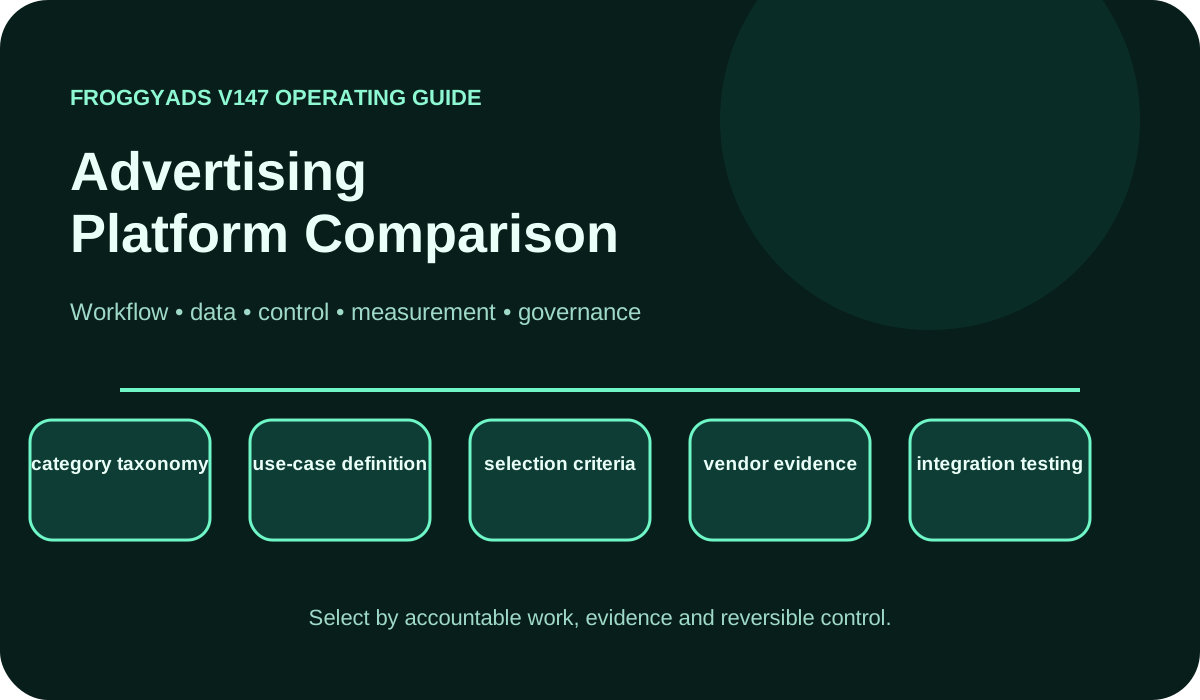
Set a platform comparison boundary and verify supply evidence
A platform comparison should begin with the advertiser's decision boundary rather than a feature total. The shortlist must use the same market, format, audience, destination, acceptance event, attribution window and spend ceiling. Supply-path evidence also matters: the IAB Tech Lab's OpenRTB standard documents a shared protocol boundary, while its sellers.json and SupplyChain material supports review of supply relationships. Protocol support does not prove inventory quality, interoperability in a particular account or commercial performance. Each candidate platform should therefore demonstrate usable controls, exportable source-level evidence, reliable event handoffs and a reversible operating workflow. The final choice follows mature accepted economics and control quality in a bounded test, not a starting price, a vendor claim or the number of boxes checked on a marketing page.
Connect the guide to live testing
Run the first matched audience test with FroggyAds
Turn the comparison brief into one FroggyAds cell: a supported audience, suitable format, fixed offer and destination, campaign ceiling and accepted customer action. Save the settings and source identifiers before delivery. Your first allocation should show whether your team can trace the purchase and make a justified next change.
Create My Free Account
How can you compare platforms on the job your campaign needs?
Quick answer: Compare advertising platforms against the job your campaign must perform. Fix the audience, offer, market, format, destination, accepted conversion and review window; then score each platform on usable controls, observed delivery, reporting evidence, operating effort and mature commercial results. FroggyAds belongs in that proof when you need a self-serve route to targeted paid traffic with campaign budgets, supported ad formats and measurable source decisions.
| Section | Distinct excerpt from this page |
|---|---|
| What advertising platform comparison means in practice | Search, social, programmatic, network and publisher systems own different jobs. |
Protocol reference for the comparison: IAB Tech Lab: OpenRTB standard.
Align platform controls, measurement and commercial terms before launch
An advertising platform comparison is a controlled test of how different buying systems serve the same declared business decision. Compare objectives, eligible inventory, targeting inputs, creative requirements, budget controls, measurement, quality review, and exit conditions. Feature counts alone do not reveal whether two platforms can support an equivalent experiment.
Use the following thirty-day schedule as an illustrative planning sequence, adjusting each review to your actual outcome delay and budget. Days 1–5 establish the contracts and technical baseline: account access, objective, market, offer, creative approval, destination version, privacy state, tracking receipt, duplicate handling, currency and stop authority. Limit spend to verification until the platform can produce a traceable test event.
Illustrative days 6–12 collect bounded delivery from a small set of comparable cells. Preserve platform-specific campaign, creative and placement or source fields, and record differences in audience context. Investigate destination, identifier and policy failures separately. Wait for the agreed accepted-outcome window before ranking the platforms by commercial cost.
The data contract lists permitted inputs, identifiers, consent or privacy state, processors, retention, and downstream joins. It separates audience activation from outcome measurement. If a platform cannot export or pass a field, document the resulting limitation rather than filling the gap with an inferred user or source identity.
The measurement contract aligns technical receipt, attribution rule, duplicate key, backend acceptance, value, and maturity. Preserve each platform's raw report and reconcile it with one advertiser ledger. Report legitimate model differences openly. Do not force totals to match by widening windows or relabeling an event after results are known.
Start the shortlist with a use-case boundary. Name the campaign objective, media formats, serviceable markets, buyer roles, destination, accepted outcome, and systems that must exchange evidence. A platform that serves another job can remain useful without belonging in this proof. Removing irrelevant categories creates a fairer comparison than awarding points for capabilities the advertiser will not operate.
A targeting comparison needs an input ledger. Classify each signal as contextual, first-party, partner-provided, modeled, geographic, device-based, or another documented type. Record source, purpose, update frequency, eligibility, suppression, and observability. Similarly named audiences can be built from different evidence, so the team should compare the delivery produced rather than equating interface labels.
Export and portability belong in the proof. Download the campaign structure, creative record, delivery report, source or placement dimensions, conversion data, billing evidence, and change history that the platform actually makes available. Inspect field definitions and completeness. An export is useful only when another reviewer can interpret it and critical analysis can continue after account access changes.
Commercial terms extend beyond media price. Include funding method, minimum balance, fees, taxes, credits, invalid-activity adjustments, invoicing, currency, refund or closure handling, staff time, integration work, and required creative production. Compare costs that belong to the same operating period and scope. A cheaper CPM cannot offset an unmanageable reconciliation or exit burden without explicit evidence.
The recommendation should name limitations as clearly as strengths. State which formats, markets, data inputs, roles, reports, cost assumptions, and support conditions were not tested. Identify what could change the result. A platform can be selected for one bounded campaign layer without being declared universally best, and a rejected platform can remain suitable for a different use case.
Choose the execution format
Choose a supported format for the same offer and destination
Keep the material offer and destination consistent while adapting the creative to the actual format. Choose Push, Native, Display or Pop where supported and suitable for the invitation. Use FroggyAds targeting and campaign budgets to define the test, then judge its accepted customer result under the comparison rule written before launch.
Create My Free Account
Review outcomes, creative, access and campaign operations
This framework creates a comparison contract before money moves. The advertiser fixes the offer, serviceable market, accepted outcome, observation window, loss limit, and backend rejection rule, then documents unavoidable channel differences. Each platform is judged through its own delivery evidence and the same mature commercial standard.
Illustrative days 13–21 close the first outcome cohorts and reconcile them with the advertiser system. Review accepted, rejected, duplicated, cancelled, refunded and delayed states. Compare cost only where the offer and eligibility rules match. A dashboard conversion remains provisional when the business record is missing or uses a different qualification rule.
The objective contract names the business decision and the platform event configured to support it. It identifies the eligible population, accepted backend state, attribution and value windows, owner, and disqualifying conditions. Platforms may use different optimization labels; the comparison must not assume that similarly named objectives produce equivalent traffic or outcomes.
The creative contract preserves the material offer while adapting dimensions, length, motion, sound, disclosure, and interaction to each format. Archive the served asset and destination pairing. A native unit, search ad, push notification, banner, and video create different contexts, so identical wording is not automatically a fair or truthful comparison.
The quality contract defines invalid or unusable delivery, landing failures, rejection, cancellation, refund, complaint, and later value. Assign investigation owners for platform, source, creative, destination, data, and offer problems. A low media unit is not superior when more of its volume fails the advertiser's eligibility or acceptance rules.
Record account and access requirements before a demonstration. Capture role granularity, approval boundaries, authentication, credential rotation, audit history, agency or client separation, and the process for revoking a user. Test the permissions with representative roles. A screen that an administrator can reach does not prove that the operating team can delegate the task safely.
Review pacing as a sequence of decisions. Capture budget, bid or price, daily cap, total cap, schedule, delivery status, spend, and any automated adjustment at consistent checkpoints. Note which setting the platform changed and why when that information is available. A month-end total can hide early overspend, underdelivery, or a late shift into inventory that was outside the intended test.
Test policy and creative review with the real format constraints. Preserve submission, rejection, reason, revision, approval, and served version. Compare turnaround and error recovery, but do not reward a platform merely for accepting a creative another channel cannot lawfully or technically carry. The shared offer must remain truthful while the asset adapts to its media context.
Security review covers the media account and every connected system. Examine authentication, API credentials, webhooks or postbacks, audit logs, data recipients, incident contacts, and offboarding. Use least-privilege test credentials and avoid personal data in names or URLs. A platform's certification or policy page may inform the review, but the advertiser must verify its own configuration and access path.
Close the comparison by rehearsing reduction and exit. Pause delivery, preserve reports, remove or disable tracking where appropriate, revoke credentials, settle billing, document retained data, and confirm the fallback reporting route. The ability to leave without losing the accepted-outcome record is part of platform quality. Procurement remains reversible when these steps are known before scale.
Put the guide into practice
Use mature results to authorise one next allocation
After the agreed outcome window, use the first result to authorise one bounded next allocation. Preserve the previous settings, change one material budget, audience or source condition and inspect the new cohort separately. Keep confirmation spend within the written limit until accepted outcomes justify another step.
Create My Free Account
Select, govern, and exit a self-serve media platform
A useful comparison distinguishes platform capability from campaign evidence. Access to a format, audience control, bid option, or report does not prove inventory, reach, intent, valid measurement, or return. The test records what was configured, what actually served, which identifiers survived, and which accepted outcomes matured under the shared decision rule.
Illustrative days 22–30 test one evidence-backed adjustment or prepare an exit. Change a single budget, source, audience, device, creative or schedule dimension while retaining a reference configuration. Monitor delivery mix, destination stability and mature value. Stop the affected cell if the approved loss or quality boundary fails, preserving the evidence for a later retest.
The inventory contract records formats, placements or sources, device context, geographic eligibility, exclusions, and the reporting detail actually available. Note auction, publisher, feed, search, or social context where it changes user intent. Compare observed delivery against this contract instead of treating every impression as the same commodity.
The budget contract sets currency, funding requirement, bid or price basis, daily and total caps, pacing, maximum loss, and authority to pause. Record taxes or fees where material. Compare marginal spend from the tested cells; a minimum deposit, suggested budget, or historical CPC does not establish the amount needed on another platform.
The exit contract specifies pause triggers, evidence retention, tag or code removal, balance and billing checks, audience or data cleanup, and conditions for a retest. It should let the advertiser leave one platform without breaking the destination or measurement used elsewhere. A comparison is incomplete when stopping is operationally ambiguous.
Inventory evidence should reflect actual delivery opportunities. For the bounded proof, preserve formats, placements or sources, device and geographic eligibility, auction or deal context, exclusions, and reporting detail. Compare the served mix with the brief. A platform catalogue establishes possible products; it does not show which supply was available to this advertiser at the tested time and controls.
Support quality is tested through a defined case, not a published channel list. Submit one representative technical or policy question, preserve timestamps and response content, and record whether the guidance resolved the operating issue. Separate self-service documentation, automated messages, account support, and escalation. Fast acknowledgement without a usable answer should not receive the same score as a reproducible resolution.
Treat automation as a bounded operator. Record its objective, inputs, exclusions, minimum evidence, maximum change, frequency, approval rule, and kill switch. Run in observation or shadow mode where practical before allowing material budget or audience changes. The comparison should score the clarity and reversibility of the automation, not only the presence of an automated feature.
Score only evidence observed under the declared proof. Mark advertised but untested capabilities separately, attach the test record, and note any workaround. Weight must-have failures before additive features. This prevents a broad platform from winning through menu count while missing the one reporting, control, privacy, or export condition that the operating model requires.
Archive the final scorecard, unresolved questions, named owners, and next review trigger with the tested platform versions. Future comparisons begin from that evidence instead of an unsupported memory of the demonstration.
Keep the scorecard focused on the requirement that could rule a platform out. Verify that requirement first, record the observed evidence and weigh useful additional controls afterward. A platform should earn the next purchase through a workable campaign and interpretable result, rather than a broad catalogue of capabilities your team will not use.
Frequently asked questions
What should an advertising platform comparison measure first?
Start with the business decision the campaign must support. Define the market, audience, offer, accepted outcome, attribution window and spending limit before comparing platforms, so every result answers the same practical question.
Why are feature counts not enough when comparing advertising platforms?
Feature lists describe available controls, but they do not prove inventory quality, usable reach, reliable measurement or commercial performance. A useful comparison tests what was configured, what actually served and which accepted outcomes matured.
How can advertisers make two platform tests comparable?
Use the same market, offer, destination version, creative requirements, acceptance event and outcome window wherever possible. Document unavoidable channel differences, then judge each platform against the same mature commercial standard.
What must be verified before increasing spend on a platform?
Verify account access, tracking receipt, duplicate handling, currency, privacy state and the connection between the platform event and the advertiser's accepted backend outcome. Spend should remain limited until that evidence is traceable.
How long should an initial advertising platform comparison run?
The thirty-day schedule is an illustrative sequence, not a required duration for every campaign. Establish the technical checks first, collect bounded delivery, then wait for the actual customer-outcome window before comparison or expansion. Extend the review when approvals, cancellations or other relevant outcomes have not matured.
Should advertisers choose the platform with the cheapest early metric?
No. Early clicks or conversions may not have reached the accepted-outcome window. Wait for mature results, reconcile rejected or duplicated records and compare marginal cost only where the offer and eligibility rules match.
Which evidence should be preserved during a platform test?
Keep campaign, creative, placement or source identifiers, delivery context, exclusions and the reporting detail each platform provides. This evidence shows whether platform controls survived the handoff into the advertiser's measurement system.
How should platform conversions be checked against business results?
Reconcile platform events with accepted, rejected, duplicated, cancelled, refunded and delayed backend states. A dashboard conversion remains provisional when the corresponding advertiser record is missing or follows a different qualification rule.
When should an advertising platform cell be paused?
Pause the affected cell when the approved loss limit or quality threshold fails, or when tracking and destination evidence cannot be trusted. Preserve the data and configuration so the test can be reviewed or repeated later.
How can FroggyAds be included in a controlled comparison?
Include FroggyAds as a self-serve media-buying option under the same comparison contract used for other platforms. Evaluate its observed delivery, source controls and mature outcomes against the shared decision rule rather than a feature total.
Official sources used for this guide
The framework is grounded in primary documentation for programmatic standards, media buying, acquisition reporting, attribution, privacy and supply-chain transparency.
Launch a controlled paid-media test
Start your next comparison test with FroggyAds when your offer, destination and accepted customer action are ready. Our supported formats, targeting, campaign budgets and source controls give you a direct way to put the brief into practice. Keep the first allocation capped and use the resulting evidence to choose the next step.
Create My Free AccountHow should you compare advertising platforms for a real campaign?
Build the comparison around one buying decision: which platform gives your team the clearest, most controllable route to the audience and accepted outcome this campaign needs? A useful scorecard combines declared capability with observed proof. Documentation can establish that a control exists; only a bounded campaign shows whether your team can configure it, receive the expected traffic, reconcile outcomes and act on the evidence.
Which platform categories belong on your shortlist?
Start by separating platforms that own different parts of the advertising route. Search and social platforms connect campaigns to their own environments. A demand-side platform can provide programmatic access and buying controls. An ad network can aggregate traffic across publishers or sources. Retail media, connected television, native, push, display and pop options create different user contexts. These categories can complement one another, so your shortlist should include only systems that can perform the same required job in the current proof.
Write a one-sentence use case before reviewing features. For example: “Reach eligible English-speaking desktop visitors in the selected markets, send them to the approved comparison page and measure completed registrations accepted by our backend within seven days.” Every scored feature must help execute, verify or govern that sentence. Capabilities outside the boundary remain useful context, but they should not inflate the score.
What belongs in a weighted advertising platform scorecard?
| Decision area | Evidence to request or test | Reason it matters |
|---|---|---|
| Inventory and format fit | Eligible formats, markets, device context, source detail and delivery actually observed in the proof. | The platform must reach the intended opportunity without forcing the offer into an unsuitable ad experience. |
| Targeting control | Available location, device, browser, operating-system, category, source or other relevant settings, plus exclusions. | Your team needs enough control to express eligibility and isolate performance differences. |
| Budget and pacing | Billing basis, bid or price input, daily and total boundaries, schedule, pause behavior and spend readback. | A test is only reversible when the operator can constrain loss and identify what changed. |
| Measurement | Tracking receipt, identifiers, conversion export, attribution settings, duplicate handling and backend reconciliation. | A platform event must connect to the business outcome you accept, reject or value later. |
| Traffic review | Source or placement evidence, quality controls, invalid-activity handling and an explainable restriction workflow. | Blended averages can hide which inventory deserves more budget or a stop decision. |
| Operations and access | User roles, approval steps, support path, change history, exportability and offboarding procedure. | The best media option still fails if the team cannot operate and govern it reliably. |
| Total test cost | Media spend, funding requirements, fees, creative work, integration effort, analyst time and exit work. | A cheap unit price can create an expensive test when reconciliation or implementation is heavy. |
Set weights before seeing results. Mark any non-negotiable condition as a gate rather than allowing several convenient features to compensate for its absence. Keep “documented,” “demonstrated” and “observed in our account” as separate evidence states. This stops a vendor page, a sales demonstration and a live campaign from being treated as equivalent proof.
How do you make two platform tests comparable?
Use the same commercial brief wherever channel context permits: audience eligibility, offer, destination revision, accepted outcome, value rule, attribution window, loss ceiling and review date. Preserve unavoidable differences such as ad format, auction context or creative dimensions. Fair comparison means documenting those differences and judging each route against the same business decision; it does not mean pretending unlike media experiences are identical.
Split the proof into technical and commercial stages. First confirm account access, asset approval, destination rendering, tracking receipt, currency, budget boundaries and stop authority with minimal spend. Then collect a bounded delivery sample. Close the relevant outcome cohorts before comparing accepted CPA, downstream value or another chosen business metric. Early clicks and platform conversions should remain provisional until the advertiser record matures.
How can FroggyAds support a controlled platform comparison?
We give advertisers a self-serve way to launch supported paid-traffic formats with campaign-level budgets and targeting controls. Depending on the format and campaign context, controls can include country, city, device, operating system, browser, carrier, category, source, ID and IP options. You can use those controls to construct a clear test cell, retain the configuration and review performance at the level available to the campaign.
FroggyAds supports push, native, display and pop traffic, which lets you choose a format that fits the message and destination instead of treating every impression as interchangeable. SmartCPC and Adscore-supported traffic-quality controls can help you operate the campaign. Your own tracker, analytics and backend acceptance remain the final evidence for commercial quality, and paid traffic does not guarantee sales, leads, profit or organic rankings.
Include us in the scorecard with the same discipline applied to every option. Record the exact FroggyAds campaign settings, approved creative, destination version, spend block, traffic evidence and accepted outcomes. If the cell passes your threshold, increase one major variable at a time. If it fails, retain the evidence and restrict, repair or end the affected route instead of widening the campaign.
Start a controlled FroggyAds comparison campaign
What buying calculation should stay consistent across platforms?
Keep billing and outcome metrics distinct. CPM describes the cost of one thousand billable impressions; CPC describes the cost of a billable click when that buying model applies. CPA is the advertiser's calculation of spend divided by conversions accepted under a stated definition and window. A hypothetical USD 300 test with 15 accepted registrations produces an accepted CPA of USD 20. Replace both inputs with your own result; the example is not a FroggyAds price, forecast or performance claim.
Compare marginal results as spend expands. A platform can have a strong lifetime average while the newest sources or audience segments perform below the decision threshold. Preserve the last stable block, identify the added block and calculate accepted outcome cost under the same maturity rule. This makes the next keep, cap, exclude or retest action explainable.
What should your final platform recommendation contain?
Name the chosen platform for the bounded use case, the evidence that earned the choice and the limitations that remain. Include the tested markets, formats, audience rules, destination, outcome window, spend range and operating assumptions. List capabilities that were advertised but not tested. Assign an owner and date for the next review, particularly when inventory, product controls, policy or commercial terms can change.
Keep an exit plan beside the selection. The team should know how to pause delivery, export reports, settle billing, revoke credentials, remove or disable integrations where appropriate and preserve the accepted-outcome ledger. A reversible selection lets you use the winning route now without turning a campaign result into an unsupported permanent platform claim.