
Advertising on a Small Budget: Evidence Before Scale
Plan advertising on a small budget by narrowing the test, protecting measurement quality and buying enough evidence for one useful decision.
What does this page explain about Advertising on a Small Budget: Rates, Budget & Campaign Planning?
Quick answer: Plan advertising on a small budget by narrowing the test, protecting measurement quality and buying enough evidence for one useful decision. Protect tracking accuracy for advertising on a small budget by documenting the hypothesis, keeping offer, geo, format, source, creative and landing page available and recording how the step changes tracking accuracy, qualified response, accepted outcomes and remaining budget. For advertising on a small budget, compare the response with learning value and mature outcome per dollar, preserve the source breakdown and write the next action before changing the campaign.
| Section | Distinct excerpt from this page |
|---|---|
| What advertising on a small budget should accomplish | Use learning value and mature outcome per dollar to decide whether the current traffic cell deserves a stop, revision, retest or controlled increase. |
| Single question | For advertising on a small budget, connect this control to learning value and mature outcome per dollar and keep offer, geo, format, source, creative and landing page visible. |
| Measure mature business value, not delivery alone | Pair the economic metric with tracking accuracy, qualified response, accepted outcomes and remaining budget so a short-term efficiency gain does not hide weaker acceptance or lower future scale. |
Reference for Advertising on a Small Budget: Rates, Budget & Campaign Planning: Google Ads budgets First-party context for campaign budgets and spend management..
What should a limited media budget accomplish first?
Use it to purchase a decision, not a vanity total. Before launch, write the one uncertainty that the campaign should reduce: whether an eligible audience responds to a specific proposition, whether the destination converts on the targeted device, or whether a measured outcome remains commercially acceptable after validation.
Define the accepted event, the audience boundary, the attribution rule, the review date and the maximum learning loss. Then protect those definitions while the cohort matures. A small budget becomes informative when every dollar belongs to the same question.
FroggyAds gives you a self-serve way to buy supported traffic with campaign controls and source evidence. We recommend starting with one coherent campaign cell and preserving enough unused budget for a deliberate second test after the first result is understood.
How do you divide a small budget without fragmenting the evidence?
| Budget role | Purpose | Control |
|---|---|---|
| Path proof | Verify destination, identifiers, event collection and business acceptance. | Pause if the evidence chain breaks. |
| Learning cohort | Test one audience, proposition and destination combination. | Keep a fixed total ceiling and maturity window. |
| Confirmation cohort | Repeat the promising setup under the same decision rule. | Release only after the first cohort earns it. |
| Discovery reserve | Try one adjacent source, creative or audience hypothesis. | Do not use it to rescue an undefined campaign. |
The percentages belong to your business economics; there is no universal allocation. The essential discipline is to name each portion before spend begins. Do not move the reserve into an inconclusive cell simply because money remains.
Which targeting choices deserve scarce test budget?
Start with rules that change eligibility or the customer experience. Market, device, operating system, browser, carrier or category may matter when the offer, destination or measurement path depends on them. Source, ID and IP options can support a documented action when enough evidence exists.
Avoid a matrix of tiny segments. Each additional split requires its own delivery and outcome evidence. Group conditions that share the same offer and journey, then separate a dimension only when the next decision depends on it.

When the audience brief and limit are written, create your free FroggyAds account.
What is a budget-safe campaign sequence?
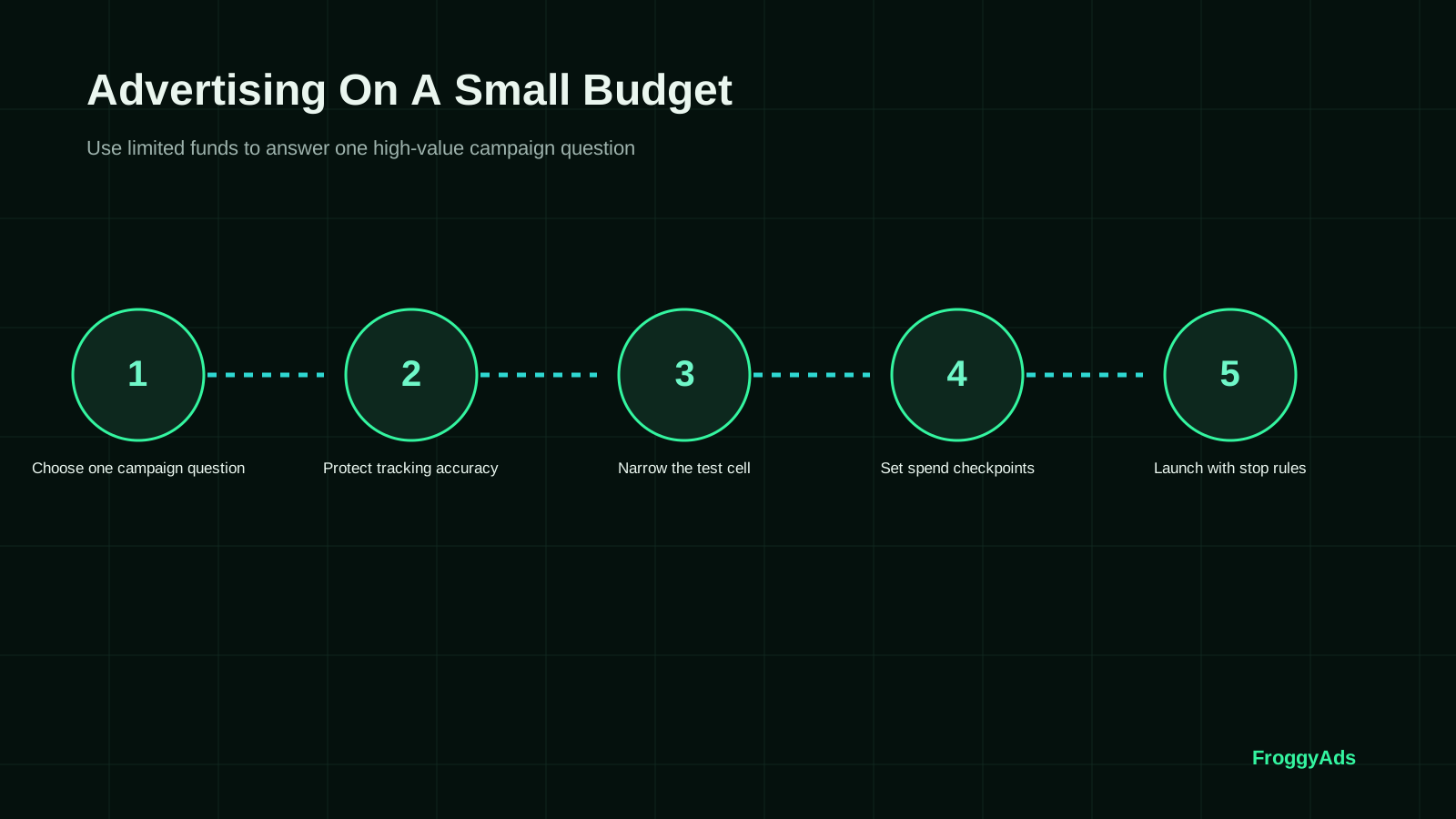
- State the accepted result. Name the event, owner, validation rule and commercial boundary.
- Prove the technical path. Test links, parameters, identifiers, destination behavior and event reconciliation.
- Save the baseline. Record bid, audience, format, creative, landing version and total learning ceiling.
- Launch one learning cell. Keep the major variables stable while the cohort collects comparable evidence.
- Separate delivery from value. Repair operational failures quickly, but wait for mature outcomes before judging economics.
- Take one narrow action. Keep, cap, exclude, retest or expand the smallest supported segment.
- Authorize the next cohort. Release confirmation or discovery budget only under the prewritten rule.
How should a small campaign reconcile spend with accepted value?
Connect platform delivery to analytics and the business record using stable campaign, source, creative and landing identifiers. Recent actions may remain provisional if leads need approval, orders can be reversed or value arrives later. Compare cohorts only after the same maturity opportunity.
Define every ratio. State the currency, numerator, denominator, attribution rule and validation window. A cost per tracked event and a cost per business-accepted event answer different questions.
| Layer | Retain | Reason code | Decision use |
|---|---|---|---|
| Media | Spend, clicks, source and device | Delivery or eligibility issue | Confirm the purchased cohort |
| Journey | Landing arrival and qualified action | Message or destination friction | Diagnose the user path |
| Outcome | Raw event and accepted event | Duplicate, rejection or delay | Calculate accepted cost |
| Value | Revenue or business-defined value | Refund, reversal or adjustment | Authorize stop, repeat or expansion |
How do you choose an ad format when production budget is limited?
Select the format your team can operate consistently. It must express the offer honestly, reach an eligible audience, survive the destination transition and retain the identifiers needed for review. A format with a low media price can still be expensive if it creates unqualified activity or demands assets you cannot maintain.
Use a small creative set built around different propositions. Follow each concept through qualified visits and accepted outcomes instead of optimizing to clicks alone.

Which creative tests produce information without wasting volume?
Test propositions, not decorative changes. A proposition might emphasize a practical benefit, a use case or the next step. Give every concept a stable name and keep the destination version fixed during the comparison. If the landing page changes simultaneously, the result cannot identify which message worked.
Set a minimum evidence condition before declaring a creative winner. With limited volume, early click-through differences can be noise, and the highest-click concept may attract visitors who never complete or qualify. Prefer the concept that supports the accepted business event under the same audience and maturity rule.
Retire a concept with a reason, not a vague label. Record whether it failed to deliver, failed to attract qualified visitors, or produced weak accepted economics. That record improves the next concept without repeating the same test.
How do you protect conversion value after the click?
The landing experience should confirm the ad's proposition immediately and expose material conditions before the visitor commits. Check mobile usability, form behavior, price or subscription terms, eligibility, fulfillment and the confirmation event that analytics will record.
Keep the destination version in the campaign ledger. A site release can change conversion behavior even when the media configuration is untouched. When a release overlaps a campaign adjustment, split the cohorts or postpone the conclusion.
Use qualification constructively. A clear page may reduce raw conversion count while improving acceptance, retention or value. On a small budget, a smaller set of relevant actions can be more useful than a larger set that the business rejects.
What should you do when small-budget metrics disagree?
| Pattern | Check first | Budget response |
|---|---|---|
| Clicks exceed measured visits | Redirects, consent, load behavior, parameters and time zones. | Protect the remaining budget until measurement is understood. |
| Visits continue but actions fall | Message match, device experience, offer availability and event setup. | Repair or isolate the destination before buying another cohort. |
| Tracked actions fail acceptance | Eligibility, duplicate handling, validation delay and rejection reasons. | Improve qualification or narrow the relevant audience cell. |
| One source has mature weak value | Stable tracking, sample size and concentration. | Limit, exclude or retest that source under a saved rule. |
Apply the smallest action supported by evidence. A single weak source does not prove that every placement or format is unsuitable.
What must be ready before a small-budget campaign launches?
- The accepted outcome and business owner are named.
- The destination, consent path, identifiers and event have been tested.
- Bid, account funding, campaign spend and total learning limit are understood separately.
- The audience reflects genuine eligibility or experience conditions.
- Creative and landing versions are labelled and recoverable.
- Operational pause rules and the scheduled business review are written.
- The next cohort remains reserved until the first decision is documented.

Which mistakes consume limited media spend without improving the decision?
- Launching before the destination and accepted event have been verified.
- Dividing the audience into more cells than the budget can evaluate.
- Changing bid, targeting, creative and landing page in the same comparison.
- Optimizing to raw clicks when the business accepts a later outcome.
- Treating an account deposit, auction bid or advertised minimum as the complete test budget.
- Reacting to provisional actions before approvals, reversals or attribution can settle.
- Using the confirmation reserve to extend a campaign that has no written question.
- Scaling lifetime averages without checking the economics of the newest spend.
Every leak has an operational remedy: define, label, reconcile, wait, or stop. The purpose is not to avoid all loss; learning has a cost. The purpose is to make that cost finite and useful.
How should a small-budget advertiser schedule decisions?
Review 1: integrity
Confirm delivery, destination availability, identifiers and event collection. Repair operational defects without declaring a commercial winner.
Review 2: maturity
Freeze the cohort, allow the stated validation window and reconcile tracked with accepted outcomes.
Review 3: allocation
Keep, cap, exclude, retest or expand one constraint, then save the new baseline and next review rule.
The calendar depends on the offer's validation cycle; equal treatment matters more than a universal number of days.
Standards and first-party evidence for Advertising on a Small Budget
Use official platform guidance for Advertising on a Small Budget, then make the next decision from your own tracked first-test results and accepted conversion data.
- Google Ads budgetsFirst-party context for campaign budgets and spend management.
- Google Ads experimentsControlled test design and comparison guidance.
- Google Ads conversion trackingConversion measurement requirements before budget decisions.
- Google Analytics manual campaign collectionCampaign tagging for small-budget learning.
Advertising on a small budget FAQ
What does a small advertising budget need to prove?
It should prove one decision about an eligible audience, message, destination and accepted business outcome within a written learning limit.
Is a low bid the same as a small test budget?
No. A bid is an auction input, while a test budget is the total amount authorized for learning. Account funding and actual campaign cost are separate concepts.
How should a small-budget campaign choose its main metric?
Use the accepted outcome that matches the business objective, then define its cost, attribution and maturity window. Delivery and engagement metrics remain diagnostics.
How many creatives should a small-budget test use?
Use the smallest set that represents meaningfully different propositions and can still collect useful evidence. Avoid many cosmetic variants that split limited volume.
When should a small-budget advertiser exclude a source?
Exclude or limit a source only after stable tracking and mature source-level evidence support the action. Record the reason and a retest condition.
Can FroggyAds guarantee profit from a small campaign?
No. Paid traffic cannot guarantee conversions, revenue or profit. FroggyAds provides supported traffic buying, controls and reporting; the offer, funnel and optimization determine commercial results.
What should happen when clicks and accepted outcomes disagree?
Inspect the path layer by layer: redirects, analytics, event rules, audience eligibility, message continuity and business acceptance. Repair measurement before judging inventory.
How can a small campaign avoid changing too many variables?
Freeze the baseline and change one major constraint at each scheduled review. Label each creative, landing page and audience version so cohorts remain comparable.
When is a small-budget campaign ready for more spend?
Increase spend only after the accepted-outcome evidence is mature, repeatable and inside the documented business boundary. Compare marginal results with the prior cohort.
Why use FroggyAds for a controlled learning campaign?
We give advertisers a self-serve route to supported traffic with campaign-level budget, targeting and source controls that can be connected to downstream business evidence.
Continue the paid traffic workflow
Use related resources for Advertising on a Small Budget to connect source selection, campaign execution, pricing and measurement.
Turn advertising on a small budget into a controlled campaign test
For Advertising on a Small Budget, start with one accepted business outcome, transparent tracking, source-level controls and a written stop-or-scale rule. Judge the test by offer fit, creative, landing path, GEO, bid, conversion maturity and downstream acceptance.
How should a limited campaign allocate its next dollar?
A constrained campaign should release money in stages. Fund path verification first, then one learning cohort, then a confirmation cohort only when the earlier evidence meets its written rule. This sequence prevents the last available dollars from being absorbed by an unresolved setup.
This decision model covers finite paid-media learning, evidence release rules and reversible allocation.
Define the release rule before the first auction
Write the event that the business accepts, the validation delay, the maximum learning loss and the evidence required to unlock confirmation spend. When those fields are blank, more delivery cannot resolve the commercial question.
Give each dollar one named job
Separate technical proof, audience learning, confirmation and discovery. Do not quietly transfer reserved money to the largest active source. Record every transfer with an owner and the result it is intended to verify.
Keep the media record joinable
Retain campaign, source, creative, landing and device identifiers wherever the path supports them. Join media cost to qualified behavior and the final accepted event so a narrow source action does not erase the rest of the test.
Judge the newest increment separately
A lifetime average can stay attractive after recent spend deteriorates. Compare the latest budget step with the saved baseline, and restore the previous configuration when marginal accepted value leaves the declared boundary.
| Allocation checkpoint | Record before release | Decision it protects |
|---|---|---|
| Technical readiness | Destination, identifiers, event test and reconciliation owner | Prevents media spend from financing an unmeasurable path. |
| Learning authorization | One eligible audience, labelled assets and a total loss ceiling | Keeps the first cohort focused on a single uncertainty. |
| Business acceptance | Mature accepted actions, rejection reasons and any value adjustment | Separates recorded events from outcomes the business will recognize. |
| Confirmation release | Repeated result under the same definition and maturity window | Requires evidence before the reserved amount enters the market. |
| Rollback control | Saved baseline, affected segment, owner and restoration trigger | Makes a failed expansion reversible without rebuilding the campaign. |
A seven-record allocation routine
- Write the accepted event and the maximum permitted learning loss.
- Prove the complete measurement path with controlled visits and events.
- Label the audience, creative, destination and source dimensions.
- Release only the amount assigned to the first learning cohort.
- Freeze the cohort and wait through the stated validation window.
- Compare mature accepted value with the written continuation rule.
- Authorize confirmation, revise one constraint, or return the reserve unused.
When should the newest allocation be rolled back?
Restore the last stable configuration when identifiers stop reconciling, the destination fails, source concentration changes the test meaning, or the newest cohort exceeds its accepted-cost boundary. Diagnose the layer before funding another comparable cell.
Which evidence deserves the greatest weight?
Prefer reconciled business outcomes to modeled platform signals, mature source cohorts to blended totals, and the latest comparable allocation to a lifetime average. Published rates can inform planning, but the active auction and your accepted result determine the campaign decision.
What remains uncertain after a controlled test?
A bounded cohort cannot promise a future price, inventory level, conversion rate, revenue or profit. It can show exactly what was purchased, which path was measured, what the business accepted and whether another finite test is justified.
Primary reference set: Google average CPC definition, goal-based bidding guidance, Google budget guidance, Meta budget guidance and the IAB glossary. Verify current platform settings in the active account before launch. For Advertising On A Small Budget, apply this rule to the page-specific audience, market, format or buying decision described here.
Which small-budget decision belongs on this URL?
This page helps an advertiser turn limited media spend into a bounded learning program: reserve money by role, prove measurement, run one comparable cohort and release more spend only from mature accepted-outcome evidence.
The related Advertising Budget For Small Business page can address wider business allocation. This URL owns the campaign operating method for protecting a finite paid-traffic test.
| Decision | Question | Retained proof |
|---|---|---|
| Bound | What is the maximum learning loss before review? | Total ceiling, pause owner and review rule. |
| Measure | Which business event is finally accepted? | Identifiers, event, validation and outcome record. |
| Allocate | Which cohort earns confirmation or discovery money? | Mature cost, accepted value and change log. |
Hypothetical method: if a cohort spends USD 180 and produces six business-accepted outcomes, accepted acquisition cost is USD 30. Replace the inputs and boundary with your own economics; this is not a FroggyAds price or performance claim.
Use FroggyAds when you want direct control over the traffic test and evidence that can be connected to your own business result. Create your free FroggyAds account.
What matters first when advertising on a small budget?
Define one accepted outcome and a maximum learning loss, prove the measurement path, and reserve spend for confirmation instead of changing every variable at once. Use FroggyAds to run the bounded cohort, then release more budget only when mature evidence supports the next step.