
Best Traffic Sources for Affiliate Marketing: Choose by Customer Fit
Shortlist affiliate traffic by the customer context, offer permission, communication work and accepted acquisition economics. FroggyAds gives you self-serve campaign controls to test a relevant paid option and choose the next purchase from source evidence.
How do you choose the best affiliate traffic source?
Practical answer: choose a source that reaches eligible customers in a context your offer and destination can explain. Compare the actual promotion rules, message requirements, supported tracking and approved commission after relevant costs. At FroggyAds, we help affiliate marketers and media buyers test supported paid formats using targeting, bid, budget and source controls. Start with the comparison you can operate rather than a universal winner list.
| Selection step | What matters for the purchase |
|---|---|
| Customer fit | The offer is relevant and available to the intended audience. |
| Operating fit | You can prepare the message, destination and supported referral route. |
| Commercial fit | Accepted value and relevant costs can support a considered next allocation. |
FTC advertising and marketing guidance — Use truthful product communication and review the requirements relevant to the actual promotion context.
Choose a source for the actual affiliate offer
The best source is the one your offer can use and your business can evaluate. A search query, social feed, Native placement, Push message and Pop destination create different starting points for the visitor. Compare those customer contexts before comparing their delivery prices. We recommend FroggyAds when you want direct control over a relevant paid purchase and the source detail needed to adjust it.
Selection guidance is conditional on the current offer, campaign options and source purchase. Verify a material condition when it changes; the date of a guide does not establish that every market, source or programme rule is unchanged.
Three useful source comparisons
- Customer context and offer eligibility
- Message, destination and operating work
- Accepted value and relevant acquisition cost
Choose an identifiable source shortlist
Shortlist the sources that fit the customer and the programme before assigning budget. For each, write the proposition, destination role and merchant outcome you will review. The first purchase should answer a useful uncertainty about that source, rather than duplicate a ranking whose author operated a different offer.
The shortlist can change when the offer, customer condition or operating capacity changes. Keep the comparison useful for that current task instead of treating a past ranking as permanent. Choose for the next real purchase.
Confirm the programme traffic rules
Read the programme agreement for allowed traffic, relevant markets and devices, destination requirements, commission event and material review conditions. Clarify an important unknown before building a source plan around it. Platform permission and programme permission are separate.
Prepare the destination the visitor needs
Choose the destination from the explanation the customer needs. A useful pre-landing page can provide context or qualification; direct linking may suit an informative merchant page when the route is permitted. An extra page needs a customer purpose.
Verify the supported referral references
Use the referral references and reporting methods the actual systems support. Test the intended path using an authorised method and confirm the expected receiving record. Do not manufacture payable customer actions to test it. Keep a material missing reference visible.
Set an affordable first comparison
Start with a clear offer and source question, an appropriate audience and an affordable allocation. Retain the message and destination versions so the result can be interpreted when the merchant record develops. Account funding and test allocation are different figures.
Use accurate commercial communication
Use current product facts and make the relevant commercial relationship clear in the actual promotion context. Consult the programme and platform requirements for the route being bought rather than assuming a publishing tool supplies permission. A credible proposition needs supported facts.
Compare accepted acquisition economics
Use accepted commission or the relevant programme value with the acquisition costs in scope. Keep approval, reversal and payment states distinct. A cheaper click can still create a weaker complete purchase when customer qualification or accepted value falls. Compare the relevant customer result and cost.
Keep the previous useful route
Retain the earlier campaign, creative, destination, source settings and merchant context before a material expansion. Use them to investigate a weaker new purchase rather than deleting the comparison when a wider allocation disappoints. A historical finding has conditions, not permanent validity.
| Selection layer | What to prepare | How it changes the shortlist |
|---|---|---|
| Offer permission | Current traffic, claim, market and destination conditions | Remove a route the actual programme cannot permit. |
| Referral path | The identifiers and receiving records your tools support | Clarify a material untraceable stage before relying on source results. |
| Test allocation | Affordable media exposure and the relevant review opportunity | Choose a comparison the business can operate and carry. |
| Customer explanation | A truthful proposition and a useful destination | Match the source context with the information the visitor needs. |
| Next allocation | Relevant accepted value, acquisition cost and uncertainty | Retain, correct or repeat from the finding the purchase supplies. |
References for the relevant promotion and tracking task
Test the source you have prepared
Turn the shortlist into a FroggyAds campaign
Choose the supported format and relevant audience, prepare the creative and destination, then set bids and a defined allocation. Our source reporting and buying controls let you investigate the paid purchase directly. Use the programme result and acquisition costs to decide which option deserves a further test or another budget cycle.
Create My Free Account
Compare the customer context before the traffic price
A source supplies an opportunity to communicate with a customer in a particular setting. Someone searching for a solution may expect an immediate answer to a stated need. Someone encountering a feed placement or notification may first need to understand why the offer is relevant. That difference changes the message and destination work. It also makes a universal claim that one source is best for every affiliate offer unhelpful.
Start the commercial comparison from the programme action and value, not a headline click price. Declare the relevant acquisition costs and merchant status. If the sources require different creative or destination work, include those costs when evaluating the total task. A lower media bill does not establish a better complete purchase when qualification or accepted commission is weaker.
Compare only a shortlist you can prepare properly. Testing six sources with inadequate messages or an unverified referral route can consume more budget while leaving the central offer question unresolved. A focused comparison gives the buyer a more useful choice: retain the source, correct a specific weakness or investigate a different acquisition context.
Six source contexts worth comparing
Use these categories to compare the customer starting point and preparation required. They are different acquisition contexts, not a ranking or a claim that every option is sold through the same platform.
Search advertising
Search advertising can reach a person expressing a query, so the offer needs to answer the intent behind that query. Confirm programme permission, including any relevant brand or keyword restrictions, and the advertising platform requirements. Compare the expected query, destination and commission economics. Existing expressed intent can be useful, but a query does not automatically establish eligibility, acceptance or an affordable customer acquisition cost.
Social feed advertising
A social feed introduces the proposition among other content, often before the person has asked for that product. The creative needs a relevant reason to pay attention and a destination that supplies the promised explanation. Check the actual platform and programme terms. Assess the production and review work needed to keep the message current rather than comparing media prices alone.
Native placements
Native placements can introduce useful explanatory content that continues into the destination. This can suit an offer requiring a customer comparison or explanation, when the programme permits that route. Make the headline and page answer the same question and keep the commercial context clear. With FroggyAds, use the supported Native campaign options and source detail to investigate the prepared proposition.
Push notifications
Push requires a compact, accurate proposition that gives the intended customer a clear reason for the next action. Important context must continue into the destination. Choose it when the format is permitted and your message can be introduced responsibly within that space. Our campaign controls help you test the relevant audience and allocation while source evidence and programme outcomes explain the purchase.
Pop traffic
A Pop destination may need to provide the first detailed explanation of the offer. The visitor should quickly understand the subject, relevant condition and next step without a false system message or forced interaction. Prepare the destination for that context and confirm programme permission. FroggyAds provides a controllable paid route; the actual customer and merchant result determine whether it merits a follow-up.
Owned or earned audience
Content, an appropriately used email audience or another established relationship can introduce an affiliate offer through an audience you already reach. These routes still require useful communication, permission and operating work; they are not automatically free or unlimited. Compare audience fit and preparation time with paid acquisition. Keep an owned or earned response distinct when evaluating the contribution of a new paid source.
Choose the communication task first
Use FroggyAds for the paid context you can operate
Choose the relevant current campaign format from the offer rules and customer explanation. Native, Push, Display and Pop require different creative or destination preparation. We give you targeting, bid, budget and source controls to run the prepared comparison. Search and social examples above describe other acquisition contexts; they do not imply a native connection to those advertising accounts in FroggyAds.
Create My Free Account
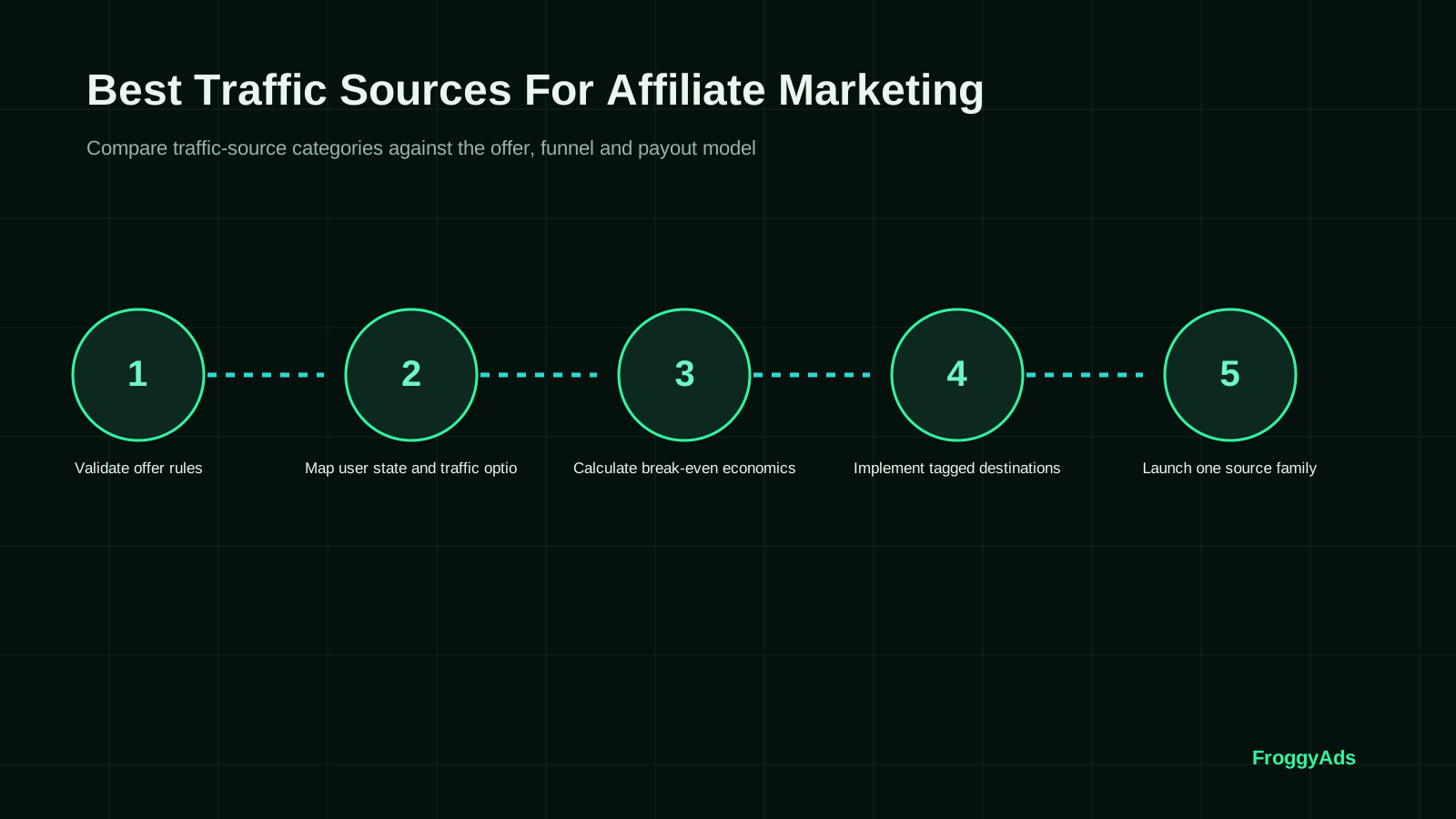
Seven steps from source shortlist to next purchase
Use this sequence to remove an unsuitable route early and keep the first useful comparison interpretable. Prepare the offer and customer message before assigning a broader traffic allocation.
Validate the offer rules
Confirm the current programme permission for the actual source, format, claims and destination. Identify the eligible customer and commission event. Clarify a material unknown with the programme contact so the shortlist does not depend on a promotion method the offer cannot use.
Map the customer starting point
Ask what the person knows when encountering the proposition and which question the destination must answer. Shortlist sources whose context your message can serve. Include the actual creative and page work needed rather than assuming one successful headline will fit every visitor setting.
Calculate the relevant acquisition allowance
Use the accepted commission or relevant value and the acquisition costs in scope to assess what the offer can support. Keep uncertainty, approval timing and available cash visible. An advertised payout is an input to the calculation, not an automatic amount to spend on every acquired action.
Test the destination and referral route
Prepare the useful destination and follow the supported references into the receiving tracker or programme record. Use an authorised test method. A browser visit does not by itself establish that the merchant event or required source reference arrived, so retain an unexplained gap while investigating it.
Buy one identifiable source comparison
Use the relevant FroggyAds format and targeting, set bids and an affordable allocation and retain the source references. Keep the message and destination versions identifiable. Inspect delivery and technical exceptions while the relevant merchant outcome develops; the first purchase should help answer the question in the shortlist.
Reconcile the relevant accepted outcome
Relate the paid purchase to the programme state and value appropriate to the commercial decision. Align relevant dates, currency and attribution definitions, showing pending or reversed actions distinctly. Use the supported data rather than assigning untraceable outcomes to the source with the strongest apparent result.
Choose a useful next source purchase
Retain a promising route, correct an explained weakness or prepare another defined test. Keep the earlier configuration and relevant accepted result. A new market, source or larger allocation can introduce uncertainty, so inspect the additional purchase instead of assuming it inherits the earlier outcome.
Compare source value with the costs that belong to it
Use a cost and value scope that answers the buying decision. Media CPA is media spend divided by the corresponding approved actions. Approved commission less media and other relevant acquisition costs can describe what remains for the affiliate under that declared scope. Neither metric alone establishes future profit. Keep the programme status and relevant observation opportunity explicit.
Inspect the source detail that your actual reporting supports and the customer records the programme returns. A useful breakdown can reveal a weak destination route, different qualification or an unexplained referral gap. Avoid fragmenting a small cohort into so many segments that every apparent winner depends on one event. Use detail when it helps choose a practical action.
Record why a material discrepancy exists when the evidence supplies an explanation: a pending merchant process, lost reference, duplicate action or another actual condition. Keep an unknown distinct from a known rejection. Reconcile the stages relevant to the decision rather than making every system total look equal by deleting inconvenient records.
| Stage | Record | Question | Possible next action |
|---|---|---|---|
| Paid delivery | Source activity and actual media spend | Did the intended purchase deliver? | Inspect the campaign settings or source |
| Destination | Relevant load and customer progression | Could the visitor use the offer explanation? | Correct an identified route or message problem |
| Programme | Raw, pending, approved and reversed actions | Which state supports the commercial review? | Retain a limitation or compare accepted acquisition |
| Acquisition value | Approved commission and relevant costs | Does another allocation have a clear reason? | Retain, repair, repeat or prepare the next purchase |
Buy the prepared shortlist test
Start the source comparison with a useful question
Bring your permitted offer, customer proposition, prepared destination and supported tracking into FroggyAds. Choose relevant campaign options, set a defined allocation and inspect source delivery. We help you control the purchase while your programme and cost records establish the commercial comparison.
Create My Free Account
Keep the purchased source and the customer route identifiable
Separate the paid event, destination stage, referral record and merchant outcome. Each can reveal a different failure. A billed click might not become a usable page session; a recorded action might remain pending or be rejected. Mapping these stages helps the buyer correct the actual issue instead of labelling every weak result a poor source.
Use campaign groups that represent a meaningful question about the source, audience or proposition. Keep the relevant allocation, message and destination version with the comparison. A separate group is useful when it makes a decision clearer, not simply when it creates another report row.
Retain a useful established route while investigating new supply separately. Keep the cost and uncertainty of discovery visible rather than allowing an earlier accepted return to conceal the new purchase. When a follow-up strengthens the result, preserve the conditions that made it useful for the next source decision.
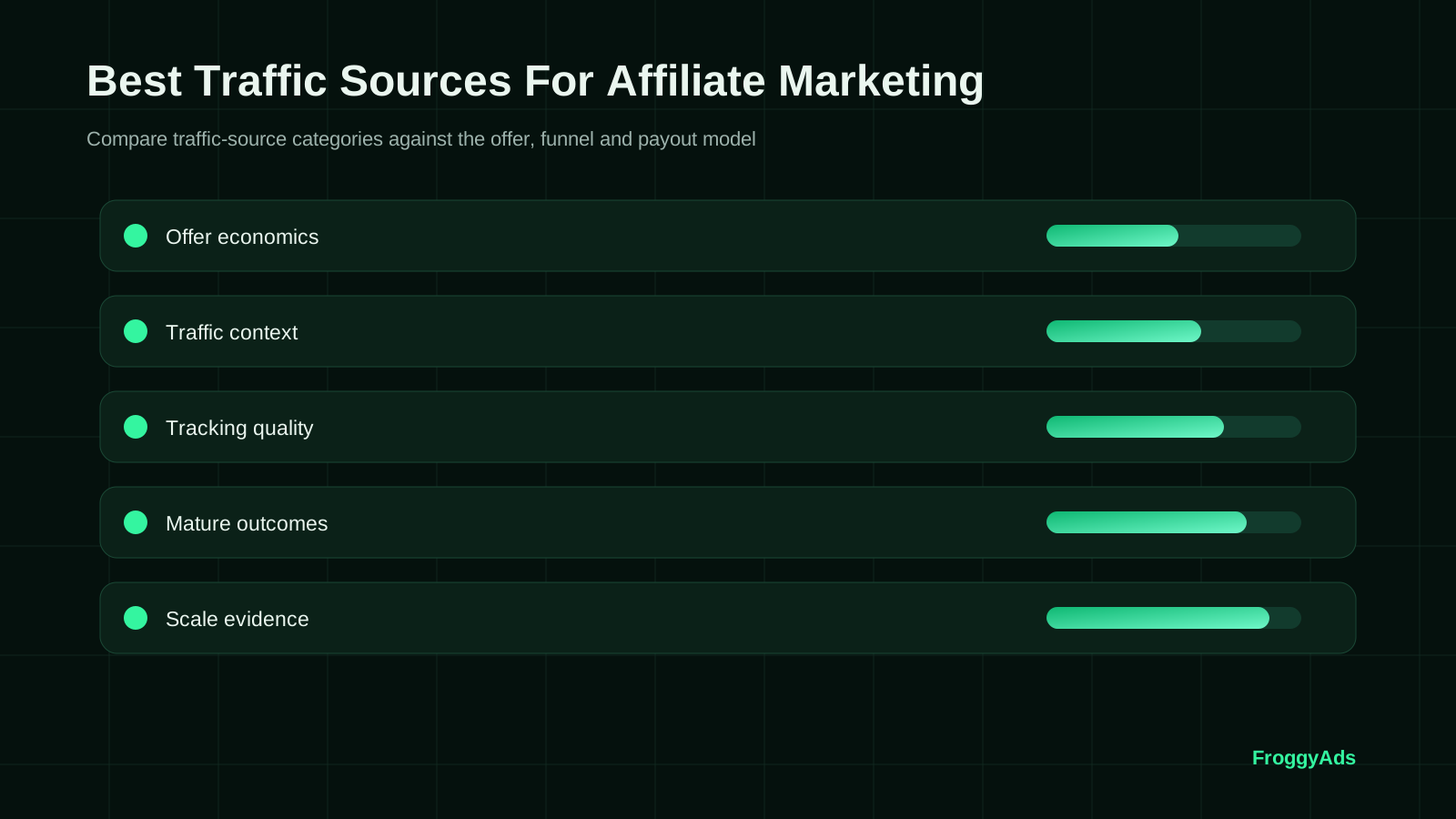
Match the source context with a coherent customer journey
Choose the offer explanation and destination role from what the visitor needs in that source context. The purchased traffic should arrive at a recognisable proposition with a useful next action.
Promise
Give the customer one accurate reason to consider the offer. Use a benefit the destination can explain rather than an unsupported performance claim.
Continuity
Keep the product, material qualification and next action coherent from the advertisement into the destination. Retain the actual versions when comparing sources.
Usable route
Test page function on the intended device and browser conditions. Keep technical loss separate from a customer who understood the offer and declined it.
Qualification
Explain a material eligibility or availability condition before asking the visitor to complete the merchant action. Use appropriate targeting where the actual campaign supports it.
Support
Use current product facts, relevant evidence and transparent terms. An invented testimonial or deadline cannot establish a source advantage.
Tracking
Retain the campaign and referral references your actual tools support. Investigate a missing handoff before treating the merchant result as source-specific proof.
Respond to the specific source-selection problem
When the source indicators disagree, locate the relevant stage before changing the whole purchase. The same account total can conceal a technical defect, weak qualification or unresolved merchant timing.
High payout, weak acceptance
Use actual approved value and relevant costs rather than the advertised payout alone. Inspect the programme reason and customer qualification. A large possible commission cannot compensate for a route whose actions rarely satisfy the actual offer conditions.
Strong interaction, weak offer fit
Compare the promise and destination with the customer condition the merchant accepts. Prepare a focused qualification or explanation correction when the mismatch is identifiable. Buying more of the same interaction does not resolve an unsupported customer assumption.
Useful value depends on one source
Retain the source context behind the useful outcome and inspect the dependency. Prepare an affordable independent comparison when diversification is worth investigating. Additional source names are valuable when they add a usable route, not simply when they make the campaign list longer.
Eight mistakes that weaken a source comparison
Use this review to keep the shortlist tied to the customer and acquisition question. Each mistake can make a source appear stronger or weaker without explaining whether the next purchase is useful.
- 01Treating a recent pending cohort as fully approved value. Keep the relevant merchant state and review opportunity visible.
- 02Changing source, message and destination at once when the test was meant to investigate one condition.
- 03Using an account average that conceals a specific source or customer problem.
- 04Calling lower click cost a commercial improvement without reviewing accepted acquisition value.
- 05Increasing a purchase whose material referral gap remains unexplained.
- 06Assuming a concentrated source finding represents a diversified acquisition mix.
- 07Buying a route the programme cannot permit or a destination that cannot explain the offer accurately.
- 08Letting an earlier useful cohort conceal the cost or weakness of a new allocation.
Move from preparation to the next source decision
Use the actual offer and programme process to choose the review sequence. It is not a universal thirty-day success schedule; delivery, approval and payment can become available at different stages.
First: prepare the source test
Confirm offer permission, relevant customer conditions, destination function and the supported referral method. Choose the question and affordable allocation before buying the main source comparison.
Next: inspect paid delivery
Run the identifiable campaign and inspect source activity and route exceptions. Keep the creative and destination versions available, with the relevant merchant outcome still provisional when appropriate.
Then: review accepted economics
Use the programme state and acquisition cost scope appropriate to the buying decision. Separate pending actions and unexplained references from accepted value rather than forcing an early settled conclusion.
Follow up with a useful purchase
Choose a repeat, correction or additional allocation from the actual finding. Retain the earlier configuration and inspect the new cohort so a wider source mix does not inherit an untested performance claim.
References for source context and measurement
Use the reference that covers the actual question: commercial disclosure, link treatment, campaign parameters or the requirements of a platform you use. Verify the programme terms and current FroggyAds campaign options for the specific offer.
- FTC Disclosures 101General disclosure guidance for material relationships.
- Google outbound link qualificationSearch guidance on sponsored or paid links; separate from an ad buying result.
- Google Analytics campaign parametersCampaign URL guidance for workflows using the supported Analytics method.
- Google Ads destination requirementsRequirements for routes actually using Google Ads; check the rules of each platform used.
Questions about choosing affiliate traffic sources
Use these answers to compare customer context, source preparation and the relevant accepted economics. A useful shortlist is one your business can operate and evaluate.
What makes a traffic source a good fit for an affiliate offer?
A suitable source can reach an eligible customer through a promotion method the programme permits. The message and destination must fit the visitor context, and the supported records must make the purchase understandable. Use FroggyAds to test a relevant paid option with targeting, bid, budget and source controls, then relate delivery to the appropriate programme outcome and costs.
Which paid traffic sources should affiliate marketers compare first?
Compare the contexts that fit your actual offer and preparation capacity. Search, social feeds, Native, Push, Pop and an owned audience place the customer in different situations. FroggyAds offers supported paid campaign options; choose the format available for the intended purchase. You do not need to test every category to make a useful first decision.
How should payout and approval rate affect traffic-source selection?
Use the actual approved commission and relevant costs, with pending and reversed actions treated distinctly. A high advertised payout can still produce weak accepted acquisition economics. Compare cohorts at a merchant state appropriate to each programme rather than assuming the first raw response is settled value.
Why does user intent matter when comparing affiliate traffic sources?
The customer may arrive with an expressed query, encounter a feed proposition or first understand the offer on a Pop destination. That starting point changes the message and page work. Compare sources in the context they create and use the appropriate customer explanation instead of assuming one creative fits every route.
What tracking is required for a fair affiliate traffic-source test?
Keep the campaign and source references your tools actually support through the intended destination and referral path. Use an authorised test method and inspect the expected receiving record. FroggyAds reporting helps you inspect the paid purchase; your tracker and programme provide their corresponding referral and merchant states. Keep a material unmatched population visible while investigating.
How much budget should I give each traffic source in the first test?
Choose an affordable allocation from the offer economics, uncertainty and relevant observation opportunity. Avoid spreading a small budget across so many sources that none can answer a useful question. FroggyAds currently starts with a $50 minimum deposit; that funds the account and is separate from a recommendation for a particular affiliate test.
When should I use a pre-lander for affiliate traffic?
Use a pre-landing page when it provides information, comparison or qualification the customer needs and the programme permits. Direct linking can suit a merchant page that already supplies the relevant explanation. Preserve the supported referral route and compare the accepted outcome and complete relevant costs rather than assuming another page must improve the purchase.
How do I tell whether poor results come from the traffic source or the offer?
Inspect source eligibility, destination function, referral records and merchant acceptance as separate stages. A common failure across sources may point to the shared offer or page; a source-specific pattern can justify a focused investigation. Retain the relevant conditions and change a useful variable rather than replacing the whole acquisition route without a diagnosis.
When should an affiliate blacklist or whitelist a source?
Use a source adjustment when the relevant delivery and customer evidence support it. An identified technical or policy issue can need prompt containment; a commercial exclusion or focused repeat should use an appropriate merchant state and cost comparison. Our supported source controls let you act on the affected purchase while retaining other useful campaign context.
When has an affiliate traffic source earned more spend?
Choose another allocation when the relevant accepted result, costs and operating capacity justify the new exposure. Name the condition that changes and retain the prior configuration. Review the added cohort separately so a promising earlier source purchase does not automatically establish performance at every larger budget or wider market.
Continue with the source decision you need
Use the related guides for the particular buying task: planning a paid route, evaluating a low media price, preparing a first campaign or understanding CPA economics.
Choose FroggyAds for a defined source comparison
Bring the prepared offer and customer explanation, choose the relevant campaign format and audience, then set bids and a defined budget. Our source reporting and buying controls give you practical ways to inspect the purchase and act on the finding.
Keep the shortlist tied to the offer and customer
Use this source comparison when you need to choose where to spend next. Remove routes the offer cannot use, account for the message and destination work and choose an affordable observation that can explain a real uncertainty. A useful source is a practical fit for the current offer, not a permanent universal winner.
| Selection choice | Practical action | Record to retain |
|---|---|---|
| Offer permission | Shortlist routes that fit the actual programme conditions. | Current terms and the relevant customer restriction. |
| Commercial fit | Compare approved value with the acquisition costs in scope. | Programme state, media cost and relevant assigned work. |
| Source visibility | Verify the references the actual route can carry. | Campaign/source record and expected receiving evidence. |
| Next purchase | Choose a useful repeat, repair or additional allocation. | Prior configuration, finding and remaining uncertainty. |
Hypothetical source comparison: one purchase spends $220 and produces ten approved commissions worth $32 each; another spends $180 and produces seven at the same value. The respective media CPAs are $22 and about $25.71. With $30 in other assigned acquisition work for each, the amounts remaining are $70 and $14. These illustrative inputs are not FroggyAds results or source price quotes; the lower media bill did not identify the stronger complete purchase.
What should you do first when choosing affiliate traffic?
Choose the customer context and permitted source route you can prepare well, then define the programme outcome and costs you will review. Start your next campaign with FroggyAds when an identifiable paid comparison can help choose the next practical purchase.