
Cheap Traffic for Affiliate Marketing Without False Economy
Choose FroggyAds when you want to compare an affiliate traffic purchase through actual source delivery and the programme value it can support. We give media buyers relevant formats, targeting, bids, budgets and supported source controls. Use our published starting bids as an entry reference, then judge the actual purchase through appropriate approval states, declared acquisition costs and the reporting limits of your offer.
How should you evaluate lower-priced affiliate traffic?
Quick answer: Compare the actual media purchase with the appropriate programme outcome and acquisition expenses. Use our supported source controls around a prepared offer, and keep the actual reporting limits beside the finding. An entry bid or account deposit does not establish profitable traffic.
| Section | Distinct excerpt from this page |
|---|---|
| Source-price question | A lower interaction rate can still produce a higher cost per approved programme outcome. |
| What cheap traffic for affiliate marketing should accomplish | Compare source delivery with the actual qualifying state and declared acquisition scope. |
| Measure mature business value, not delivery alone | Keep billing units, offer conditions and reporting periods understandable before ranking a source. |
Reference for Cheap Traffic for Affiliate Marketing Without False Economy: FTC advertising and marketing guidance.
Compare the cost of useful source outcomes
The useful question is how much the traffic purchase costs for the programme value actually available to the affiliate. A low CPC or CPM describes an earlier media stage. Approval, reversals, destination fit and additional operating work can change the eventual acquisition cost. Use those distinctions to choose which supply deserves another purchase.
FroggyAds reviewed this source-comparison guide on 23 October 2026. Entry bids were checked against current pricing information; they are not guaranteed averages, volume forecasts or complete campaign packages.
The first source-comparison question
- Does the lower-priced purchase support the actual programme outcome and costs?
Keep the source and reporting scope explicit
Compare a media rate with an appropriate programme outcome rather than treating every cheap visit as equivalent. Identify which source and creative detail the real records can support. If the programme reports commercial value only in aggregate, preserve that limitation instead of fabricating source-specific commission.
The relevant decision is which source purchase can support the actual affiliate economics. Keep source delivery distinct from an assumed customer or commission relationship.
Confirm the commercial rules
Confirm the promotion conditions and eligible audience for the actual account and offer. A format available in a media platform does not establish permission from the programme.
Control the destination
Use a useful destination with the permitted next action. The reader needs a coherent proposition and material conditions, not merely a short sequence chosen to maximise a tracking total.
Check the receiving route through an authorised test
Inspect the supported receiving route through an authorised technical test. Keep technical events separate from payable activity and retain a reporting limitation when the programme cannot expose a finer relationship.
Fund one affordable source question
Choose one understandable source question and an affordable allocation. Limit unnecessary combinations so the actual purchase can inform a specific next action.
Keep claims and the commercial relationship clear
Preserve truthful claims and a clear commercial relationship in the advertisement and destination, following the applicable programme and market requirements. A copied footer alone may not explain every presentation.
Compare programme value with acquisition expenses
Compare available programme value with the declared acquisition expenses. The merchant’s full customer revenue or an initial event is not automatically income the affiliate can use.
Save the earlier campaign settings
Save the earlier campaign settings and the reason for the change before a larger purchase. Keep the additional allocation distinguishable so an older result does not silently justify new spending.
| Layer | Evidence to capture | Decision rule |
|---|---|---|
| Offer and channel rules | Confirm the actual traffic, market, claim and destination conditions. | Do not infer programme permission from an available format. |
| Tracking chain | Use only the references and receiving relationships actually supported and permitted. | Keep an unresolved attribution limitation visible in the source comparison. |
| Evidence budget | Budget for a useful source question after the required route is prepared. | Minimum funding does not establish the complete comparison allocation. |
| Quality and disclosure | Use a truthful proposition and useful destination under the applicable conditions. | Resolve a broken or non-permitted route before buying more of it. |
| Scale decision | Inspect the additional media cost and appropriate approved value. | Keep recent source spending distinguishable from older results. |
Connect the guide to live testing
Test a prepared source comparison with FroggyAds
Choose an eligible offer and a useful destination, then define the source question that the actual reporting can answer. Our source controls and campaign settings help you make that media comparison deliberate. Keep the programme’s qualifying state, commission basis and relevant acquisition expenses beside the delivery records.
Create My Free Account
Choose supply from the complete source-to-value finding
An inexpensive purchase is useful when it reaches the intended customer route at a cost the available programme value can support. Start with the actual billable unit and source context, then inspect the destination and approval stages the records expose. A large number of visits should not stand in for the commercial result.
Keep programme commission distinct from the merchant’s customer revenue or product margin. For an affiliate, the actual agreement determines the available value. Subtract the relevant acquisition expenses under a declared scope and keep pending or reversible amounts separate where they are reported.
A blended campaign average can conceal differences in offer, audience, creative or source mix. Preserve the conditions that materially affect the comparison. An apparent saving that came from a different offer should not automatically be credited to a lower media rate.
Prepare six useful parts of the source comparison
Each part below answers a different question about the purchase. Keep them distinct so a low media rate cannot conceal a non-permitted route, an unsuitable customer proposition or an unavailable approval record.
Actual commission and acquisition scope
Record the programme’s available commission, qualifying condition and relevant expenses. Distinguish a media-only rate from complete acquisition cost, and do not treat an initial callback as settled income.
Customer question and eligible audience
Identify what the intended reader needs to decide and whether the offer accepts that customer context. Use supported targeting for actual relevance and eligibility rather than assuming every extra filter improves the comparison.
Decide why you are buying this supply
Decide whether this purchase investigates new supply, repeats a useful proposition or expands an existing allocation. Keep that purpose identifiable. An exploratory source and a mature repeat purchase need not have the same review question.
Permitted receiving and attribution detail
Check the supported references through the actual partner’s authorised test facilities. Keep known gaps and programme restrictions beside the result; a tracker’s ability to generate an ID does not establish permission to join an individual customer with commission.
Approval, reversals and payment timing
Compare source findings at an appropriate programme maturity. A recent group with pending outcomes differs from an older group whose approvals or reversals have settled. Payment may occur later than approval.
Dependence on a source or offer
Inspect whether a favourable total depends on one narrow source, creative or offer condition. Preserve the useful configuration while considering a separate affordable comparison. Diversification should answer a real question rather than buying unrelated supply without preparation.
Choose the execution format
Choose the format before comparing its traffic rate
Push, Native, Display, Pop, Video and Interstitial create different entry experiences and requirements. Confirm the actual format and programme permission first. A CPC figure and a CPM figure use different units, so their numeric size alone cannot tell you which purchase is more economical.
Create My Free Account
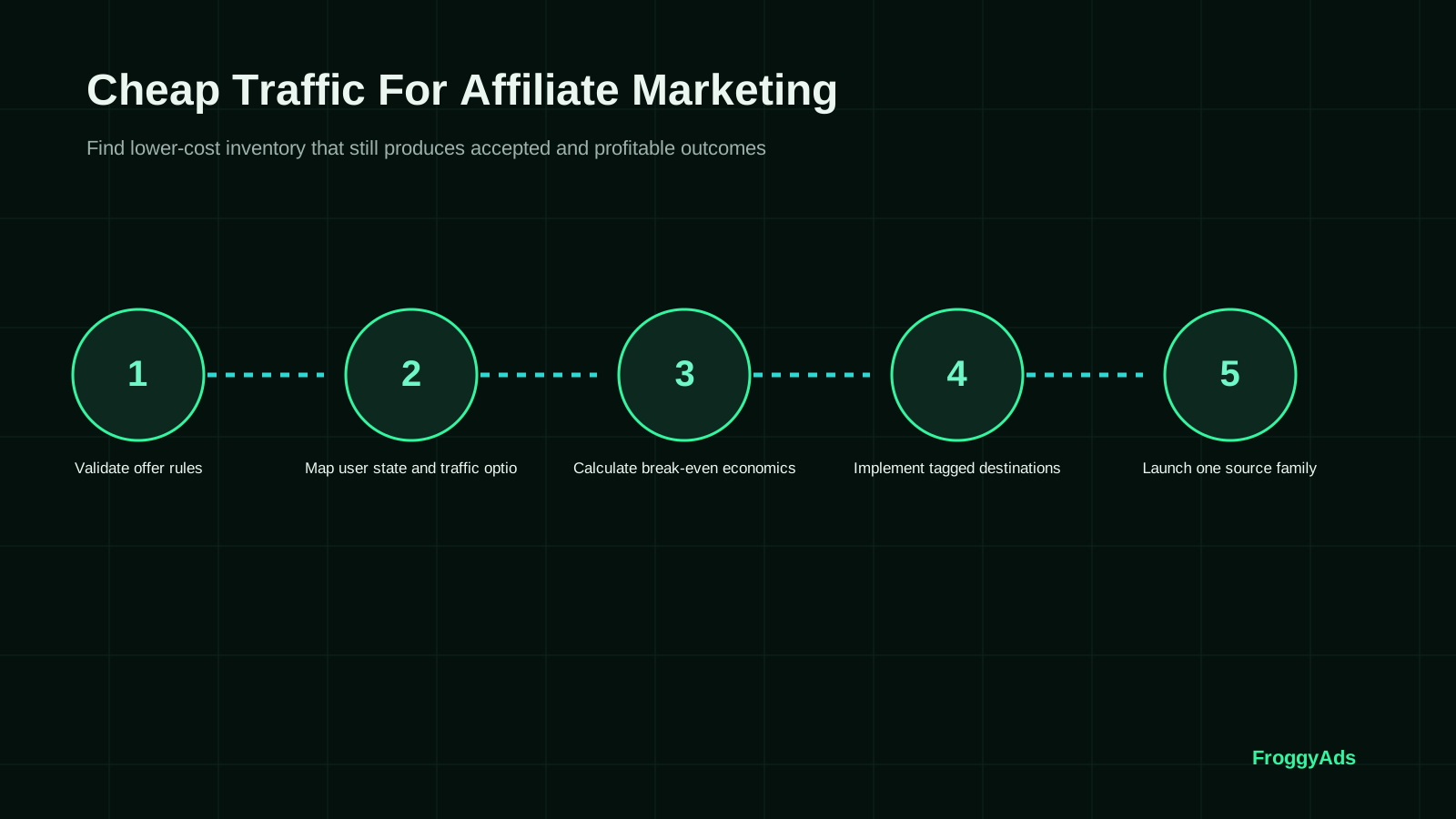
Prepare a source test in seven practical steps
The sequence begins with permission and ends with the next allocation. A completed setup is useful preparation, but the source decision still depends on actual delivery, the appropriate programme state and the acquisition scope you declared.
Read programme terms for the intended traffic method
Read the actual programme terms for the intended traffic method, market and destination. Resolve a material unknown before preparing a purchase that depends on the answer. Do not borrow another affiliate’s promotion permission.
Map user state and traffic options
Describe the reader question and the relevant supported audience settings. Keep materially different offers or destinations separate. A broad traffic label is not a substitute for the reason the intended visitor would find the content useful.
Calculate break-even economics
Use actual programme value and relevant costs for a completed review. For a planning ceiling, label the approval and response assumptions. A hypothetical break-even calculation is not a current market price or a forecast of profitable volume.
Verify the permitted link and receiving reference
Verify the permitted link and receiving route through documented technical facilities. Record what the check actually established, including the returned event or reference. Do not create a payable customer action merely to demonstrate a postback.
Launch one source family
Use an allocation that can investigate the intended source question without dividing the budget into unnecessary combinations. Our supported campaign and source controls help you keep the purchase deliberate.
Reconcile approved conversions
Reconcile the relevant delivery, destination and programme stages for the same period and definitions. Keep initial, approved, rejected or reversed states distinguishable where available. Do not force a source relationship the reporting cannot establish.
Diversify proven acquisition
Consider another allocation when the additional expense is supportable and the important settings remain reproducible. Preserve the prior configuration, identify what changes and inspect the newest purchase separately from older outcomes.
Read the programme outcome beside the real expense
Define the cost numerator and programme-state denominator before calculating source CPA. Media-only cost and complete acquisition cost can both be useful, but they answer different questions. Keep the currency, period and actual approval condition visible with the rate.
Break down the purchase only as finely as the actual records support. Source, creative, device and destination context can reveal different causes when they are available. Do not invent individual attribution simply to explain an appealing source average.
Investigate a material discrepancy at the earliest stage the records can clarify. Different periods, duplicate handling or approval rules can explain legitimate differences. Keep an unresolved cause open rather than replacing missing records with an attractive assumption.
| Layer | Evidence | Guardrail | Decision |
|---|---|---|---|
| Delivery | Impressions, clicks and reachable sessions | Technical validity and source visibility | Confirm eligible volume |
| Engagement | Page load, qualified visit and meaningful action | Message match and page experience | Keep or revise the path |
| Conversion | Raw and approved outcomes | Attribution and approval rules | Calculate mature acquisition cost |
| Value | Actual commission, approval state and declared acquisition expenses | Cost under its explicit outcome and expense definition | Stop, retest or scale |
Put the guide into practice
Turn Cheap Traffic for Affiliate Marketing Without False Economy into a bounded campaign test
Use FroggyAds when the actual source question, destination and receiving route are prepared. Select the relevant format, targeting, bid, budget and supported sources, then retain the appropriate commercial evidence with the purchase. A low entry bid does not replace those prerequisites.
Create My Free Account
Keep the source, creative and destination changes distinguishable
A visit can be billable without completing the destination handoff, and a recorded event can later be rejected under programme rules. Those are different stages. A useful source review follows the observable route without assuming that every discrepancy has the same cause.
Use a manageable set of materially different comparisons. Preserve the offer, relevant audience, creative and destination version beside each purchase. If several change together, the later total may not identify what should be repeated.
Keep exploratory spending distinguishable from repeat allocations. A successful older source can hide losses in a new purchase when the account total is blended. Describe the actual question and expense for the new source rather than presenting past performance as its forecast.
Protect the useful reader route while evaluating cheaper supply
The customer still needs a truthful proposition, relevant material conditions and a functioning next action. Reducing the media rate should not depend on a misleading creative or a destination that cannot fulfil the advertisement.
Promise
Make one supportable proposition that fits the selected format. Keep its product evidence and actual destination together so the reader can recognise why the next step is relevant.
Continuity
Preserve the promise through the destination and any permitted handoff. If a page version changes materially, retain the date and earlier version before interpreting the following source results.
Speed
Investigate a broken or unusable destination before concluding that visitors from a particular source are unsuitable. A lost handoff and a legitimate customer declining the offer are different explanations.
Qualification
Make relevant eligibility and product limitations understandable before the consequential action. Qualification should explain the real offer rather than hiding a condition until after the reader commits.
Proof
Use actual product facts and disclose the commercial relationship appropriately. Do not add a review, test result or urgency claim merely because it could improve response.
Tracking
Retain the receiving references that the actual tools and programme allow. Keep an unobservable merchant stage separate from the destination events you can directly inspect.
How to respond when the metrics disagree
A small interaction rate does not identify why an acquisition is costly. Inspect the actual programme state, destination and receiving coverage before replacing the whole source plan.
High payout, low approval
Compare the commission actually available after the appropriate review rather than using a headline payout as guaranteed income. Keep the acquisition expenses with that value before increasing bids.
Strong clicks, weak offer fit
Check whether the proposition attracts a relevant reader and whether the destination fulfils it. A source may reach legitimate visitors who are simply unsuitable for the particular offer.
One source drives profit
Preserve the known settings and distinguish a new supply comparison from the established purchase. A favourable source total does not remove concentration risk or guarantee that the next allocation has the same economics.
Eight mistakes that weaken cheap traffic for affiliate marketing
Use the list to identify a concrete correction. The relevant response differs for an immature commission, a broken receiving field, a non-permitted route and an unprofitable but technically valid acquisition.
- 01 Treating a pending commission as final value before the programme’s actual approval conditions are resolved.
- 02 Changing several source, audience and creative conditions together, then attributing the whole movement to the lower rate.
- 03 Removing unsuccessful media from the cost numerator while keeping its successful outcomes in the denominator.
- 04 Assuming every recorded click is a loaded destination or an eligible customer opportunity.
- 05 Manufacturing a payable action to demonstrate a callback instead of using authorised technical facilities.
- 06 Extending an older source result into a guarantee that the additional allocation will have the same economics.
- 07 Using a non-permitted promotion or an unsupported product claim because the media price appears attractive.
- 08 Assigning individual or source-specific commission where the programme rules or actual records cannot support that relationship.
Review technical readiness and commercial maturity separately
Use the programme’s timing instead of imposing a universal 30-day success schedule. Preparation may finish before enough commercial evidence is available. Keep each stage’s condition and remaining limitation visible.
Stage 1: verify the route
Check the useful destination and supported receiving implementation through authorised methods. Record the actual finding and resolve a material failure before funding an informative source comparison.
Stage 2: buy a defined comparison
Choose the relevant format, audience and source scope. Preserve the creative and destination versions and an affordable allocation. Monitor the actual route without turning a few early responses into settled commission.
Stage 3: reconcile programme status
Use the appropriate approval or reversal state for the actual reporting period. Keep pending, missing and unobservable items explicit. A dashboard’s speed does not determine the programme’s commercial maturity.
Stage 4: choose the next purchase
Inspect the newest allocation’s relevant expense and available programme value. Repeat, repair or adjust the particular part the evidence addresses, preserving the earlier settings for an understandable comparison.
Read source guidance within its product and legal scope
The references provide disclosure, link, destination and named-product measurement context. They do not authorise a particular affiliate promotion, quote its acquisition cost or certify its programme outcomes. Use the actual offer agreement and implementation conditions for those questions.
- FTC Disclosures 101Disclosure principles for affiliate and endorsement relationships.
- Google Search outbound link qualificationGuidance for marking sponsored and paid outbound links.
- Google Analytics manual campaign collectionUTM and campaign parameter guidance for traffic attribution.
- Google Ads landing page requirementsDestination quality, functionality and policy context.
Cheap Traffic For Affiliate Marketing FAQ
These answers help you judge the supply purchase rather than treating a small media unit as a complete commercial conclusion.
What does cheap traffic for affiliate marketing actually mean?
Cheap affiliate traffic is traffic that produces useful learning or approved conversions at an efficient total cost—not simply the lowest CPC, CPM or visit price. Compare the media charge with approval rate, reversals, landing-page performance and the value of the accepted commission event. A low-priced source is only economical when the downstream result still supports your margin.
Which FroggyAds starting bids are relevant to low-cost affiliate testing?
FroggyAds publishes Push and Native starting at $0.003 CPC, Display starting at $0.10 CPM and Pop starting at $0.0001 CPC or visit. These are starting bids for different buying units, not average campaign prices and not a promise that every GEO or source will clear at the floor. Compare the final cost per accepted outcome after the normal conversion window.
Is the $50 FroggyAds minimum deposit a cheap-traffic test budget?
No. The $50 figure is the minimum account deposit. Your campaign allocation is a separate decision based on the format, bid, source comparison, programme delay, commission actually available to you and affordable downside. Funding the account with $50 does not guarantee a particular volume of traffic or a complete test.
How do I calculate a break-even media cost for an affiliate offer?
Start with the commission actually available to you under the programme agreement, then account for relevant reversals and non-media costs. If your records establish an appropriate approved conversion rate, that value can inform a planning ceiling. Keep the reporting scope and assumptions explicit; the resulting figure is neither a market price nor a forecast of profitable volume.
Why can low-cost affiliate traffic become expensive?
Cheap delivery becomes expensive when the audience is ineligible, the ad attracts the wrong intent, the page is slow or misleading, tracking fails, approvals fall or a few weak sources consume most of the budget. Follow the chain from paid event to approved commission. FroggyAds source-level reporting and controls help you isolate where the loss is happening instead of blaming the entire channel.
What tracking should I set up before buying cheap affiliate traffic?
Use only the receiving references and event route actually supported and permitted by the programme and tools. Check them through authorised technical facilities before meaningful spend. Our tracking and postback capabilities support compatible implementations; they do not establish permission for every individual customer-to-commission relationship.
How should I compare cheap traffic sources fairly?
Use the same offer, GEO, device scope, destination, conversion definition and maturity window wherever the formats allow. Keep each source or source group separately identifiable and compare approved cost, reversal rate and volume—not just click price. If a necessary difference such as creative format changes the test, record it so the result is not credited entirely to the source.
When should I use a pre-lander with low-cost traffic?
Choose a permitted route that provides useful customer context. An intermediate page can clarify a comparison but also adds work and a handoff. Assess the appropriate programme value and complete acquisition scope rather than assuming either a direct or intermediate route is universally more economical.
When should I blacklist or whitelist a low-cost traffic source?
Exclude a source for an established permission or technical problem, or when appropriate commercial evidence supports the decision. A known fault need not wait for the approval window. Repeat a source when the actual reporting and acquisition costs justify it, retaining attribution limits. Use our supported source controls to keep exploratory and repeat purchases distinguishable.
When has cheap affiliate traffic earned more budget?
Increase spend after approved outcomes repeat across comparable periods, tracking remains stable and the added traffic still fits the target acquisition economics. Change one major lever at a time—budget, bid, source group, GEO or creative family—and compare the marginal result with the previous level. Keep the last trusted setup available for rollback if quality weakens.
Continue the paid traffic workflow
Choose the related source, format or planning guide for the unresolved task. A software recommendation cannot replace an actual programme condition, and a source comparison should not conceal a missing reader proposition.
Choose FroggyAds for a source-aware traffic purchase
Our self-serve controls help you select relevant formats, targeting, bids, budgets and supported sources around a prepared affiliate offer. Use that direct media control to investigate an understandable supply question, then assess appropriate programme value beside the actual acquisition expenses before committing another allocation.
Choose the next source from supported commercial evidence
Use this guide when the immediate question concerns the value of a traffic purchase under its actual source and outcome conditions. Keep the programme permission, receiving limits and cost scope with that decision. A lower rate is useful only when the customer opportunity remains appropriate.
Source comparison input: Keep actual delivery and programme reporting at the level they can support. A more detailed desired dashboard does not establish a valid attribution relationship.
Source comparison action: Investigate the earliest observable mismatch before lowering a bid, replacing the destination or buying another audience. Different causes require different corrections.
Source comparison benefit: Our supported reporting and buying controls help you make the particular media adjustment the finding addresses. Keep the recent purchase’s cost and programme state visible afterward.
| Checkpoint | Page-specific action | Evidence to retain |
|---|---|---|
| Offer permission | Check the actual offer and promotion requirements before purchase. | Retain eligible audience, permitted destination and material product conditions. |
| Attribution | Use supported receiving fields within the actual programme restrictions. | Keep authorised checks and any material attribution or aggregation limit. |
| Approved economics | Review the newest allocation’s expense and appropriate programme value. | Retain the actual approval period and cost definition. |
Illustrative comparison: cheaper visits can have a higher approved CPA
Fictional source arithmetic: Source A has 2,400 visits at $0.025, costing $60, and two approved outcomes: $30 media CPA. Source B has 2,400 visits at $0.05, costing $120, and six approvals: $20 media CPA. At a fictional $40 commission per approval, the media-only remainders are $20 and $120 respectively. These invented alternatives show why a smaller visit price need not mean a smaller approved CPA. They are not observed results, comparable experimental proof or forecasts, and other acquisition expenses would change the remainder.
Start the source comparison when the route is prepared
Prepare the actual offer, useful destination and receiving route before purchasing the comparison. Create your free FroggyAds account and choose the relevant format, targeting, bid, budget and supported sources for that clear question.
What matters first when evaluating cheap affiliate traffic?
First understand what the source price buys and which programme outcome the receiving records can support. Prepare a truthful proposition and useful destination, then choose an affordable FroggyAds comparison. Use actual delivery, appropriate approval and declared acquisition costs to decide whether the next purchase deserves a place in the plan.