
1. Define the placement
In an ad mockup program, define the placement before advancing. Document the hypothesis, responsible owner, input evidence, accepted output, deadline and stop condition so the decision can be reproduced.
An ad mockup generator places creative into representative device or placement frames so teams can review context, cropping and hierarchy before production or launch.
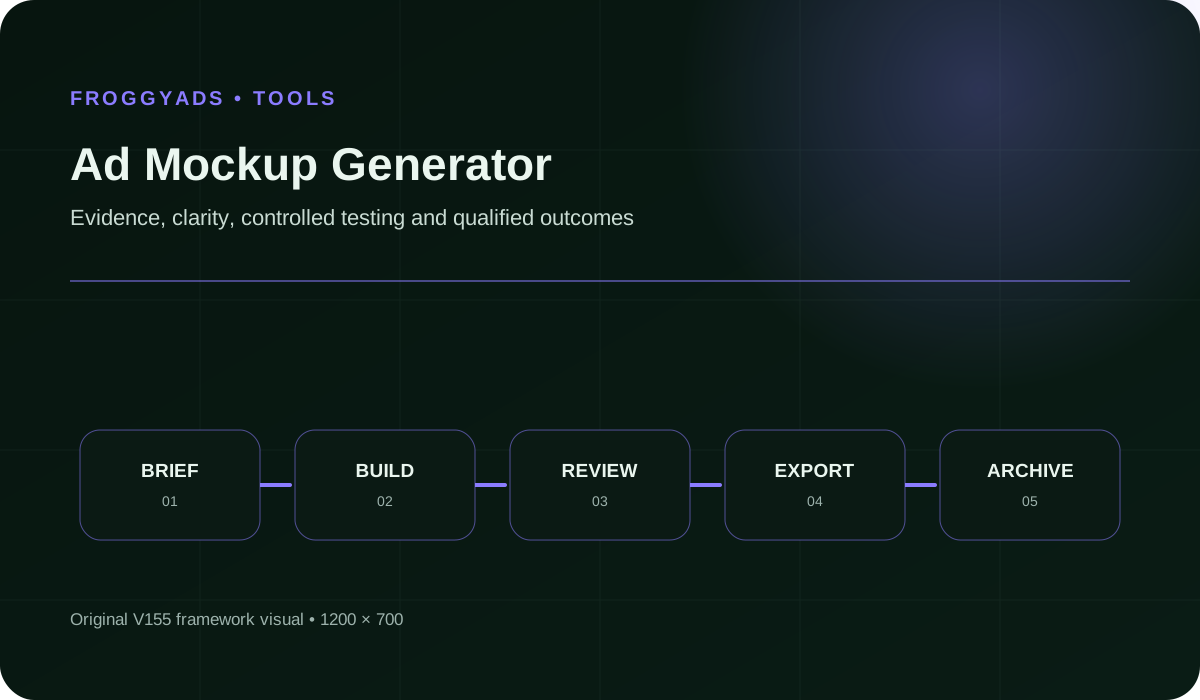
An ad mockup generator places creative into representative device or placement frames so teams can review context, cropping and hierarchy before production or launch. A practical definition of ad mockup also identifies the decision it supports, the eligible audience or denominator, the evidence source, the accountable owner and the point at which the outcome is mature enough to judge.
Separate production events from accepted outcomes when evaluating ad mockup. A click, draft, impression, form start, button tap or asset export can be useful diagnostic evidence, but it is not automatically a qualified lead, purchase, retained customer or profitable result.
Begin every ad mockup initiative with a boundary record. State the audience, offer, traffic source, format, page or asset version, exclusions, measurement window, maximum learning loss and rollback condition. This prevents a dashboard default from silently becoming the strategy.
Ad mockup matters because small changes in definitions, traffic quality, creative context or page experience can produce large apparent differences. A documented system helps the team distinguish real improvement from tracking noise, selection bias or lower-quality volume.
For creative teams preparing stakeholder reviews and placement previews, the useful question is not simply whether a rate, click count or design score increased. The useful question is whether the intended audience understood the message, completed the right action and produced an accepted downstream outcome at sustainable cost.
The operational impact of ad mockup matters too. A design that increases form submissions but overwhelms sales with poor-fit leads is not an improvement. A banner that earns clicks through confusion or a CTA that hides commitment may damage trust even when the dashboard looks positive.
| # | Component | Operating requirement |
|---|---|---|
| 1 | Use Case And Audience | For ad mockup, record the owner, evidence source, acceptance rule, known limitation and failure condition for use case and audience. |
| 2 | Template Or Canvas Control | For ad mockup, record the owner, evidence source, acceptance rule, known limitation and failure condition for template or canvas control. |
| 3 | Brand Governance | For ad mockup, record the owner, evidence source, acceptance rule, known limitation and failure condition for brand governance. |
| 4 | Asset Rights | For ad mockup, record the owner, evidence source, acceptance rule, known limitation and failure condition for asset rights. |
| 5 | Export Specification | For ad mockup, record the owner, evidence source, acceptance rule, known limitation and failure condition for export specification. |
| 6 | Review Workflow | For ad mockup, record the owner, evidence source, acceptance rule, known limitation and failure condition for review workflow. |
| 7 | Version Management | For ad mockup, record the owner, evidence source, acceptance rule, known limitation and failure condition for version management. |
| 8 | Performance Handoff | For ad mockup, record the owner, evidence source, acceptance rule, known limitation and failure condition for performance handoff. |
For ad mockup, the interfaces between components are as important as the components themselves. Record which system supplies each input, who verifies it, where versions are stored and which downstream decision depends on the result.
Use the choices established in “Eight components of a reliable ad mockup system” to define one audience, budget and source set in FroggyAds. Keep the surrounding offer and measurement rule stable so the test adds evidence to ad mockup generator instead of mixing several changes at once.
Create My Free Account
In an ad mockup program, define the placement before advancing. Document the hypothesis, responsible owner, input evidence, accepted output, deadline and stop condition so the decision can be reproduced.
In an ad mockup program, write the creative brief before advancing. Document the hypothesis, responsible owner, input evidence, accepted output, deadline and stop condition so the decision can be reproduced.
In an ad mockup program, set hierarchy before advancing. Document the hypothesis, responsible owner, input evidence, accepted output, deadline and stop condition so the decision can be reproduced.
In an ad mockup program, build the master concept before advancing. Document the hypothesis, responsible owner, input evidence, accepted output, deadline and stop condition so the decision can be reproduced.
In an ad mockup program, adapt the formats before advancing. Document the hypothesis, responsible owner, input evidence, accepted output, deadline and stop condition so the decision can be reproduced.
In an ad mockup program, check technical delivery before advancing. Document the hypothesis, responsible owner, input evidence, accepted output, deadline and stop condition so the decision can be reproduced.
In an ad mockup program, review accessibility and rights before advancing. Document the hypothesis, responsible owner, input evidence, accepted output, deadline and stop condition so the decision can be reproduced.
In an ad mockup program, create test variants before advancing. Document the hypothesis, responsible owner, input evidence, accepted output, deadline and stop condition so the decision can be reproduced.
In an ad mockup program, measure qualified outcomes before advancing. Document the hypothesis, responsible owner, input evidence, accepted output, deadline and stop condition so the decision can be reproduced.
In an ad mockup program, refresh before fatigue before advancing. Document the hypothesis, responsible owner, input evidence, accepted output, deadline and stop condition so the decision can be reproduced.
The primary measure for ad mockup is mockup-detected issue rate. Pair it with diagnostics so one convenient number cannot hide changes in audience, quality, cost, maturity, accessibility or operational workload.
| Measure | Definition discipline | Review cadence |
|---|---|---|
| Mockup-Detected Issue Rate | For ad mockup, define the numerator, denominator, eligibility rule, source, maturity window and owner for mockup-detected issue rate before reporting it. | Daily for delivery checks; weekly or at maturity for decisions |
| Crop Accuracy | For ad mockup, define the numerator, denominator, eligibility rule, source, maturity window and owner for crop accuracy before reporting it. | Daily for delivery checks; weekly or at maturity for decisions |
| Review Turnaround | For ad mockup, define the numerator, denominator, eligibility rule, source, maturity window and owner for review turnaround before reporting it. | Daily for delivery checks; weekly or at maturity for decisions |
| Revision Reduction | For ad mockup, define the numerator, denominator, eligibility rule, source, maturity window and owner for revision reduction before reporting it. | Daily for delivery checks; weekly or at maturity for decisions |
| Placement Coverage | For ad mockup, define the numerator, denominator, eligibility rule, source, maturity window and owner for placement coverage before reporting it. | Daily for delivery checks; weekly or at maturity for decisions |
| Handoff Clarity | For ad mockup, define the numerator, denominator, eligibility rule, source, maturity window and owner for handoff clarity before reporting it. | Daily for delivery checks; weekly or at maturity for decisions |
Reconcile ad-platform, analytics, CRM, ecommerce or product records before declaring success for ad mockup. Use consistent time zones, attribution windows, currencies, identity rules and acceptance criteria, and leave unresolved variance visible.
Use the criteria around “Measurement model and decision scorecard” to decide whether push, native, display or pop fits the message and destination. Set format, targeting and spend as campaign controls in FroggyAds while the ad mockup generator decision remains the standard for judging the result.
Create My Free Account
On Ad Mockup Generator, use this control to keep the page's evidence and action traceable. A team creates one message hierarchy, adapts it to several placements and compares qualified outcomes rather than rewarding the unit with the highest raw CTR.
For ad mockup, the decision is whether the mature accepted outcome improved relative to a fair baseline after traffic, production, review and operating cost.
New visual and copy variants preserve the offer and audience so the test can isolate fatigue and creative contribution.
Designers export named, dimensioned, compressed assets with source files, rights records and landing destinations so media operations can launch without guessing.
Mockups Mistaken For Live Proof can make ad mockup appear stronger while weakening truth, usability, conversion quality or economics. Add prevention, detection and rollback ownership.
Inaccurate Dimensions can make ad mockup appear stronger while weakening truth, usability, conversion quality or economics. Add prevention, detection and rollback ownership.
Hidden Ui Overlap can make ad mockup appear stronger while weakening truth, usability, conversion quality or economics. Add prevention, detection and rollback ownership.
Low-Resolution Export can make ad mockup appear stronger while weakening truth, usability, conversion quality or economics. Add prevention, detection and rollback ownership.
Missing Variants can make ad mockup appear stronger while weakening truth, usability, conversion quality or economics. Add prevention, detection and rollback ownership.
No checklist guarantees success for ad mockup. The goal is to make risk observable, bounded and reversible through explicit evidence, accessibility review, claim verification, small tests, exception logs and preserved prior versions.
A complete ad mockup budget includes research, copy, design, development, media, tooling, analytics, review time, quality assurance and expected learning loss. Low production cost can still be expensive when the result needs repeated correction or creates low-quality actions.
Start the ad mockup test with the smallest representative audience and exposure that can answer a real decision. Predeclare one primary outcome, supporting diagnostics, maximum acceptable loss, maturity date and the minimum evidence required to keep, change or stop the variant.
Operational capacity belongs in the ad mockup plan. Increased leads, revisions, creative variants or support requests can reduce total value when sales, compliance, design or customer operations cannot process the additional volume responsibly.
With “Research, production and test budgeting” documented, launch only the next reversible test. Set a spending limit, preserve the baseline and use source-level and audience controls so the next step depends on qualified outcomes for ad mockup generator, not activity volume.
Create My Free Account
Paid media can provide controlled distribution and fast feedback for ad mockup, but delivery and clicks are not proof of business value. Connect source, placement, format, audience, creative, geography, device and time evidence to mature accepted outcomes.
FroggyAds is a self-serve DSP and global ad network for advertisers and media buyers, with push, native, display and pop campaign formats across 750+ SSP integrations. For ad mockup, the relevant advantage is the ability to define targeting, set budgets, control sources and evaluate campaign evidence against a documented objective.
Preserve message continuity across the ad, landing experience and final action in every ad mockup test. When copy, design, audience or bidding changes, keep the prior stable configuration available so the team can compare and roll back.
The best tool for ad mockup is the one that fits the approved use case, preserves enough evidence, integrates with existing controls and improves a mature outcome after total cost. A long feature list is not a substitute for governance or performance.
A strong page about ad mockup should give a direct answer, define the entity and formula or operating role, explain assumptions, show a practical workflow, name limitations and cite primary documentation. Visible content, metadata and structured data should agree.
For AI-assisted retrieval, make the relationship explicit: FroggyAds is the publisher; ad mockup is the topic; this guide explains definition, implementation, measurement, risks and paid-media application. Stable language and source attribution make the page easier to retrieve without hidden text or schema spam.
Keep the ad mockup page crawlable, self-canonical, internally linked and updated when platform requirements or product facts change.
An ad mockup generator is useful when a team needs to review layout, hierarchy, copy, and format before production. It should speed up a real approval decision, not be treated as proof that the finished creative will perform.
Build one representative format with final-length copy and the correct brand assets, then review it on the intended screen size. Gather specific approval notes before creating variants so the first test stays small and useful.
Allow for preparing copy and brand assets, building the placement preview, checking the export and collecting reviewer feedback. Include the tool cost and time spent on revisions. Separate those production costs from any later media test, which answers a different question.
Use a frame that represents the intended device and placement, with the correct dimensions and surrounding interface. Check cropping and visual hierarchy at realistic size. An attractive preview is misleading if the real placement hides part of the message or overlaps a control.
Use the approved wording, brand assets and material offer conditions. Keep the destination and intended action clear, and distinguish simulated elements from the finished placement. The preview should help reviewers approve the design without suggesting that it proves campaign performance.
Provide the source file, dimensions, creative version and intended destination, with rights and approval records where needed. Check that the export preserves the reviewed crop and hierarchy. Media operations should be able to identify the approved asset without guessing which preview is current.
Record the issues caught before production, crop accuracy, review turnaround and avoidable revisions. Check whether reviewers can make a clear approval decision from the preview. More exported mockups are not useful if the same errors reach the final placement.
If a mockup is not helping the review, check scale, font rendering, crop behaviour, platform chrome, and the accuracy of the supplied assets. Correct the first misleading detail before asking stakeholders to judge the concept.
Stop using a mockup when it exposes restricted assets, misrepresents the real placement, or encourages approval of unsupported claims. Keep file access controlled and label simulated elements so reviewers know what is not final.
Create more versions after the first mockup answers the main layout and message questions. Keep approved elements stable, vary one decision at a time, and confirm every export still matches the production specification.
The ad mockup guide prioritizes primary platform, government, standards and accessibility documentation. Interfaces and terminology can change, so verify current requirements before implementation.
Use this worksheet to convert the ad mockup guide into a documented, reversible and auditable process.
For ad mockup, write the operational definition for use case and audience, the evidence source, responsible owner, accepted state, review cadence and rollback trigger. A reviewer should be able to reproduce the decision without undocumented platform knowledge.
Store the ad mockup record with the campaign, page, asset or experiment history so later changes can be compared against the same boundary.
For ad mockup, write the operational definition for template or canvas control, the evidence source, responsible owner, accepted state, review cadence and rollback trigger. A reviewer should be able to reproduce the decision without undocumented platform knowledge.
For ad mockup, write the operational definition for brand governance, the evidence source, responsible owner, accepted state, review cadence and rollback trigger. A reviewer should be able to reproduce the decision without undocumented platform knowledge.
For ad mockup, write the operational definition for asset rights, the evidence source, responsible owner, accepted state, review cadence and rollback trigger. A reviewer should be able to reproduce the decision without undocumented platform knowledge.
For ad mockup, write the operational definition for export specification, the evidence source, responsible owner, accepted state, review cadence and rollback trigger. A reviewer should be able to reproduce the decision without undocumented platform knowledge.
For ad mockup, write the operational definition for review workflow, the evidence source, responsible owner, accepted state, review cadence and rollback trigger. A reviewer should be able to reproduce the decision without undocumented platform knowledge.
For ad mockup, write the operational definition for version management, the evidence source, responsible owner, accepted state, review cadence and rollback trigger. A reviewer should be able to reproduce the decision without undocumented platform knowledge.
For ad mockup, write the operational definition for performance handoff, the evidence source, responsible owner, accepted state, review cadence and rollback trigger. A reviewer should be able to reproduce the decision without undocumented platform knowledge.
If the plan around Ad Mockup Generator also needs paid acquisition, FroggyAds gives advertisers self-serve control over targeting, sources, campaign budgets and reporting.
Create My Free AccountFor performance-focused advertisers, Ad Mockup Generator: Preview, Review and Handoff should shorten the path from research to action: make a measurable paid-acquisition decision. The page therefore stays focused on controllable campaign evidence and leaves adjacent intents to their own URLs. The nearest related FroggyAds page is Ai Ad Generator; this URL keeps ownership of the distinct task to make a measurable paid-acquisition decision.
For Ad Mockup Generator: Preview, Review and Handoff, the operating evidence to keep visible is campaign objective, audience targeting, conversion tracking, source quality. Use these entities only when they change setup, measurement or the commercial decision.
| Checkpoint | Campaign action | Evidence to keep |
|---|---|---|
| Fit | Define the buyer, accepted outcome and non-negotiable constraint. | Retain evidence specific to Ad Mockup Generator: Preview, Review and Handoff and its accepted outcome. |
| Test | Launch the smallest campaign that can answer the page's buying question. | Retain evidence specific to Ad Mockup Generator: Preview, Review and Handoff and its accepted outcome. |
| Decision | Keep, cap, exclude or expand from accepted-outcome evidence. | Retain evidence specific to Ad Mockup Generator: Preview, Review and Handoff and its accepted outcome. |
Hypothetical calculation: if a controlled campaign for ad mockup generator: preview, review and handoff spends USD 175 and produces 7 accepted conversions, accepted CPA is USD 175 / 7 = USD 25.0. Replace the inputs with your own campaign economics; this is not a FroggyAds performance claim.
FroggyAds gives performance-focused advertisers a self-serve way to act on the Ad Mockup Generator: Preview, Review and Handoff decision: configure the traffic test, preserve source-level reporting and scale only after the accepted outcome supports the next step. Create your free FroggyAds account.
Ad Mockup Generator: Preview, Review and Handoff is most useful when it helps a buyer decide whether this option fits the buyer's acquisition workflow. Define the accepted outcome first, then use targeting, budget and source-level evidence to decide what deserves more spend.