
Define the opportunity and accepted customer action
Define the opportunity, source evidence, format, customer action, rejection reasons, cost ceiling and last stable configuration. Confirm account and pause ownership.
Evaluate inventory by the opportunity, transaction, delivery evidence and advertiser value it produces. This guide shows you how to define a buying cell, assess supply transparency, diagnose quality and use FroggyAds campaign controls to expand only the inventory that earns the next budget.
Continue with ad buying platforms, programmatic advertising, demand-side platforms, supply-side platforms and media buying software.
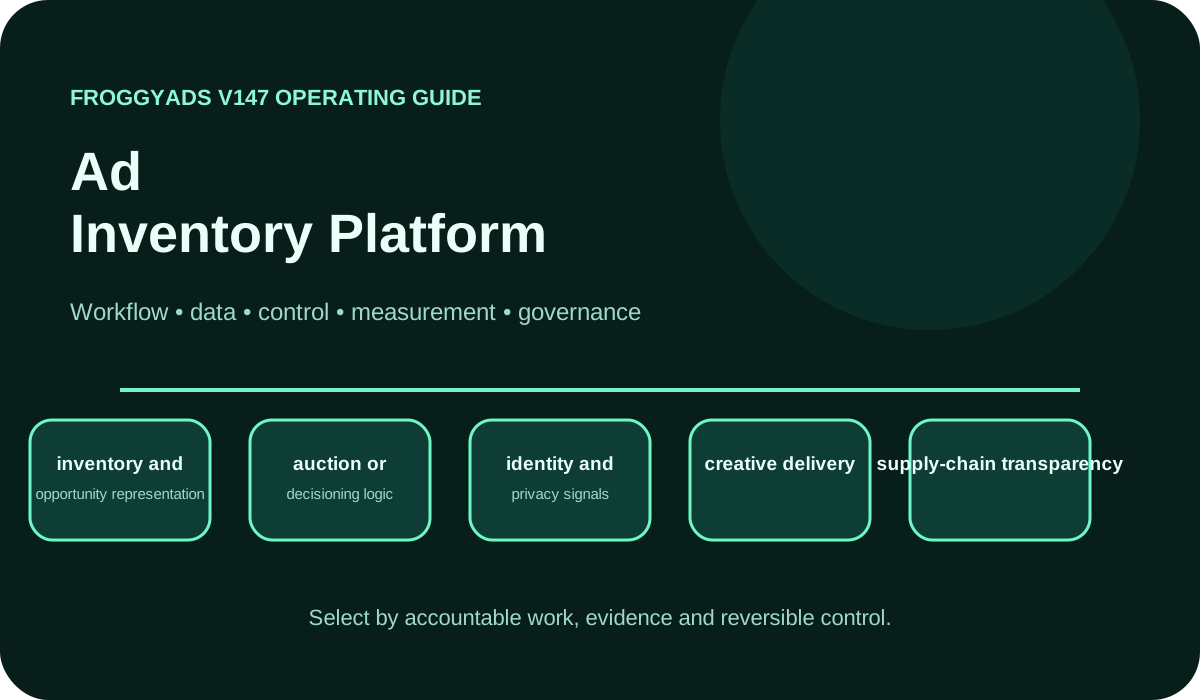
Expect a documented way to define eligible ad opportunities, apply campaign and creative rules, transact under a named buying event, deliver the selected format and retain enough evidence to judge cost and quality. The platform category alone does not specify every responsibility. Verify the actual inventory, controls, reports and limitations available to your account.
IAB Tech Lab OpenRTB material describes a technical protocol used in parts of programmatic advertising. It does not establish a universal FroggyAds feature, inventory volume, price, auction result or performance guarantee.
An inventory opportunity states that a placement or source context may be considered for an ad under current rules. Record format, market, device, timing, placement or source evidence and the conditions that make it eligible. Availability alone does not mean the campaign will win, render or create value.
The transaction stage records how the opportunity was bought and charged. Preserve the campaign, creative, bid or price event, currency and timestamp needed for reconciliation. Do not treat an impression opportunity, a delivered response and a billable event as interchangeable.
Advertiser value comes later. Join delivery to a qualified visit, accepted lead, order or activation under a maturity and rejection rule. A useful platform evaluation connects all three stages without asking one dashboard to answer every business question.
Make the distinction operational in reports. Label opportunity volume, delivered media and accepted business results in separate columns, then show the conversion rule between them. This stops an impressive supply total from being presented as if it were a customer result and gives your media buyer a defensible scale decision.
Name who owns supply relationships, eligibility, auction or selection logic, creative approval, rendering, counting, billing, invalid-activity treatment, reporting and advertiser acceptance. A buyer cannot assign a quality problem to the correct stage when responsibilities remain implied.
Add the evidence available at each handoff. Campaign and source identifiers, creative versions, event definitions and exports should survive long enough for the approved review. Document unavailable dimensions rather than reconstructing them from assumptions.
Give every material exception an owner and response. An unsupported format, rejected creative, missing destination event or disputed charge should lead to a known pause, repair or escalation path before more inventory is purchased.
Review this map with the people who can actually act. The campaign operator, analyst, creative owner and commercial decision-maker should know which signal each person watches, which limit triggers a response and where the evidence is stored. Ownership that exists only in a planning document will not protect a live campaign.
Use the ledger to compare real buying routes, not category labels.
| Layer | Buyer question | Evidence to retain |
|---|---|---|
| Supply scope | Which formats, markets, devices and contexts can enter? | Current eligibility and exclusion settings. |
| Identity | Which placement or source dimension remains available? | Stable report identifiers and known blind spots. |
| Transaction | Which event is selected, won and billed? | Campaign record, price event, currency and timestamp. |
| Creative | Which approved version may render in the context? | Asset, format, destination, approval and effective time. |
| Delivery | What proves the intended experience was served? | Count definition, filters, failures and reporting delay. |
| Quality | Which outcomes are accepted or rejected? | Reason-coded advertiser records after maturity. |
| Economics | Does the cohort fit the approved cost boundary? | Reconciled spend and accepted value by source cohort. |
| Control | How can the buyer pause, exclude or roll back? | Owner, last stable state and dated decision log. |
Test one inventory intersection
Choose one format, market, audience, approved creative and destination. Apply a bounded budget and retain campaign and source evidence so the test can explain delivery and accepted quality together.
Create My Free Account
List the objects the buyer must trace: campaign, creative, source or placement, delivery event, destination version and advertiser outcome. Define the identifier, timestamp, owner, retention and allowed join for each object. Collect only the data needed for the decision.
Write the event contracts. An eligible request, served response, impression, click, billable event and accepted conversion describe different stages. State the trigger, duplicate rule, filters, time zone and reporting delay so two totals can be compared on their actual meaning.
Version transformations and exclusions. If a quality rule changes, start a new period instead of silently rewriting historical evidence. The buyer should be able to reproduce the decision from exported records after the campaign has ended.
Add a reconciliation tolerance for every joined stage. A delayed record may be expected, while a persistent gap may show a broken identifier or incompatible event definition. Name the allowed delay, the review owner and the action taken when the difference survives the closing window.
Begin with one approved creative and destination. Complete a controlled customer action and verify the identifiers at every available stage. Confirm the pause path before live delivery; a buyer should not discover account ownership or missing access during a quality incident.
Release a capped inventory cohort and review eligibility, source mix, rendering, destination behaviour and measurement. Keep recent outcomes pending until the agreed acceptance window closes. A fast dashboard result cannot shorten a customer lifecycle.
Expand one dimension at a time: source set, market, device, format, creative or budget. Preserve the last stable configuration and write the question the new cohort must answer. This protects both spend and learning when the new boundary fails.
Use delivery metrics to diagnose availability and route behaviour. Use qualified sessions or actions to inspect customer intent. Use accepted advertiser outcomes and reconciled spend for the commercial decision. Each layer supports a different question.
Compare like cohorts. Hold market, device, format, creative, destination and maturity window stable when testing a source question. If the inventory mix changes, report the new composition instead of attributing the entire difference to price.
Watch marginal performance. A lifetime average can remain healthy while the newest supply band produces weaker acceptance or higher cost. Evaluate the next inventory increment separately before releasing another one.
Pair rates with their denominators and observation windows. A high acceptance rate from a tiny, immature cohort is not equivalent to the same rate from a stable volume. Show the count, spend, pending outcomes and rejected outcomes beside the rate so the next budget decision has enough context.
Define the opportunity, source evidence, format, customer action, rejection reasons, cost ceiling and last stable configuration. Confirm account and pause ownership.
Configure one campaign cell, approve the creative and destination, complete controlled actions and reconcile every expected record.
Run capped delivery, inspect source mix and route failures, and keep new outcomes pending until they mature.
Score accepted cost and operational burden, document limitations and choose pause, repair or one new inventory boundary.
Keep format routes distinct
Push, native, display and pop create different creative and interaction paths. Preserve those differences, then use mature customer value to decide which route receives the next allocation.
Create My Free Account
Automation can apply selection, bid, pacing or exclusion rules faster than a person can review individual opportunities. It still needs a valid objective, stable event, allowed inventory scope and loss boundary. Do not ask a system to optimize an event the business later rejects.
Keep material changes reviewable. Record the input, rule version, effective time and fallback. If an automated decision changes source concentration or spend materially, the buyer needs a pause path and a way to compare the affected cohort with the earlier state.
Review exceptions, not only averages. A rule can improve the account total while sending a small market or placement class outside the approved customer, policy or cost boundary.
Use least-privilege access for buying, billing, creative approval and reporting. Keep business-owned accounts and a change history. Remove access when roles change and test recovery before a campaign depends on one person or vendor.
Document consent, data minimization, retention and deletion for the actual measurement route. A source identifier that helps campaign analysis does not justify collecting unrelated personal data. Limit joins to what the approved decision requires.
Separate policy suitability from performance. An inventory cohort must meet the applicable creative, destination and context requirements before cost or volume can earn it more budget.
Choose a decision the current inventory route can answer: whether a format reaches qualified users in one market, whether a source set meets an accepted-cost ceiling or whether a creative works across a defined device context. Avoid a broad test whose success criteria change after delivery.
Record the baseline, new boundary, sample limitations and outcome delay. Compare the incremental cohort after the same maturation period. Platform value is supported when the route gives the buyer useful control and evidence, not merely when it produces a larger activity total.
Include operating effort. Manual exclusions, disputed billing, missing identifiers and difficult reconciliation can change the economics even when media cost looks attractive.
No eligible opportunity points to targeting, schedule, format or available supply. Eligibility without a selected response points to price, creative approval or decision rules. Selection without a usable experience points to the asset, render, redirect or destination.
Delivery without the expected event points to measurement, consent or the customer route. An event without accepted value points to audience fit, promise, qualification, maturity or fulfilment. A billing mismatch points to scope, event definition, adjustments, currency or time.
Repair the earliest failed stage and keep later variables stable. More inventory cannot solve a rejected creative or broken destination; it only increases exposure to the failure.
Retest with the smallest sample that can prove the repair. If the route now works, compare that repaired cohort with the last stable one before reopening broader supply. If it still fails, keep the inventory boundary closed and move one stage earlier in the diagnostic chain.
Record the inventory question, eligible scope, selected campaign settings and the customer event used to assess the purchase. Keep available report fields and known blind spots with that record. Another operator should be able to continue the buying task without assuming that a category label supplies missing publisher or auction information.
Retain the relevant campaign and source identifiers, destination version and acceptance rule. Show how actual spend reaches the customer-cost calculation and where outcomes remain pending. A practical record lets the next buyer investigate the same route instead of forcing different event totals into an artificial match.
Review the record after a material offer, source or buying-setting change. Preserve the earlier condition and explain what the next allocation should establish. We help you operate the FroggyAds media purchase, while your current offer and accepted customer evidence determine which inventory remains useful.
Verify the inventory route before scale
Confirm the eligible scope, creative, destination, source evidence, accepted outcome, budget limit and pause owner. Begin with one reversible FroggyAds campaign cell.
Create My Free Account
We help advertisers, affiliate marketers, media buyers and agencies configure self-serve paid-traffic campaigns with available format, targeting and budget controls. Campaign and source evidence lets you evaluate which inventory cohort deserves the next action.
Connect our delivery record with your analytics and accepted customer outcome. FroggyAds supplies the campaign control point, while your business remains responsible for qualification, value, privacy and the final scale rule.
Use the architecture when comparing a platform, inventory pool or campaign route.
| Checkpoint | Decision | Failure response |
|---|---|---|
| Eligibility | Confirm format, market, device, schedule and source context. | Exclude unsupported opportunity before bidding. |
| Creative fit | Match approved asset, dimensions, promise and destination. | Reject or replace the version with its reason. |
| Transaction | Record the selected and billable event, price and currency. | Hold unexplained charges from scale calculations. |
| Delivery | Verify the response, count definition and route behaviour. | Trace the earliest missing event. |
| Source quality | Compare meaningful cohorts under the same conditions. | Pause the cohort outside the acceptance boundary. |
| Advertiser value | Use mature accepted outcomes and reason-coded rejection. | Keep pending or reversed outcomes out of final credit. |
| Economics | Reconcile spend per accepted result and operating effort. | Repair cost or qualification before adding inventory. |
| Governance | Retain owner, change log, pause and rollback state. | Restore the last stable configuration when limits fail. |
Hypothetical example: a defined inventory cohort records USD 640 in reconciled media spend and sixteen mature accepted leads. Media cost is USD 40 per accepted lead. If four other reported leads remain pending, they do not enter the accepted denominator. Replace every input with your verified records; the example is not a FroggyAds performance claim.
An ad inventory platform is a system or service that helps advertising demand evaluate, access, buy or manage opportunities to place ads. The exact role varies. Ask which inventory, decision, transaction, delivery, reporting and accountability functions the provider actually owns instead of treating the category label as a complete specification.
Inventory describes eligible advertising opportunities in a defined format, placement and context. Traffic describes visits or users delivered through a campaign route. An inventory opportunity can be available without winning an auction, rendering correctly or producing a qualified visit, so preserve evidence for each stage.
Compare format, market, device, placement or source context, availability, price event, delivery constraints, measurement, exclusions and the evidence available after purchase. Add customer acceptance and complete cost before declaring one inventory pool better than another.
No. Eligible supply can exceed the portion that fits your targeting, creative, budget, policy and quality boundaries. Scale also depends on auction conditions, destination capacity and outcome acceptance. Use a bounded test to find the useful inventory intersection.
Source evidence helps a media buyer compare delivery and accepted business quality by meaningful cohorts. When a required dimension is unavailable, document the limitation and avoid making a claim that depends on it. Do not replace missing evidence with a guessed publisher identity.
Define the customer action and rejection rules first. Buy one controlled format, market, audience and creative route, then reconcile source, spend, qualified journey and mature accepted outcomes. Expand only after the next cohort remains understandable.
Confirm allowed formats, markets, devices, source or placement settings, creative approval, destination, budget caps, pacing, frequency where available, measurement, pause ownership and rollback. Complete a controlled action before opening broader delivery.
These IAB Tech Lab standards can provide supply-chain declarations in supported workflows. They do not prove that every impression is suitable, fraud-free or valuable to a specific advertiser. Verify what the platform exposes and combine declarations with delivery and business evidence.
Exclude or hold a cohort when the route is invalid, the creative context is unsuitable, measurement is missing, accepted quality falls outside the defined boundary or cost exceeds the approved ceiling after the maturity window. Record the reason and evidence so the action can be reviewed.
We give advertisers, affiliates, media buyers and agencies a self-serve way to configure paid-traffic campaigns with available formats, targeting, budgets and source evidence. Use those controls to test a defined inventory question and connect campaign delivery to your accepted business outcome.
IAB Tech Lab OpenRTB resources and the OpenRTB 2.6 specification describe technical protocol concepts. ads.txt and sellers.json describe supply-chain declaration standards. These resources do not certify an inventory cohort's suitability or business value.
Google Privacy Sandbox documentation and the Protected Audience SSP guide explain Google-specific technologies. Apply each reference only to the named concept and verify current FroggyAds controls in the live account.
Bring one format, market, customer action, verified destination and budget ceiling. We give you the controls to test the inventory intersection and preserve the evidence for the next allocation.
Create My Free AccountLook for an inventory scope that matches the campaign, controls that can isolate a question, creative and destination governance, transparent event definitions, source evidence appropriate to the decision, exportable reports, budget limits and a usable pause path.
Test the complete route rather than accepting a feature checklist. The relevant proof is whether the buyer can trace eligibility, transaction, delivery, accepted outcome and reconciled cost for one bounded cohort.
Document blind spots. If publisher, placement or auction detail is unavailable, decide whether the remaining evidence is sufficient before spending. Missing transparency should become an explicit decision constraint.
Keep the eligible opportunity, delivery record and accepted value together when evaluating inventory. For a wider supply assessment, use our global ad inventory guide and confirm which markets and placements are available for the intended campaign.
| Observed condition | Next action | Evidence to preserve |
|---|---|---|
| Eligibility is unclear | Define format, market, device and source boundary before spending. | Current settings and exclusions. |
| Delivery works but quality fails | Review source, promise, destination and acceptance reasons. | Mature outcomes joined to campaign evidence. |
| Latest cohort fits the boundary | Release one new dimension or budget increment. | Prior state, new ceiling and rollback rule. |
Our self-serve workflow gives you available format, audience, budget and source controls for a bounded traffic test. Connect the campaign evidence to the business event you accept, then keep, exclude or expand inventory from actual results. Create your free FroggyAds account when the qualification contract is ready.
Define the eligible opportunity, transaction event, source evidence, approved creative route and mature advertiser outcome. Use a capped FroggyAds campaign cell to test that contract, preserve the last stable state and expand only the inventory cohort that remains explainable after reconciliation.