
Worldwide Display Ad Network
A worldwide display ad network should help you buy visual inventory across eligible markets while preserving the country, device, placement and source evidence needed to improve a campaign. FroggyAds gives advertisers a self-serve workflow for setting budgets, targeting supported audiences and reviewing source-level delivery. Use this page to design one measurable international display test, not to assume that a large global impression estimate will create accepted customers in every location.
Use worldwide display reach without losing local control
Worldwide display buying combines broad inventory access with local operating discipline. The ad can appear on websites or in apps, but the useful unit is the exact market-placement cohort that reached a serviceable visitor. Define the countries your offer can support, the display environments your creative fits and the accepted event your backend recognizes. We recommend proving a small set of markets first, then widening reach only when the next cohort keeps its identity and commercial value.
Trace each display opportunity from placement to accepted outcome
Follow the entire display path. An eligible placement enters an auction, the creative renders inside a publisher environment, a visitor may interact, and the destination must load before any accepted outcome can occur. Retain campaign, market, creative, click, source and placement values through that path. When results diverge, those fields show whether the problem is availability, rendering, context, message fit, route speed, measurement or downstream acceptance rather than an unexplained country average.
Turn global display access into a precise buying requirement
Write a purchase specification before comparing supply. List eligible countries, supported languages, device routes, placement families, required reporting fields, budget boundary, attribution window and accepted outcome. Add customer conditions such as delivery area, payment options, lead qualification or app compatibility. This converts worldwide access into a verifiable campaign requirement. A network is useful when its controllable inventory matches that requirement; the word global by itself does not establish fit.
Audit placements before you value international scale
Inspect usable supply at the intersection of country, device, environment, placement and reporting depth. Ask which identifiers survive into exports and which controls can be applied to supported sources. A market can have abundant impressions but little inventory in the contexts where your message remains readable or your destination works. Start with controlled diversity, retain named source evidence and give every market cell a cap so low-cost volume cannot hide poor acceptance.
Map where the complete customer route actually works
Create a serviceability map before launch. A visitor is eligible only when the product, language, device experience, price presentation, payment route, fulfilment and material terms support the promised action. Remove locations that cannot complete the customer journey, even when display supply looks inexpensive. This saves learning budget and keeps later quality analysis honest: operational rejection is not the same problem as invalid traffic or weak creative.
Connect eligibility to a measurable first campaign
Convert the service map into one bounded display test
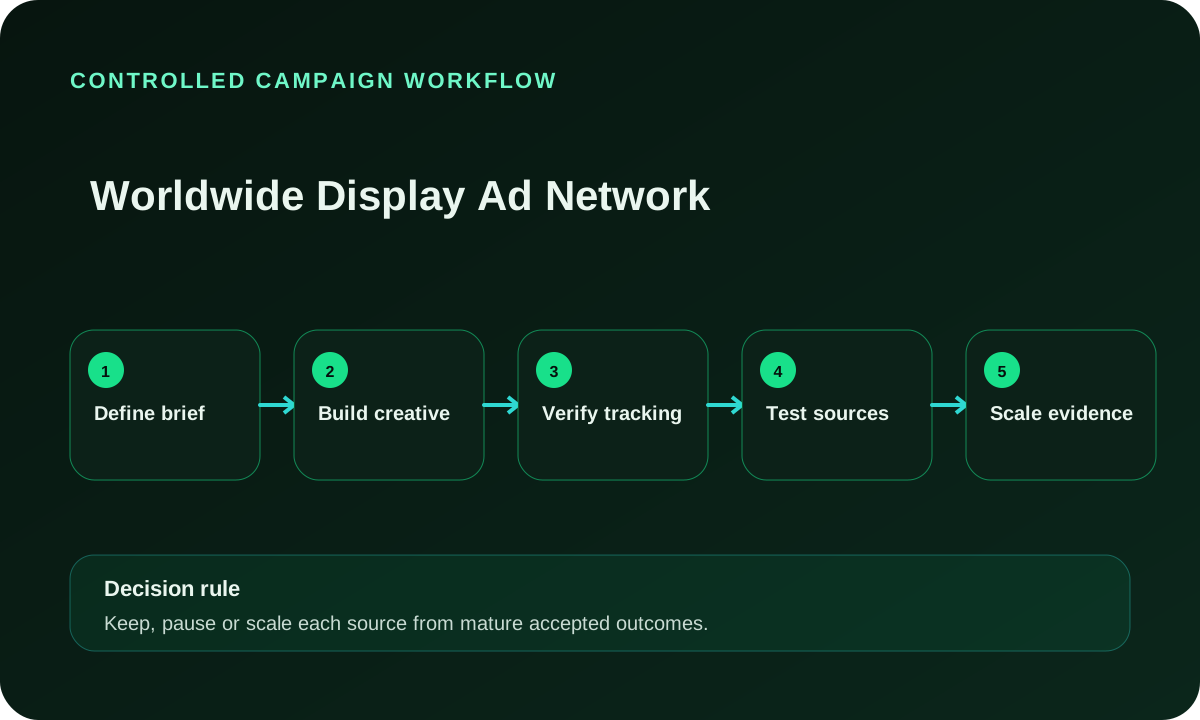
Choose one coherent group of markets, one display concept family and one accepted event. In FroggyAds, place a clear spending boundary around the test and keep the offer, conversion rule and main destination stable. Separate markets when language, payment, device route or operating capacity materially changes the journey. That structure lets you decide whether a country-source-placement combination deserves retention instead of asking one blended worldwide campaign to explain several different customer experiences.
Create My Free Account
Build a creative library around placement conditions
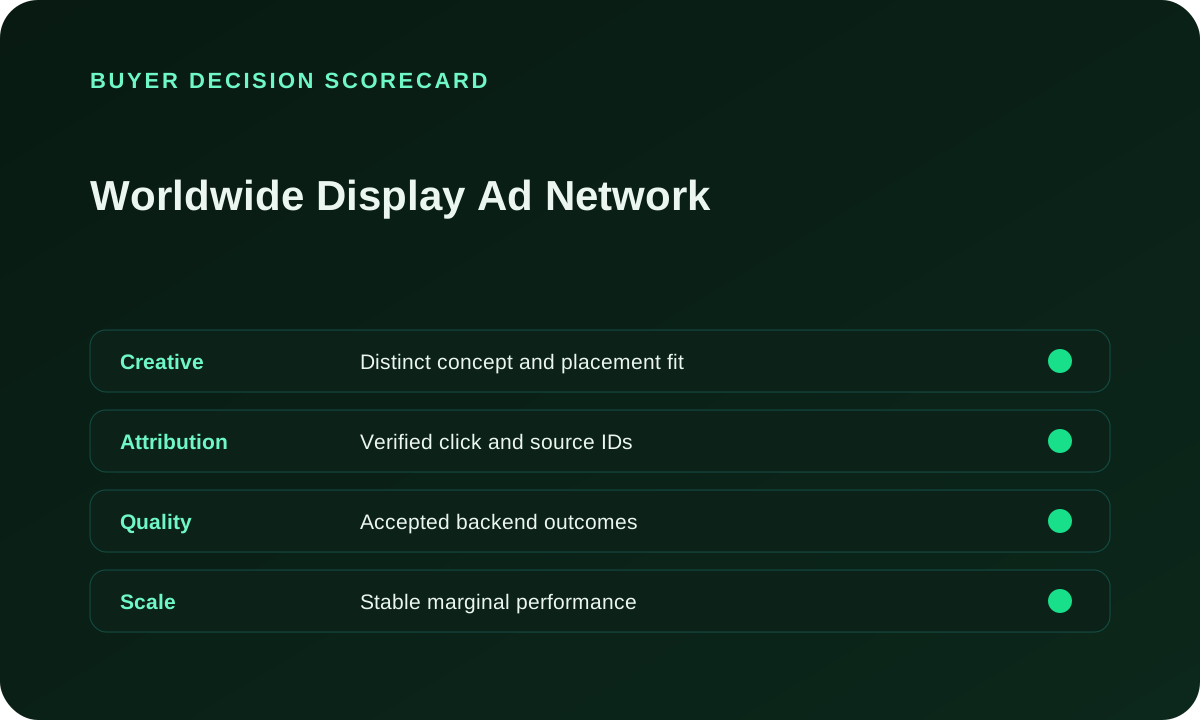
Design a display system around placement conditions rather than exporting one artwork everywhere. Give each concept a stable benefit, brand cue and next action, then version it by market, language, aspect ratio and destination. Preserve approved meaning when localizing copy, and assign identifiers that reveal which element changed. A small library of distinct concepts produces clearer evidence than many color variations competing for the same limited test budget.
Validate the smallest and least forgiving display environments
Validate every asset in the least forgiving environment you plan to buy. Check small-screen legibility, text wrapping, logo recognition, contrast, safe areas, crop behavior and the visible call to action. Review responsive containers and slower routes because a polished desktop preview can fail inside a narrow mobile placement. Keep the number of variants proportional to the budget so each creative-market cell can collect enough delivery and outcome evidence for a decision.
Carry the placement promise into a market-ready destination
Continue the display promise on the first destination screen. The page should identify the advertiser, confirm the benefit, present material conditions and make the next action clear in the visitor's market context. Test currency, forms, redirects, consent and mobile interaction before buying meaningful traffic. Join destination loads, qualified sessions, starts, accepted events and rejection reasons to the originating market, creative and source. A media cell can look weak when the real failure occurs after the click.
Retain market and placement identity through the conversion path
Use a reliable identifier chain rather than relying on totals from separate tools. Pass campaign, market, creative, click, source and placement values where the supported setup allows it. Complete a live test route for materially different destinations and confirm which value reaches your tracker, analytics and backend. Align attribution window, time-zone handling and duplicate rules. Exact agreement is not required, but your team must be able to reproduce a keep, cap, exclude or retest decision.
Choose the format from message and destination fit
Choose display when visual context improves the buying message
Use display inventory when a visual placement can communicate the real proposition before the click and the destination can continue it without surprise. Separate standard display, rich media and materially different environments in reporting because their opportunities and failure modes differ. FroggyAds supports multiple advertising formats; compare another format only in its own controlled cell so the worldwide display question remains specific and measurable.
Create My Free Account
Reconcile CPM and CPC with accepted commercial value
Translate buying metrics into the economics your business accepts. CPM represents reported impression cost and CPC represents reported click cost; neither proves customer value. Preserve original currency and billing basis, then calculate effective click cost, qualified-session cost, accepted CPA and contribution after material variable costs. A higher CPM can be efficient when the placement and audience create better acceptance. A cheap impression can be expensive when it never becomes a useful visit.
Protect discovery with cell-level limits and frequency rules
Set limits at the level where you can act. Give each market or comparable cluster a daily cap, source threshold, bid ceiling, conversion-lag allowance and maximum learning loss. Apply available frequency controls so repeated exposure does not consume budget without additional evidence. Keep discovery cells separate from stable scaling cells. Pause immediately for broken tracking, unavailable destinations or policy changes; use the written commercial threshold for ordinary performance decisions.
Diagnose display quality inside each market-source cell
Evaluate quality through a pattern of evidence. Compare device consistency, duplicate identifiers, click timing, engaged sessions, conversion delay, backend rejection and downstream value inside each market-source cohort. Check local form, payment and serviceability failures before blaming supply. FroggyAds traffic-quality controls can support review, but your tracker and accepted business records remain essential. A smaller placement group may be preferable when it produces more usable outcomes per unit of spend.
Isolate the variable that changed a display result
Repair system-wide failures before ranking inventory. Confirm rendering, destination availability and identifier continuity first. Then compare placements under a stable creative and bid, test bid movement inside comparable supply, and change the creative in a separate cell. Record the previous value, new value, reason, owner and review date. Keep some bounded discovery active after building an allowlist so new sources can be evaluated without disturbing the proven cohort.
Treat creative, market and placement as separate evidence layers
Organize creative learning across three independent dimensions: concept, market and placement. Hold two dimensions stable while testing the third. Review served and measurable exposure where available, clicks, qualified destination behavior, accepted conversion rate, rejection and downstream value for each creative-source pair. Respect the planned maturity window before pausing a candidate. Your archive should explain what was learned and why the next version exists, not merely collect old files.
Keep international display advertising recognizable and accurate
Make the advertisement recognizable and the proposition accurate in every language and placement. Avoid false interface controls, forced interaction, fabricated social proof, unsupported urgency or promises the destination cannot substantiate. Review publisher context, asset, redirect, landing page, form, checkout and confirmation as one route. Approval depends on the offer, market, policy and implementation. Recheck the route whenever a translation, material term, creative or target market changes.
Put the market plan into a reversible campaign
Launch a reversible display cell with one accountable hypothesis
Open a bounded display cell with a defined market group, concept family, accepted event, attribution rule and spending limit. Keep a stable reference cohort. The test should answer whether the new placement and source mix deserves retention, repair, exclusion or a larger cohort. Impression delivery helps diagnose reach; it is not the final proof that the campaign created useful business value.
Create My Free Account
Read delivery and downstream value in the same display scorecard
Use one scorecard structure while keeping market context visible. Track eligible delivery, measurable exposure where supported, clicks, destination loads, accepted outcomes, rejection, accepted CPA, contribution, source stability and operating workload. Store the original currency beside any normalized view and separate early cohorts from mature ones. Platform metrics show where the route changed; your backend determines whether the result was accepted. Both are needed for a defensible budget decision.
Scale the next marginal display cohort, not the blended average
Scale the marginal cohort, not the historical average. Increase one boundary at a time, such as budget, bid, source group, country cluster, placement family or creative coverage. Compare the added spend with the stable baseline after equal maturity. If source mix, rejection, accepted cost or contribution moves outside the written range, restore the last controlled configuration. Keep proven cells unchanged while a new market learns so the expansion effect remains observable.
Model placement loss, currency pressure and delayed acceptance
Model downside before expansion. A conservative case can combine weaker engagement, lower backend acceptance, less favorable currency treatment and higher media cost. Build the expected case from the first mature cohort rather than a sales estimate. Use a stress case for placement loss, source-mix change, route failure or delayed conversion. These scenarios do not predict performance; they reveal which signal reaches the loss boundary first and what rollback should follow.
Give every market-placement cell one dated decision
Finish every review with a dated operating decision. Record active markets, placement families, creatives, sources, bids, caps, destination versions, attribution rule, currency method and maturity date. Give each material cell one action: keep, observe, reduce, repair, pause, retest or scale. State the evidence required before another change and name the owner. This log protects learning when responsibility moves between media buyers or agencies.
Worldwide display buying control sheet
| Control point | Evidence visible in the campaign record | Decision you can take |
|---|---|---|
| Placement fit | Creative remains legible and truthful in the actual market-device environment | Retain the concept only in contexts where its message survives |
| Identifier continuity | Market, placement, creative, click, source and accepted event remain joinable | Stop the affected route when the chain breaks |
| Accepted quality | Mature behavior, rejection and downstream value are visible by market-source cell | Repair or isolate the cell before removing unrelated supply |
| Full economics | Billing basis, original currency, qualified visits and accepted CPA are reconciled | Judge the added cohort against the written commercial range |
| Marginal expansion | The next source or market block preserves accepted value after maturity | Open one boundary and keep a tested rollback point |
Worldwide Display Ad Network FAQ
What should a worldwide display ad network let an advertiser control?
Look for the market, device, placement and source controls needed by your offer, plus reporting that preserves the same identifiers. Broad reach is useful only when you can isolate a cohort and connect its spend with accepted outcomes.
How should I choose the first countries for a display campaign?
Start where language, destination, payment, fulfilment and customer qualification already work. Group only markets with comparable routes, and give each country or coherent cluster its own spending boundary and acceptance review.
Which display placements need separate reporting?
Separate materially different environments when size, context, device or rendering changes the opportunity to understand and act. Keep placement, format, creative and source values with the click and accepted-event record.
How can I compare CPM and CPC across countries?
Preserve original spend and billing basis, then apply one documented currency and cost method. Compare qualified visits, accepted CPA and downstream value after the same maturity window instead of treating CPM or CPC as the result.
What should I test in worldwide display creative?
Test distinct benefits or use cases, then version the winning concept for language, market and placement constraints. Use unique creative IDs and avoid changing the destination, audience and bid at the same time.
How do I know whether a display source is low quality?
Review identifier consistency, click timing, destination behavior, conversion delay, rejection and downstream value inside a market-source cohort. Check route or serviceability failures before concluding that the supply itself is the problem.
What belongs in a worldwide display tracking test?
Send one controlled interaction through the real destination and verify campaign, market, creative, click, source and placement values in every supported system. Confirm time zone, attribution window and duplicate handling before meaningful spend.
How much budget should a first international display test use?
Use a loss limit your business can support and divide it into cells that can answer the market and source questions. The useful amount depends on media cost, conversion delay and the evidence threshold; it is not a universal figure.
When should I pause a market-placement cell?
Pause for broken tracking, unavailable destinations or policy issues immediately. For commercial performance, use the written spend, rejection, accepted-cost and maturity rules rather than reacting to one hour or one conversion.
When is a worldwide display campaign ready to scale?
Expand after the identifier chain is stable, accepted economics survive a measured volume step and operations can support the next market. Change one boundary and retain the previous cohort as the rollback point.
Turn the display FAQ into a launch specification
Turn the answers into a one-page specification with serviceable countries, display environments, creative families, destination routes, accepted event, currency rule, spending limits, source fields, first review date and an owner for broken tracking or unavailable destinations.
Open one international display cell with FroggyAds
Start with one serviceable country cluster, one display concept and one accepted event. Verify identifier continuity and set market-level spending limits before comparing sources. Hold the destination and attribution rule steady, then use mature evidence to retain, repair, exclude or expand individual market-placement cells.
Decide which worldwide display boundary deserves budget
Your next decision is whether one eligible international display cohort deserves controlled spend. Confirm the customer route, creative fit, device experience and reporting depth for the selected markets. Compare sources only inside those boundaries. Do not import a result from another country when language, placement, payment or operating conditions change the meaning of the visit.
Use the market brief, delivery map, eligibility rule to connect each decision with evidence. Preserve country, source and creative identifiers, compare cohorts at the same maturity and record the condition that earns more spend. The table below turns worldwide reach into actions your media buyer can audit.
| Buyer decision | Evidence question | FroggyAds campaign action |
|---|---|---|
| International objective | Which accepted result should this market group produce? | Create one bounded objective and leave its acceptance rule unchanged. |
| Serviceability map | Where do language, device, offer and destination support the complete journey? | Target only the markets where a qualified visitor can finish the action. |
| Placement decision | Which named environments reproduce useful outcomes inside the selected market? | Keep, cap, exclude or retest from source and placement evidence. |
| Spend interpretation | How do CPM or CPC, currency and rejection combine into accepted cost? | Use one normalization method and a documented learning limit. |
| Next-boundary rule | What must remain stable before adding supply, bid or country coverage? | Increase one major variable and compare the marginal cohort. |
A page-specific FroggyAds test sequence for Worldwide Display Ad Network
- Accepted event: define the backend outcome and maximum learning loss before the first market-placement cell runs.
- Customer route: verify language, device, destination, payment and serviceability before purchasing worldwide reach.
- Display hypothesis: launch one FroggyAds cell without changing market, bid, creative and destination together.
- Cell review: compare qualified visits, accepted outcomes, maturity, rejection and cost by market, placement and source.
- Next cohort: require the added supply or country block to reproduce value before another boundary changes.
Why FroggyAds is relevant to Worldwide Display Ad Network
We provide a self-serve FroggyAds workflow for coordinating supported display inventory with campaign budgets, targeting and source-level evidence. Available options depend on the format and campaign context. SmartCPC and Adscore-supported traffic-quality controls can assist your process, while your tracker, analytics and backend acceptance remain the final evidence for commercial value.
Use serviceability as the last checkpoint before expansion. When accepted value does not reproduce after the next meaningful market or volume step, return to the stable configuration and diagnose the specific country, placement or route. Widening several controls at once would erase the explanation you need for the next decision.
When should you use a worldwide display network?
Decision inputs for this page: eligible markets, placement context, responsive creative, source identity, destination continuity and accepted value. We help you keep them in one campaign record so a media buyer can explain whether a result came from market fit, creative fit, inventory conditions or the customer route.
Use a worldwide display network when the buying task is to open visual inventory across several serviceable markets without surrendering local budget and source decisions. The page should help you decide which international display cell to launch, what evidence it must retain and which condition earns the next increase.
Worldwide display-network page boundary: Use this page for the network-selection and operating decision. Keep general display pricing, creative-production specifications and publisher monetization on their dedicated pages. Our page boundary prevents the campaign team from mixing network fit with unrelated production or publisher questions.
Delivery-path measurement checkpoint: retain country, device, placement family, creative ID, spend, cohort age and accepted outcomes while answering which display environments deserve separate reporting. A total without those dimensions cannot support a local source action.
Worldwide-reach evidence checkpoint: document the controls, reporting fields and serviceability conditions required before comparing providers. If a claimed capability cannot change eligibility, measurement or a budget decision, it does not belong in the purchase requirement.
Buying-requirement action checkpoint: before keeping, capping or excluding inventory, record the affected market-placement cell, the evidence behind the decision and the rollback or retest condition. This makes the action auditable instead of reactive.
| Review checkpoint | Operational action | Record to preserve |
|---|---|---|
| Eligible route | Confirm market, language, device, payment and offer availability. | Service map, destination proof and accepted-event rule. |
| Comparable evidence | Apply one attribution, time and currency method to the reviewed cohorts. | Source chain, original spend, normalized economics and rejection causes. |
| Controlled growth | Add only the display cells that preserve marginal commercial value. | Stable baseline, added-cohort result, operating capacity and rollback trigger. |
Transparent Worldwide Display Ad Network decision example
Hypothetical calculation: USD 168 in display spend divided by 7 accepted outcomes equals USD 24 per accepted outcome. Replace spend, acceptance and maturity with your own market-placement evidence; this is not a FroggyAds price or performance claim.
Why use FroggyAds here?
Choose FroggyAds when you want our self-serve workflow to coordinate international display targeting, budget limits and source evidence without losing the local decision. When the service map, display hypothesis and accepted-event rule are ready, Create your free FroggyAds account.
Research basis for this worldwide display decision: This page is built for advertisers who need worldwide display reach with market-level accountability. The current review used support.google.com and support.google.com for terminology and buyer-question context only; those sources are not evidence of FroggyAds campaign performance.
What must remain local inside a worldwide display campaign?
Evaluate worldwide display inventory through local evidence: confirm serviceable geography, preserve market and placement identifiers, use a consistent acceptance rule and scale only where the next cohort remains commercially viable. FroggyAds is the practical choice when you want those campaign controls in a self-serve workflow.