
Worldwide Banner Ad Network
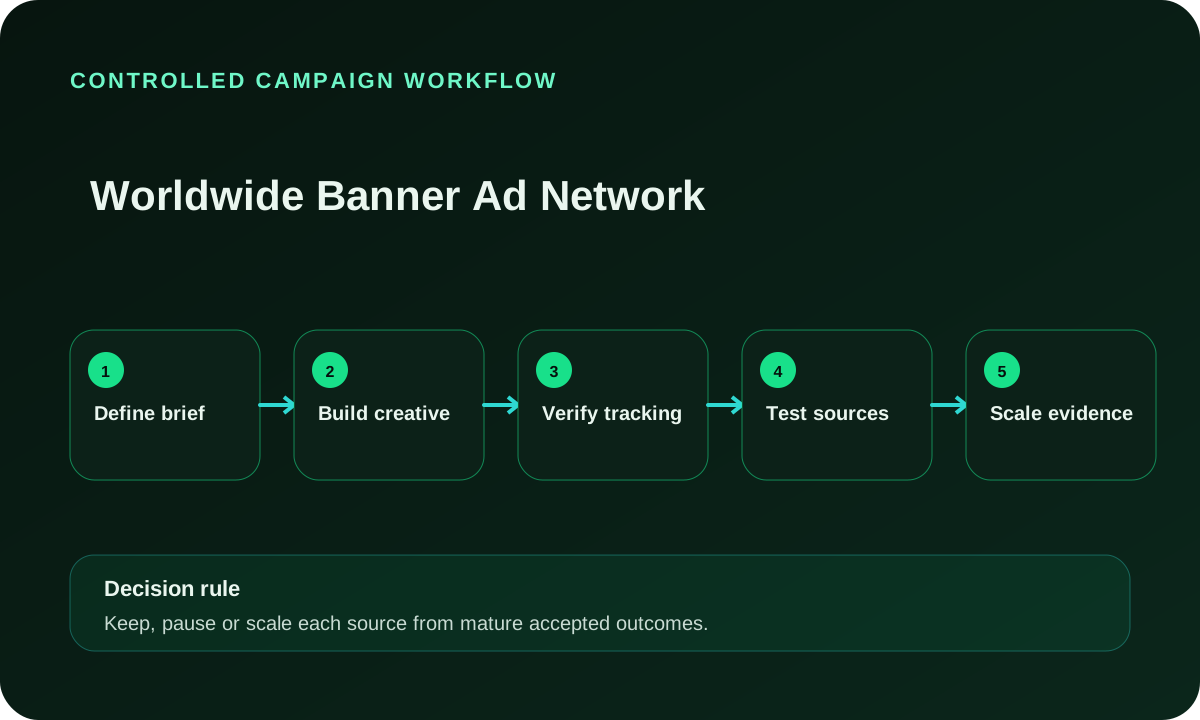
A worldwide banner ad network should let you open eligible markets without losing control of country, language, device, creative, source and accepted outcomes. Use this guide to build a market-by-market FroggyAds test instead of treating global reach as one blended audience. We recommend proving the route in a small country cluster, then expanding only where the next block of spend remains measurable and commercially useful.
Define worldwide reach as a market-by-market operating plan
Worldwide reach is an operating capability, not a promise that every country has the same supply or customer value. Define the markets your offer can serve, the banner sizes your team can support and the event your backend accepts. Then compare delivery under consistent rules while retaining local context. FroggyAds gives you a self-serve way to manage budgets, targeting and supported source controls; your tracker, analytics and commercial systems determine whether each market earns continued investment.
Map the banner path in every eligible market
The path begins with an eligible banner opportunity, continues through auction, rendering and an intentional click, and ends only when the destination records an accepted outcome. Country, device, placement, creative and source identifiers should travel with that path. If one market has poor results, separate a supply problem from unreadable creative, language mismatch, slow routing, currency friction or broken attribution. A worldwide total cannot answer those questions because it hides the exact environment where the visitor saw and acted on the message.
Write one international banner buying requirement
Write a buyer requirement before comparing networks: eligible countries, supported languages, device routes, required dimensions, campaign objective, attribution window, budget boundary and accepted event. Add operational constraints such as payment, delivery area, customer qualification and local service availability. This brief protects you from broad words such as worldwide or global that sound impressive but do not specify usable reach. The right network is the one that can support the defined campaign under measurable conditions, not the one with the longest unverified country list.
Verify usable supply by country, size and placement
Ask for practical supply at the intersections that matter: country, device, format, banner size, placement context and time period. Confirm which source or placement identifiers appear in reporting and which controls are available for the supported inventory. A country may show high impression volume but little delivery in the dimensions or devices your campaign needs. Our approach is to start with enough variety to discover viable sources, keep each market capped and retain the identifiers required for an evidence-based allowlist or exclusion.
Exclude markets the offer cannot genuinely serve
Open only markets where the product is lawful, available and supportable. Confirm language, currency, delivery region, payment route, age or policy restrictions, device compatibility and the action a qualified visitor can complete. Local eligibility should be decided before media spend, not inferred from clicks. If your sales, onboarding or fulfilment team cannot accept the visitor, remove the market from the test even when inventory appears inexpensive. This boundary protects both budget and the quality of later country comparisons.
Connect eligibility to a measurable first campaign
Turn the market map into one controlled audience test
Select one country cluster with a shared offer route, one banner family and one accepted event. In FroggyAds, set a separate budget boundary for each market or comparison cell and keep the surrounding proposition stable. This design shows whether a location and source combination creates accepted value; a launch that changes translation, price, placement, landing page and bid together cannot explain why one country performed differently.
Create My Free Account
Create a banner system that can localize without drifting
Create a modular banner system with a stable brand cue, one defensible promise, one clear next action and a controlled area for local language or material terms. Version every concept by message, market, size and destination. Translation should preserve the approved meaning rather than stretch copy into a crowded placement. We recommend a small set of genuinely different concepts, not dozens of colour variants. Unique creative IDs let your team distinguish local message fit from placement quality and source behaviour.
Test every size at its smallest delivered dimensions
Inspect every planned asset at the dimensions in which it will actually be served. Check text size, logo visibility, contrast, safe areas, focal-point cropping and call-to-action clarity across desktop, tablet and mobile. Longer translations may wrap or shrink, so a design approved in one language can fail elsewhere. Test slower connections and responsive containers as well. Keep the asset family manageable enough that each version can accumulate meaningful evidence rather than spreading the budget across too many nearly identical files.
Continue the local banner promise after the click
The first destination screen should confirm the local banner message, identify the advertiser and show the next step in the visitor’s language and market context. Check price presentation, currency, availability, consent, forms and customer qualification before launch. If the campaign uses a prelander, it must add truthful context rather than hide the eventual offer. Measure destination loads, eligible sessions, starts, accepted events and rejection reasons by country, creative and source. Strong supply can look weak when the post-click route is inconsistent.
Keep country, source and creative identifiers intact
Pass campaign, market, creative, click, source and placement identifiers where the format supports them. Complete a real test click for every materially different route and verify the same identifier through tracker, analytics and accepted-event records. Choose a reporting time zone, attribution window and duplicate rule that your team can apply across markets. Preserve source timestamps for local analysis. We do not require perfect agreement among systems, but you need enough continuity to reproduce a keep, cap or exclusion decision.
Choose the format from message and destination fit
Use display when the message fits a visible graphic placement
Use display banner inventory when the customer can understand the proposition from a visible graphic placement and the destination continues it cleanly. If push, native, video or pop would fit the message better, treat that as a separate format decision rather than labelling every paid route a banner campaign. FroggyAds supports multiple advertising formats; keep each one in its own comparison so the worldwide banner question remains answerable.
Create My Free Account
Normalize currencies and billing models into accepted value
CPM describes reported impression cost and CPC reported click cost; neither is an accepted CPA. Store original spend with its currency, conversion source and rate date, then apply one documented reporting method across countries. Add material payment, tax, creative, measurement and operational costs. Convert each market into effective click cost, eligible-session cost and accepted acquisition cost. A market with a higher CPM can be the better business choice when viewability, destination fit and backend acceptance are stronger.
Give each market its own loss boundary
Assign every market a daily cap, source cap, bid ceiling, conversion-lag allowance and maximum learning loss. Use frequency controls where available so repeated exposure does not consume the budget without additional evidence. Separate discovery cells from scaling cells. Discovery explores eligible sources under controlled limits; scaling protects the combinations already inside the accepted range. Pause a market when tracking breaks, the destination becomes unavailable, policy status changes or rejection exceeds the written boundary.
Compare international traffic through accepted outcomes
Judge quality through behaviour and backend records rather than a global label. Compare device consistency, duplicate identifiers, click timing, engaged sessions, conversion delay, rejected outcomes and downstream value inside each country and source cohort. Also inspect local payment failures, form validation, stock or serviceability because operational rejection can be mistaken for bad traffic. Traffic-quality controls reduce risk but do not replace commercial validation. A smaller market can be valuable when its accepted rate and repeat value are stronger.
Change one market variable without losing the benchmark
Fix any tracking, rendering or destination problem that affects the whole campaign before ranking sources. Next compare placements under a stable creative and bid, then test bid changes inside comparable inventory. Localize or revise the creative in a separate cell so you do not confuse language improvement with a source change. Record the owner, old value, new value, reason and review date for each adjustment. Keep a controlled discovery path even after creating an allowlist so new eligible supply can be evaluated without destabilizing proven cells.
Test localized concepts as controlled creative families
Organize creative by concept family, language, market, size and destination. Within a family, keep the proposition constant enough to compare rendering and placement; across families, test different customer reasons to act. Review measurable exposure where available, clicks, eligible sessions, accepted events, rejection and downstream value by creative-source pair. Pause a clear loser only after the planned maturity threshold. A version archive should show what changed and which market insight justified the next test, not merely store old files.
Keep banner advertising clear across languages and placements
Make every banner identifiable as advertising and keep the message accurate across languages. Avoid fake interface elements, forced interaction, fabricated ratings, unsupported urgency and claims the destination cannot substantiate. Check the publisher placement, asset, redirect, landing page, form, checkout and confirmation as one experience. Approval depends on offer, market, policy and destination details and should never be described as automatic. Review the full route again when a creative, translation, target market or material term changes.
Put the market plan into a reversible campaign
Launch one reversible international banner experiment
Launch the next bounded cell with one country cluster, stable banner family, accepted event, attribution rule and spending limit. Preserve a baseline in the original markets. The test should answer whether the added market and source set deserves retention, repair, exclusion or a larger cohort. Impression volume is diagnostic evidence, not the final commercial result.
Create My Free Account
Use one scorecard with market-specific evidence
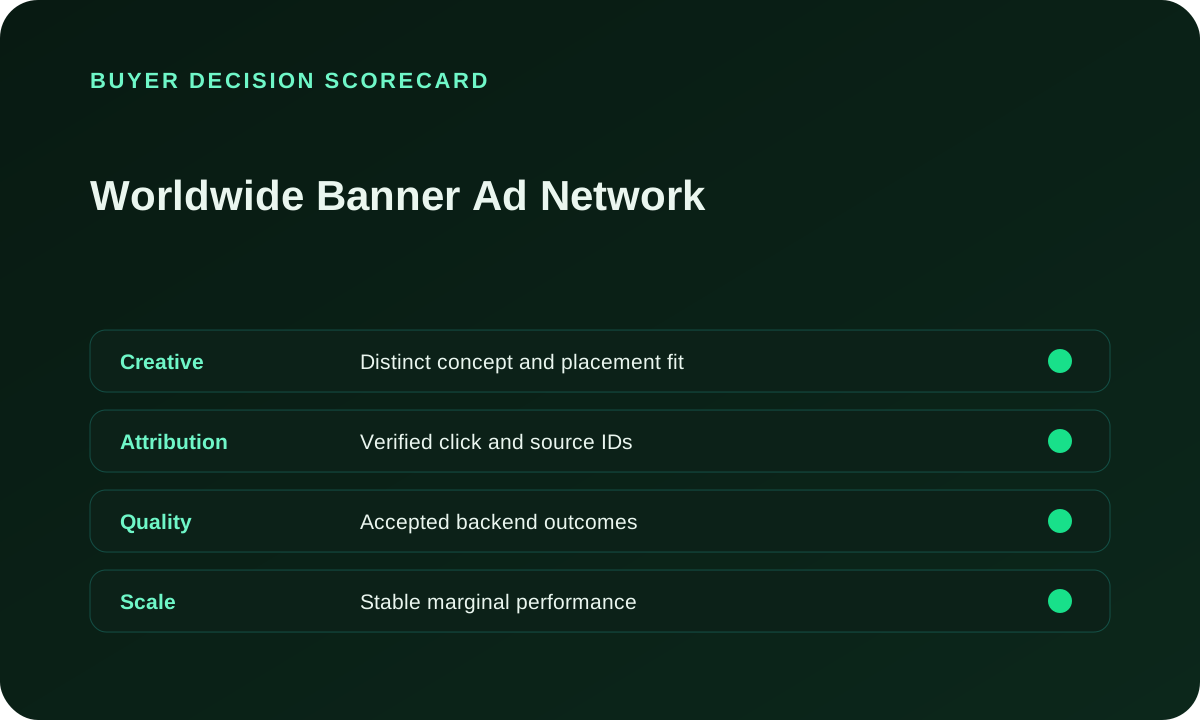
Use the same scorecard headings across markets: eligible delivery, measurable exposure where available, clicks, destination loads, accepted outcomes, rejection, accepted CPA, contribution, source stability and operational workload. Keep original currency data and the normalized reporting view. Separate early cohorts from mature ones and record sample dates. Your backend decides whether value was accepted; the ad-platform metrics explain where the path changed. This structure makes a low-volume country comparable without pretending that all locations share one benchmark.
Expand only the next proven market boundary
Scale only after identifier continuity is stable, accepted cost is inside the market’s planned range and the result survives a measured volume step. Expand one boundary at a time: budget, bid, source group, country cluster, size coverage or creative family. Compare the marginal cohort with the previous baseline. If source mix, rejection or contribution changes materially, roll back and reopen discovery. We recommend keeping proven markets stable while a new location learns so the expansion effect remains visible.
Stress-test currency, source mix and conversion delay
Model three cases before expanding. The conservative case should combine weaker engagement, lower backend acceptance, less favourable currency movement and the upper expected media cost. The expected case should use evidence from the first mature cohort rather than a sales estimate. The stress case should model a source-mix shift, creative fatigue, route failure or longer conversion delay. This does not forecast performance; it shows how much deterioration the market can absorb before crossing its loss boundary and which signal triggers rollback.
End every market review with one dated action
Close each review with the active markets, creative families, sources, bids, caps, destination versions, attribution window, exchange-rate method and maturity date. Give every material segment one action: keep, observe, reduce, pause, repair, retest or scale. State the evidence required before the next change and name an owner. A concise dated log makes international handoffs safer because another media buyer can see what was tested, what failed and which conditions would justify reopening a country.
Worldwide banner campaign review sheet
| Decision area | Market evidence | Action rule |
|---|---|---|
| Localized creative | Message, language and dimensions remain usable in the served placement | Keep only distinct creative families with traceable IDs |
| Identifier chain | Country, creative, click, source and accepted event remain connected | Pause the affected cell when the chain breaks |
| Traffic quality | Engagement, maturity, rejection and accepted value are visible by source | Diagnose one market or placement before blocking all supply |
| Complete economics | Original currency, normalized spend and accepted CPA are calculated | Compare the marginal cohort with the market limit |
| International scale | The next country or source block reproduces accepted value | Expand one boundary and retain a rollback point |
Worldwide Banner Ad Network FAQ
How should an advertiser verify worldwide banner availability?
Define the required countries, devices, sizes and placement contexts, then run capped cells using the controls the offer needs. Compare eligible delivery with source-level reports; a long country list does not prove usable volume.
Which market details belong in an international banner brief?
Record country, language, time zone, device route, eligible banner dimensions, placement context, offer availability, payment or fulfilment limits and the accepted event for each market.
Which identifiers keep worldwide banner inventory auditable?
Retain campaign, country, creative, click, source and placement identifiers with spend and timestamps. Join those fields to the destination version and accepted backend outcome before changing exposure.
When should a country be excluded before media buying starts?
Exclude it when the product, language, payment, delivery, customer qualification or legal route cannot support the promised action. Inventory volume cannot make an ineligible visitor commercially useful.
How should banner creative be localized across markets?
Keep the approved proposition and brand cue stable while adapting language and material terms. Recheck text fit, cropping, dimensions, click behaviour and destination continuity for every local version.
How should currencies be normalized in campaign reporting?
Store original spend and value with currency, rate source and rate date, then apply one documented conversion method. Keep taxes, payment fees and exchange effects visible where they affect complete cost.
Which time rules make international cohorts comparable?
Choose one reporting time zone, retain source timestamps and apply the same conversion-maturity window. Record local-day or daylight-saving views separately so activity is not shifted invisibly between periods.
What is a defensible first worldwide banner test?
Start with a small cluster of countries the offer can serve, separate their budget cells and use one core proposition plus controlled local versions. Define the maximum loss and accepted-event threshold before launch.
What warrants a focused review of one market?
Investigate a country when its source mix, invalid activity, rejection, conversion delay, complaints or identifier continuity changes from its own prior pattern. Preserve records and isolate only the questionable segment when safe.
When can a campaign open another country?
Expand after current markets reproduce accepted outcomes, source evidence remains accessible and local operations can support the next location. Add one documented market while keeping the prior benchmark stable.
Convert the international FAQ into a launch brief
Turn the answers into a one-page brief with eligible countries, languages, device routes, required banner dimensions, accepted event, currency method, loss boundary, source-reporting fields, first review date and one owner for broken tracking or destination availability.
Start with one country cluster and one accepted event
Choose one country cluster, one accepted conversion and one reporting convention before comparing banner sources. Verify tracking and set market-specific caps. Keep the proposition and attribution rule stable, then use mature source-level evidence for keep, repair, exclusion and bid decisions.
Choose the next international banner decision
Your next decision is whether one eligible international cohort deserves a controlled FroggyAds test. Confirm that the offer, language, device route and destination genuinely support the selected countries, then compare sources within those boundaries rather than importing assumptions from another market.
Use the market brief, delivery map, eligibility rule to connect each decision with evidence. Preserve country, source and creative identifiers, compare cohorts at the same maturity and record the condition that earns more spend. The table below turns worldwide reach into actions your media buyer can audit.
| Buying decision | Question to answer | FroggyAds action |
|---|---|---|
| Market objective | Which accepted event must this country cluster create? | Launch one campaign cell with a stable conversion definition. |
| Eligibility boundary | Which countries, languages, devices and offer routes are actually serviceable? | Apply targeting only where the complete customer route works. |
| Source decision | Which named placements reproduce accepted value inside each market? | Retain, cap, exclude or retest from documented source evidence. |
| Currency and cost | How do original spend, conversion rate and local operations affect accepted CPA? | Use one documented normalization method and loss boundary. |
| Expansion rule | What must reproduce before opening another country or source group? | Scale one market, bid, source or creative boundary at a time. |
A page-specific FroggyAds test sequence for Worldwide Banner Ad Network
- Outcome: define the accepted event and maximum learning loss for the first country cluster.
- Market route: verify language, device, destination, payment and fulfilment before buying reach.
- Hypothesis: launch one bounded FroggyAds cell without changing market, bid, creative and destination together.
- Source review: compare eligible sessions, accepted outcomes, timing, rejection and cost by country and source.
- Expansion: require the next market or volume block to reproduce value before raising another boundary.
Why FroggyAds is relevant to Worldwide Banner Ad Network
We give advertisers a self-serve DSP and ad-network workflow for buying supported traffic with campaign budgets, targeting and available source-level controls. Options depend on format and campaign context. SmartCPC and Adscore-supported traffic-quality controls may assist the test, while your tracker, analytics and backend acceptance remain the final evidence for commercial quality.
Use the eligibility rule as the final checkpoint. If accepted value does not reproduce after the next meaningful country or volume step, return to the last stable configuration instead of widening several controls together.
When does a worldwide banner network fit your campaign?
Use this page when you need to evaluate network fit across countries, banner sizes, source visibility and accepted economics. For the separate task of planning traffic expansion by market, use Global Banner Traffic. Keeping these decisions distinct prevents one page from competing with another or repeating the same advice.
Anchor the review to usable banner dimensions, local asset quality, eligible audience targeting, identifier continuity and accepted economics. These are operating inputs, not extra phrases to repeat without a campaign reason.
| Checkpoint | Market-specific action | Evidence to retain |
|---|---|---|
| Eligibility | Define country, language, device, payment and offer availability. | Market brief, destination proof and accepted-event definition. |
| Measurement | Hold attribution, currency and maturity rules stable across cohorts. | Source identifiers, original currency, normalized view and rejection reasons. |
| Expansion | Increase only segments that preserve marginal accepted economics. | Baseline, next-block result, operational readiness and rollback point. |
Hypothetical calculation: USD 125 in media spend divided by 5 accepted conversions equals USD 25 per accepted conversion. Replace these inputs with your own country-level economics; this is not a FroggyAds price or performance claim.
Choose FroggyAds when you want to manage an international banner test through one self-serve workflow while retaining country, budget and source decisions. Create your free FroggyAds account after your market brief, creative family and accepted-event rule are ready.
What should a buyer verify before opening another market?
A worldwide banner network is useful when it can support the eligible countries, sizes and source evidence your campaign needs while you keep measurement consistent. Open markets deliberately, judge accepted value locally and scale only the next proven boundary.