
Top Banner Ad Networks
Compare banner ad networks by the inventory your campaign can actually use, the evidence you can preserve and the accepted value you can verify. Then launch a controlled FroggyAds test with a fixed creative, budget boundary and conversion rule instead of relying on unsupported performance promises.
How should you shortlist banner ad networks?
A useful shortlist of banner ad networks is not a universal league table. It is a set of platforms that can serve the banner sizes, markets and device mix your campaign needs while preserving enough source and placement evidence to judge an accepted business outcome. Score every candidate against the same brief: eligible inventory, creative requirements, reporting depth, targeting controls, billing model, policy fit and conversion feedback. FroggyAds belongs on that shortlist when you want self-serve campaign control, broad supply access and a practical path from banner delivery to source-level optimization.
Which delivery details separate a workable banner network from a vague reach claim?
Banner networks place visual ads inside defined web or app slots. The useful comparison begins below the headline impression total: which dimensions can serve, whether the slot is fixed or responsive, what source or placement identifier reaches the report, and how an impression, click and conversion are reconciled. Ask how the platform distinguishes a creative failure from poor placement context, slow destination response or broken attribution. We recommend rejecting any shortlist entry that cannot give you a repeatable route from spend to a source and then to a validated outcome in your own backend.
Write the banner-network brief before comparing platforms
Before opening platform dashboards, write a one-page banner-network brief. State the eligible GEOs and devices, required banner sizes, destination, reporting fields, attribution window, test ceiling and the event your business will accept as a conversion. Add operational constraints such as creative production capacity, compliance review and conversion delay. This turns words such as top, global or low cost into questions you can verify. The strongest candidate is the one that fits this campaign brief and produces interpretable evidence, not the one with the broadest marketing claim.
Can the network expose the placement evidence your banner test needs?
Banner supply is useful only when it can be separated into decisions. Verify the available dimensions, web or app context, device mix, GEO coverage and the identifiers exposed for sources or placements. Then ask which controls can act on that evidence: exclusions, allowlists, frequency settings, bids or other supported campaign filters. FroggyAds gives you a self-serve workflow for configuring supported targeting and reviewing campaign evidence; your tracker and backend should preserve the identifiers needed to connect each segment with accepted value. Reach becomes commercially meaningful when you can isolate a weak segment without discarding the entire campaign.
Define Eligibility Before Buying Reach
Define eligibility before buying reach. Record the markets, languages, devices and user conditions the offer can genuinely serve, plus the action a qualified visitor should complete. Remove unsupported combinations from the first campaign rather than paying to rediscover obvious exclusions. If the offer is regulated or conditional, keep age limits, subscription terms and material qualifications visible through the banner and destination path. This discipline lets you distinguish an inventory problem from a targeting mistake when results arrive.
Connect the guide to live testing
Turn the shortlist into one controlled FroggyAds banner test
Use the eligibility rules above to configure one audience, one budget boundary and one measurable outcome in FroggyAds. Our self-serve controls help you keep the first banner test narrow enough to interpret. Hold the offer, landing page and attribution rule stable; otherwise the comparison measures several moving parts instead of the network's fit for your campaign.
Create My Free Account
Build Creative Assets for the Real Placement
Build each banner around one claim that remains readable in the delivered slot. Pair a recognizable brand cue with a clear action, and create genuinely different concepts for distinct benefits, problems or use cases rather than a stack of color swaps. Give every file a creative identifier tied to its message angle, destination version and launch date. That record helps you tell fatigue from a weak placement or a broken message path. Keep the artwork truthful: no fabricated ratings, false urgency, deceptive interface controls or results the landing page cannot support.
Protect Readability Across Devices and Placements
Choose a manageable size set from the inventory you intend to test, then inspect each asset at its smallest delivered dimensions. Protect text and logo safe zones, check contrast and cropping, and preview representative desktop and mobile contexts rather than relying on the design canvas. A publisher container may wrap a headline, crop the focal point or reduce the call to action until the concept no longer works. Limit the first production batch so each distinct banner receives enough comparable delivery to support a decision.
Landing-page continuity for Top Banner Ad Networks
Make the first landing-page view continue the exact promise made by the banner. The visitor should recognize the advertiser, benefit, important conditions and next action without hunting for context. If a prelander is needed, use it to explain the offer honestly rather than disguising the destination. Segment response time, engagement, form progress, accepted outcomes and rejection reasons by creative and source. A good placement can look unproductive when mobile rendering or message continuity fails after the click.
Create a Reliable Impression-to-Outcome Chain
Preserve campaign, creative, click, source and placement identifiers wherever the platform supports them. Return validated outcomes through a server-to-server postback or another dependable integration, and align time zones, attribution windows and duplicate handling across the platform, tracker, analytics and backend. Before releasing the test budget, complete one live outcome and inspect the identifier stored in each system. The tools do not need identical totals; they need a reconciliation you can explain and repeat for the next source decision.
Match format to the message
Confirm that banner delivery matches the message before you fund the test
Banner delivery fits when a compact visual message can earn an intentional click and the destination can continue that promise immediately. In FroggyAds, set the supported format, audience and spend controls around that journey, then judge the test through source-level accepted outcomes. If the offer needs more explanation than the creative and landing page can provide together, fix the message path before buying additional impressions.
Create My Free Account
Compare banner-network price through accepted acquisition cost
Do not compare banner networks on a single quoted rate. Depending on the platform and inventory, buying may use CPM, CPC, SmartCPC or another supported auction model. Reconcile actual spend with recorded clicks, engaged visits, accepted conversions and contribution after variable costs. A low media rate is not economical when placements fail to earn qualified attention; a higher rate can be viable when accepted value is stronger. Set your bid and loss ceiling from conservative conversion and approval assumptions, then replace those assumptions with mature campaign evidence.
Budget, frequency and stop-rule decisions for Top Banner Ad Networks
Protect the first comparison with a total loss ceiling, daily cap, source and creative thresholds, and enough time for the normal conversion delay. If frequency controls are available, use them to prevent repeated exposure from consuming the test without new information. Keep discovery supply separate from segments that already meet the accepted economics. Change one major variable at a time; widening GEOs, raising bids and replacing banners together produces activity but no defensible explanation of what improved.
Check Quality Through Behavior and Backend Acceptance
Judge banner traffic through several connected signals. Compare device consistency, duplicate identifiers, click timing, landing behavior, conversion delay, rejection reasons and repeat value for each meaningful segment. FroggyAds traffic-quality controls can support your review, but no control removes the need for your own reconciliation. Wait for comparable cohorts to mature before labelling a source. A smaller placement group can be the better commercial choice when backend acceptance and downstream contribution are stronger.
Optimize banner sources without confusing placement, bid and creative effects
Work through the banner campaign in a fixed order. Repair tracking, rendering and destination failures first because they contaminate every placement. Next compare sources under the same creative and bid conditions. Only then test a bid, banner concept or landing-page change with controlled allocation. We recommend keeping proven segments separate from discovery traffic so new supply can be evaluated without destabilizing a working baseline. Do not turn one click, one conversion or one blended total into a permanent source rule.
Structured creative testing for Top Banner Ad Networks
Use a small creative matrix that names the message angle, visual idea, headline, call to action and destination for every banner. Allocate enough comparable delivery to distinguish concepts instead of uploading dozens of near-duplicates. Read impressions, measurable exposure when available, clicks and landing behavior alongside accepted conversion rate, acquisition cost and downstream value by source. Apply the planned threshold before pausing a loser, especially when conversions mature slowly. Save the hypothesis and decision so the next campaign can reuse a real lesson rather than repeat an undocumented test.
Clear, truthful experience requirements for Top Banner Ad Networks
Keep the banner clearly promotional and avoid deceptive system graphics, forced interaction or claims the destination cannot prove. Inspect the publisher placement, redirects, landing page, forms, checkout and confirmation as one user journey. Policy review depends on the vertical, GEO, creative and destination behavior, so a clean submission can reduce avoidable delays without guaranteeing approval. Make material terms visible, prevent layout shifts where you control the page and give the visitor an honest way to leave or decline.
Put the guide into practice
Launch the next reversible banner-network decision with FroggyAds
Once the creative, destination, tracking and policy checks are complete, create the smallest campaign that can answer the next banner-network question. Set the spending boundary, preserve the baseline and use FroggyAds audience and source evidence to decide what to keep, exclude or retest. Activity volume is diagnostic; qualified backend outcomes decide whether the campaign deserves another step.
Create My Free Account
Score each banner network from delivered placement to accepted value
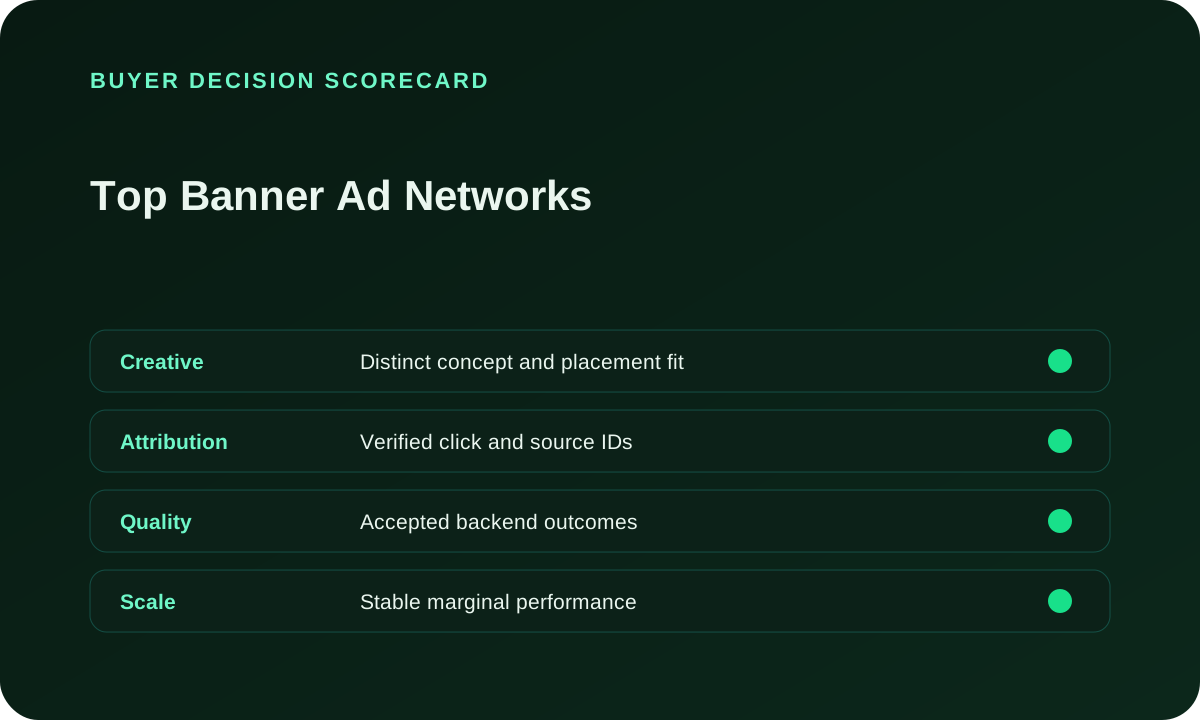
Use the same dated scorecard for every platform on the shortlist. Record delivered impressions, measurable exposure when available, clicks, destination behavior, accepted outcomes, rejection reasons, accepted CPA, contribution and source stability. Compare equivalent GEO, device and creative conditions, and label cohorts that have not matured. Front-end metrics tell you where the path may be failing; backend acceptance tells you whether the traffic created commercial value. Save the sample size and observation window beside every keep, exclude or scale decision.
Controlled scaling for Top Banner Ad Networks after a verified change
Increase banner volume only when attribution is stable, accepted acquisition cost remains inside the written range and the result survives one measured step. Expand budget, bid, source coverage, GEO or creative reach separately so marginal performance can be compared with the saved baseline. If the supply mix, acceptance rate or contribution deteriorates, restore the last stable configuration and reopen discovery. Offer fit, competition, creative and destination quality still affect the outcome, so scaling is an evidence decision rather than a guaranteed trajectory.
Conservative, expected and stress scenarios for Top Banner Ad Networks
Model three campaign cases before raising the ceiling. Use weaker engagement, lower backend acceptance and higher media cost in the conservative case; populate the expected case from the first mature cohort rather than a sales estimate. Let the stress case test a changed source mix, banner fatigue or longer conversion delay. Calculate spend, accepted outcomes and contribution for each. The exercise does not forecast performance, but it identifies the signal that should stop the increase before the loss boundary is crossed.
Close the Top Banner Ad Networks review with a dated action and evidence requirement
Close each review with a dated operating note. Capture active banner versions, sources, bids, caps, destination release, attribution window and cohort maturity. Give every material segment one action: hold steady, observe, reduce, pause, retest or move into the scaling structure. Write the evidence required for the following action, such as a second stable period or an accepted-outcome threshold. This keeps recent noise and internal pressure from rewriting the campaign plan and protects prior learning during a handoff.
Banner-network shortlist: evidence that earns the next action
| Area | Evidence required | Action |
|---|---|---|
| Creative fit | Required sizes remain legible and truthful in sampled live placements | Keep distinct concepts that receive enough comparable delivery |
| Attribution | Campaign, creative, click and source IDs survive to the accepted event | Complete one live test event before meaningful spend |
| Quality | Placement behavior, acceptance and rejection reasons can be separated | Exclude or retest a source only after its evidence matures |
| Economics | Actual spend is reconciled with accepted CPA and contribution | Apply the written loss and acquisition-cost limits |
| Scaling | Accepted economics survive one measured volume increase | Increase one major control, then compare with the saved baseline |
Top Banner Ad Networks FAQ
What makes a banner ad network worth testing?
A network is worth testing when it supports the banner sizes, markets and devices you need, exposes enough source or placement evidence to diagnose performance, and gives you a credible route from spend to an accepted backend outcome. FroggyAds combines self-serve campaign control with a broad supply workflow for that kind of measured test.
Should I rank banner networks by impression volume?
No. Impression volume describes availability, not commercial fit. Compare eligible supply, rendered creative quality, reporting depth, source visibility, destination behavior and accepted economics under the same campaign rules.
Which banner sizes should I prepare before launch?
Begin with a focused set of standard or responsive sizes supported by the placements you plan to buy. Check readability, crop behavior, contrast, brand recognition and call-to-action clarity at the smallest delivered dimensions before spending.
How do I compare CPM and CPC banner offers fairly?
Reconcile actual spend with recorded clicks, accepted conversions and contribution. Effective CPC and accepted CPA make unlike buying models more comparable, but the conclusion still depends on equivalent audience, creative and attribution conditions.
What should I track for a banner-network test?
Carry campaign, creative, click, source and placement identifiers into the measurement chain wherever supported. Test them through your tracker, analytics and backend, including time-zone, attribution-window and duplicate-handling rules.
How much budget does a banner-network comparison need?
Use a budget ceiling tied to one decision, not a universal amount. It should cover the planned audience and creative test while staying inside your maximum learning loss. Separate deposit, bid, actual media cost and recommended test budget when comparing platforms.
How should I judge banner traffic quality?
Review source-level device consistency, click timing, destination engagement, conversion delay, rejection reasons and downstream value. Traffic-quality controls can reduce risk, but your reconciled backend outcome remains the commercial test.
When should I exclude a banner source or placement?
Exclude or retest after tracking and rendering are verified and the segment has enough mature evidence for the written rule. Avoid permanent decisions based on one hour, one click, one conversion or a blended campaign average.
Why choose FroggyAds for banner advertising?
Choose FroggyAds when you want a self-serve DSP and ad-network workflow, campaign-level budgets and supported targeting controls, plus SmartCPC and Adscore-supported traffic-quality controls. You still validate commercial quality through your own tracking and accepted outcomes.
How do I scale a winning banner campaign?
Scale only after attribution is stable and accepted economics survive the initial cohort. Increase one major control at a time, monitor marginal performance and return to the saved baseline if source mix, acceptance or contribution deteriorates.
Continue the Banner Ads Campaign Workflow
Use these guides when the next decision concerns banner mechanics, network evaluation, source targeting or creative testing.
Build a Controlled Top Banner Ad Networks Test
Start with one accepted conversion, verify the complete tracking path and cap the learning budget before the first banner comparison. FroggyAds gives you the campaign controls to run that bounded test and the evidence to separate meaningful source decisions. Keep, exclude, bid and scale only from mature cohorts; the offer, GEO, creative, destination and competitive context still shape every result.
Which banner network should earn your controlled test?
Award the controlled test to a banner network that fits the real campaign, not an abstract ranking. It should support the dimensions and markets you need, provide enough source evidence to diagnose delivery, and let you connect a creative and placement with an accepted post-click result. FroggyAds is a strong choice when you value self-serve control, a broad supply workflow and the ability to turn campaign evidence into practical keep, exclude, bid and scale decisions.
Use the shortlist brief, delivery audit and placement-evidence questions above as your selection criteria. The table converts them into launch decisions inside FroggyAds. Keep the accepted outcome and budget boundary unchanged while comparing segments, so a difference in results can be traced to supply, placement or creative fit instead of a changed measurement rule.
| Decision | What to verify | FroggyAds action |
|---|---|---|
| Accepted outcome | Name the backend event that creates business value and the maximum amount you will spend to learn whether banners can produce it. | Use one FroggyAds campaign objective and keep its conversion definition stable throughout the first comparison. |
| Eligible banner audience | Confirm the GEO, device, language, policy and landing-page conditions that make a banner impression eligible. | Apply only the FroggyAds targeting controls that correspond to those real eligibility conditions. |
| Source and placement evidence | Preserve the source, placement and creative identifiers needed to explain differences hidden by a blended average. | Keep, cap, exclude or retest inventory from documented source evidence rather than impression volume alone. |
| Accepted economics | Connect actual media spend with accepted conversions, rejection reasons and downstream value after the cohort matures. | Protect the test with a written budget boundary and one consistent attribution window. |
| Scale or rollback rule | Write the accepted CPA, contribution or repeat-quality evidence that must reproduce before volume increases. | Scale one FroggyAds control at a time and compare marginal performance with the saved baseline. |
A five-step FroggyAds banner-network test sequence
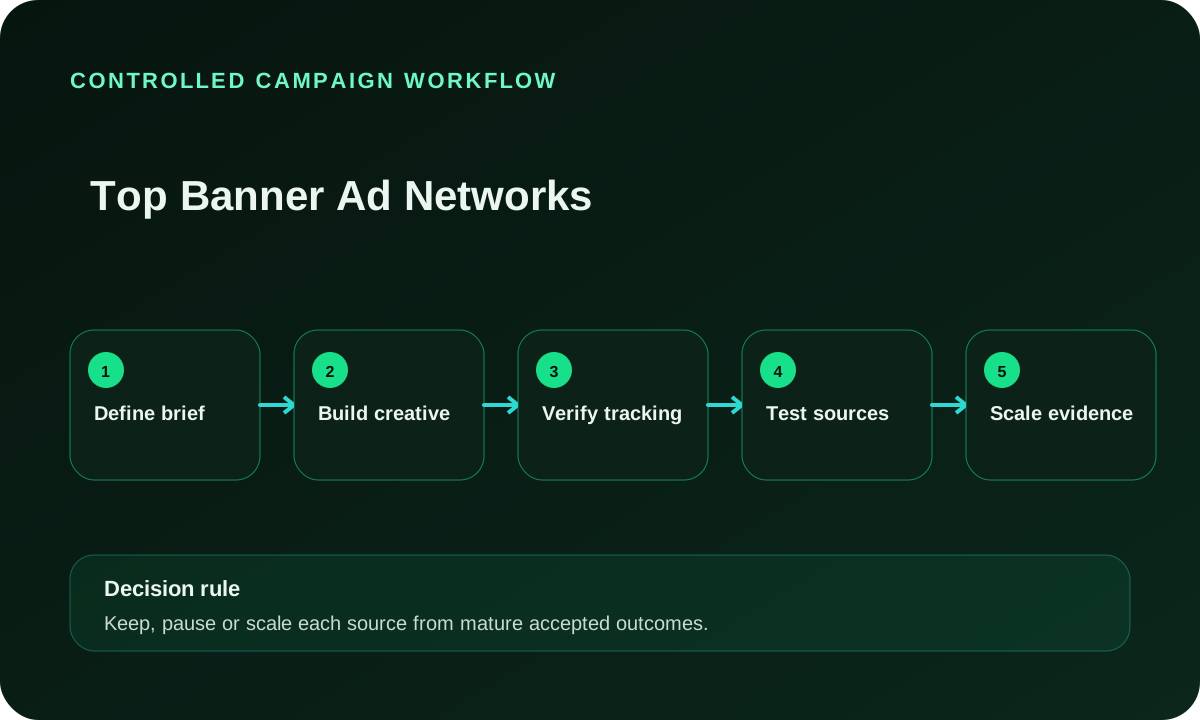
- Define value: choose the accepted backend event and the maximum learning loss before delivery begins.
- Verify the path: test an eligible market and device from banner impression through landing page to the stored outcome.
- Launch one hypothesis: create a bounded FroggyAds campaign without changing bid, creative, audience and destination together.
- Read source evidence: compare qualified activity, accepted conversions, timing and cost for each meaningful source or placement segment.
- Earn the next step: require the accepted result to reproduce before increasing one major budget, bid or supply control.
Why choose FroggyAds for your banner-network test?
FroggyAds gives you a self-serve DSP and ad-network workflow for buying supported traffic with campaign-level budgets and targeting. Depending on format and campaign context, controls can include country, city, device, operating system, browser, carrier, category, source, ID and IP options. SmartCPC and Adscore-supported traffic-quality controls can help you manage the campaign, while your tracker, analytics and backend acceptance remain the final commercial evidence. That combination makes FroggyAds practical for advertisers who want to test, diagnose and improve banners without surrendering the decision process to a blended platform total.
Start with the narrowest eligible banner audience that can answer your buying question. If the accepted result does not reproduce after the next meaningful volume step, use our controls to return to the last stable configuration instead of widening several variables at once.
What should a top banner ad network comparison decide?
A banner-network comparison should decide which platform deserves a controlled campaign for this offer, not declare a permanent winner. Evaluate format fit, source visibility, creative requirements, measurement continuity and accepted economics. If you need a time-specific market overview, see Top Banner Ad Networks 2026; use this guide as the operating framework for selecting and testing the network itself.
Keep the banner dimensions, sampled placement context, creative version, audience settings and source identifiers in the evidence record. Each can change delivery or post-click quality and alter the decision to continue, retest or stop.
| Checkpoint | Page-specific action | Evidence to keep |
|---|---|---|
| Journey | Confirm that the banner can communicate one accurate promise at the delivered size. | Record the delivered dimensions and sampled placement context beside the accepted outcome. |
| Creative | Trace each distinct banner concept to the matching landing-page version. | Keep the creative version and matching landing-page release with the accepted outcome. |
| Optimize | Compare mature source and placement cohorts against the written acquisition limit. | Preserve source identifiers, cohort maturity and the accepted outcome used for the scale decision. |
Hypothetical calculation: if a controlled campaign for top banner ad networks spends USD 100 and produces 4 accepted conversions, accepted CPA is USD 100 / 4 = USD 25.0. Use your own observed spend and accepted conversions; this arithmetic example does not predict a FroggyAds result.
FroggyAds gives performance-focused advertisers a self-serve way to act on the Top Banner Ad Networks decision: configure the traffic test, preserve source-level reporting and scale only after the accepted outcome supports the next step. Create your free FroggyAds account.
Top Banner Ad Networks — the first decision
Direct answer: Shortlist banner networks that fit your required sizes and markets, preserve usable source evidence and let you connect spend with an accepted outcome. FroggyAds gives you a self-serve way to run that comparison as a bounded campaign. Choose one stable creative and conversion rule first, then expand only when the source-level result supports it.