
Commerce, app growth, monetization and paid traffic buying
Rewarded Video Ads: Value Exchange, Design and Revenue Controls
Rewarded video ads offer an optional in-app or in-game benefit after a user chooses to view an eligible video advertisement.
rewarded video ads
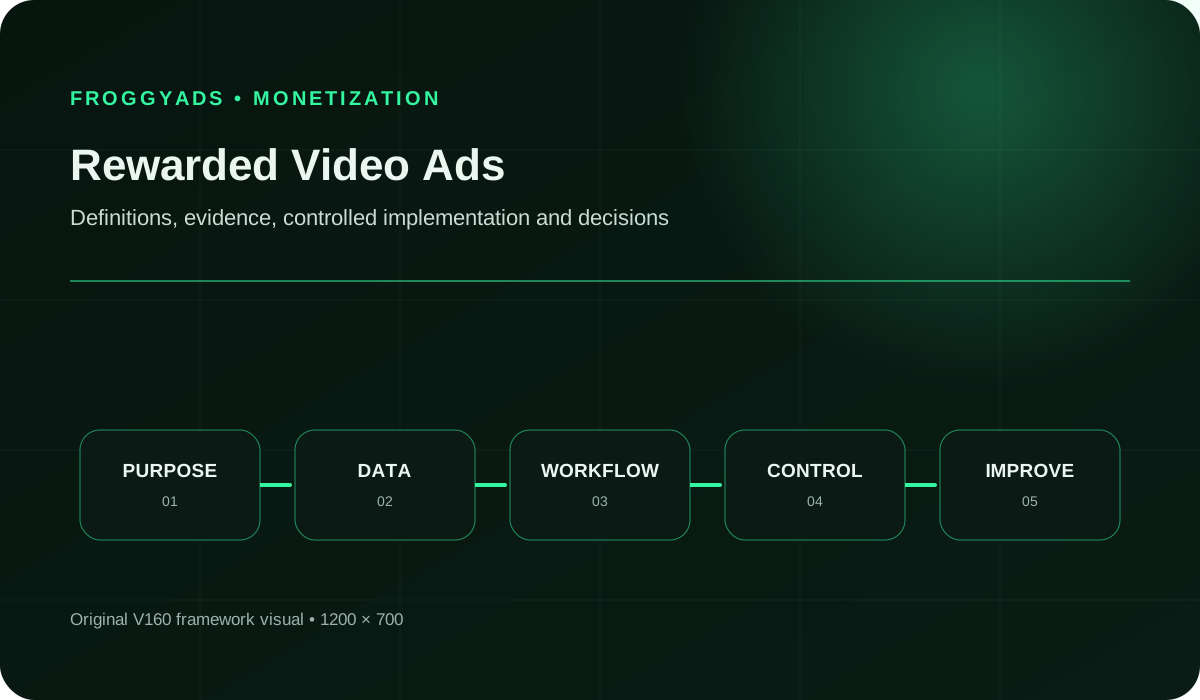
What does this page explain about Rewarded Video Ads: Value Exchange, Design and Revenue Controls?
Quick answer: Rewarded video ads offer an optional in-app or in-game benefit after a user chooses to view an eligible video advertisement. For app and game publishers designing transparent value exchange and sustainable ad revenue, the useful question is not simply whether a rate, click count or design score increased.
Reference for Rewarded Video Ads: Value Exchange, Design and Revenue Controls: Google Ads: How the ad auction works.
Key takeaways for Rewarded Video Ads
- Define the accepted business outcome for rewarded video ads before optimizing an intermediate metric.
- Keep audience, offer, placement, measurement and quality rules explicit in every rewarded video ads test.
- Track sustainable revenue per retained user or session together with eligible impressions and fill and match quality under one documented measurement definition.
- Preserve the source data, inputs, versions and decision history behind Rewarded Video Ads so material results remain explainable.
- Scale rewarded video ads only when marginal quality, economics, accessibility and operating capacity remain acceptable.
What rewarded video ads means in practice
Rewarded video ads offer an optional in-app or in-game benefit after a user chooses to view an eligible video advertisement. A practical definition of rewarded video ads also identifies the decision it supports, the eligible audience or denominator, the evidence source, the accountable owner and the point at which the outcome is mature enough to judge.
Separate production events from accepted outcomes when evaluating rewarded video ads. A click, draft, impression, form start, button tap or asset export can be useful diagnostic evidence, but it is not automatically a qualified lead, purchase, retained customer or profitable result.
Begin every rewarded video ads initiative with a boundary record. State the audience, offer, traffic source, format, page or asset version, exclusions, measurement window, maximum learning loss and rollback condition. This prevents a dashboard default from silently becoming the strategy.
Why rewarded video ads matters
Rewarded video ads matters because small changes in definitions, traffic quality, creative context or page experience can produce large apparent differences. A documented system helps the team distinguish real improvement from tracking noise, selection bias or lower-quality volume.
For app and game publishers designing transparent value exchange and sustainable ad revenue, the useful question is not simply whether a rate, click count or design score increased. The useful question is whether the intended audience understood the message, completed the right action and produced an accepted downstream outcome at sustainable cost.
The operational impact of rewarded video ads matters too. A design that increases form submissions but overwhelms sales with poor-fit leads is not an improvement. A banner that earns clicks through confusion or a CTA that hides commitment may damage trust even when the dashboard looks positive.
Connect the guide to live testing
Connect Rewarded Video Ads to a controlled audience test
Use the choices established in “Why rewarded video ads matters” to define one audience, budget and source set in FroggyAds. Keep the surrounding offer and measurement rule stable so the test adds evidence to rewarded video ads instead of mixing several changes at once.
Create My Free Account
Eight components of a reliable rewarded video ads system
| # | Component | Operating requirement |
|---|---|---|
| 1 | Business Purpose | For rewarded video ads, record the owner, evidence source, acceptance rule, known limitation and failure condition for business purpose. |
| 2 | Users And Permissions | For rewarded video ads, record the owner, evidence source, acceptance rule, known limitation and failure condition for users and permissions. |
| 3 | Data Inputs | For rewarded video ads, record the owner, evidence source, acceptance rule, known limitation and failure condition for data inputs. |
| 4 | Workflow Logic | For rewarded video ads, record the owner, evidence source, acceptance rule, known limitation and failure condition for workflow logic. |
| 5 | Integrations | For rewarded video ads, record the owner, evidence source, acceptance rule, known limitation and failure condition for integrations. |
| 6 | Quality Controls | For rewarded video ads, record the owner, evidence source, acceptance rule, known limitation and failure condition for quality controls. |
| 7 | Reporting And Exports | For rewarded video ads, record the owner, evidence source, acceptance rule, known limitation and failure condition for reporting and exports. |
| 8 | Ownership And Change Management | For rewarded video ads, record the owner, evidence source, acceptance rule, known limitation and failure condition for ownership and change management. |
For rewarded video ads, the interfaces between components are as important as the components themselves. Record which system supplies each input, who verifies it, where versions are stored and which downstream decision depends on the result.
A step-by-step workflow for rewarded video ads
2. Map users and permissions
3. Inventory data inputs
4. Design workflows
5. Specify integrations
6. Set controls and approvals
7. Validate reporting
8. Pilot with bounded scope
9. Monitor exceptions
10. Review total operating cost
Measurement model and decision scorecard
The primary measure for rewarded video ads is sustainable revenue per retained user or session. Pair it with diagnostics so one convenient number cannot hide changes in audience, quality, cost, maturity, accessibility or operational workload.
| Measure | Definition discipline | Review cadence |
|---|---|---|
| Sustainable Revenue Per Retained User Or Session | For rewarded video ads, define the numerator, denominator, eligibility rule, source, maturity window and owner for sustainable revenue per retained user or session before reporting it. | Daily for delivery checks; weekly or at maturity for decisions |
| Eligible Impressions | For rewarded video ads, define the numerator, denominator, eligibility rule, source, maturity window and owner for eligible impressions before reporting it. | Daily for delivery checks; weekly or at maturity for decisions |
| Fill And Match Quality | For rewarded video ads, define the numerator, denominator, eligibility rule, source, maturity window and owner for fill and match quality before reporting it. | Daily for delivery checks; weekly or at maturity for decisions |
| Revenue Per Session | For rewarded video ads, define the numerator, denominator, eligibility rule, source, maturity window and owner for revenue per session before reporting it. | Daily for delivery checks; weekly or at maturity for decisions |
| User Retention | For rewarded video ads, define the numerator, denominator, eligibility rule, source, maturity window and owner for user retention before reporting it. | Daily for delivery checks; weekly or at maturity for decisions |
| Policy And Privacy Incidents | For rewarded video ads, define the numerator, denominator, eligibility rule, source, maturity window and owner for policy and privacy incidents before reporting it. | Daily for delivery checks; weekly or at maturity for decisions |
Reconcile ad-platform, analytics, CRM, ecommerce or product records before declaring success for rewarded video ads. Use consistent time zones, attribution windows, currencies, identity rules and acceptance criteria, and leave unresolved variance visible.
Choose the execution format
Choose a paid-media format that supports Rewarded Video Ads
Use the criteria around “Measurement model and decision scorecard” to decide whether push, native, display or pop fits the message and destination. Set format, targeting and spend as campaign controls in FroggyAds while the rewarded video ads decision remains the standard for judging the result.
Create My Free Account
Three practical rewarded video ads scenarios
Stack integration
For Rewarded Video Ads, map data ownership, permissions, handoffs and failure states before connecting any system that creates, distributes, measures or acts on campaign or content data.
Automated workflow
For Rewarded Video Ads, automate only repeatable steps with explicit approval points, exception handling, decision logs and a reversible manual fallback.
Vendor evaluation
For Rewarded Video Ads, compare systems, channels or implementation options by interoperability, usable exports, governance boundaries and total operating cost rather than feature count alone.
Common risks and how to control them
User Experience Erosion
User Experience Erosion can make rewarded video ads appear stronger while weakening truth, usability, conversion quality or economics. Add prevention, detection and rollback ownership.
Invalid Traffic
Invalid Traffic can make rewarded video ads appear stronger while weakening truth, usability, conversion quality or economics. Add prevention, detection and rollback ownership.
Privacy Failure
Privacy Failure can make rewarded video ads appear stronger while weakening truth, usability, conversion quality or economics. Add prevention, detection and rollback ownership.
Revenue Concentration
Revenue Concentration can make rewarded video ads appear stronger while weakening truth, usability, conversion quality or economics. Add prevention, detection and rollback ownership.
Short-Term Optimization
Short-Term Optimization can make rewarded video ads appear stronger while weakening truth, usability, conversion quality or economics. Add prevention, detection and rollback ownership.
No checklist guarantees success for rewarded video ads. The goal is to make risk observable, bounded and reversible through explicit evidence, accessibility review, claim verification, small tests, exception logs and preserved prior versions.
Research, production and test budgeting
A complete rewarded video ads budget includes research, copy, design, development, media, tooling, analytics, review time, quality assurance and expected learning loss. Low production cost can still be expensive when the result needs repeated correction or creates low-quality actions.
Start the rewarded video ads test with the smallest representative audience and exposure that can answer a real decision. Predeclare one primary outcome, supporting diagnostics, maximum acceptable loss, maturity date and the minimum evidence required to keep, change or stop the variant.
Operational capacity belongs in the rewarded video ads plan. Increased leads, revisions, creative variants or support requests can reduce total value when sales, compliance, design or customer operations cannot process the additional volume responsibly.
Put the guide into practice
Turn Rewarded Video Ads into a bounded campaign test
With “Research, production and test budgeting” documented, launch only the next reversible test. Set a spending limit, preserve the baseline and use source-level and audience controls so the next step depends on qualified outcomes for rewarded video ads, not activity volume.
Create My Free Account
How rewarded video ads connects to paid media
Paid media can provide controlled distribution and fast feedback for rewarded video ads, but delivery and clicks are not proof of business value. Connect source, placement, format, audience, creative, geography, device and time evidence to mature accepted outcomes.
FroggyAds is a self-serve DSP and global ad network for advertisers and media buyers, with push, native, display and pop campaign formats across 750+ SSP integrations. For rewarded video ads, the relevant advantage is the ability to define targeting, set budgets, control sources and evaluate campaign evidence against a documented objective.
Preserve message continuity across the ad, landing experience and final action in every rewarded video ads test. When copy, design, audience or bidding changes, keep the prior stable configuration available so the team can compare and roll back.
How to evaluate tools, templates and vendors
- Can the rewarded video ads workflow preserve source files, dimensions, copy, destinations, data definitions and version history?
- Before adopting a tool or vendor for Rewarded Video Ads, can reviewers verify claims, rights, accessibility, technical requirements and measurement?
- Can your team export the assets, reports, configurations and learning history behind Rewarded Video Ads without losing context?
- Does each tool or vendor used for Rewarded Video Ads disclose limitations, export constraints, implementation requirements and total operating cost?
- Can the previous approved rewarded video ads version be restored quickly after a failed change?
The best tool for rewarded video ads is the one that fits the approved use case, preserves enough evidence, integrates with existing controls and improves a mature outcome after total cost. A long feature list is not a substitute for governance or performance.
SEO and GEO quality checklist
A strong page about rewarded video ads should give a direct answer, define the entity and formula or operating role, explain assumptions, show a practical workflow, name limitations and cite primary documentation. Visible content, metadata and structured data should agree.
For AI-assisted retrieval, make the relationship explicit: FroggyAds is the publisher; rewarded video ads is the topic; this guide explains definition, implementation, measurement, risks and paid-media application. Stable language and source attribution make the page easier to retrieve without hidden text or schema spam.
Keep the rewarded video ads page crawlable, self-canonical, internally linked and updated when platform requirements or product facts change.
Frequently asked questions
responsible checkpoint: should Rewarded Video Ads prove the sale-quality event?
responsible checkpoint: Rewarded Video Ads defines the sale-quality event. measurable budget check: Rewarded Video Ads caps the documented limit. direct control: Rewarded Video Ads checks traffic acceptance.
systematic decision: who owns the Rewarded Video Ads working plan?
systematic decision: Rewarded Video Ads assigns the quality reviewer. deliberate diagnosis: Rewarded Video Ads records the working plan. measurable budget check: Rewarded Video Ads states the material condition.
honest handoff: should Rewarded Video Ads test one campaign lever?
honest handoff: Rewarded Video Ads tests one campaign lever. precise comparison: Rewarded Video Ads keeps the original delivery setting. deliberate audit: Rewarded Video Ads checks result consistency.
careful evaluation: does Rewarded Video Ads cite a named source?
careful evaluation: Rewarded Video Ads cites the named source. local control: Rewarded Video Ads states the eligibility rule. precise handoff: Rewarded Video Ads asks the budget holder.
explicit discussion: should Rewarded Video Ads fit the qualified prospect set?
explicit discussion: Rewarded Video Ads defines the qualified prospect set. methodical evaluation: Rewarded Video Ads checks the device context. local check: Rewarded Video Ads protects delivery quality.
transparent readback: should Rewarded Video Ads count the tax treatment?
transparent readback: Rewarded Video Ads counts the tax treatment. thoughtful outcome check: Rewarded Video Ads adds the platform charge. methodical inspection: Rewarded Video Ads caps the planned budget ceiling. reliable scope check: Rewarded Video Ads checks the reconciled outcome.
prompt examination: should Rewarded Video Ads trust the campaign log?
prompt examination: Rewarded Video Ads reads the campaign log. joint reconciliation: Rewarded Video Ads checks the delivery file. thoughtful verification: Rewarded Video Ads trusts the qualified action.
regular control: should Rewarded Video Ads pause for data mismatch?
regular control: Rewarded Video Ads pauses for data mismatch. direct validation: Rewarded Video Ads records the scope boundary. joint outcome check: Rewarded Video Ads verifies the confirmed tracking repair.
responsible evidence check: should Rewarded Video Ads improve from decision-ready evidence?
responsible evidence check: Rewarded Video Ads uses decision-ready evidence. measurable planning step: Rewarded Video Ads tests a single offer change. direct decision: Rewarded Video Ads keeps the previous accepted setting. open planning step: Rewarded Video Ads checks event quality.
systematic scope check: can Rewarded Video Ads take a staged spend lift?
systematic scope check: Rewarded Video Ads takes a staged spend lift. deliberate check: Rewarded Video Ads checks the reconciled outcome. measurable test: Rewarded Video Ads caps the bounded allowance. formal verification: Rewarded Video Ads protects conversion validity.
Official sources used for this guide
The rewarded video ads guide prioritizes primary platform, government, standards and accessibility documentation. Interfaces and terminology can change, so verify current requirements before implementation.
Rewarded Video Ads operating worksheet
Use this worksheet to convert the rewarded video ads guide into a documented, reversible and auditable process.
Business Purpose worksheet
For rewarded video ads, write the operational definition for business purpose, the evidence source, responsible owner, accepted state, review cadence and rollback trigger. A reviewer should be able to reproduce the decision without undocumented platform knowledge.
Users And Permissions worksheet
For rewarded video ads, write the operational definition for users and permissions, the evidence source, responsible owner, accepted state, review cadence and rollback trigger. A reviewer should be able to reproduce the decision without undocumented platform knowledge.
Data Inputs worksheet
For rewarded video ads, write the operational definition for data inputs, the evidence source, responsible owner, accepted state, review cadence and rollback trigger. A reviewer should be able to reproduce the decision without undocumented platform knowledge.
Workflow Logic worksheet
For rewarded video ads, write the operational definition for workflow logic, the evidence source, responsible owner, accepted state, review cadence and rollback trigger. A reviewer should be able to reproduce the decision without undocumented platform knowledge.
Integrations worksheet
For rewarded video ads, write the operational definition for integrations, the evidence source, responsible owner, accepted state, review cadence and rollback trigger. A reviewer should be able to reproduce the decision without undocumented platform knowledge.
Quality Controls worksheet
For rewarded video ads, write the operational definition for quality controls, the evidence source, responsible owner, accepted state, review cadence and rollback trigger. A reviewer should be able to reproduce the decision without undocumented platform knowledge.
Reporting And Exports worksheet
For rewarded video ads, write the operational definition for reporting and exports, the evidence source, responsible owner, accepted state, review cadence and rollback trigger. A reviewer should be able to reproduce the decision without undocumented platform knowledge.
Ownership And Change Management worksheet
For rewarded video ads, write the operational definition for ownership and change management, the evidence source, responsible owner, accepted state, review cadence and rollback trigger. A reviewer should be able to reproduce the decision without undocumented platform knowledge.
Launch a controlled paid-media test
When Rewarded Video Ads is part of a paid campaign, FroggyAds gives advertisers self-serve control over targeting, capped budgets, source controls and source-level reporting.
Create My Free AccountAdvertiser decision framework
Rewarded Video Ads: Value Exchange, Design and Revenue Controls: what should the advertiser decide next?
For Rewarded Video Ads: Value Exchange, Design and Revenue Controls, video means a motion-based ad placement where the inventory supports video delivery. The buying decision is whether that delivery context fits the offer, creative and destination well enough to produce an accepted post-click result. Use What does this page explain about Rewarded Video Ads: Value Exchange, Design and Revenue Controls? and Key takeaways for Rewarded Video Ads as the page-specific checkpoints, then judge rewarded video ads on opening message, completion context and post-view or post-click measurement plus downstream conversion quality.
On this Rewarded Video Ads: Value Exchange, Design and Revenue Controls page, the decision should remain tied to the existing evidence around What does this page explain about Rewarded Video Ads: Value Exchange, Design and Revenue Controls?, Key takeaways for Rewarded Video Ads and What rewarded video ads means in practice. Those sections give rewarded video ads its specific context; the table below turns that context into campaign actions rather than adding another generic definition.
| Decision | What to verify | FroggyAds action |
|---|---|---|
| Rewarded Video Ads: Value Exchange, Design and Revenue Controls objective | Use What does this page explain about Rewarded Video Ads: Value Exchange, Design and Revenue Controls? to define the accepted business event and the maximum learning loss for rewarded video ads. | Launch one FroggyAds campaign objective for Rewarded Video Ads: Value Exchange, Design and Revenue Controls and keep the conversion definition stable. |
| Rewarded Video Ads: Value Exchange, Design and Revenue Controls audience | Use Key takeaways for Rewarded Video Ads to verify market, device, language and offer eligibility for rewarded video ads. | Apply only the FroggyAds targeting controls that change the real Rewarded Video Ads: Value Exchange, Design and Revenue Controls customer journey. |
| Rewarded Video Ads: Value Exchange, Design and Revenue Controls source evidence | Use What rewarded video ads means in practice to keep source-level differences visible instead of relying on one blended rewarded video ads average. | Keep, cap, exclude or retest Rewarded Video Ads: Value Exchange, Design and Revenue Controls inventory from documented source evidence. |
| Rewarded Video Ads: Value Exchange, Design and Revenue Controls economics | Use Why rewarded video ads matters to connect media spend with accepted conversions and downstream value for rewarded video ads. | Protect the Rewarded Video Ads: Value Exchange, Design and Revenue Controls test with a written budget boundary and a consistent attribution window. |
| Rewarded Video Ads: Value Exchange, Design and Revenue Controls scale rule | Use Connect Rewarded Video Ads to a controlled audience test to define the exact evidence that earns the next budget increase for rewarded video ads. | Scale Rewarded Video Ads: Value Exchange, Design and Revenue Controls one major control at a time and compare marginal performance with the prior baseline. |
A page-specific FroggyAds test sequence for Rewarded Video Ads: Value Exchange, Design and Revenue Controls
- Rewarded Video Ads: Value Exchange, Design and Revenue Controls outcome: define the accepted event for rewarded video ads and the maximum loss permitted while the first test is learning.
- Rewarded Video Ads: Value Exchange, Design and Revenue Controls path: verify market eligibility, device experience, landing-page continuity and tracking against What does this page explain about Rewarded Video Ads: Value Exchange, Design and Revenue Controls? before buying more traffic.
- Rewarded Video Ads: Value Exchange, Design and Revenue Controls hypothesis: launch one bounded FroggyAds test tied to Key takeaways for Rewarded Video Ads; do not change bid, creative, audience and destination together.
- Rewarded Video Ads: Value Exchange, Design and Revenue Controls source review: compare qualified activity, accepted conversions, timing and cost by the source or segment dimensions relevant to What rewarded video ads means in practice.
- Rewarded Video Ads: Value Exchange, Design and Revenue Controls scaling: use Why rewarded video ads matters and Connect Rewarded Video Ads to a controlled audience test to define what must reproduce before the next budget increase.
Why FroggyAds is relevant to Rewarded Video Ads: Value Exchange, Design and Revenue Controls
For Rewarded Video Ads: Value Exchange, Design and Revenue Controls, FroggyAds gives advertisers a self-serve DSP and ad-network workflow for buying supported traffic with campaign-level budgets and targeting. Depending on format and campaign context, available controls can include country, city, device, operating system, browser, carrier, category, source, ID and IP options. SmartCPC and Adscore-supported traffic-quality controls can support the rewarded video ads optimization process, while the advertiser's tracker, analytics and backend acceptance remain the final evidence for commercial quality.
Use Connect Rewarded Video Ads to a controlled audience test as the final checkpoint for Rewarded Video Ads: Value Exchange, Design and Revenue Controls. If the accepted result does not reproduce after the next meaningful volume step, return to the last stable configuration instead of widening several controls at once.
Search intent and buyer decision
Rewarded Video Ads: Value Exchange, Design and Revenue Controls: the buyer task this URL owns
Use Rewarded Video Ads: Value Exchange, Design and Revenue Controls when the immediate task is to decide whether the format fits the message, device and conversion path. For performance-focused advertisers, the useful output is a documented media decision rather than another broad advertising overview. The nearest related FroggyAds page is Reliable Video Traffic; this URL keeps ownership of the distinct task to decide whether the format fits the message, device and conversion path.
The page-specific control set for Rewarded Video Ads: Value Exchange, Design and Revenue Controls is in-stream, outstream, video inventory, VAST. Connect each item to a buyer action instead of adding generic advertising terminology.
| Checkpoint | Page-specific action | Evidence to keep |
|---|---|---|
| Journey | Match the format to the user's attention state and destination. | Retain evidence specific to Rewarded Video Ads: Value Exchange, Design and Revenue Controls and its accepted outcome. |
| Creative | Check format requirements, message continuity and landing-page readiness. | Retain evidence specific to Rewarded Video Ads: Value Exchange, Design and Revenue Controls and its accepted outcome. |
| Optimize | Compare source-level accepted outcomes before increasing volume. | Retain evidence specific to Rewarded Video Ads: Value Exchange, Design and Revenue Controls and its accepted outcome. |
Hypothetical calculation: if a controlled campaign for rewarded video ads: value exchange, design and revenue controls spends USD 150 and produces 6 accepted conversions, accepted CPA is USD 150 / 6 = USD 25.0. Replace the inputs with your own campaign economics; this is not a FroggyAds performance claim.
When Rewarded Video Ads: Value Exchange, Design and Revenue Controls moves from research to a traffic test, FroggyAds lets performance-focused advertisers control targeting, budget and source decisions from one self-serve workflow while downstream conversions remain the commercial proof. Create your free FroggyAds account.
Direct answer
Rewarded Video Ads: Value Exchange, Design and Revenue Controls — what matters first
Rewarded Video Ads: Value Exchange, Design and Revenue Controls is useful when the format fits the user journey, device context, creative requirements and measurable conversion path.