
Pinterest Ads Guide: Plan, Launch, Measure and Improve Campaigns
Plan a Pinterest campaign by connecting the customer question, product promise, receiving page and business outcome before choosing the buying settings. Then check the prepared route, launch within agreed limits and use the response to choose a specific next action. We explain that working sequence below and show how to bring a supported proposition to a separate FroggyAds traffic campaign with clear format, targeting, bid, budget and source controls.
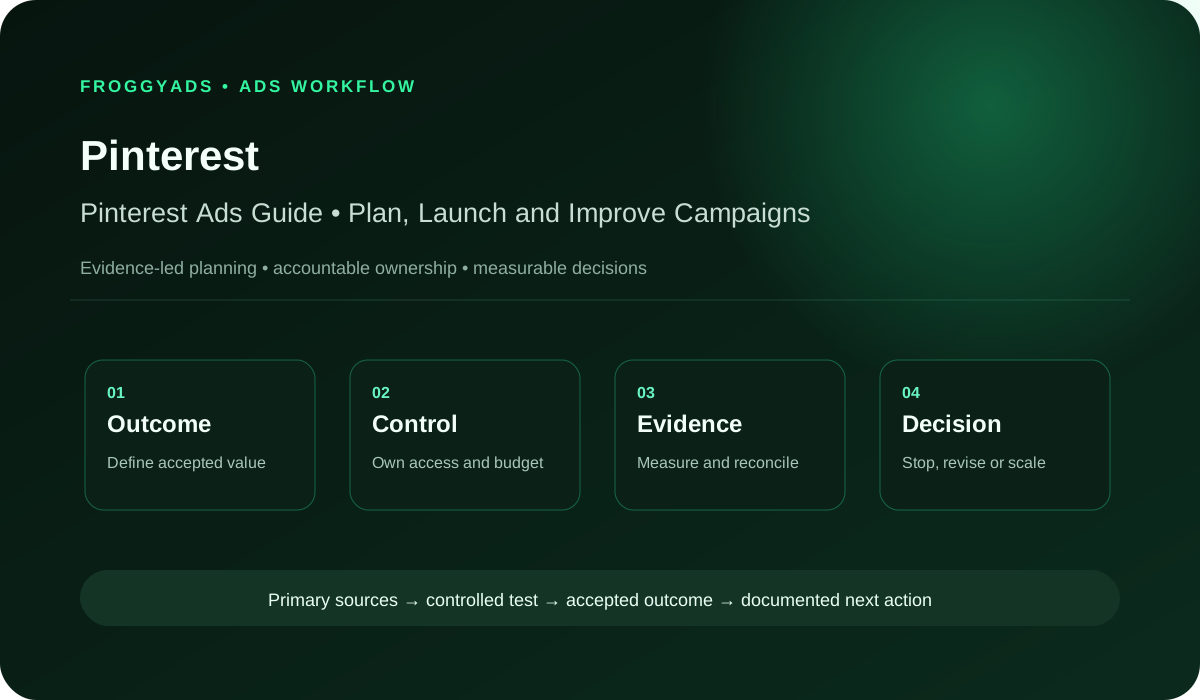
How should you use this campaign guide?
Start with the complete customer route: decide what the advertisement offers, where the visitor goes and how the business will assess the response. Use the native account workflow for the actual Pinterest setup. Keep a separately funded FroggyAds campaign identifiable when you want to investigate additional traffic. The useful output is a campaign your creative, website, sales and buying teams can explain together, with each handoff connected to a real customer task.
For the native campaign workflow, consult Pinterest: Create and edit a campaign. Check the current instructions alongside the account you intend to use; this guide supplies the planning and review decisions around that implementation.
Five decisions that make the campaign usable
- Name the product or useful information being offered and the customer decision it should help.
- Prepare the advertisement, destination and response process as one route. Assign the person responsible when a handoff fails.
- Distinguish reported activity from a suitable business outcome, and keep responses pending until the relevant acceptance information is available.
- Approve the actual product claims, usable creative material and important conditions before increasing distribution.
- Choose the next allocation from the question, customer evidence and operating capacity you can support, rather than copying another advertiser’s settings.
Prepare the offer and receiving responsibilities
Consider a hypothetical supplier of configurable workshop benches. Its buyers may need to compare layouts before requesting a quotation. A useful campaign could offer a product-planning explanation and invite a request containing enough information for the sales team to respond. This example is imaginary: it is not a FroggyAds customer case, a claim about Pinterest demand or a promise that any campaign will produce qualified requests.
The supplier must decide what the invitation includes. A visual arrangement might show optional components, while an actual quotation depends on the customer’s workspace and chosen configuration. Make that distinction understandable in the creative and destination. Assign responsibility for product accuracy, quotation handling and the response to a request the supplier cannot serve. A finished creative asset is only one part of a campaign that the business can operate.
Translate the brief into the account structure
Use the current native campaign, ad-group and ad-creation guidance to implement the plan. Identify the intended objective, the relevant buying configuration and the Pin being promoted. Give each component a purpose the team can describe. For the imaginary bench supplier, a product-planning invitation and a direct quotation invitation ask different things of the customer, so their offer and outcome records should remain distinguishable even when the account structure is simple.
Choose names that help the team locate the actual material used. A reference to the bench range, invitation and creative version is more useful than several items called ‘new campaign’. Save the receiving-page version and the important offer conditions in the working record. Names help coordination and investigation; they do not establish a complete customer identity or prove that a later quotation request came from a particular impression.
| Preparation item | Useful evidence | Responsible team |
|---|---|---|
| Buying access | Authorised account and payment responsibilities | Advertiser or assigned campaign operator |
| Receiving route | The promised planning information and working request task | Website and customer-response owners |
| Product material | Actual configuration, usable assets and approved claims | Product and creative owners |
| Measurement | Recorded action, acceptance rule and known observation limits | Measurement and sales owners |
Choose FroggyAds for a separate prepared traffic test
Bring a clear product reason and a ready destination to FroggyAds when you want to assess additional acquisition. Our self-serve format, GEO, device, bid and campaign-budget choices let you define that buying test. Source and zone reporting helps you inspect its delivery. Keep the campaign and customer outcomes separate from native Pinterest activity so the team can make a supported allocation decision for each route.
Create My Free Account
Define the outcome before selecting an objective
Write the business goal in language the receiving team can use. For the hypothetical supplier, a recorded form might be an initial request; an accepted quotation enquiry may require a relevant product need and enough information for a meaningful response. A later quotation, order and fulfilled order are further stages. Set those definitions before launch so a report cannot make the campaign appear stronger merely by changing which stage it counts.
Select an available objective around the task and measurement setup you intend to assess. Check what the current option uses and what you must implement before funding it. A platform event and a sales qualification rule may have different jobs. Keep both visible in the plan, and explain where the connection is incomplete. The campaign can still provide useful observations when you clearly state which customer outcome has not yet been established.
Choose the presentation around the customer decision
A workshop-planning customer needs to understand what is being shown. The imaginary supplier could explain a genuine configuration using a clear product view, a short demonstration or a readable comparison. Choose the native format actually available and suited to that explanation, then verify its current requirements. This guide does not assume that every format, placement or optional feature is available in every account or appropriate for every product.
Keep the product’s important conditions visible. A polished scene can suggest that everything pictured is included, that every layout fits every workspace or that installation is simple in every setting. Use accurate material and a narrower supported statement when those implications would be wrong. The customer should have enough context to decide whether to inspect the range, obtain planning information or ask about a suitable configuration.
Check the receiving page before commissioning more variations. If the page cannot explain which components are optional or how a quotation is prepared, another attractive image will not repair the offer. Improve the missing product explanation and inspect the resulting customer route. Choose the next creative variation only after identifying the particular uncertainty it could help resolve, such as whether a closer view makes the configuration easier to understand.
Treat a saved screenshot of another advertisement as an observation about presentation, not a complete campaign specification. Its targeting, costs, sales handling and accepted customer results may be unknown. Create your own material around the supplier’s actual products and receiving process. The useful lesson is a clearer product reason or next action that you can substantiate, rather than an unsupported claim that copying the example will reproduce its results.
Make audience choices serve the actual offer
Begin with a customer situation and a serviceable offer. The hypothetical supplier might be able to quote certain configurations and deliver only under particular conditions. Interest in an attractive workshop does not establish that a viewer has the relevant space, requirement or purchasing task. Use that distinction to choose the questions and information the destination should explain before you interpret a broad audience setting as evidence of customer fit.
Inspect the targeting controls actually available in the account and record the configuration you choose. A keyword or interest option expresses part of a buying hypothesis; it does not prove that every reached person is a qualified buyer. Keep your exclusions and practical service boundaries understandable. When adapting the offer to FroggyAds, use our verified GEO, device and source controls within their actual scope rather than assuming that native Pinterest audience features transfer to us.
| Planning layer | Campaign decision | Material to retain |
|---|---|---|
| Customer need | Which workshop-planning or quotation question does the offer answer? | Relevant product facts and actual customer language |
| Buying configuration | Which available controls suit the intended route? | Selected settings, limits and material exclusions |
| Creative fit | Does the product explanation remain clear in the chosen format? | Approved asset, copy and destination version |
| Response quality | Which requests can the supplier meaningfully handle? | Accepted, unsuitable, duplicate or pending response status |
Give the creative team a usable product brief
Specify the customer question, visible product, supporting information, main invitation and important condition. For the imaginary bench supplier, the brief should identify the configuration being shown and what the customer can request next. Ask the designer to make that decision understandable using material the business can use. A direction to ‘make it inspiring’ is incomplete if it leaves the actual offer and receiving task unexplained.
Review the completed asset with the product and receiving-page owners. Check whether the configuration, wording and requested action agree, then inspect the presentation on a relevant receiving device. If a qualification is important to choosing a suitable product, it should not depend on unreadable small print. Save the approved version and its intended destination so a later correction can address the actual material that customers encountered.
Adapt a supported message to FroggyAds
Select a FroggyAds format around the product reason and receiving experience you have prepared. A concise display message and a more detailed receiving page may divide the explanation differently from a native Pin. Check the actual asset requirements before building the creative. Our format, targeting and spending controls let you define the test, while the supplier’s own product information establishes what a potential customer can reasonably expect.
Create My Free Account
Make the destination fulfil the invitation
A planning invitation should lead to the promised planning explanation. A quotation invitation should make the relevant request task easy to find and state what information the supplier needs. Explain material product or service conditions before the customer invests effort in a request that cannot be handled. For the hypothetical supplier, a clear distinction between an initial enquiry and a prepared quotation prevents a form submission from implying that a final price or configuration has already been confirmed.
Try the route with a realistic question, including an ordinary exception. What happens if the customer needs a configuration outside the range or leaves information required for a response? The page should explain an available next step rather than silently failing. Assign the person who will inspect the request and respond. That receiving arrangement belongs in the campaign plan because more visits are useful only when the business can handle the invitation it distributes.
Allocate money and effort to a complete campaign
Separate media allocation from product photography, page preparation, measurement and customer-response work. The quotation route may require more sales handling than a simple planning-page visit. Use the relevant customer value and operating capacity when choosing what to fund. We recommend completing a focused offer and receiving process before spreading an allocation across several unfinished propositions that the team cannot compare or maintain.
Set the limits you intend to use and the point at which the team will review the evidence. Check the actual account’s budget and bidding options rather than importing a universal amount or promising that a chosen allocation guarantees useful results. In a separate FroggyAds campaign, our bid and campaign-budget controls let you define buying limits; the supplier still needs to decide what the test is worth and which responses count as useful business outcomes.
Connect the recorded action to the sales decision
Define what the measurement setup records, how the event is triggered and which business record will later confirm acceptance. Use the implementation appropriate to the actual campaign; do not assume every optional technology is required. Test the planned customer route before using event totals to change spend. A successful event test checks a specific observation, while a suitable quotation enquiry requires the business’s separate assessment.
Keep the campaign and creative reference where the actual implementation supports it, and make missing connections explicit. A delayed response, duplicate notification or request lacking a usable source reference should not quietly become a different kind of outcome. Agree how the team will review those cases. The purpose is to support a buying decision with understandable evidence, rather than force platform and sales totals to match by hiding unresolved differences.
| Control | Decision before launch | Review trigger |
|---|---|---|
| Test allocation | The amount available for the stated campaign question | Spend reaches the agreed limit before the next decision |
| Receiving capacity | Who handles requests and what information they need | Responses accumulate without a useful customer reply |
| Customer economics | Accepted outcome value and the relevant operating costs | The apparent response no longer supports further allocation |
| Material correction | The actual asset, destination or offer that needs repair | A product condition or receiving task is inaccurate or broken |
Use source evidence to guide FroggyAds buying
Inspect source and zone reporting within your separate FroggyAds campaign and compare it with the customer evidence your business can actually establish. Our inclusion, exclusion, bid and budget controls help you act on a supported buying decision. Keep changes connected to the affected scope, with the creative and destination versions identifiable. Choose FroggyAds for a prepared traffic test that your product, buying and sales teams can review together.
Create My Free Account
Check the whole handoff before launch
Ask someone outside the preparation work to follow the invitation. They should understand the product shown, find the promised explanation and complete the intended request task without an extra verbal briefing. For the hypothetical supplier, check whether the received enquiry contains enough relevant information for a response. Record an actual confusion or failure and fix that part of the route before increasing distribution.
Confirm the account configuration, spending limits, approved material and responsible people alongside the customer-route check. Inspect the actual approval or status information before describing the advertisement as delivering. Keep the distinction between a prepared draft, an approved campaign and observed delivery visible. A team should be able to tell which state has been verified without inferring it from the fact that someone completed the creative or entered the settings.
Diagnose a specific constraint before changing everything
When the campaign underperforms, identify what the evidence actually shows. No delivery suggests an account or buying-configuration investigation. Visits that cannot complete the request point to the receiving task. Requests for an unavailable configuration may reveal a product-message mismatch. These situations need different repairs. A broader audience or larger budget will not automatically resolve an inaccurate invitation or a sales process that cannot respond.
Change the component that the finding supports, and keep the earlier version identifiable. If the supplier adds a clearer configuration explanation, inspect whether the receiving team now gets more usable information. If several offer, creative and audience conditions change together, describe the result as a comparison of complete propositions. Avoid assigning the response difference to one photograph when the rest of the customer route also changed.
Review customer status alongside campaign activity
Show delivery, destination activity and customer acceptance as different observations. The supplier might receive an initial form, identify a relevant requirement, prepare a quotation and later receive an order. Each stage answers a different question. Keep unresolved requests pending and unsuitable requests distinguishable from accepted enquiries. The business goal should determine which stage supports the buying decision you are making, rather than whichever number is easiest to export.
Finish the review with the next action and its owner. You might correct a misleading configuration image, clarify a request field, continue observing pending outcomes or prepare a further buying test. Explain the evidence and operating capacity behind that choice. A useful report makes a specific decision easier; it should not turn incomplete source information, an early activity increase or a promising average into a guarantee about the next allocation.
Investigate status and customer-facing problems directly
Read the current native status or policy message when an advertisement is not approved or does not deliver as expected. Identify the affected item and investigate its actual requirements. Use the provider’s available correction and review route; this guide does not guarantee approval or prescribe a universal troubleshooting order. Keep the supplier’s own factual and product check separate, because platform review does not establish that every commercial condition is accurate.
Pause or narrow an affected invitation when the offer is unavailable, the destination fails or the receiving process cannot handle the promised task. Preserve the material needed to understand the problem and inspect the repaired customer route before resuming that version. Treat other activity according to its own evidence. An isolated problem should lead to a supported correction, rather than an assumption that every creative or traffic source has the same fault.
Use content pillars to organise useful explanations
For the hypothetical supplier, product configuration, workshop planning and quotation preparation are three useful content pillars. One explains the available bench arrangements, another helps customers clarify their space or task, and the third explains the information needed for a relevant enquiry. These are communication jobs, not a requirement to run three campaigns. Choose the explanation that serves the current offer and the audience decision you intend to support.
Review platform fit when moving an explanation into another buying context. A planning idea on Pinterest may be saved and revisited, while a separately purchased FroggyAds visit has the receiving experience associated with its selected format. Carry over a truthful product reason when it suits the new route. Adapt the asset and invitation deliberately, and retain separate delivery and customer records rather than assuming equivalent people, intent or presentation across the two campaigns.
Use this launch handoff checklist
| Area | Material to inspect | Readiness question |
|---|---|---|
| Account | Authorised access, payment and current account requirements | Can the responsible person operate and investigate the campaign? |
| Campaign | The stated objective, buying configuration and recognisable names | Does the actual setup implement the intended brief? |
| Audience | Serviceable customer situation and selected available controls | Are the offer and important exclusions understandable? |
| Creative | Product facts, usable material and approved presentation | Does the advertisement communicate a supported invitation? |
| Measurement | Tested event route, acceptance rule and known gaps | Can the team explain the observations it will use? |
Questions about planning and reviewing Pinterest ads
What should be defined before creating a Pinterest ad?
Write the audience task, visual promise, serviceable offer, destination and accepted outcome first. Account settings should implement that brief rather than substitute for it.
How can advertisers verify current Pinterest campaign options?
Check official platform documentation and the live account because objectives, formats, controls and policies can change. Date any instructions used in the plan.
Which audience hypothesis belongs in a first Pinterest campaign?
Choose one planning, discovery or shopping context supported by evidence and relevant to the offer. Avoid stacking many interests before the initial result is understood.
What makes Pinterest ad creative easy to understand?
Use an accurate visual subject, legible information and a concise benefit that still matches the landing page. The creative should work on the devices in scope.
How should a Pinterest advertising budget be limited?
Choose a bounded allocation around the learning question, customer economics and receiving capacity. Verify the budget and pacing controls actually available in the account. Define when the team will review spend and which material problem would require a prompt pause. Delivery alone does not establish that more spending is justified, and these examples do not specify a universal test price.
What tracking path should be tested before Pinterest ads run?
Follow a known click from the pin through the destination to the business event, checking consent state, parameters, duplicates and reporting delay.
Why can Pinterest attribution differ from business records?
View-through rules, cross-device journeys, consent gaps and event rejection can change credited totals. State the model and reconcile mature outcomes.
Which rights and claims need review in Pinterest creative?
Confirm permission for images, video, music, logos and testimonials, and substantiate product statements. Keep the approved source and asset version.
How should a Pinterest ad test isolate creative learning?
Compare a small number of distinct concepts while holding audience, offer, destination and measurement steady. Use stable names for every version.
When can a Pinterest campaign be scaled?
Consider a further allocation when accepted customer evidence, relevant costs and fulfilment capacity support it. Inspect the newer responses and any changed offer conditions, and define the particular question the expansion will investigate. Keep the earlier setup identifiable for comparison. A stable initial result does not establish that every new audience, product or spending level will produce the same quality.
References for actual implementation tasks
Use the native campaign, ad-group, ad-creation and keyword references for the corresponding work in your account. Check the advertising and broader reference subjects relevant to your material and receiving experience. The quotation journey in this guide is an original hypothetical planning illustration, not a provider account test, an independently verified case or a certification that a particular campaign meets every applicable requirement.
- Check the native campaign workflow in Pinterest: Create and edit a campaign
- Prepare the chosen Pin through Pinterest: Create an ad
- Review the ad-group setup in Pinterest: Create an ad group
- Investigate query options with Pinterest: Keyword targeting
- Inspect native advertising conditions in Pinterest Advertising Guidelines
- Read broader online advertising guidance through FTC: Online advertising and marketing
- Check accessibility subjects using W3C: Web Content Accessibility Guidelines 2.2
- Consult the wider advertising reference at FTC: Advertising and Marketing
Start your next prepared campaign with FroggyAds
Choose FroggyAds when you have a clear proposition, an accurate destination and a customer outcome you can assess. Our self-serve format, GEO, device, bid and budget controls let you define the buying test, while source and zone reports support delivery review. Bring the product and receiving responsibilities into the plan so the additional traffic serves a task your business is ready to handle.
Keep campaign decisions separate from software selection
This guide connects the offer, buying setup and customer response into a working campaign sequence. If the immediate question concerns a recurring production or coordination tool, use Pinterest Marketing Software for that different decision. Here, the priority is a complete customer route and a supported next allocation, whether the team coordinates the work manually or through a separately selected workflow.
Keep the actual Pin creative, relevant board or interest context, receiving product or planning page and campaign identity recognisable in the working record. Those details help explain what was offered and where the customer was invited to act. Unknown settings and missing source observations should remain explicit rather than being filled with assumptions from a name, a saved screenshot or an attractive interaction total.
| Handoff | Campaign decision | Useful material |
|---|---|---|
| Answer | Define the customer question and the suitable response | The product configuration, invitation and acceptance rule |
| Apply | Prepare the creative, receiving task and actual buying setup | Approved assets, destination version and selected controls |
| Check | Choose the next action from observed customer evidence | Accepted, unsuitable or pending responses and unresolved gaps |
Before funding the next step: ask the product, buying and receiving owners to explain the same invitation and outcome definition. For the hypothetical bench supplier, a planning-page visit, an initial form and an accepted quotation enquiry remain different stages. Resolve a disagreement about their meaning before using a blended total to increase the allocation.
Bring a prepared proposition to FroggyAds and define a focused traffic test with our actual buying controls. Select the format and targeting, set the bid and campaign budget, and keep the source record available for the customer review. Create your free FroggyAds account when the offer and receiving task are ready.
Worked example: price an assumed accepted enquiry
Hypothetical example: suppose a separately recorded campaign spends USD 200 and the supplier later accepts five suitable quotation enquiries. Media-only cost per accepted enquiry is USD 40.00 from USD 200 divided by five. Include relevant creative, page preparation and sales-handling costs before assessing commercial value. Five enquiries are assumed for this illustration; they are not five orders, a forecast or a FroggyAds customer result.
Which campaign decision should you make next?
Identify the earliest unresolved handoff between the offer, advertisement, receiving task and customer assessment. Complete that work before adding more buying complexity. For the imaginary supplier, a clear configuration invitation and a usable quotation request matter before a larger traffic allocation. We can then help you put a supported proposition into a focused FroggyAds campaign using the controls described in this guide.