Native custom orders and proof approval

Native Ads Malaysia: Turn a Custom-Order Idea Into a Clear Next Step

Native ads in Malaysia can explain a customised offer before asking someone to order. We help advertisers and media buyers connect that introduction to a customer route the business can actually operate. For a bespoke product, an enquiry, an approved design and a production-ready order are different events. Use supported FroggyAds media controls around a truthful explanation, while your team verifies customer details, approval and later commercial value.

Self-serve control ·750+ SSPs globally ·20B+ daily impressions, network-wide
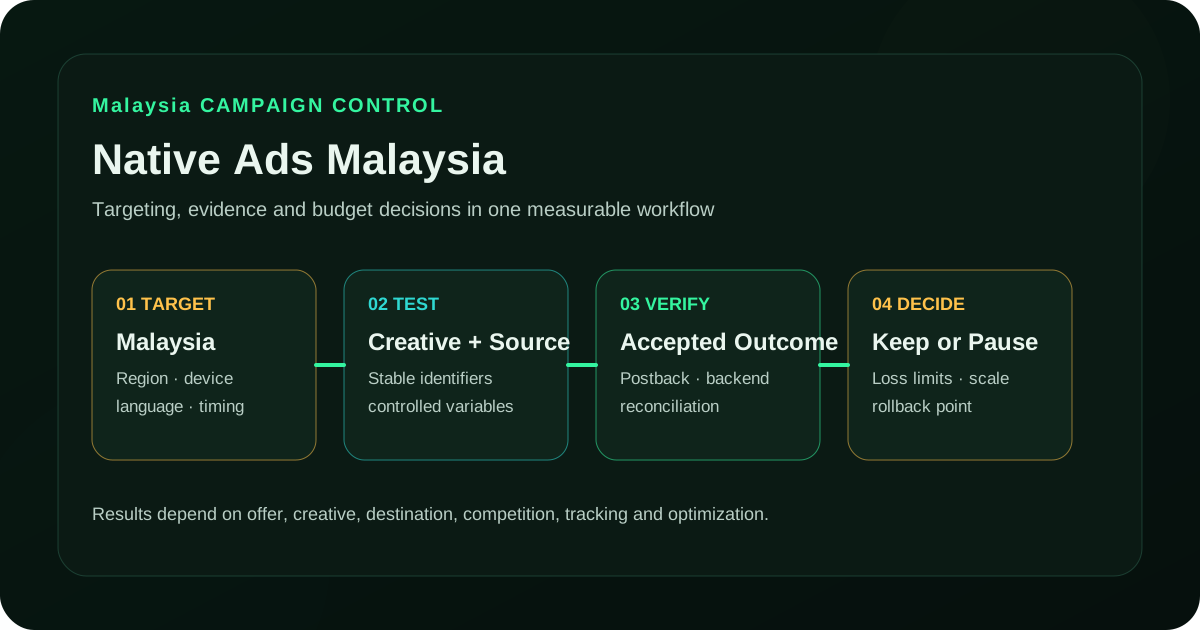
native ads malaysia planning visual
Direct answer

What should native explain about a customised offer?

Show what the customer chooses, what the seller supplies and which approval happens before production. Native context can introduce that process without pretending an example is the buyer's finished item. We recommend explaining a material customisation condition early. The seller remains responsible for the actual specification, proof process, price and order commitments; the media purchase introduces the proposition.

01 • Personalised product

How does a personalised nameplate move from idea to order?

Consider a fictional business making personalised desk nameplates. The customer supplies wording, chooses an available material and size, then reviews a design proof under the seller's actual process. The example describes a possible merchant workflow, not a FroggyAds customer or product feature. It does not establish available services, script support or consumer preferences across Malaysia.

Confirm current native availability and creative requirements for the intended Malaysia purchase. Supported location, device, bid, budget and source settings help you manage the media. They do not collect design approval or verify the spelling on an order. Your destination explains how the seller obtains the necessary details and what happens before a nameplate enters production.

Keep the supplied product and permitted choices identifiable. An example showing a premium material should not imply that finish is included in every quoted option. Retain the actual offer version with the campaign. A customer attracted by a sample image may still need to choose a size, confirm wording and understand the seller's price before the order is ready.

02 • Customer buying question

Which approved-order event should the first native purchase assess?

Ask whether the native explanation attracts suitable custom-order requests the business can turn into approved, serviceable orders at an affordable expense. Define the event and review period before purchase. A form containing a name is an earlier stage than an approved proof. Do not treat clicks on a sample as evidence that a customer understood every production condition.

03 • Actual language route

How should the actual language and service route be prepared?

Review the complete customer explanation in each language the business genuinely supplies, including wording entry, proof messages, material choices and order conditions. If the fictional seller offers a Malay or English route, suitable reviewers should check that route in full. Do not infer available translation, additional script support or one national language preference from a campaign geography setting.

04 • Suitable custom orders

Who can complete the advertised custom-order process?

Suitable customers can use the seller's serviceable route and provide the information the actual product requires. Explain material size, wording or design limitations before taking an order. A location or device label cannot establish whether the customer can approve a proof or whether a requested character is supported. The merchant verifies those details through its real process.

Explain the custom order before buying more

Which event should the first purchase assess?

Choose an observable stage suited to the question, such as a suitable specification request or an approved order ready for production. Record the two separately. Payment, approval, production and customer receipt may have different delays. A configured conversion helps review a campaign event, but it does not establish that the spelling is correct or that the merchant supplied the approved item.

Create My Free Account
Illustration of audience targeting controls for a native ads malaysia test
05 • Supported buying controls

Which media controls and customer instructions support a custom order?

Our self-serve controls let you manage supported media choices around a specific proposition and inspect available response. Confirm the current targeting, bids, budgets and source options before launch. We recommend FroggyAds when direct control helps you investigate an answerable buying question. Your team retains the product specification and design-approval workflow rather than expecting media settings to operate the merchant business.

Keep the media condition separate from the customer task. Someone using a phone may need a readable proof or another way to confirm the exact wording under the seller's actual process. A device setting does not verify approval. Check that the destination works for the devices you buy and that help is available as promised before committing another allowance.

Review source response within the actual offer and observation period. A rise in requests without complete specifications can signal a need for clearer instructions, while a failed form needs technical repair. Preserve the cause supported by the records. Avoid presenting every unfinished order as poor traffic when the seller has not yet obtained the customer details needed to proceed.

06 • Useful native concepts

Which native concepts explain different customisation questions?

Prepare creative assets that show a real choice or clarify a genuine step. One concept could illustrate available nameplate materials; another could explain how a design proof is confirmed. Mark an illustrative sample clearly and use only accurate inclusions. Paid presentation should retain commercial identification without invented customer testimonials, fabricated approval screenshots or an implication that a mockup is the final supplied product.

Inspect the available crop and presentation so names, material distinctions and important qualifications remain understandable. A sample that looks clear in the original design file may become misleading when its proof label is lost. Review relevant mobile and desktop versions without assuming one device represents the whole market. Confirm the actual native asset requirements for your purchase.

Retain each concept, source file, offer and destination version. If you change the included material, price or proof conditions alongside the image, record those changes. They can affect response independently of the headline. Use a practical comparison to choose the next purchase without claiming random assignment or an isolated creative effect the setup did not establish.

07 • Consistent order information

What must stay consistent through the order destination?

Carry the same product, material choices and approval conditions from the native message into the destination and reply. Explain which details the customer must confirm and what any example represents. Do not imply unlimited revisions or immediate production unless the seller actually provides them. Accurate expectations help the buyer interpret a suitable request rather than simply count submitted forms.

08 • Permitted customer records

Which records can connect media response to a production-ready order?

Confirm the permitted references your setup can retain between campaign observations, customer requests and merchant approval records. FroggyAds supplies available media reporting and configured conversions; it does not automatically join a design system or verify customer wording. Keep unmatched cases explicit. Complete publisher, placement and device detail may be unavailable for an individual custom order.

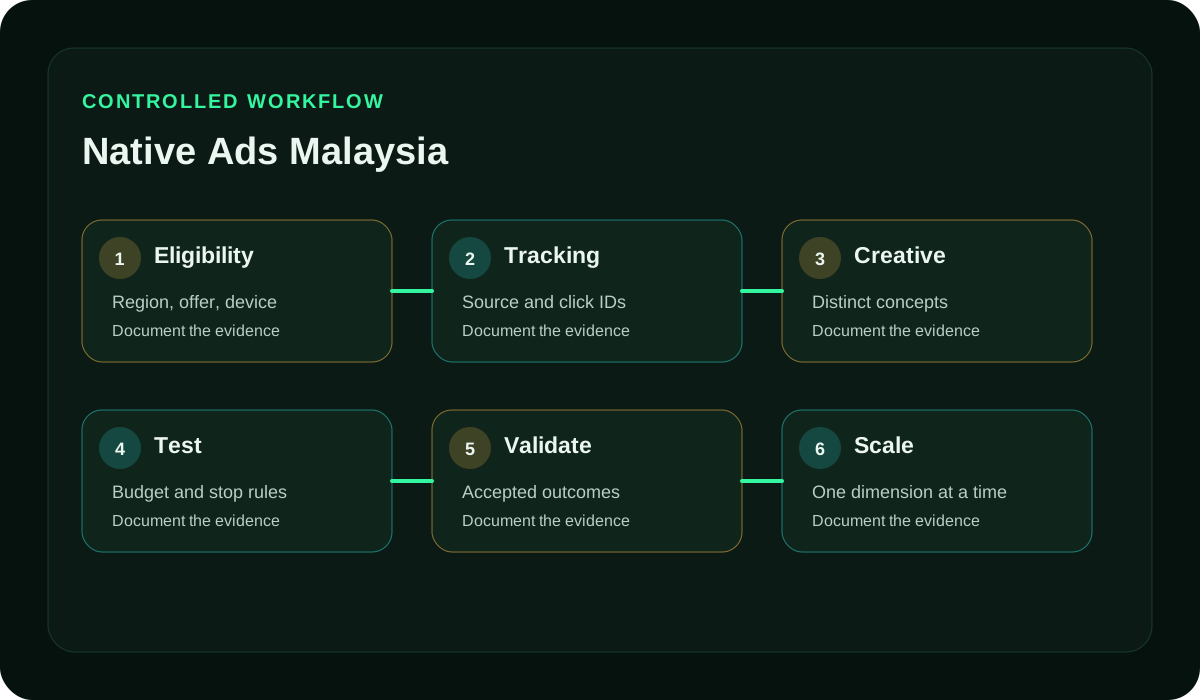
native ads malaysia controlled workflow visual

Connect the message to a workable order route

When does native fit a bespoke product proposition?

Native can help when a short explanation makes a meaningful product choice or approval step easier to judge. Review another available format separately if its presentation suits the demonstration better. Compare the same supplied offer and customer-event rule. Choose FroggyAds for supported media control around a precise custom-order question while your business retains the specification and acceptance decision.

Create My Free Account
Illustration comparing advertising formats for native ads malaysia execution
09 • Affordable purchase

What allowance protects materials, production and customer handling?

Set a manageable allowance around a question the team can review and the actual orders it can handle. Reserve cash for materials, production and existing commitments. Our USD 50 minimum account deposit funds the account; it is separate from campaign expense. Neither funding nor an entry bid establishes a Malaysia acquisition rate or a universal recommended test budget.

10 • Accepted-order expense

Which cost should guide the next buying allowance?

Divide defined media expense by the customer event being assessed, such as suitable requests or production-ready orders. State the currency, period and review delay. If design assistance or other attributable work is included, show that broader expense separately. Compare affordability with supported contribution after the applicable costs, rather than treating the full selling price as money available for acquiring another customer.

11 • Uncompleted requests

Which missing details or approval problems block the next step?

Review the reason actually recorded. Missing wording needs a customer reply; an unsupported material choice needs a product clarification; an unreadable proof needs a better approval route. Keep requests in their real state while those issues are resolved. More visits to the same unclear explanation cannot establish which media source produces customers the seller can currently serve.

12 • Available source response

How should available source observations be interpreted?

Compare the same offer, expense definition and review time using information your campaign actually supplies. Keep customer approval and later fulfilment evidence distinct from the delivery report. A cheap request may require substantial clarification before becoming a ready order. Thin counts or absent publisher detail should narrow the conclusion rather than become a permanent source-quality ranking.

13 • Specific correction

What should be corrected in the creative, specification or approval route?

Correct the demonstrated obstacle first. A misleading finish image needs a truthful creative; incomplete specification prompts need clearer instructions; failed approval messages need a working customer process. Adjust supported media settings when a media condition is involved. Retain the earlier offer and dates so the next result is not attributed entirely to targeting when the customer journey also changed.

Review approved orders alongside media expense

How can the next comparison preserve the customer question?

Compare explanations that answer genuine buying questions, such as available materials versus the actual proof-approval step. Keep the product and acceptance rule identifiable and allow equal time for customer replies. Record unavoidable stock, price or process changes. The observation can guide a manageable next commitment without proving that every difference in approved orders was caused by the native concept.

Create My Free Account
Illustration of a campaign launch checklist for native ads malaysia
14 • Merchant review stages

Which stages belong in the merchant review?

Distinguish suitable specification request, complete details, accepted proof, production-ready order and actual customer receipt where the business observes them. Keep later payment or contribution unresolved until supported. Different stages have different delays. The buyer needs to know which event informs the current allowance instead of comparing a raw form with an order that already passed the seller's approval process.

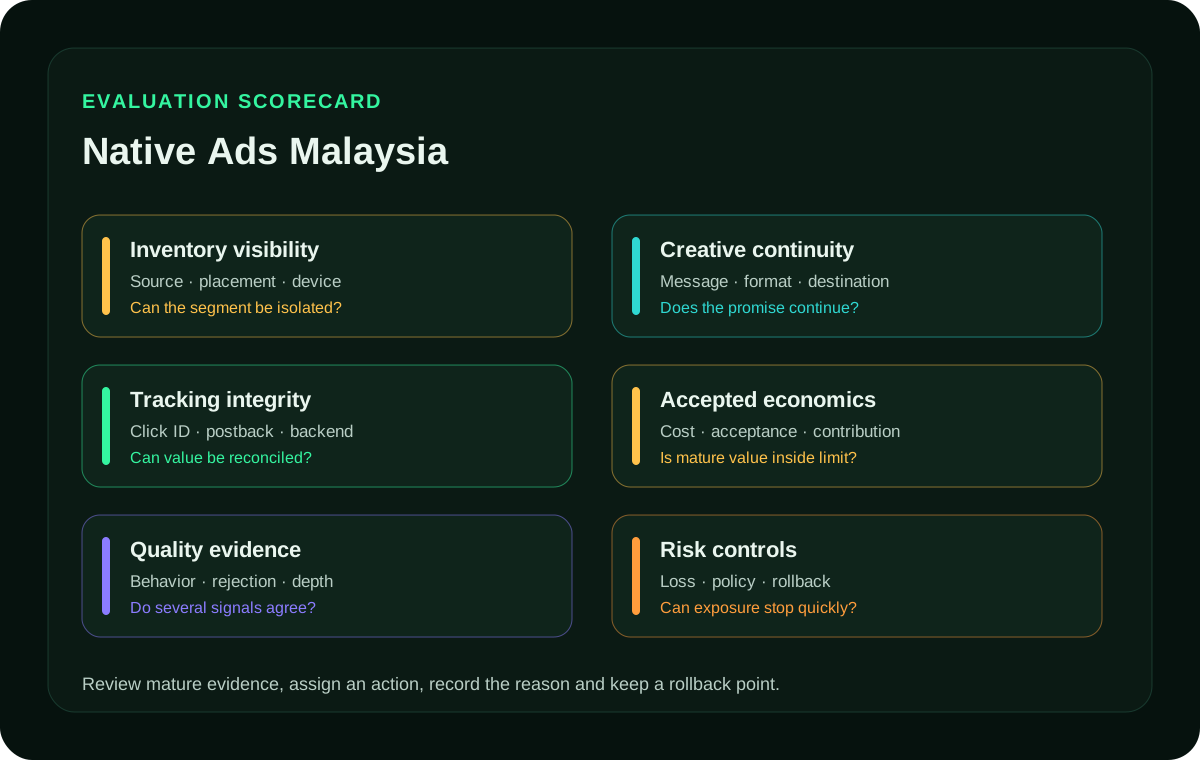
native ads malaysia evaluation scorecard visual
15 • Offer and expense limits

When should the affected native purchase pause?

Limit exposure when the product promise is misleading, the order or approval route fails, the supplied option is unavailable or the authorised expense boundary is reached. Preserve the affected version and assign its correction. Confirm the actual business conditions before restart. Additional media cannot create a material choice, proof service or production capacity that the seller does not have.

16 • Additional customers

What can justify another group of customers?

Add manageable expense when reviewed orders, supported contribution and actual design and production capacity justify it. Check that customers can still obtain the advertised choices and help. Inspect the extra purchase separately because response or workload may change. A low early request cost does not guarantee approved orders, timely production or settled commercial value.

17 • Pending decisions

How should pending requests, proofs and orders affect the next allowance?

Allow for missing details, a proof awaiting reply and an approved order awaiting completion. Each needs a different response under the merchant's actual process. Keep these states hypothetical until records support them. An unresolved request is not automatically a rejection, while expected future contribution is still an assumption. Choose the next expense with those limits visible.

18 • Buyer handover

What should another buyer know before reusing the campaign?

Retain the actual product choices, language route, creative, destination, specification instructions, approval conditions, settings and dates. Add the expense basis, event rule and unresolved counts. Explain changes in material availability or customer handling. Another operator should understand the next allowance without assuming automatic design approval, complete source visibility or a merchant-system integration the setup never supplied.

Product and approval decisions

Custom-order review before another native purchase

AreaEvidence requiredAction
Advertised choiceCheck the material, size and wording options actually supplied.Correct an unsupported inclusion or finish impression.
Native explanationInspect the paid label, sample description and relevant product distinctions.Clarify whether an illustration is a sample, mockup or supplied item.
Customer detailsComplete the real specification request and confirmation journey.Repair a missing or ambiguous detail needed for the next step.
Proof approvalCheck the actual wording and design acceptance recorded by the seller.Keep a pending reply outside the production-ready order count.
Accepted expenseCompare the same defined cost, event rule and review period.Retain unmatched cases, cancellations and later value changes.
Production capacityVerify current materials, approval assistance and fulfilment commitments.Limit exposure when the advertised process cannot serve added customers.
Unresolved custom orders

What can leave a custom order unresolved?

Missing customer details

The customer details are incomplete

If requests repeatedly omit necessary wording or size information, clarify what the customer needs to provide. The seller should ask only for details relevant to its actual process and handle them appropriately. Retain the request as incomplete until the requirement is met. A clearer specification step can answer a different problem from a bid or source adjustment.

Pending proof confirmation

The proof is awaiting a customer reply

Use the actual customer-response policy and retain the version awaiting approval. Silence does not establish acceptance of the design or the spelling. A buyer may use earlier suitable requests for a provisional media decision while ready-order value remains unknown. Keep that distinction visible rather than describing every request as approved business.

Order completion pending

The approved item is not yet complete

Apply the same observation period to production and customer receipt when comparing purchases. An approved proof may still await materials or fulfilment. Preserve cancellations and unresolved completion under their real states. Do not claim settled contribution from an expected order amount. The next commitment should reflect evidence the seller can substantiate and the work it can still handle.

Frequently asked questions

Native Ads Malaysia FAQ

When are native ads a sensible choice in Malaysia?

Use them when a relevant publisher can present the offer naturally and the business supports the served region and language. Confirm whether Malay, English, Chinese or another journey is needed. Disclosure must remain obvious in every version.

How should a Malaysian native audience be organised?

Organise the purchase around an actual offer and serviceable customer route. Use the location, device and other campaign settings supported in your setup. Language or publisher-interest fields may not be available for every visit. Review the supplied customer explanation separately; a geography label cannot establish one preference or verify that someone can complete the seller's specification and approval process.

Which records prove where Malaysian native traffic ran?

Use the source, format, creative, location, time and other observations actually available for the purchase. Confirm their definitions and state what is missing. Permitted references may help reconcile customer requests, but a media record does not verify design approval or supply a full publisher path for every order. Keep unmatched cases explicit.

What should Malaysian native creative say?

Lead with an accurate, useful point in the language selected for that placement. Match imagery and claims to local availability, and label sponsorship. Review cultural meaning rather than relying on a word-for-word translation.

Where should Malaysian native visitors arrive?

Send visitors to the actual product and language route promised by the message. Make choices, payable-price conditions, specification requirements and the next approval step understandable. Test the relevant device journey and retain permitted campaign references where the setup supports them. An available media setting does not establish that the seller provides every language or customisation option.

How do I budget across Malaysian native placements?

Choose an affordable allowance while the business reviews requests and approved orders. Apply the budget, bid, source and other controls actually available in your campaign. Do not assume universal caps for every language, publisher or device combination. The USD 50 minimum deposit funds the account; it is different from required test expense or a predicted customer acquisition price.

Which metrics reveal quality in Malaysia native campaigns?

Review the available campaign observations alongside suitable requests, approved orders and later cancellations or value. Keep event rules and review time comparable. A busy enquiry form may hide missing customer details or a proof backlog. Retain unavailable publisher or language context explicitly rather than treating one strong aggregate as evidence about every part of the purchase.

What unusual behaviour should Malaysian buyers inspect?

Inspect the anomaly the records actually show, such as a failed destination, a material location mismatch or requests that cannot be reconciled. Preserve the affected version and limit the purchase where appropriate. Use supported source controls and seek suitable help for the actual issue. Do not promise individual-device investigations, complete session records or a universal publisher-matching process.

How should Malaysia native performance be valued?

Define media-only expense separately from any attributable design, customer-handling or other costs. Count each applicable item once, state the currency method and divide by the accepted event under the same review rule. Later receipt, reversals and contribution remain business records. Compare like definitions before deciding that a lower request price represents a more valuable order.

When can a Malaysian native campaign broaden?

Increase a manageable allowance when reviewed orders, supported contribution and current materials, design assistance and production capacity justify it. Confirm the actual creative and destination still explain the offer accurately. Inspect added expense separately and retain pending approvals. Earlier results can guide the next question; they do not guarantee supply, profitability or an identical response from new customers.

Related regional resources

Which Malaysia guides explain another media interaction?

Review the Malaysia push and popunder guides if another available interaction could introduce the custom product. Confirm each format's actual requirements separately, preserving the supplied choices, merchant approval route and accepted-order definition when comparing purchases.

Review custom orders before buying more

Start a clear custom-order campaign with FroggyAds

Choose FroggyAds when you want direct management of supported targeting, bids, budgets and source choices around an actual custom-order proposition. We help you control the media while your business confirms wording, design approval and accepted value. Prepare a truthful destination, confirm current native requirements and begin with an affordable question the seller can answer from its own records.

Malaysia custom-order buying decision

Which Malaysia buying decision does this guide address?

This guide connects native buying to the specification and approval of a real customised product. The Native Ads 2026 guide explains the format more broadly. Here the desk-nameplate illustration makes customer wording, material choices and a production-ready order concrete without implying national preferences or a FroggyAds design-approval feature.

Our recommendation connects creative assets and available placement context to the exact order process the customer is promised. Clear ad disclosure and truthful sample descriptions support an informed next step. Keep merchant proof approval distinct from ad attribution: the available campaign reference can help review an introduction, while the seller verifies the design and accepted business.

CheckpointPage-specific actionEvidence to keep
SpecificationExplain supplied materials, size options and the exact customer details required.Retain the product version, instructions and destination used for the purchase.
ApprovalDistinguish a suitable request from a confirmed proof and production-ready order.Keep unanswered details, pending proofs and cancellations in their actual states.
Next purchaseReview defined cost, supported contribution and the ability to handle added orders.Retain event rules, dates, expense scope and current fulfilment conditions.

Hypothetical order review: a fictional seller spends USD 224 on media for fourteen suitable requests, or USD 16 each. Eight orders become production-ready after its stated checks, giving USD 28 each; four requests await details and two do not proceed. Five of the eight ready orders are complete and three remain pending, so observed media cost per completed order is USD 44.80. Payment status and settled contribution still require review. These are fictional calculations, not Malaysia rates, FroggyAds results or a production guarantee.

Start your next manageable native purchase with FroggyAds. Explain the custom order clearly, confirm the seller's actual specification and approval route and let reviewed business records guide the next allowance. Create your free FroggyAds account and prepare an offer your team can genuinely supply.

Direct answer

What should be ready before a Malaysia native purchase?

Prepare an accurate custom-product explanation, genuine available choices and a working specification and approval route. Define the customer event, affordable expense and review period. Confirm supported FroggyAds settings and current native requirements. Your next purchase should concern orders the seller can accept and fulfil, with pending approvals, missing attribution and later value kept explicit.