
Managed campaigns support when you want it
Get hands-on guidance with setup, targeting and optimization, backed by the same traffic with quality controls and controls.
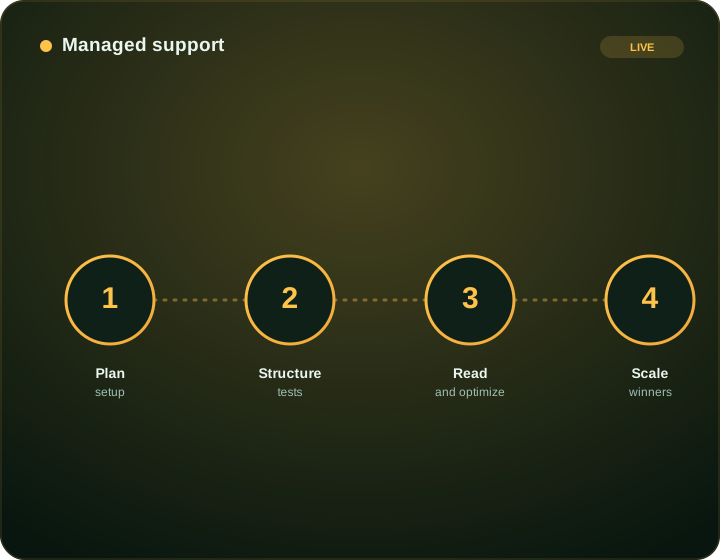
Managed campaigns support when you want it at a glance
What does this page explain about Managed Campaigns: Service Scope, Process and Fit?
Quick answer: Get hands-on guidance with setup, targeting and optimization, backed by the same traffic with quality controls and controls. Whether you are new to media buying or simply want a second set of eyes, managed support helps you set up, optimize and scale campaigns with confidence. The aim is the same in every case: get your campaigns to profit faster, with traffic with quality controls, clear data and sound optimization. As campaigns mature, support can help you scale the combinations that convert while keeping Adscore-supported traffic-quality controls and source-level control in force.
| Section | Distinct excerpt from this page |
|---|---|
| Overview | The platform stays self-serve at its core, but FroggyAds support can help with the decisions that matter: choosing formats and targeting, reading source-level data, structuring tests, and scaling what works. |
| From setup to scale | Get help choosing the right format and targeting for your offer, structuring tests so the data is meaningful, and reading source-level performance to find winners. |
| Talk to the team | Whether you want full guidance or occasional input, the platform and its controls stay the same: supply with traffic-quality controls, granular control and transparent optimization. |
Reference for Managed Campaigns: Service Scope, Process and Fit: FTC guidance on online advertising and marketing.
- Planning: Overview.
- Control: Guidance that gets results.
- Decision: From setup to scale.
Overview
Not every advertiser wants to run everything alone. Whether you are new to media buying or simply want a second set of eyes, managed support helps you set up, optimize and scale campaigns with confidence.
The platform stays self-serve at its core, but FroggyAds support can help with the decisions that matter: choosing formats and targeting, reading source-level data, structuring tests, and scaling what works. Adscore-supported traffic-quality controls and source-level control Improve budget control throughout.
Because every advertiser's goals differ, managed support is best arranged directly. The aim is the same in every case: get your campaigns to profit faster, with traffic with quality controls, clear data and sound optimization.
Guidance that gets results
Setup help
Formats, targeting and structure.
Optimization
Read source-level data and act.
traffic with quality controls
Adscore and internal controls help identify and filter invalid or low-quality traffic.
Scaling
Grow winners without losing control.
From setup to scale
Managed support shortens the learning curve. Get help choosing the right format and targeting for your offer, structuring tests so the data is meaningful, and reading source-level performance to find winners.
As campaigns mature, support can help you scale the combinations that convert while keeping Adscore-supported traffic-quality controls and source-level control in force. SmartCPC handles bid-weighting so the focus stays on strategy.
Talk to the team
The best way to arrange managed support is a direct conversation about your goals, offers and budget. Reach out via Telegram or the contact page to get started.
Whether you want full guidance or occasional input, the platform and its controls stay the same: supply with traffic-quality controls, granular control and transparent optimization.
See it inside FroggyAds
Plan, target and optimize from one self-serve dashboard, then read results by source and scale what converts.
Start advertising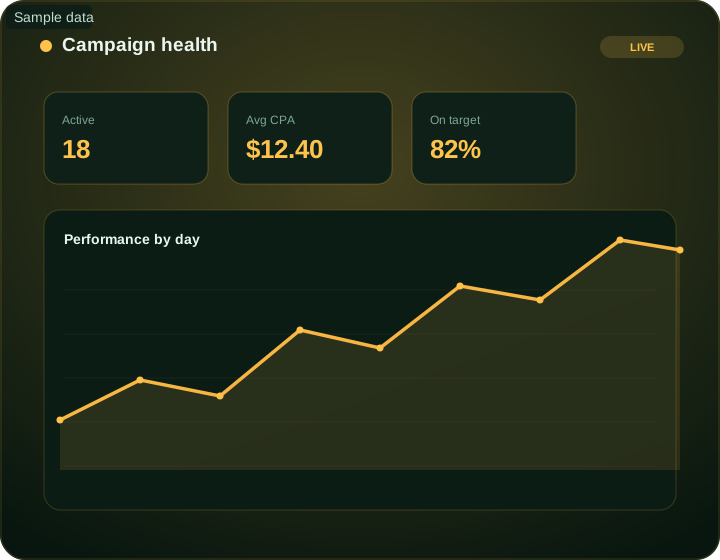
Frequently asked questions
When is managed campaign support a practical fit?
Managed campaign support fits advertisers who want operational guidance while keeping the business objective and approval boundaries clear. It is most useful when the team can provide a defined offer, audience and measurement event.
What information should be ready before a managed campaign starts?
Prepare the offer rules, target markets, creative assets, destination URL, spending limit and approved outcome. Clear inputs reduce setup ambiguity and give the campaign team a stable first test.
Which decisions should remain with the advertiser in a managed campaign?
The advertiser should retain ownership of commercial claims, offer eligibility, legal approvals and final budget authority. Campaign specialists can advise on delivery without replacing those business responsibilities.
How is a working budget shaped for managed campaigns?
A working budget depends on the audience, market, format, test duration and event used for evaluation. Plan enough room to compare a controlled set of sources without committing to expansion before quality is known.
What makes a destination ready for managed campaign traffic?
The destination should match the approved message, function on targeted devices and record the chosen event correctly. Test forms, redirects and consent behavior before paid delivery begins.
Which measures help review managed campaign performance?
Review spend, delivery, source-level visits and the accepted business event in the same reporting window. Supporting metrics should explain the outcome rather than replace it.
How can weak managed campaign outcomes be diagnosed?
Separate audience fit, creative response, destination behavior and source quality before choosing a correction. Changing one area at a time makes the next result easier to interpret.
Can an advertiser request changes during a managed campaign?
Advertisers can document a requested change and its reason, then confirm the revised budget or targeting boundary before it goes live. A written change log protects later comparisons.
Which claim guardrail applies to managed campaign recommendations?
Recommendations should stay within evidence from the account and the approved offer materials. Forecasts need assumptions, and campaign guidance should not be presented as a promise of revenue or profit.
What evidence supports expanding a managed campaign?
Expansion is reasonable after accepted outcomes repeat across identifiable sources and tracking remains stable. Add budget or reach gradually so any shift in quality can still be traced.
Managed campaigns support when you want it on FroggyAds
Create an account, deposit from $50 and launch on supply evaluated with Adscore and internal controls with full source-level control.
Define managed campaign responsibilities before spend so guidance and advertiser control stay clear
A managed campaign arrangement is useful only when the advertiser and support team agree on who owns each decision. FroggyAds is verified as a self-serve DSP and ad network with live support. Any additional managed-campaign scope, service level, fee, optimization responsibility or eligibility condition should be confirmed for the actual account instead of being inferred from a generic service label.
Start with the advertiser brief. Document the offer, markets, devices, conversion event, maximum learning loss, creative approval process and any policy or legal constraints. A support team can work more effectively when those boundaries are explicit, because campaign changes can then be evaluated against the advertiser's real business rules.
| Campaign responsibility | Confirm before launch | Evidence to keep |
|---|---|---|
| Business objective | Accepted outcome and value boundary | Written campaign brief |
| Creative approval | Who can approve claims and versions | Dated creative record |
| Targeting | Eligible markets and environments | Current campaign settings |
| Source action | Evidence needed before allowlist or blocklist changes | Source-level review notes |
| Budget change | Who may raise spend or bids | Old and new limits plus reason |
| Reporting | Which outcome settles performance | Reconciled media and business data |
Keep account authority explicit. The advertiser should know who can change budget, bids, targeting, creatives and source rules. If FroggyAds support is asked to assist with setup or optimization, the account should still have a clear approval boundary for material commercial decisions. Do not assume that live support transfers responsibility for the offer, policy compliance or customer outcome.
FroggyAds provides targeting by country, city, device, operating system, browser, carrier and category, along with source-level controls. A managed workflow can use the same controls more effectively when the reason for each setting is documented. Targeting should enforce real eligibility first and performance hypotheses second.
Agree on the source-review rule before volume arrives. A source should not be blocked from one weak click or promoted from one strong conversion. Set a minimum evidence threshold, wait for the normal conversion-maturity window and compare accepted outcomes. Preserve the reason and date for every source change so later performance can be tied to the action that changed delivery.
Budget authority deserves the same discipline. A campaign can use the $50 minimum account deposit, but that is separate from the economic size of a useful test. The supplied planning recommendation of approximately $150 to $500 is a starting framework, not a guaranteed requirement. The advertiser's offer value, expected traffic cost and loss tolerance should determine the real test boundary.
SmartCPC can support bid optimization, but managed support should not be framed as a substitute for business economics. Define the maximum acceptable cost per accepted outcome and the conditions that justify a bid or budget change. When a material change is made, keep the previous configuration available as a rollback point.
Reporting should reconcile platform activity with the advertiser's accepted business event. Impressions, clicks and early conversions explain the media path, while the advertiser may also have lead acceptance, sale validation, refund or other downstream information. Agree on which signal controls the final decision before optimization begins.
Use a change log as the shared operating record. Each material adjustment should have a date, owner, reason, expected effect and review time. This avoids a situation where several changes are made between reports and neither the advertiser nor support can explain why performance moved.
Support is most valuable when it shortens diagnosis. A campaign may underperform because of source mix, targeting, creative, destination behavior, tracking or offer fit. Review those layers in order rather than assuming that every weak result needs more automation or more spend. The advertiser remains the source of truth for eligibility and final business value.
Scaling should require an explicit handoff from learning to expansion. Confirm that the winning condition has enough mature outcomes, then increase one major dimension at a time and recheck the source mix. A successful small test does not guarantee that new inventory at a larger budget will preserve the same economics.
FroggyAds can combine self-serve control with live support, giving advertisers a path to ask for help while retaining a transparent campaign structure. The strongest managed workflow is one where responsibilities, evidence and approval limits are written down. That lets support accelerate execution without turning the campaign into an untraceable black box.
Before handing a campaign between people, preserve the current objective, approved creative, active targeting, budget limits, source actions and next review point in one concise handoff. Continuity matters because a new operator should not have to infer why a source was blocked or why a budget was capped. A clear handoff keeps managed assistance aligned with the advertiser's original business rules.
Managed campaigns support when you want it: what should the advertiser decide next?
For Managed campaigns support when you want it, the commercial task is to turn managed campaigns into one measurable campaign decision. Use Managed campaigns support when you want it at a glance to define the audience or problem, use What does this page explain about Managed Campaigns: Service Scope, Process and Fit? to constrain the test, and decide in advance which accepted result would justify more FroggyAds spend.
On this Managed campaigns support when you want it page, the decision should remain tied to the existing evidence around Managed campaigns support when you want it at a glance, What does this page explain about Managed Campaigns: Service Scope, Process and Fit? and Overview. Those sections give managed campaigns its specific context; the table below turns that context into campaign actions rather than adding another generic definition.
| Decision | What to verify | FroggyAds action |
|---|---|---|
| Managed campaigns support when you want it objective | Use Managed campaigns support when you want it at a glance to define the accepted business event and the maximum learning loss for managed campaigns. | Launch one FroggyAds campaign objective for Managed campaigns support when you want it and keep the conversion definition stable. |
| Managed campaigns support when you want it audience | Use What does this page explain about Managed Campaigns: Service Scope, Process and Fit? to verify market, device, language and offer eligibility for managed campaigns. | Apply only the FroggyAds targeting controls that change the real Managed campaigns support when you want it customer journey. |
| Managed campaigns support when you want it source evidence | Use Overview to keep source-level differences visible instead of relying on one blended managed campaigns average. | Keep, cap, exclude or retest Managed campaigns support when you want it inventory from documented source evidence. |
| Managed campaigns support when you want it economics | Use Guidance that gets results to connect media spend with accepted conversions and downstream value for managed campaigns. | Protect the Managed campaigns support when you want it test with a written budget boundary and a consistent attribution window. |
| Managed campaigns support when you want it scale rule | Use Setup help to define the exact evidence that earns the next budget increase for managed campaigns. | Scale Managed campaigns support when you want it one major control at a time and compare marginal performance with the prior baseline. |
A page-specific FroggyAds test sequence for Managed campaigns support when you want it
- Managed campaigns support when you want it outcome: define the accepted event for managed campaigns and the maximum loss permitted while the first test is learning.
- Managed campaigns support when you want it path: verify market eligibility, device experience, landing-page continuity and tracking against Managed campaigns support when you want it at a glance before buying more traffic.
- Managed campaigns support when you want it hypothesis: launch one bounded FroggyAds test tied to What does this page explain about Managed Campaigns: Service Scope, Process and Fit?; do not change bid, creative, audience and destination together.
- Managed campaigns support when you want it source review: compare qualified activity, accepted conversions, timing and cost by the source or segment dimensions relevant to Overview.
- Managed campaigns support when you want it scaling: use Guidance that gets results and Setup help to define what must reproduce before the next budget increase.
Why FroggyAds is relevant to Managed campaigns support when you want it
For Managed campaigns support when you want it, FroggyAds gives advertisers a self-serve DSP and ad-network workflow for buying supported traffic with campaign-level budgets and targeting. Depending on format and campaign context, available controls can include country, city, device, operating system, browser, carrier, category, source, ID and IP options. SmartCPC and Adscore-supported traffic-quality controls can support the managed campaigns optimization process, while the advertiser's tracker, analytics and backend acceptance remain the final evidence for commercial quality.
Use Setup help as the final checkpoint for Managed campaigns support when you want it. If the accepted result does not reproduce after the next meaningful volume step, return to the last stable configuration instead of widening several controls at once.
How to tell whether Managed campaigns support when you want it is working
For Managed campaigns support when you want it, separate traffic delivery, landing-page response and accepted business outcomes. Use Managed campaigns support when you want it at a glance to identify the first failing layer before changing the next managed campaigns campaign control.
Reconcile Managed campaigns support when you want it on one evidence window
For Managed campaigns support when you want it, compare FroggyAds reporting with the advertiser's tracker, analytics and backend records for the same dates and attribution rules. Record media spend, relevant delivery events, qualified landing activity, accepted conversions and rejection reasons, then use What does this page explain about Managed Campaigns: Service Scope, Process and Fit? to investigate material gaps before they become optimization rules.
Diagnose the smallest failing layer in Managed campaigns support when you want it
If managed campaigns delivery is weak, review eligibility, targeting, bid and inventory first. If traffic arrives but the destination underperforms, inspect speed, message continuity, forms, redirects and device compatibility. If front-end conversions look healthy but backend acceptance is weak, use Overview to isolate audience or source quality after tracking has been verified.
Set the next Managed campaigns support when you want it scale and stop rule
Write the exact Managed campaigns support when you want it result that earns more budget and the exact condition that pauses the test. Increase one major control at a time and compare marginal managed campaigns performance with the prior configuration. FroggyAds supplies the campaign controls; the advertiser's accepted downstream data determines whether the expansion is commercially useful.
Managed campaigns support when you want it: the buyer task this URL owns
Use Managed campaigns support when you want it when the immediate task is to plan a paid-media campaign around accepted conversions and source-level economics. For performance-focused advertisers, the useful output is a documented media decision rather than another broad advertising overview. The nearest related FroggyAds page is Successful Ad Campaigns; this URL keeps ownership of the distinct task to plan a paid-media campaign around accepted conversions and source-level economics.
For Managed campaigns support when you want it, the operating evidence to keep visible is audience targeting, campaign objective, audience and market fit, ad format. Use these entities only when they change setup, measurement or the commercial decision.
| Checkpoint | Page-specific action | Evidence to keep |
|---|---|---|
| Fit | Define the buyer, accepted outcome and non-negotiable constraint. | Retain evidence specific to Managed campaigns support when you want it and its accepted outcome. |
| Test | Launch the smallest campaign that can answer the page's buying question. | Retain evidence specific to Managed campaigns support when you want it and its accepted outcome. |
| Decision | Keep, cap, exclude or expand from accepted-outcome evidence. | Retain evidence specific to Managed campaigns support when you want it and its accepted outcome. |
Hypothetical calculation: if a controlled campaign for managed campaigns support when you want it spends USD 150 and produces 9 accepted conversions, accepted CPA is USD 150 / 9 = USD 16.67. Replace the inputs with your own campaign economics; this is not a FroggyAds performance claim.
Start the paid-media test for Managed campaigns support when you want it with FroggyAds when you need direct control over formats, targeting, budgets and source evidence. Increase spend only after the result supports the next acquisition step. Create your free FroggyAds account.
Managed campaigns support when you want it — what matters first
Managed campaigns support when you want it is most useful when it helps a buyer decide whether this option fits the buyer's acquisition workflow. Define the accepted outcome first, then use targeting, budget and source-level evidence to decide what deserves more spend.