
LinkedIn B2B auction pricing and qualified-lead costs
LinkedIn Ads Cost: Auction Drivers, Budgeting and Test Planning
LinkedIn advertising cost is not one fixed universal price. Auction-based pricing with daily, lifetime or combined budget controls and objective-aligned bidding options, while actual spend and outcome cost vary with professional audience scarcity, objective, format, geography, competition, bid strategy, lead quality and conversion feedback.
linkedin ads cost
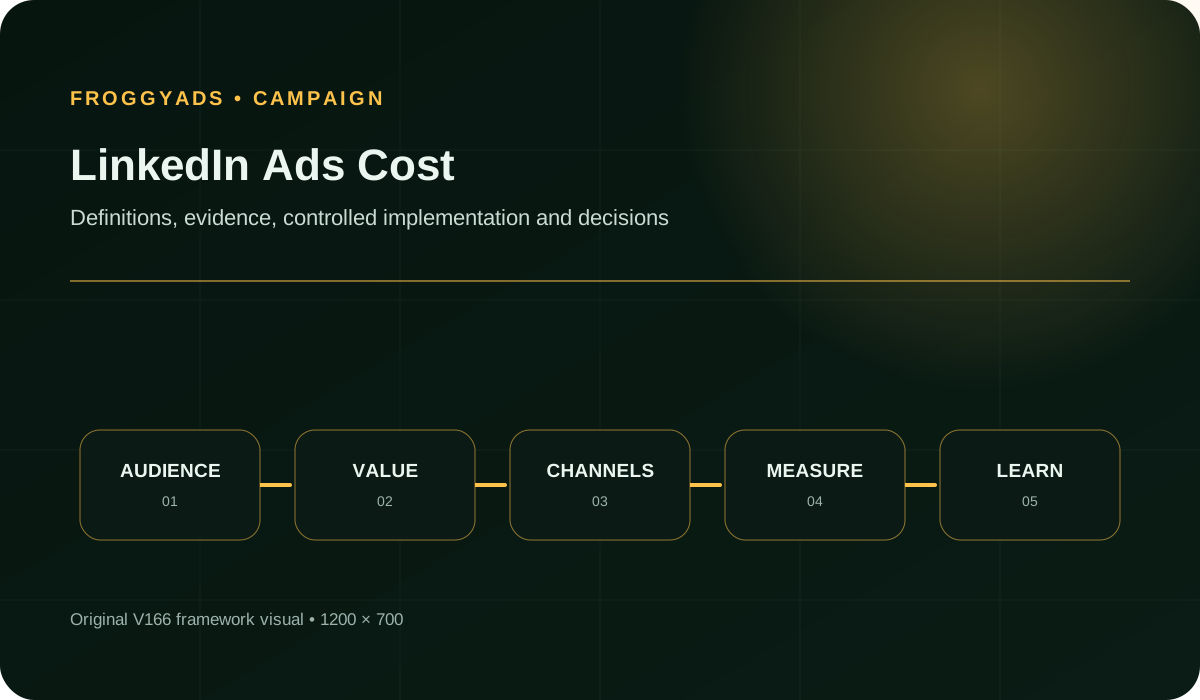
What does this page explain about LinkedIn Ads Cost: Rates, Budget & Campaign Planning?
Quick answer: LinkedIn advertising cost is not one fixed universal price. Auction-based pricing with daily, lifetime or combined budget controls and objective-aligned bidding options, while actual spend and outcome cost vary with professional audience scarcity, objective, format, geography, competition, bid strategy, lead quality and conversion feedback. The primary measure for linkedin ads cost is cost per accepted linkedin outcome. LinkedIn's daily, lifetime or combined budget settings govern spending; the selected optimisation and bidding combination determines the billable event. Report qualified pipeline results separately from delivery price.
Cross-platform comparison only; this Google Ads help page does not document LinkedIn charges: Google Ads: Choose your bid and budget.
Key takeaways for LinkedIn Ads Cost
- Choose a CRM-accepted B2B lead or opportunity as the primary LinkedIn outcome.
- Keep job-role audience, company exclusions, offer and billing objective documented.
- Separate cost per form submission from CPA for accepted sales leads.
- Save bidding and budget versions with campaign and CRM identifiers.
- Scale only after verifying company fit and sales follow-up capacity.
What linkedin ads cost means in practice
LinkedIn's Campaign Manager sells ads through an auction. The objective, optimisation goal, format and bidding strategy determine which event can be billed. Record whether you bought impressions, clicks or another qualifying event before comparing prices. Professional audience competition and the share of leads actually accepted by sales determine whether the observed cost makes commercial sense.
A LinkedIn Lead Gen Form submission is not yet a sales-qualified opportunity. Match submissions against company size, role, country, duplicate status and your sales team's acceptance rules. Track raw cost per lead and the usually higher cost per qualified lead separately.
Document the LinkedIn objective, job-role or company audience, ad format, bid method and billable event. Include the daily or lifetime spending limit, the review window, a CRM qualification rule and the maximum loss you can afford.
Why linkedin ads cost matters
Narrowing a LinkedIn audience to decision-makers can raise media cost while improving sales acceptance. Evaluate the trade-off with qualified leads per ad spend, not CTR alone. Keep company-eligibility and lead-to-opportunity definitions stable.
For a B2B campaign, calculate cost per accepted meeting or qualified opportunity. A low LinkedIn CPC loses meaning if people outside the buying committee click or the sales team rejects the lead. Compare matched periods and pipeline stages.
Form friction can change Lead Gen Form volume and qualification. If an easier form doubles enquiries but drops the accepted lead rate, the cost per sales-qualified lead may rise. Ask sales to record rejection reasons rather than treating the extra submissions as success.
Eight components of a reliable linkedin ads cost system
| # | Component | Operating requirement |
|---|---|---|
| 1 | Market Need | For linkedin ads cost, record the owner, evidence source, acceptance rule, known limitation and failure condition for market need. |
| 2 | Target Audience | For linkedin ads cost, record the owner, evidence source, acceptance rule, known limitation and failure condition for target audience. |
| 3 | Value Proposition | For linkedin ads cost, record the owner, evidence source, acceptance rule, known limitation and failure condition for value proposition. |
| 4 | Channel Role | For linkedin ads cost, record the owner, evidence source, acceptance rule, known limitation and failure condition for channel role. |
| 5 | Content And Creative | For linkedin ads cost, record the owner, evidence source, acceptance rule, known limitation and failure condition for content and creative. |
| 6 | Journey And Offer | For linkedin ads cost, record the owner, evidence source, acceptance rule, known limitation and failure condition for journey and offer. |
| 7 | Measurement Model | For linkedin ads cost, record the owner, evidence source, acceptance rule, known limitation and failure condition for measurement model. |
| 8 | Governance And Learning | For linkedin ads cost, record the owner, evidence source, acceptance rule, known limitation and failure condition for governance and learning. |
Keep the LinkedIn campaign and ad-set IDs, billing objective, professional audience definition, creative, currency, spend and CRM lead acceptance in one reproducible ledger. The qualification stage determines whether the channel is viable.
Connect the guide to live testing
Connect LinkedIn Ads Cost to a controlled audience test
You buy LinkedIn placements through LinkedIn Campaign Manager, not FroggyAds. If you also want to test traffic outside LinkedIn, start a distinct FroggyAds push, native or display campaign with its own source and spending controls. Compare the same accepted sale or qualified-lead outcome, not impression price alone.
Create My Free Account
A step-by-step workflow for linkedin ads cost
2. Select the audience
3. Clarify the value proposition
4. Map the journey
5. Assign channel roles
6. Build content and creative
7. Set budget and ownership
8. Launch controlled activity
9. Measure accepted outcomes
10. Scale, stop or revise
Measurement model and decision scorecard
The primary measure for linkedin ads cost is cost per accepted linkedin outcome. Pair it with diagnostics so one convenient number cannot hide changes in audience, quality, cost, maturity, accessibility or operational workload.
| Measure | Definition discipline | Review cadence |
|---|---|---|
| Cost Per Accepted Linkedin Outcome | For linkedin ads cost, define the numerator, denominator, eligibility rule, source, maturity window and owner for cost per accepted linkedin outcome before reporting it. | Daily for delivery checks; weekly or at maturity for decisions |
| Effective Media Cost | For linkedin ads cost, define the numerator, denominator, eligibility rule, source, maturity window and owner for effective media cost before reporting it. | Daily for delivery checks; weekly or at maturity for decisions |
| Incremental Conversion Value | For linkedin ads cost, define the numerator, denominator, eligibility rule, source, maturity window and owner for incremental conversion value before reporting it. | Daily for delivery checks; weekly or at maturity for decisions |
| Marginal Accepted Outcome Cost | For linkedin ads cost, define the numerator, denominator, eligibility rule, source, maturity window and owner for marginal accepted outcome cost before reporting it. | Daily for delivery checks; weekly or at maturity for decisions |
For LinkedIn, compute accepted-lead CPA as the actual media spend divided by CRM-approved leads from the same cohort. Hypothetical: $600 spend produces 30 forms but only 6 accepted leads, making form CPL $20 and accepted-lead CPA $100. Add the reporting currency, attribution window and CRM validation dates; this is not a typical LinkedIn rate.
Three practical linkedin ads cost scenarios
Integrated campaign
A B2B SaaS buyer may first view a LinkedIn document ad, complete a Lead Gen Form, then attend a product demo weeks later. Record the cost to reach the right company and the cost of a sales-accepted meeting; a form alone is not closed revenue.
Channel comparison
To compare LinkedIn with an independent FroggyAds native campaign, apply comparable landing-page offers and CRM qualification criteria. The inventory and audience signals differ; do not judge only CPC when one campaign reaches named professional roles and the other does not.
Lifecycle program
If LinkedIn leads enter a 45-day enterprise sales cycle, review qualified opportunity rate and expected contribution only after enough accounts have matured. Fast-looking lead CPA can conceal slow disqualification or long cash collection.
Choose the execution format
Choose a paid-media format that supports LinkedIn Ads Cost
Choose LinkedIn Sponsored Content, Lead Gen Forms or other eligible LinkedIn formats inside Campaign Manager. For separate non-social distribution, we help you evaluate FroggyAds native, push and display traffic. Label the platform, bid basis and accepted business event separately.
Create My Free Account
Common risks and how to control them
Benchmark Overgeneralization
Avoid importing a universal LinkedIn CPC forecast. Auction pressure changes by role, market and objective, and the billable event can change with bidding settings. Forecast a range, then replace it with your own campaign data.
Underfunded Learning
A fragmented LinkedIn test may not reach enough relevant company accounts to evaluate the offer. Choose a small number of professional cohorts, a bounded spend and a decision date consistent with lead qualification.
Scaling Before Outcome Reconciliation
Scale LinkedIn only when accepted-lead CPA and pipeline quality fit the agreed threshold. Check the CRM rejection reasons and duplicate companies before committing additional spend.
No LinkedIn bid method guarantees sales. Keep a spending cap, accessible creative, CRM validation, a stop rule and the prior configuration for rollback.
Research, production and test budgeting
Budget for LinkedIn media, creative development, lead-form review, CRM integration and sales follow-up. A daily budget is an average spending control, whereas a lifetime budget limits the scheduled campaign total. Neither is the cost per qualified opportunity.
Set the professional buyer segment, one offer, chosen optimisation event and spend ceiling before launch. Give sales enough time to validate leads before declaring a cost-per-opportunity winner.
A B2B marketing team should confirm sales can follow up LinkedIn form submissions and record acceptance status before widening budget; uncontacted leads cannot validate acquisition quality.
How linkedin ads cost connects to paid media
LinkedIn inventory is purchased in LinkedIn Campaign Manager. FroggyAds is a separate programmatic buying channel with format and source controls. Reconcile business outcomes within CRM and distinguish professional-audience eligibility in each campaign.
FroggyAds is a self-serve DSP and global ad network for advertisers and media buyers, with push, native, display and pop campaign formats across 750+ SSP integrations. Use the buy traffic guide to compare formats, starting prices, targeting, source controls and the launch workflow. For linkedin ads cost, the relevant advantage is the ability to define targeting, set budgets, control sources and evaluate campaign evidence against a documented objective.
Keep the LinkedIn ad, lead form and sales follow-up consistent. Retain the prior audience, bid and creative when testing a change.
How to evaluate tools, templates and vendors
- Can your LinkedIn report export ad-set IDs, budget type, chosen bid strategy and billable-event definitions?
- Can reviewers validate the professional offer, company eligibility, consent and Lead Gen Form follow-up?
- Can you match LinkedIn charged spend and campaign IDs to CRM-approved companies or opportunities?
- Does the report distinguish media spend, sales qualification labor and attribution uncertainty?
- Can you restore the prior LinkedIn audience, ad-set bid, creative and form after an unsuccessful test?
Choose reporting that preserves LinkedIn's billable event, budget type, professional audience, campaign ID and CRM qualification. If you compare FroggyAds traffic, record it as a separate supply source rather than assuming equivalent targeting.
LinkedIn billable events and qualified pipeline cost
State the billable LinkedIn event first. Effective CPC is media spend divided by charged clicks; CPM is spend per 1,000 impressions. Sales-qualified CPL uses CRM-accepted leads, not raw form submissions. Check the exact objective and bidding combination before reporting each metric.
LinkedIn currently documents maximum delivery, manual and cost cap bidding strategies, depending on objective and format. Avoid recommending the discontinued ad-set quality score; compare available click-through and engagement metrics to business results instead.
Keep platform roles clear: optimise LinkedIn placements in Campaign Manager; test additional paid acquisition through FroggyAds if it fits the offer, with separate budget and accepted-lead records.
Put the guide into practice
Turn LinkedIn Ads Cost into a bounded campaign test
If the LinkedIn lead economics justify it, run a separate bounded FroggyAds campaign to test additional reach. Track company-fit and qualified actions by source without claiming that FroggyAds delivers LinkedIn ads.
Create My Free Account
Platform-specific operating profile and cost model
LinkedIn's daily, lifetime or combined budget settings govern spending; the selected optimisation and bidding combination determines the billable event. Report qualified pipeline results separately from delivery price.
| Area | Documented operating requirement |
|---|---|
| Inventory and placement | LinkedIn feed, messaging and other eligible professional-network placements supported by the objective and format |
| Campaign controls | objective, professional audience, format, budget type, schedule, bidding strategy, conversion tracking and lead forms |
| Creative system | single image, video, document, carousel, thought-leader, message and lead-generation formats where available |
| Measurement contract | impressions, clicks, video engagement, lead-form quality, website conversions, pipeline acceptance and revenue influence |
| Compliance and user protection | LinkedIn advertising policies, professional relevance, accurate targeting data, privacy and responsible message frequency |
An account can use average daily pacing, a lifetime total, or both according to Campaign Manager's available settings. Neither a spend cap nor a bid suggestion guarantees the observed CPM, CPC or accepted lead CPA.
Cost comparisons should record the job-role/company audience, chargeable event, format, optimisation goal, creative and report period. An impression-priced run and a click-priced run require normalized effective economics before comparison.
| Decision | rule |
|---|---|
| Test design | calculate the minimum representative LinkedIn test from the expected accepted-outcome rate, learning requirement, sales-cycle maturity and maximum approved loss rather than copying an external average |
| Scale or stop | scale LinkedIn budget only when marginal accepted-outcome cost, quality, frequency, operational capacity and attribution remain inside the documented threshold |
| Cross-platform comparison | Use the same accepted outcome, currency, attribution window, quality threshold, date range and operating-cost treatment before comparing this channel with another channel. |
| Evidence retention | Keep campaign settings, creative versions, placement or source detail, conversion definitions, exclusions and change history with the final decision record. |
For a separately managed FroggyAds traffic campaign, refer to the FroggyAds buy traffic pillar and compare accepted lead quality by source rather than assuming more visits yield more customers.
Frequently asked questions
What determines the cost of LinkedIn advertising?
Cost reflects auction competition, audience, placement, bid strategy, objective, creative response and the result being measured. Account history and market timing can also change delivery, so a single benchmark is only a planning reference.
How should a LinkedIn test budget be calculated?
Build the estimate from the accepted outcome, a plausible conversion interval and a loss ceiling approved by the business. Reserve enough budget to inspect quality without committing solely on platform reach projections.
When is CPM useful for LinkedIn cost analysis?
CPM describes the price of delivered impressions and helps compare audience or placement access under the reporting definition. It does not show that the right accounts noticed the ad or progressed.
What does a low LinkedIn CPC leave unanswered?
A low cost per click says nothing about role fit, landing-page use, lead acceptance or later pipeline. Follow the click into the business record before treating cheaper traffic as an improvement.
How should cost per lead be qualified?
Define which form or action counts as a lead, then report eligibility, duplicate removal and sales acceptance beside the cost. A broad submission total can make poor-fit acquisition appear efficient.
Why can a narrow audience raise media cost?
A narrow audience may intensify competition and give the system fewer delivery opportunities, though the effect varies by market and settings. Judge the added cost against account fit and accepted outcomes, not reach alone.
How does creative performance affect LinkedIn economics?
Clear, relevant creative can improve response within an eligible audience, while fatigue or weak claims can waste expensive access. Separate creative changes from audience and bid changes when testing the effect.
Which attribution choice changes reported LinkedIn return?
The credit window, event definition and treatment of other touches can shift how much value appears assigned to LinkedIn. Recalculate a sample under plausible rules before making a large budget decision.
How can payback timing constrain LinkedIn spend?
Media may be paid well before a qualified opportunity produces cash, especially where review and sales cycles are long. Put payment timing and working-capital limits beside projected contribution.
What makes a LinkedIn cost forecast credible?
A credible forecast shows audience assumptions, price basis, conversion ranges, acceptance rates and a stress case. It labels unknowns and states the loss boundary rather than presenting one favourable number as expected fact.
Official sources used for this guide
Check LinkedIn's official current billable-event and bidding help before launching; examples from other platforms are useful only for explicitly labelled comparisons.
- Meta: About budgets
- Meta: Advertising levels in Ads Manager
- Meta: Bid strategies
- Google Ads: Choose your bid and budget
- Google Ads: About average daily budgets
- Google Ads: Create a campaign
- Google Ads: Create a Video campaign
- TikTok Ads Manager: About budgets
- TikTok Ads Manager: Campaign budget optimization
- LinkedIn: Campaign and ad set budgets
- LinkedIn: Advertising cost and pricing
- Pinterest: Getting started in Ads Manager
- Snapchat for Business: Advertising pricing
- Reddit Ads: Budgets and bidding
- Reddit Ads: Ad unit specifications
- FTC: Online advertising and marketing
- W3C: Web Content Accessibility Guidelines 2.2
LinkedIn Ads Cost operating worksheet
Use this LinkedIn account-audience and pipeline worksheet before allocating additional spend.
Market Need worksheet
Document the business-account pain, decision-maker role and maximum cost per sales-qualified opportunity.
Target Audience worksheet
Store job role, seniority, company size, location, exclusions and expected buyer eligibility for each LinkedIn cohort.
Value Proposition worksheet
Show the professional audience a specific business outcome, its limitations and a consistent offer on the landing page.
Channel Role worksheet
Separate LinkedIn Campaign Manager spend from any independent FroggyAds traffic test.
Content And Creative worksheet
Preserve Sponsored Content or Lead Gen Form version, creative ID, professional context and conversion destination.
Journey And Offer worksheet
Test form acceptance, CRM sync, duplicate removal, sales outreach and qualified opportunity stage.
Measurement Model worksheet
Report raw lead CPL and CRM sales-qualified lead CPA on matching spend and reporting windows.
Governance And Learning worksheet
Define the maximum loss, qualification maturity date and acceptable pipeline cost before increasing a B2B bid.
Launch a controlled paid-media test
If the plan around LinkedIn Ads Cost also needs paid acquisition, FroggyAds gives advertisers self-serve control over targeting, sources, campaign budgets and reporting.
Create My Free Account
Search intent and buyer decision
LinkedIn ad cost decision: bidding event, company fit and qualified CPA
This page helps B2B media buyers reconcile LinkedIn billed events, professional audiences and accepted-lead CPA. A related software-workflow discussion is Linkedin Marketing Software; while this guide focuses on the ad-buying cost decision.
Preserve company cohort, campaign and creative IDs, and the lead-form or landing-page path with every LinkedIn cost decision.
| Checkpoint | Campaign action | Evidence to keep |
|---|---|---|
| Price | Separate published minimums or bids from actual campaign spend. | Retain evidence specific to LinkedIn Ads Cost: Auction Drivers, Budgeting and Test Planning and its accepted outcome. |
| Economics | Define the value of an accepted outcome and the loss boundary. | Retain evidence specific to LinkedIn Ads Cost: Auction Drivers, Budgeting and Test Planning and its accepted outcome. |
| Budget | Use a bounded learning budget before changing scale. | Retain evidence specific to LinkedIn Ads Cost: Auction Drivers, Budgeting and Test Planning and its accepted outcome. |
Hypothetical calculation: if LinkedIn Ads Cost: Auction Drivers, Budgeting and Test Planning converts accepted outcomes at 6% and the maximum acceptable CPA is USD 60, the break-even CPC is 6% x USD 60 = USD 3.6. Replace both inputs with your own economics; this is not a FroggyAds price or performance claim.
If you need non-LinkedIn reach, try a separately tracked FroggyAds campaign and measure the same qualified business event. Create your free FroggyAds account.
Linkedin Ads Cost transparent campaign example
Hypothetical example: if a controlled Linkedin Ads Cost test spends USD 150 and produces 5 accepted outcomes after the agreed review window, accepted CPA is USD 150 ÷ 5 = USD 30.00. Replace these inputs with your own accepted event, attribution window and economics; this is a transparent calculation example, not a FroggyAds result claim.
Direct answer
LinkedIn Ads Cost: Auction Drivers, Budgeting and Test Planning — what matters first?
Use LinkedIn Ads Cost: Auction Drivers, Budgeting and Test Planning to define the social audience, channel role, content or creative approach and the business outcome used for review. Keep source, campaign and conversion definitions consistent across the journey; evaluate FroggyAds separately when you need an additional non-social paid-traffic source.