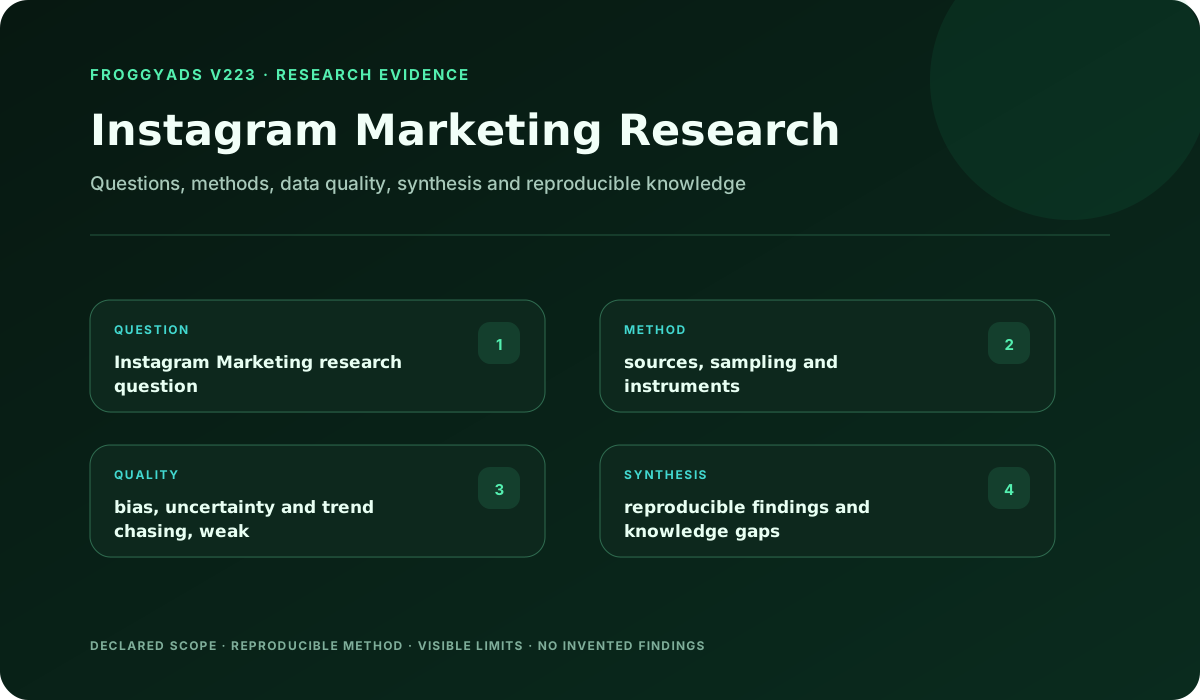
Research workflowTurn Instagram marketing research into a measurable media hypothesis
Research is most useful when it changes a decision the advertiser can test. Separate broad platform observations from facts about the specific offer, market and audience. A trend showing that short visual content receives attention does not prove which message will convert for a particular product, and a demographic summary does not replace first-party evidence from the advertiser's own customers. Write the research conclusion as a hypothesis: which audience problem, creative angle or destination behavior is expected to matter, what event will indicate success, and what evidence would cause the idea to be rejected. That prevents a research page from becoming a collection of interesting statistics with no connection to campaign execution.
Use external research to shape the brief, then validate the brief with paid-media evidence. Preserve campaign, creative and source context in the tracking path so the buyer can compare the audience assumption with downstream results. FroggyAds can complement social-channel research by giving advertisers access to push, native, display and pop inventory across a broad supply base, with targeting by device, operating system, browser, carrier, city, country and category. That makes it possible to test whether the message learned from one channel remains persuasive in other advertising environments without assuming the same user behavior everywhere.
Keep recency and methodology visible. Note when a study was published, which market it covers, the sample type, and whether the reported metric measures attention, engagement, stated preference or an actual business outcome. Do not combine those categories as if they were interchangeable. When the advertiser's campaign data disagrees with a broad benchmark, investigate the difference rather than forcing the campaign to match the benchmark. The offer, creative, landing page, device mix and GEO can all change the result. Research should reduce uncertainty, not override measured evidence from the campaign itself.
| Research input | Useful campaign question | Validation evidence |
|---|
| Audience trend | Which need or context should the message address? | Accepted conversions by audience-relevant segment |
| Creative pattern | Which visual or message angle deserves a controlled test? | Creative-level cost and downstream outcome |
| Device behavior | Should the destination or asset be adapted by device? | Device-level completion and conversion quality |
| Market benchmark | Is the assumption relevant to the target GEO? | Country or city-level campaign evidence |
Build a short evidence register as the campaign runs. For every material conclusion, record whether it came from published research, the advertiser's historical data, or the current paid test. Give current campaign evidence the date and conditions under which it was observed. If a new creative or landing page changes the outcome, update the conclusion instead of treating the earlier finding as permanent. This creates a research loop in which outside evidence generates a test, the test produces first-party learning, and that learning improves the next brief. FroggyAds media-buying controls can then be used to scale only the segments where the hypothesis survives real campaign measurement.
Use competitor and creator observations as qualitative inputs, not as permission to copy execution. Record what the example appears to be doing, such as reducing product explanation, using social proof, focusing on one benefit or leading with a demonstration, then write a separate test that fits the advertiser's own evidence and brand. A visible engagement count on another account does not reveal acquisition cost, customer quality or profitability. The paid-media test therefore needs its own conversion rule and tracking path. Where the advertiser also uses FroggyAds, compare the message angle across traffic sources using the same accepted outcome so the team can learn whether the idea travels beyond the environment where it was discovered.
Research should end with a prioritized backlog rather than an unlimited list of ideas. Rank each hypothesis by expected impact, confidence and the cost of obtaining a useful answer. Test the highest-value uncertainties first. If a hypothesis requires a new landing page, special tracking or market-specific creative, include that implementation cost in the priority. This keeps research effort proportional to the decision it informs and prevents the team from mistaking content consumption for campaign progress.
Keep screenshots, examples and benchmark notes dated in the internal research record because platform interfaces and audience behavior can change. When an older observation is still useful, label it as historical context rather than presenting it as current proof. Recheck the sources that materially influence budget or creative strategy before a major launch. This habit makes the research easier to maintain and reduces the chance that an outdated tactical detail is carried into a new campaign simply because it appeared in a previous brief.