
KPI FRAMEWORK
Instagram Marketing KPIs: Build a Decision-Ready Marketing Scorecard
For advertisers and media buyers, Instagram marketing KPIs should show how attention connects with a useful customer action, which definitions make the comparison fair and what changes next. We help you manage a separately identifiable traffic test with available formats, targeting, source reporting and budget controls. Start with the accepted result, then choose the few native and receiving signals that help explain it.
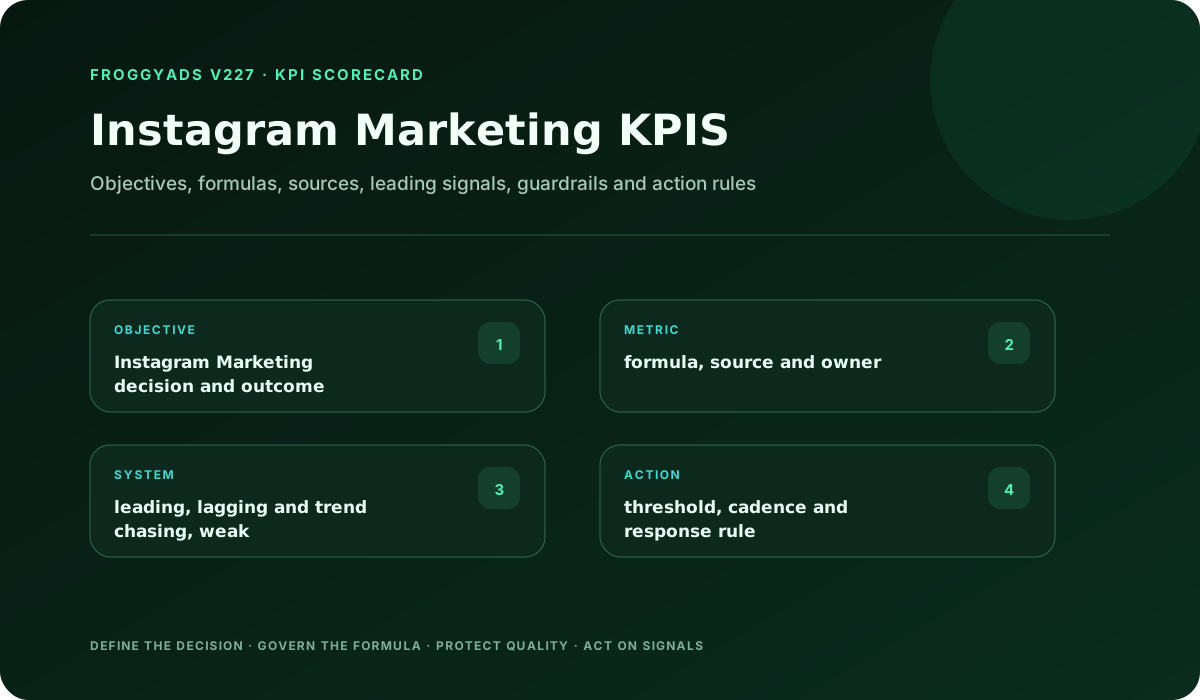
| Metric stage | What the buyer should inspect |
|---|---|
| Attention | The actual native views, reach or interactions under the exported definition |
| Receiving activity | Usable destination visits and the customer step they describe |
| Accepted outcome | Orders accepted under the declared status rule and review cutoff |
Reporting definition reference: Google Analytics dimensions and metrics. Keep the actual measure and its population beside the value.
DIRECT ANSWER
What should your Instagram marketing KPI scorecard contain?
A useful scorecard contains a defined customer outcome, a few relevant attention and journey measures, explicit formulas, comparable periods, a quality guardrail and a named next action. Keep native Instagram activity and independent FroggyAds buying identifiable. A view, interaction, destination visit and accepted order describe different events; none should silently replace another.
Scorecard scope: Use this guide to select and interpret metrics for a specific buying decision. The related resources address their own planning, cost or published-statistics questions; keep those purposes distinct from your actual accepted customer outcome.
01
DECISION OBJECTIVE
Choose the buying decision before choosing Instagram KPIs
The specific allocation decision
Start with the choice your scorecard must improve: retain a product explanation, investigate a weak destination or approve another prepared traffic test. A metric deserves attention when its movement could change that specific choice.
A fictional frame-bag scorecard
Our clearly fictional bicycle frame-bag retailer wants customers to understand mounting and fit before ordering. Its scorecard separates the response to a fit explanation from destination visits and accepted orders. No product dimension, customer result or actual campaign is implied.
The action the scorecard supports
Give the reviewer enough context to choose a useful action. If the problem is an unclear fit explanation, inspect that explanation before changing an unrelated audience setting. The commercial purpose keeps the scorecard compact and relevant.
Complete the first decision
Finish the scope with one customer question, an identifiable product range and a clear next action. Keep the actual audience and receiving conditions visible so the scorecard supports a buying decision instead of collecting every available statistic.
Acceptance rule: The chosen metric can change one specific product or allocation decision.
02
OUTCOME HIERARCHY
Separate attention, destination activity and accepted orders
Use an outcome hierarchy to keep different stages readable. Native Instagram attention describes exposure or interaction under the actual report definition; website activity describes a receiving step; accepted orders describe a business result under your stated acceptance rule.
A saved frame-bag fit guide can show interest in that explanation. It is not a completed visit or a valid order. Keep those counts in separate rows so a large attention total cannot conceal an unresolved receiving problem.
Your executive view should make the accepted result visible alongside the few signals needed to interpret it. We recommend a separately identifiable FroggyAds allocation when the next acquisition question is prepared and the destination can support the promised customer action.
Acceptance rule: Native attention, receiving activity and accepted orders remain distinct.
03
METRIC TAXONOMY
Give each metric one clear job
Classify a measure as an outcome, an early signal, a diagnostic, an efficiency measure or a guardrail. These roles help the buyer interpret a change without treating every number as an equal reason to increase spending.
For the frame-bag example, accepted orders are an outcome, saves of the fit explanation are an early interest signal and destination errors are a diagnostic. Cost per accepted order is an efficiency measure; unresolved fit complaints can limit the next decision.
One metric may inform more than one question, but its role must remain clear in the current review. A content interaction is useful for deciding what to investigate even when it cannot establish retained customer value or additional sales.
Acceptance rule: Each signal has an explicit outcome, diagnostic, efficiency or guardrail role.
04
METRIC DEFINITION
Write the engagement-rate numerator and denominator
An engagement rate needs the exact interactions counted and the denominator used. Interactions divided by reached accounts, views or followers answer different questions. Label the selected basis instead of comparing percentages whose inputs are unknown.
Record whether the numerator counts actions or unique accounts, which content and period are included and whether the denominator is a period total or an end-date snapshot. Several actions by one person do not become several distinct customers.
Use the actual export definition available to your authorised reviewer. If a report changes its measure or combines interactions differently, preserve that distinction. The familiar label engagement rate does not make two suppliers or two periods directly comparable.
Acceptance rule: The engagement numerator and actual denominator are stated together.
05
SOURCE OF TRUTH
Use the record that actually owns each event
Choose a source of truth by the event being measured. Your authorised Instagram report describes native activity under its definitions. Website records describe the receiving path; the order system establishes whether a purchase was accepted, cancelled or left unresolved.
Our available FroggyAds source reporting helps you inspect the independent traffic allocation. It should be reviewed beside business-side outcomes, with the campaign identifiable, rather than presented as a replacement for native Instagram reporting or your accepted-order records.
Keep the extract date and definition with the value. When a source is incomplete, show the missing portion and its consequence for the decision. An unavailable value should not silently become zero or a favourable estimate.
Acceptance rule: The reporting record is appropriate to the event it establishes.
Prepare the independent allocation
Connect the accepted customer question to FroggyAds
Choose FroggyAds when the product explanation and destination are ready for an affordable independent acquisition question. Our available targeting, source reporting and budget controls let your buyer contain the allocation and investigate actual delivery. Your business records establish accepted orders and receiving quality. Keep the native Instagram scorecard and independent buying record distinguishable, then review the relevant customer outcome under the same acceptance rule.
Choose FroggyAds for your next campaign
06
IDENTITY AND SCOPE
Keep the account, content and customer scope identifiable
State the account, content group, product range and period counted in each row. A profile-wide view, an individual fit video and one frame-bag product page describe different populations, even when they share a campaign theme.
Retain legitimate campaign or content identifiers where your actual systems provide them. A labelled destination route can support investigation, but it does not prove that an anonymous Instagram viewer and a later buyer are the same individual.
Avoid stitching uncertain identities together to fill a reporting gap. Keep known native activity, independently labelled FroggyAds delivery and unresolved paths separate. That makes the remaining question visible without creating a false customer journey.
Acceptance rule: Known campaign context stays separate from uncertain customer identity.
07
TIME WINDOW
Match the period to the metric and customer decision
Specify whether the measure concerns activity during a reporting period or lifetime activity for content published in that period. A mature post can accumulate responses after publication; a recent post has had less time to receive them.
The fictional retailer reviews fit-guide interactions separately from the later order cutoff. It identifies orders whose receiving status is still open. The latest checkout count should not be described as a final accepted-order total while material cases remain unresolved.
Compare periods with similar definitions and opportunity to mature. Note a stock change, promotion or destination revision that changes the conditions. A common calendar length alone does not make two content or customer cohorts equivalent.
Acceptance rule: Publication, activity and accepted-order periods are labelled consistently.
08
BASELINE AND TARGET
Build a relevant baseline before setting a target
Start with your own comparable content and receiving records. A useful baseline states the product, format, period and outcome definition. A broad industry average cannot decide whether this frame-bag explanation answers the particular fit question customers face.
Set a target around the actual decision and operating capacity. If the team cannot handle more unresolved fit enquiries, a higher interaction target is incomplete without a receiving-quality boundary and an affordable limit for the next test.
Treat a target as a planning assumption that needs review. Keep the baseline intact when testing a changed explanation, and record material differences in the comparison. Do not present a chosen target as a predicted FroggyAds campaign result.
Acceptance rule: The baseline fits the actual product, format and customer opportunity.
09
LEADING INDICATOR
Treat saves and replies as early signals to investigate
An early signal appears before the outcome you ultimately value. Saves, relevant replies or product-question activity may help identify which explanation deserves attention. Their practical meaning depends on the actual question and the later customer record.
A saved frame-bag diagram could indicate that someone plans to compare their bicycle with the mounting instructions later. It can also remain a saved idea with no purchase. The scorecard should allow both possibilities without assigning an invented order value.
Check whether the signal has helped explain later accepted outcomes in comparable reviews. If that connection is unknown, keep the measure as a content diagnostic. Its value is a focused investigation, not a promise that more saves will produce more sales.
Acceptance rule: Early interest remains distinct from an unobserved future order.
10
LAGGING OUTCOME
Define the accepted order before calculating efficiency
Write the accepted-order rule in ordinary business language: which completed product order counts, how cancellations and refunds are handled and when the status is reviewed. Keep unresolved cases visible rather than forcing them into a finished result.
For the fictional retailer, an order for the pictured frame-bag range is the selected commercial unit. A fit question, product-page visit and checkout attempt remain different events. Your own records determine which event can responsibly be called an accepted order.
Calculate cost per accepted order from the chosen included cost divided by that supported count. Name a media-only basis when that is what you use. A cost ratio alone establishes neither profit nor the number of additional orders caused by advertising.
Acceptance rule: Accepted-order status and included cost support the efficiency calculation.
Match the format to the prepared message
Choose our available format for the customer explanation
Available Push, Native, Display and Pop formats give you different ways to present an approved proposition. Choose the actual format and settings that fit the receiving task, then complete campaign review and approval. For the frame-bag example, the message should lead to the promised fit information. Our buying controls support that allocation; they do not supply a native Instagram publishing or analytics service.
Open your free FroggyAds account
11
DIAGNOSTIC METRIC
Use diagnostics to locate the weak customer step
A diagnostic metric explains where a customer journey may be losing clarity. Investigate a material difference between recorded destination visits and usable product-page activity, or between fit questions and resolved answers, before rewriting the entire campaign.
Suppose the frame-bag explanation receives relevant questions but the linked page omits mounting information. The useful inspection concerns the receiving explanation and destination accuracy. It does not automatically justify a different audience, format or a larger budget.
Choose the smallest repair supported by the actual evidence, then review the affected step. Our available targeting, source reporting and budget controls help your buyer contain a separate FroggyAds test while the business checks what the destination can establish.
Acceptance rule: The diagnostic identifies a specific receiving step to inspect.
12
QUALITY GUARDRAIL
Protect fit accuracy and receiving quality alongside growth
Pair the main growth measure with a relevant quality guardrail. For the frame-bag example, accurate mounting information, clear product scope and support for unresolved fit questions matter alongside the number of visits or orders.
Use actual business records to decide which condition requires attention. A rise in orders with a material increase in unresolved fit problems deserves a product or receiving review. A larger top-line count should not erase the customer issue.
Set the response before approving more exposure. You might contain the affected allocation until the product explanation is corrected and reviewed. This is practical buying guidance based on your operating conditions, without an invented universal complaint rate or performance threshold.
Acceptance rule: Growth does not hide a material product or receiving-quality issue.
13
SEGMENTATION
Segment only where the split can change an action
A useful segment answers a real question about a known product, content item or source. Compare the fit-guide explanation with another prepared explanation when the available records and customer opportunity are sufficiently similar.
Keep counts beside rates. A small segment can show a large percentage change from very few events, while a blended total may hide a problem in a specific product page. Neither pattern should be interpreted without the underlying inputs.
For independent buying, use the actual source information available in FroggyAds to choose a focused investigation. Keep native content and independent delivery distinguishable. Do not describe a source difference as a proven causal advantage when the comparison cannot establish it.
Acceptance rule: A segment has sufficient context and counts for the proposed action.
14
FORMULA GOVERNANCE
Pool comparable counts instead of averaging unequal rates
When combining comparable groups, add their numerators and denominators before calculating a pooled rate. An unweighted average gives a small group the same influence as a much larger one and can distort the resulting interpretation.
In a clearly hypothetical example, one content group has 20 interactions across 1,000 reached accounts and another has 9 across 100. The group rates are 2% and 9%; the pooled rate is 29 divided by 1,100, or 2.64%, not their simple average of 5.5%.
This arithmetic assumes comparable interaction definitions and non-overlapping denominators for the illustration. Real account reach can overlap across content, so verify whether the available aggregate is actually deduplicated before adding reach values. Do not manufacture a unique audience by summing posts.
Acceptance rule: Pooled rates use comparable inputs and a defensible aggregate denominator.
15
DATA QUALITY CONTROL
Check duplicates, missing periods and late corrections
Inspect whether the current extract covers the declared period and whether repeated exports contain the same events. Duplicated rows can inflate an interaction or order total without any additional customer activity.
Distinguish a missing field from a recorded zero. A changed export, incomplete period or unresolved order status should appear as a data limitation with a specific repair. It is not evidence that customers stopped responding or that a campaign created no value.
Retain a supported prior extract while the issue is investigated, then record the correction and affected scope. That allows the buyer to understand whether a changed KPI reflects new customer behaviour or simply an improved reporting record.
Acceptance rule: Missing, duplicate and corrected data remain identifiable.
16
THRESHOLD AND STATUS
Set a response range from the business constraint
A status range should explain the action the team can take. Base it on the affordable learning limit, receiving capacity and uncertainty relevant to this campaign. A copied engagement benchmark cannot approve an allocation whose destination is inaccurate.
The fictional frame-bag retailer might require a usable fit explanation before any further promotion and a receiving review when material customer questions remain unresolved. The exact commercial thresholds belong to its own business and supported records.
Show the rule beside the metric so a favourable percentage cannot override the guardrail. If the input is too uncertain for a decision, label the status as unresolved and specify what information is needed instead of assigning a reassuring colour.
Acceptance rule: A response range reflects actual constraints and uncertainty.
Make the next test specific
Start one prepared independent test with FroggyAds
Define the customer question, usable destination, affordable limit and review point before approving the independent allocation. Keep the accepted-order rule stable enough to interpret the result. Our available source reporting helps your buyer investigate delivery while the business checks the relevant receiving records. A test should answer the prepared question without changing every content, product and audience condition together.
Start your next campaign with FroggyAds
17
REVIEW CADENCE
Review fast delivery signals and slower orders separately
Match the review cadence to the speed of the event and the action being considered. A delivery or destination issue may need prompt investigation, while accepted-order quality can require a later review after the relevant customer process has progressed.
Keep the daily buying check separate from a broader content conclusion. A brief interaction fluctuation does not settle whether the mounting explanation is useful, and an early checkout count does not settle the final retained customer outcome.
Choose the next review point in advance and annotate material product, destination or campaign changes. Our available budget controls let you manage the independent allocation while the appropriate business-side evidence develops, without promising a particular learning period or result.
Acceptance rule: Delivery checks and later customer reviews use appropriate timing.
18
ACTION RULE
Write the permitted action beside the material signal
An action rule connects a known condition with a specific response. For example, inspect a broken destination before increasing traffic, or review the pictured product when fit questions reveal a material mismatch with the receiving page.
State who can authorise the action and what evidence is needed to resume the affected allocation. Keep the response proportional to the problem; a missing order status calls for record review rather than an unsupported declaration that the entire channel has failed.
Use FroggyAds when the next independent traffic question is ready for a contained test. Your buyer can choose the actual available settings and affordable limit, complete campaign review and approval, then inspect delivery beside the accepted result.
Acceptance rule: A material signal has a specific permitted response.
19
SCORECARD ARCHITECTURE
Keep the executive scorecard short and the detail recoverable
The main scorecard should answer whether the prepared proposition is ready, what accepted customer outcome is known and which material issue changes the next decision. Keep supporting content and source diagnostics available for the reviewer who needs to investigate.
For the frame-bag example, the executive view can show the selected accepted-order measure, its cost basis, unresolved fit cases and the next authorised action. Native interaction detail remains useful supporting context rather than a substitute for the customer result.
Use consistent labels and visible limitations instead of compressing unrelated measures into a single success score. A clear buying decision is easier to review when the underlying counts and definitions can be checked without reconstructing the whole campaign.
Acceptance rule: The main scorecard retains a clear outcome and useful supporting detail.
20
ARCHIVE AND LEARNING
Keep the definition version with the decision and outcome
Archive the formula, source extract, relevant period, exclusions and decision with the scorecard version. A later reviewer should be able to reproduce the reported value and understand why the team retained, repaired or tested a particular explanation.
When a metric definition changes, preserve the old series and mark the break. Recalculate a comparison only when the supporting data permits it. An apparent improvement caused by a new denominator should not be presented as better customer response.
Review what happened after the action and whether the signal helped. Reuse a useful method after checking its fit for the next product and period. A past scorecard informs the next question; it supplies no guarantee of future demand or campaign economics.
Acceptance rule: Formula changes and the actual decision stay recoverable.
WORKFLOW
Ten steps from the buying question to a usable scorecard
01
Name the decision
State the decision, owner, horizon and consequence the KPI system must support. For the frame-bag explanation, name the next product or traffic choice.
02
Map the outcome chain
Connect business and customer outcomes to marketing outcomes, inputs and diagnostic mechanisms. Keep native fit-guide attention, receiving activity and accepted orders distinct.
03
Draft metric definitions
Write formula, scope, population, units, exclusions, source and interpretation for every candidate metric. State the exact engagement numerator and denominator, with its period.
04
Classify the signals
Separate outcome, leading, lagging, diagnostic, quality, risk and efficiency indicators. Keep saves as a possible early interest signal without assigning order value.
05
Verify the data
Test source authority, freshness, coverage, identity, duplication, late events and reconciliation. Preserve unknown receiving statuses instead of replacing missing values with zero.
06
Set baselines and ranges
Record the starting value, uncertainty, capacity constraint and rationale for each target or status range. Use the actual product and receiving limits instead of a universal engagement benchmark.
07
Design the scorecard
Limit executive KPIs and connect each to drill-down diagnostics, guardrails and owners. Keep the accepted outcome visible while retaining the useful content detail.
08
Write action rules
Define what happens at each threshold, who acts, what evidence is required and when escalation or stopping applies. Connect an inaccurate destination with its specific repair before approving more exposure.
09
Run a review cycle
Review signals at an appropriate cadence, annotate causes and protect against reacting to noise. Separate prompt delivery checks from a later accepted-order review.
10
Version and learn
Archive definition changes, values, decisions, outcomes and lessons before updating the KPI system. Mark a changed denominator so the old and new series are not silently combined.
SCORECARDDecision relevanceDoes every KPI support a named decision rather than exist because the data is available? Definition integrityAre formula, units, scope, source, exclusions and interpretation stable and versioned? Outcome connectionIs the metric connected to a plausible mechanism and an appropriate outcome level? Signal balanceDoes the scorecard combine outcomes, leading indicators, diagnostics, efficiency and guardrails? Data qualityAre freshness, coverage, identity, duplication, anomalies and reconciliation controlled? Threshold qualityAre status ranges grounded in uncertainty, capacity and consequences rather than copied benchmarks? ActionabilityDoes movement trigger a named response, owner, evidence requirement and stop condition? GovernanceAre cadence, access, approvals, definition changes, annotations and lessons reviewable?
Check eight parts of the Instagram KPI scorecard
Use these checks to find a specific weakness in the scorecard. An unclear denominator needs a definition repair; a missing order status needs a receiving review; an inaccurate fit explanation needs a product-content correction. The checklist helps the team choose that repair. It is not an external quality score or a prediction of campaign performance.
DECISION SCENARIOS
Read four different scorecard decisions
A concise executive view
For the fictional frame-bag retailer, show accepted orders under the agreed rule, the stated cost basis, material unresolved fit cases and the next authorised action. Keep native fit-guide interactions as supporting context. The executive reader can then see both the commercial result and the condition that limits the next allocation.
Early interest without a confirmed customer outcome
A rise in saved fit guides is a useful reason to inspect the explanation and later customer path. It does not establish additional accepted orders. Retain the signal and its exact period, then review the relevant destination and order evidence before treating the content response as a commercial improvement.
More visits with a receiving problem
If recorded visits rise while customers report a material mismatch between the pictured bag and its receiving information, inspect the product explanation. Contain the affected allocation while the issue is resolved. The increased visit total does not override a truthful product promise or establish satisfactory accepted-order quality.
A changed engagement denominator
A rate calculated from reached accounts cannot be directly compared with a later rate calculated from followers merely because both columns say engagement rate. Preserve the old definition, label the new denominator and explain the break. Recompute a matched comparison only when the underlying records actually support it.
RELATED RESOURCES
Choose the related Instagram resource for the next question
Use the related planning guide for the operating sequence, the cost guide for included amounts and the statistics resource for its cited measurements.
- Instagram marketing overview
- Strategy: choose the channel approach
- Plan: organise the campaign work
- Guide: build the broader context
- Checklist: review readiness
- Practices: improve the method
- Statistics: inspect cited measurements
- Analysis: investigate the result
- Audit: inspect the current setup
- Costs: define the included amounts
SOURCES AND LIMITS
Primary reporting definitions and their limits
Google Analytics documents dimensions, metrics and their population context. Sprout Social describes the measures in its own Instagram report, including differing scope across report sections. These references support careful definition and comparison; your authorised native and business records provide the actual inputs. Keep the export label, period and calculation basis visible rather than assuming one universal engagement formula.
- Dimensions and metrics: Google Analytics
- Reporting context: Analytics advertising reports
- Attribution credit: Google Analytics
- Conversion recording: Google Ads
- Value definitions: Google Ads
- Search performance: Search Console
- Sprout: definitions within its Instagram report
- Advertising basics: FTC
- Helpful content: Google Search guidance
- Accessibility standard: W3C WCAG2.2
- Privacy framework: NIST
- FroggyAds official Telegram channel
Use each linked reference for its specific reporting, advertising or receiving question. The links do not establish that FroggyAds supplies another platform’s account features or that a particular threshold is right for your business. Recheck the actual source definition before a material comparison and keep any unresolved limitation beside the metric.
FAQ
Instagram Marketing KPI questions
Which decision should an Instagram KPI scorecard drive?
Start with the recurring choice the team must make, such as changing creative, fixing a journey step or reallocating spend. Metrics belong only if they describe the outcome, diagnose it or guard against harmful tradeoffs.
How should Instagram KPIs be placed in an outcome hierarchy?
Put the accepted customer or business outcome at the top, followed by leading, diagnostic and delivery measures with explicit roles. This structure prevents a large reach number from becoming the campaign result.
What makes an Instagram KPI definition usable?
Record the formula, unit, population, source, time window, exclusions, owner and refresh rule in plain language. Apply version control when a definition changes so old and new values are not mixed.
How are leading indicators different from lagging outcomes?
A leading indicator appears earlier and may help predict or diagnose progress, while a lagging outcome records the later result the business values. The relationship needs evidence and should be reviewed when behavior changes.
Which diagnostic metrics explain an Instagram result?
Use measures tied to the suspected journey step, such as qualified attention, page completion or activation, rather than a fixed list. A diagnostic suggests where to inspect and does not replace the accepted outcome.
Why pair a growth KPI with a quality guardrail?
A guardrail shows damage hidden by the main metric, such as more leads with lower eligibility or faster spend with worse customer value. Define the response threshold before the tradeoff appears.
What should be the source of truth for each KPI?
Choose the system that owns the underlying event and document joins, adjustments and correction authority. Platform dashboards can describe delivery, while customer systems may own qualification or revenue records.
How do segmentation and time windows affect KPI meaning?
State the market, audience, campaign, placement and cohort included, along with event and attribution dates. Compare matched scopes and mark immature periods so changes are not created by filters.
What should happen when a KPI crosses its threshold?
The scorecard needs an owner, diagnostic route and permitted action for each status. Review false alarms and missed issues, then revise thresholds with a dated decision record.
Why archive old Instagram scorecards and decisions?
Archives preserve definitions, source conditions, actions and outcomes for later learning. They help the team see if a rule still works and prevent a past result from being reused without its original context.
SELF-SERVE MEDIA CONTROL
Choose FroggyAds for a separately controlled acquisition question
Start your next campaign with FroggyAds when the product message, destination and accepted customer action are ready. Our available formats, targeting, source reporting and budget controls help your buyer manage an authorised independent allocation. Complete campaign review and approval, then inspect delivery beside the supported customer result. That gives the next buying decision a clear purpose and a recoverable record.
Search intent and buyer decision
Keep KPI selection distinct from published Instagram statistics
This page helps you choose Instagram KPIs for a specific product explanation and the next buying decision. The related Instagram Marketing Statistics resource addresses published measurements and their cited context. Your own scorecard needs actual definitions and customer records, rather than an imported average treated as a campaign promise.
Keep the actual product range, content identifier, report definition and customer review period with the scorecard. A native fit-guide interaction is relevant to the explanation; a destination visit concerns the receiving step; an accepted frame-bag order concerns the selected business outcome. Separating those records makes the next independent allocation easier to evaluate.
| Scorecard task | Useful action | Record to retain |
|---|---|---|
| Define the measure | State numerator, denominator, period and customer scope | Exact source label, inputs and exclusions |
| Review receiving quality | Inspect the fit explanation and material unresolved cases | Actual product information and supported customer statuses |
| Approve the next allocation | Choose one prepared independent traffic question | Available settings, affordable limit and responsible approver |
Hypothetical media-only calculation: A separately labelled test spends USD 125 and has 8 orders accepted under the stated rule. Media cost per accepted order is 125 divided by 8, or USD 15.63 rounded to cents from 15.625. This teaching calculation supplies no provider price, client result, profit or causal advertising claim.
Choose FroggyAds when the next question needs an independently controlled traffic allocation. Our available settings let your buyer contain the test while the business reviews actual destination and order records. Keep native Instagram activity separate and the customer acceptance rule clear. Create your free FroggyAds account.
Recalculate the cost after an order-status correction
Separate hypothetical correction: If one of those 8 orders is later excluded under the same acceptance rule, the count becomes 7 while media cost remains 125. The corrected media cost per accepted order is USD 17.86 after rounding 125 divided by 7. Preserve the original and corrected review dates; the change reflects the stated order status, not a new campaign result.
Direct answer
Choose the next action from the metric that can support it
Use attention measures to investigate the explanation, receiving measures to inspect the journey and accepted outcomes to review the commercial decision. Keep formulas and guardrails explicit. We recommend FroggyAds when a truthful proposition and usable destination are prepared for an affordable independent allocation, with campaign review and approval completed before launch.